Textiles of the Muslim period
The Muslim Period stretches from the ninth to the fourteenth centuries and may be identified with the Arab expansion within the Mediterranean and its consequent domination over Spain and Sicily, countries that also distinguished themselves in their important fabric production.
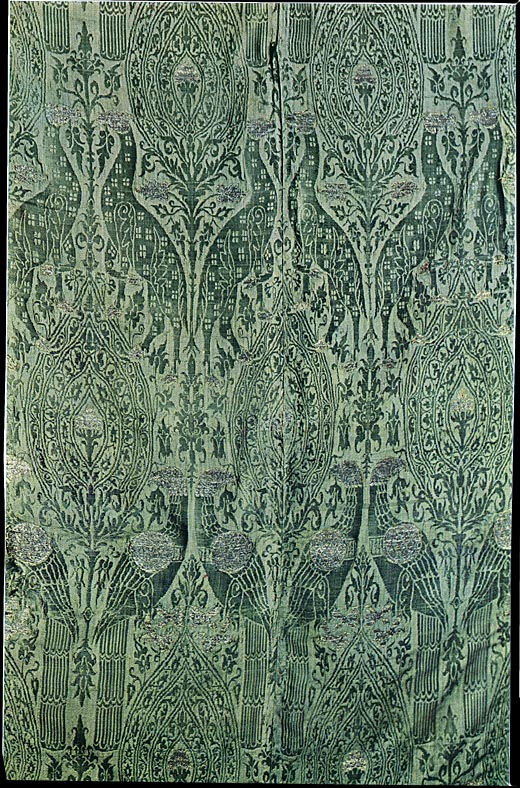
Muslim art, is concerned above all with ornamental effect, through the use of two means: the repetition of the decorative motif and the accumulation of ever smaller details; in this way the essential form of the motif is concealed and merges with the decoration.
As regards the style of the textile production of this period, what is decisive is its division into Eastern and Western, together with consideration of the cultural influences relating to the different production centres
PERSIAN AND SASSANIAN FABRICS
Period - 9th-14th c.
Description
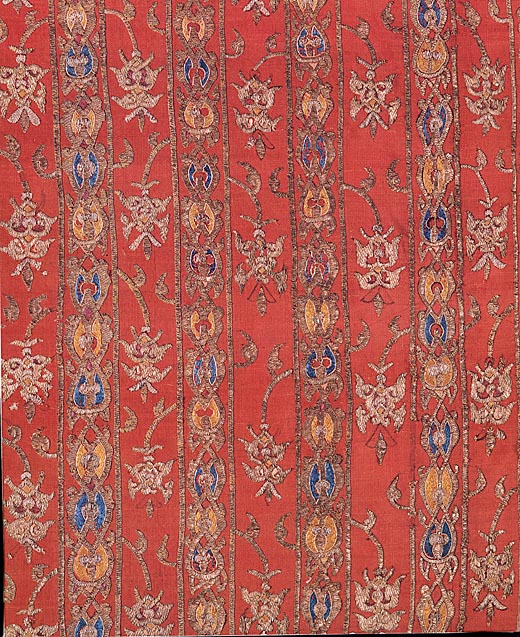
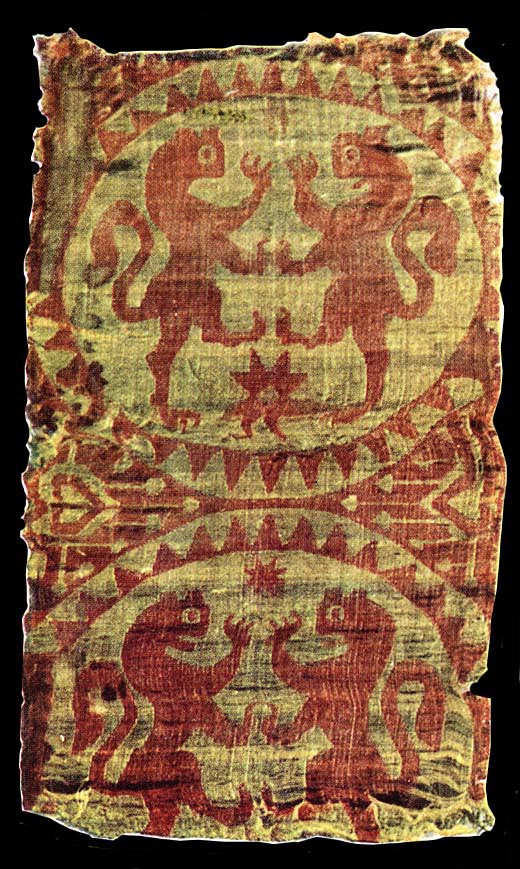
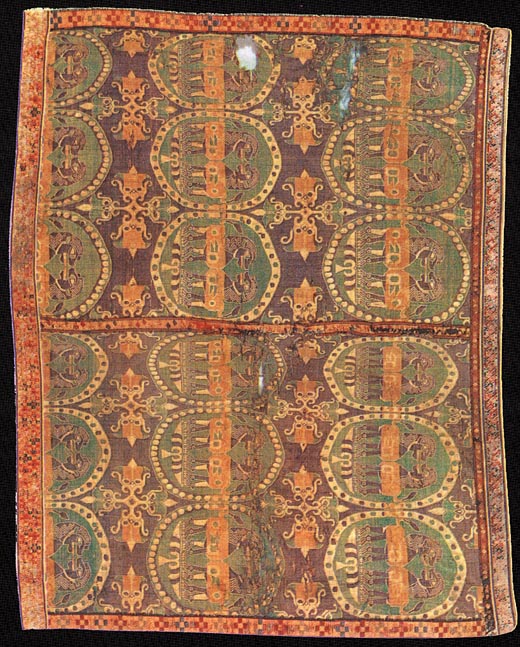
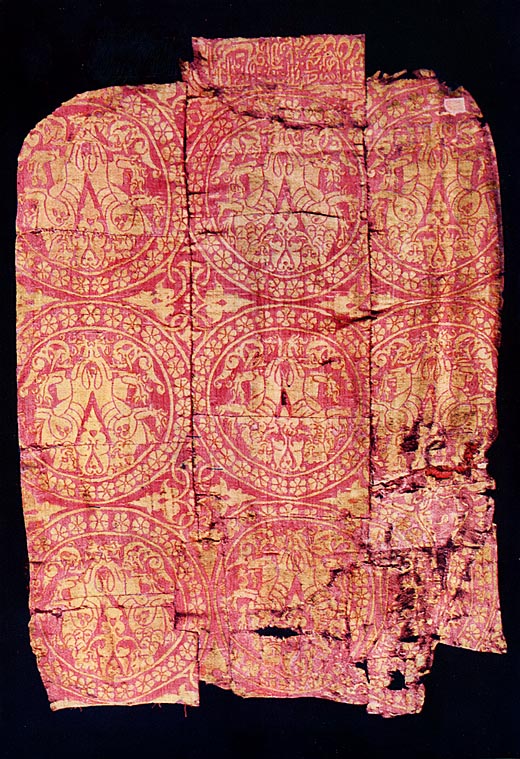
Flowers, animals and figures enriched with ornaments and accessories to the point of concealing their true anatomical form, immobile poses, hieratic, not without a certain realism, all on plain grounds, in clear and easily legible compositions. There are four compositional structures: roundels, horizontal rows, lozenges, small trees.
Technique
Taffeta, twill, satin, velluto.
Origin
A refined art, a society fond of opulence, an intense commercial activity and peaceful relations with the known world.
SPAIN
Period from 900 to 1500
Description
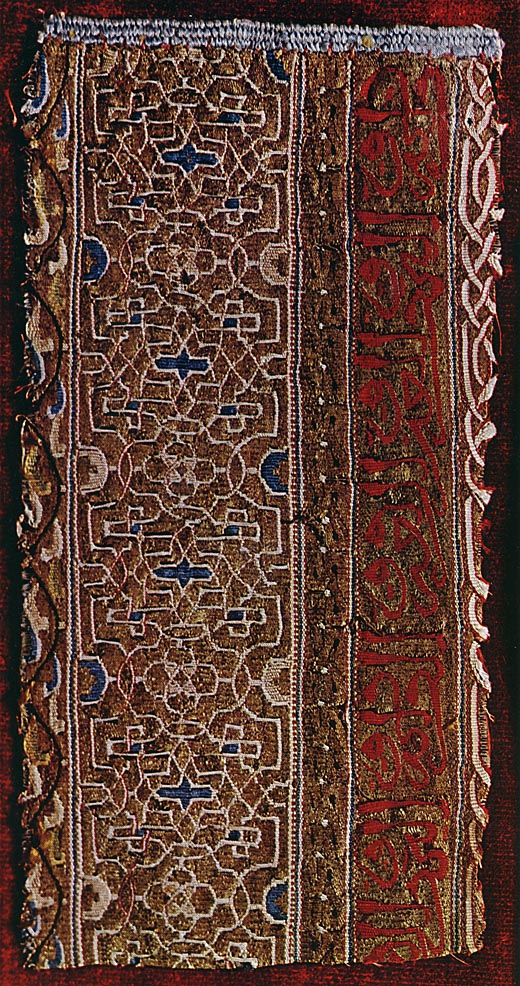
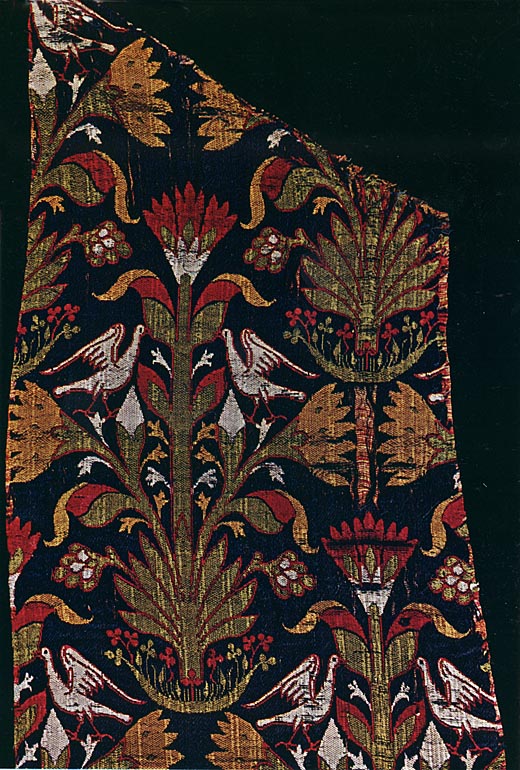
Decoration laid out in large circles or tangent meshes and in horizontal sequences of elements clearly comparable with those found in architecture. Specific characteristics are the presence of Arabic script, of palmette trees and of a rich bestiary, each creature with its own symbolic meaning. The colours are very vivid and contrasting, the design stands out particularly through the use of dark outlines.
Technique Samites-Figured taquetés-Lampas-
Origin
The coexistence of two cultures: the indigenous one, originally that of the Goths, and that of the conquerors who established the first Umayyad caliphate in Cordoba, with cultural traditions of Persian origin.
THE BEGINNINGS AND LOCATION OF ITALIAN WEAVING
Of the three main Italian textile centres: Sicily, Lucca and Venice, we document here only the first two, whose relatively short duration poses no problems for a concise documentation.
For Venice, whose production lasted until the 18th century, we refer to the documentation of the Italian Period, recalling that the economic and commercial power of the Serenissima was the primary cause of such lasting success.
SICILY Period 900-1300
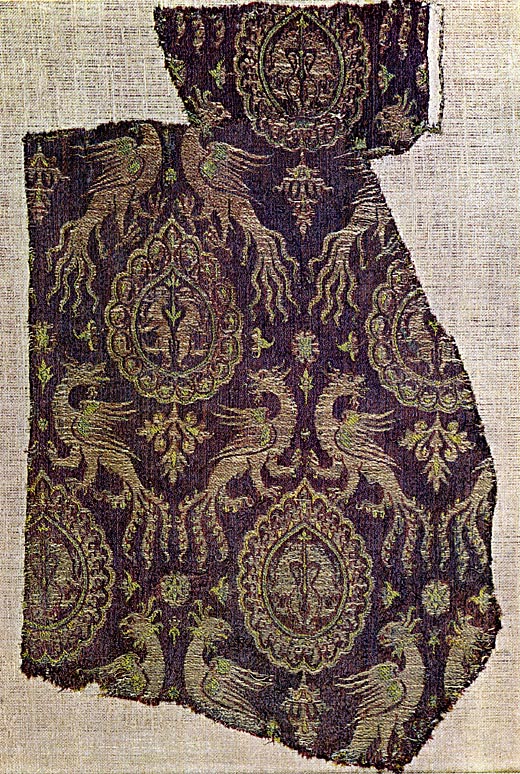
Description Very similar to that of the Hispano-Moresque fabrics, with characteristics of greater clarity, softness and compositional balance. Christian and heraldic symbols appear in the decoration, flora and fauna take on a more realistic appearance, less hieratic.
Technique Lampas make their appearance, derived from samites, which in turn will give rise to diaspers.
Origin
The succession of different rulers, Arab and Norman among the most influential, and the influences of their cultures. This concerns a span of time running from 820, the year in which the Arabs attacked Sicily, up to 1282, the year in which the Sicilian Vespers set off the exodus of the Palermo weavers towards the North LUCCA
Period Early 1300s-first half of the 1400s
Description
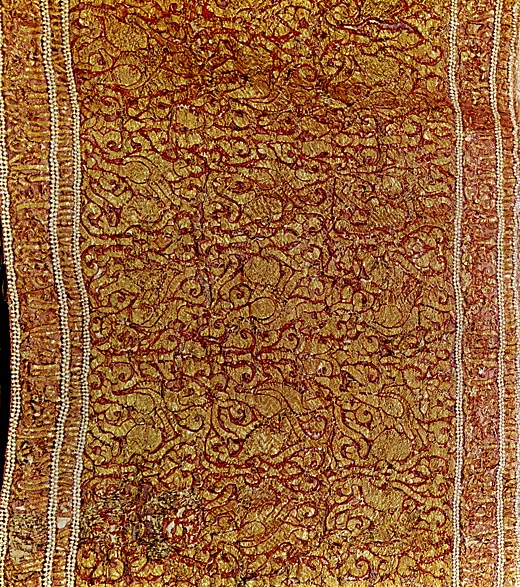
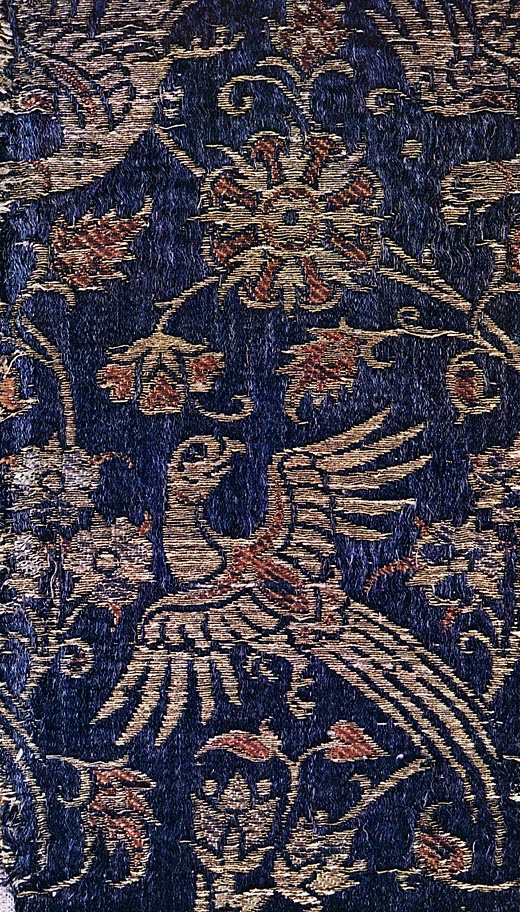
Very similar to that of chinoiserie, with an increasingly Western interpretation, predominance of the floral element and inclusion of heraldic motifs.
Technique
Samites and lampas.
Origin
The economic and mercantile power of Lucca, organised in a pre-industrial way, present throughout Europe and in close collaboration with the Maritime Republic of Pisa, as well as the welcome given to the Sicilian weavers in their exodus and the proximity of Florence, to which it passed on its heritage. CHINOISERIE Period Early 1300s-first quarter of the 1400s
Description
In a floral context, plurality and fusion of Christian symbols, such as the pelican, and Chinese ones, for example the “chi”, the “luen” or the parrot, with the design laid out in an undulating, mirrored or diagonal pattern, and also in oval meshes.
Technique Lampas with taffeta ground, with twill ground, with satin ground.
Origin First cultural and commercial contacts with the Far East, connected with the travels of Marco Polo. Interest in an unknown country, which is given a predominantly Western interpretation.
FIGURATIVE FABRICS
Period Late 1300s-early 1500s
Description
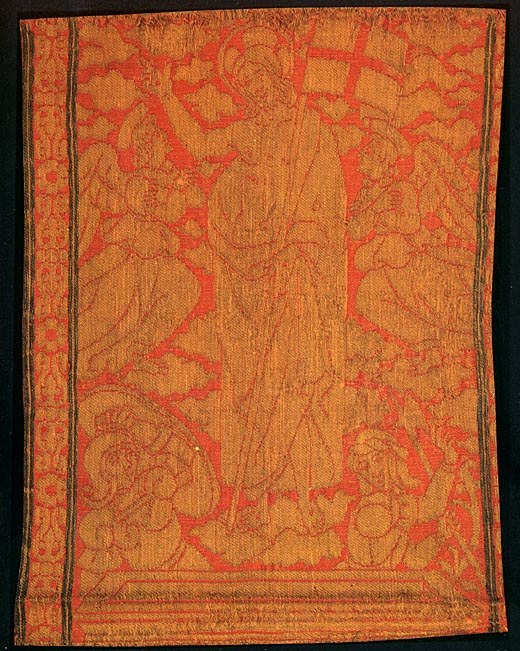
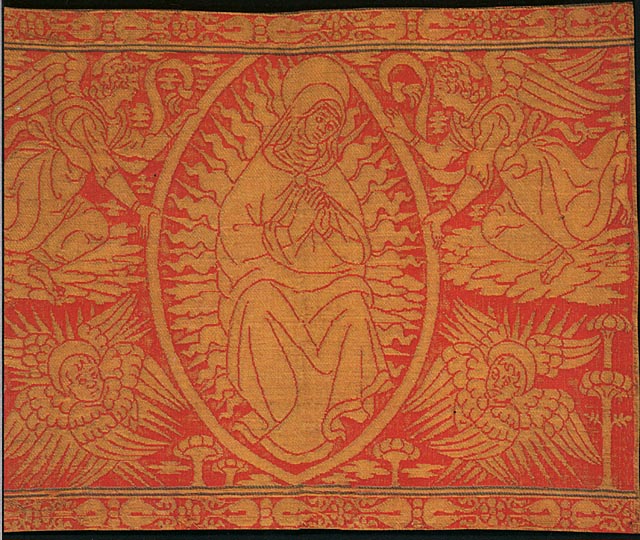
Depictions of the life of Christ and of the Virgin framed in rectangles so that they could be used as decorative borders on ecclesiastical vestments. Often copies of famous paintings.
Technique Lampas Origin
Diversification of traditional production linked to the great technical specialisation of the craftsmen and to religious patronage.