Drawings by Italian painters
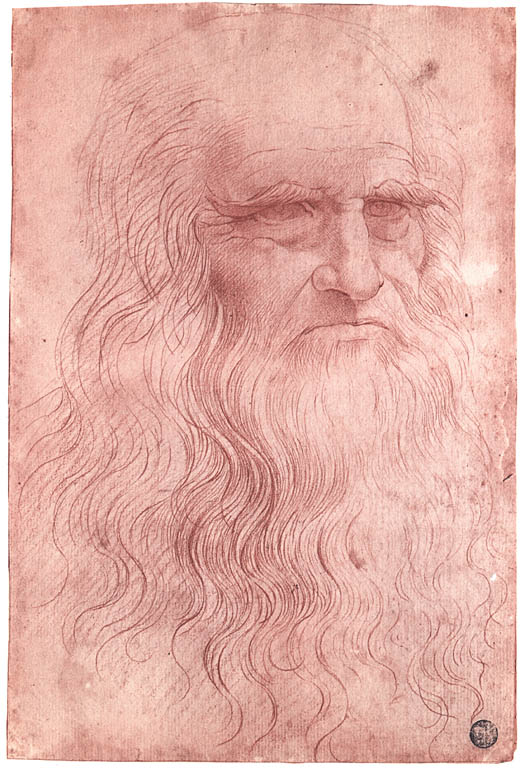
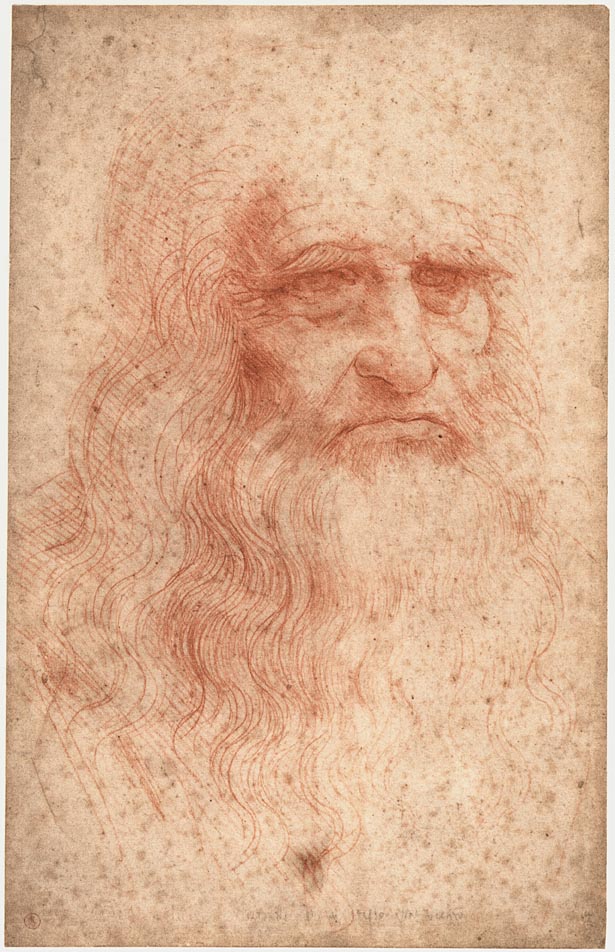
Beginning this collection of drawings by Italian painters with a 19th-century copy of a copy of Leonardo da Vinci’s self-portrait is not meant as a provocation; it is a tribute to one of the greatest artists, and it allows us to tell a story of difficult and contested attributions. Until 1960 the authenticity of this version was still authoritatively upheld, while that of the sheet kept in the Biblioteca Reale in Turin was denied. In 1854 Pietro Selvatico, cataloguing the works of art in the Accademia in Venice, wrote: “Drawing in red chalk of the utmost exquisiteness, in which all the science of the supreme author appears; the eyes and the mouth in particular are of a perfection not easily surpassed.” In reality this drawing appeared, as an engraving, in a volume of 1810 devoted to Leonardo’s Last Supper, and its author Giuseppe Bossi clearly stated: “This print, by the hand of Signor Giuseppe Benaglia, was not taken from Leonardo’s original drawing (whose whereabouts are unknown) but from a copy of it made by Signor Raffaello Albertolli.” The drawing long preceded the age of the reproducibility of the work of art: made as a note, for study, as a tribute to the author or to make a work transportable, it often gave rise to multiples that are difficult to attribute. Considered a minor art, a preparatory stage, a moment of practice or simply the sketch of an idea, it was made on loose sheets that were rarely signed (paper, as Bernard Berenson recalled in his volume on the Florentine painters of the Renaissance, was an expensive material, and household accounts and miscellaneous notes often appeared beside the drawings). For this reason, in the absence of reliable documentation, the problem of authorship becomes a problem of critical and aesthetic sensibility, and attribution “is never rigorously scientific, that is, measurable, reversible and demonstrable, but, at best, simply plausible” (Berenson, 1937 preface to The Drawings of the Florentine Painters). It should not be surprising, therefore, that the self-portrait of Leonardo kept in Turin was judged to be autograph only centuries later. Another interesting observation by Berenson raised the question of the quality of photographic reproductions of drawings, necessary for comparing scattered and hardly accessible originals and for aiding the critic’s far from infinite memory. “It should be added that the study of drawings is seriously hampered by the lack of adequate reproductions. A well-printed photograph of a painting is enough to refresh our memory of the original and even to give a fair idea of its quality. But in drawings everything comes down to line and shadow, and no mechanical process seems capable of reproducing them faithfully. Every negative, and every print from the same negative, gives different results, and this shows that no photograph is worthy of trust.” Fortunately, photography has made considerable progress since 1937, and the images presented here, independent of the paper and inks with which they used to be printed in books, can guarantee a brilliance and a fidelity that “improve” on the original. Even with monitors whose performance and prices are not stratospheric, and provided the phosphors are not too tired.
Leonardo and his circle: some drawings in collections in the United States. Introducing the catalogue The Drawings of Leonardo da Vinci and his Circle in America, Patricia Trutty-Coohill observes how phenomenal the sales of Leonardesque drawings, and the sums paid by Americans to acquire them, have been in recent years. The work dates from 1993, so as evidence of the inflation that hit the art market in the 1980s and of the Americans’ appreciation for this fragile medium it cites the 5.2 million dollars for which Armand Hammer secured the Codex Leicester in 1980. In the United States, the author observes, the collecting of Leonardo’s drawings is recent history (“more than half of the fifteen drawings in American collections arrived there after 1950”), and in the last century Leonardo was held in great esteem as a scientist and as an artist. The first two drawings in this section were bought in 1989 for 11 million dollars. As is well known, the Codex Leicester, renamed Hammer, was bought by Bill Gates in 1994, the auction bid jumping from 10 to 30 million dollars in a single stroke, which meant paying more than 1,300 million lire per sheet (there are 36 of them, measuring 29x22 cm). Trutty-Coohill would invoke some other factor besides inflation, while it is interesting to see what Gates, firmly anchored to the idea of Leonardo the scientist, has said: “Surprisingly little is known about Leonardo, outside of what is in these scientific notebooks. […] In the notebook, Leonardo speculates on hydraulics, cosmology, astronomy, geology, paleontology and other topics.” And again: “Leonardo was one of the most amazing people who ever lived. He was a genius in more fields than any scientist of any age, and he was an astonishing painter and sculptor. His notebooks were hundreds of years ahead of their time. They anticipated submarines, helicopters and other modern inventions.” Leonardo the inventor and scholar, then an extraordinary painter and sculptor (?); in the entries that follow, which are numbered continuing from the previous section, we shall instead see above all the artist.
Drawings by Leonardo da Vinci
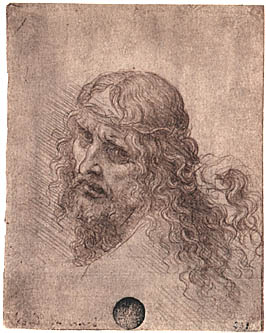
Copy after Leonardo da Vinci – Self-portrait
The drawing is clearly derived from the famous autograph self-portrait kept in the Biblioteca Reale in Turin. Following what was mentioned in the preface, it only remains to say that, in the commentary cited, Selvatico, who had not been able to see the authentic self-portrait, was able to perceive even in the copy the full force of the original.
Leonardo da Vinci (1452-1519) — Head of an old man with a flowing beard; in all probability a self-portrait
The phrase “in all probability” can today be dropped; it is quoted as evidence of the great caution of Berenson, who has no doubts about the attribution, and observes: “It is true that the person depicted seems older than Leonardo should have been, but that he looked older than his years is a known and established fact.”
Leonardo da Vinci — Study of a kneeling figure, of an angel and of putti
It is considered to be the study for an Adoration of the Shepherds that was never painted, and is dated to around 1478, “a magnificent example of Leonardo’s youthful genius” (Heydenreich). For Berenson the drawing may not be a preparatory sketch for a commissioned work, but simply a compositional exercise, evidence of Leonardo’s need to translate immediately into images his creative visions and his observations on the movement of bodies.
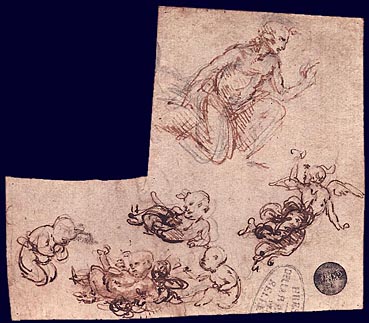
Leonardo da Vinci — The Virgin adoring the Child, other figures, angels
Drawing considered contemporary with the previous one, with which it shares the possible reference to an Adoration of the Shepherds that was never executed or to the Adoration of the Magi in the Uffizi. The whirling angels (the “rotating” angels, as Ragghianti calls them) are the same as those seen in a panel by Filippino Lippi dated 1485, as if this were the completion of a work begun by Leonardo. Berenson comments tersely: “Enchanting”
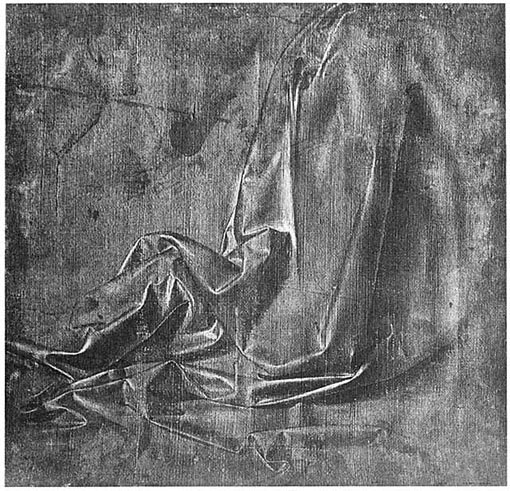
Study of drapery wrapping the legs of a kneeling angel
Most critics consider it a preparatory work for the angel’s mantle in the Annunciation in the Uffizi. Berenson thinks it may be a study in its own right, an exploration of the possibilities offered by the subject, and notes how in the painting “the folds are more complex, most bizarre.”
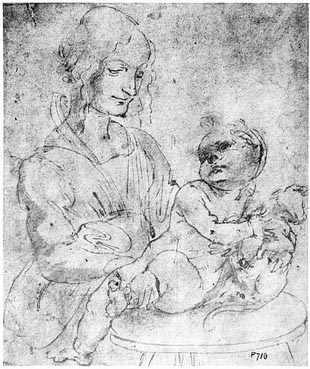
Madonna and Child stroking a kitten
It belongs to the early drawings of Madonnas, datable around 1480, and is the most beautiful on the theme of the Madonna of the Cat. “It has, in addition, the mystery, the subtlety, the majesty of Leonardo’s most disturbing female types” (Berenson).
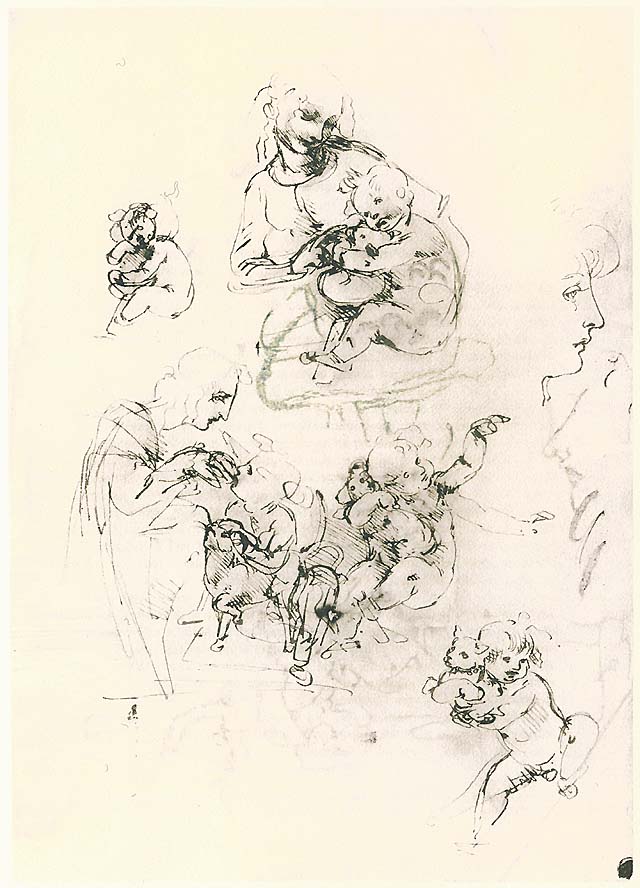
Two studies of the Madonna and Child stroking a kitten, three studies of the Child with the kitten and profile of a young woman
Clearly an early work. Rather than stroking the cat, the Child clutches it by the neck and carries it on his shoulder; in one of the studies the Madonna seems to be warning him not to mistreat the animal; the study of the playful relationship between the Child and the cat is remarkable.
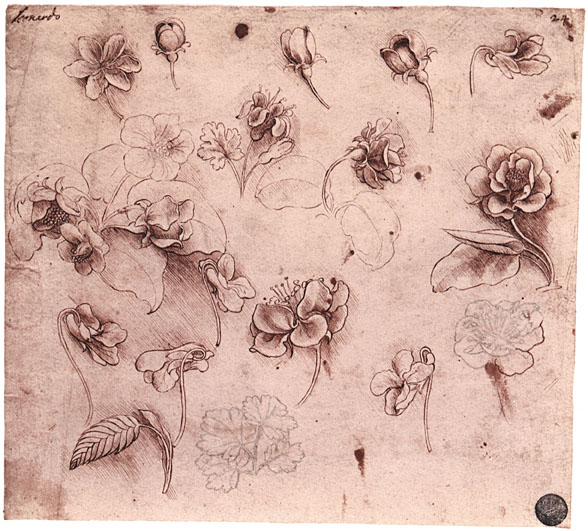
Study of flowers
Its attribution once contested by some critics, it is today unanimously considered autograph by Leonardo scholars. For Adolfo Venturi it reveals the sovereign assurance of Leonardo’s pen in rendering the outline of the flowers. Datable to 1480-1481, it is one of the “many flowers portrayed from nature” that Leonardo listed in the inventory of his own studies and works (folio 324 recto of the Codex Atlanticus) and is part of the research that would find expression in paintings such as the famous Annunciation in the Uffizi.
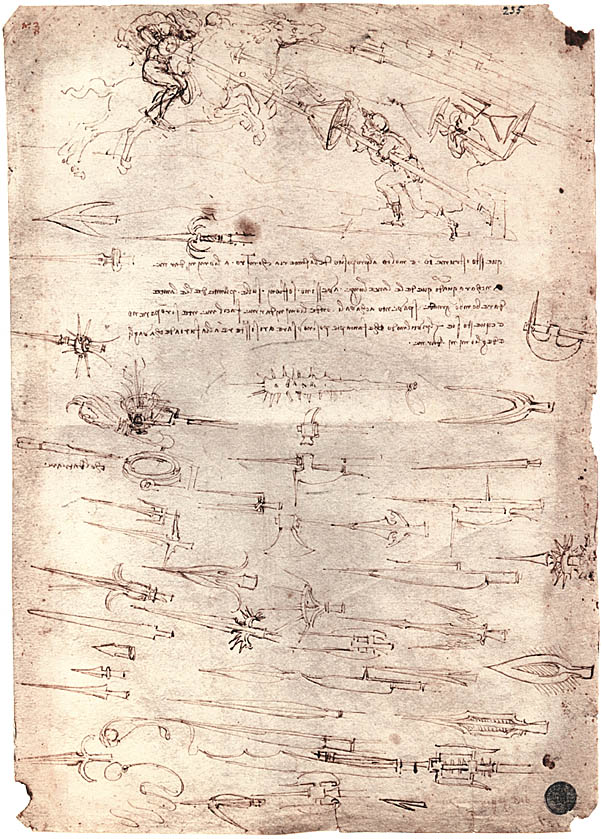
Leonardo da Vinci — Recto: sketches of weapons, fight between infantry and horsemen, and inscription; verso: war machines and inscription
Given its size, this sheet probably formed part of a manuscript or codex devoted to the art of war. The dating is very uncertain; Berenson speaks only of the first Milanese period (1482-1499), while others propose dates between 1482 and 1488. These are “pen sketches precious for their intelligence and refinement” (Selvatico). For the various lance-heads illustrated on the recto, a partial transcription of Leonardo’s text may be useful: “Quessto istrumento è molto al proposito della fanteria contro a li omini d’arme. Ancora quando que’ de le lance lunghe avessino soffioni sulle punte delle lance, dare(bom)bon grande spavento a’ cavali, onde li omini d’arme facilmente si romperono…”
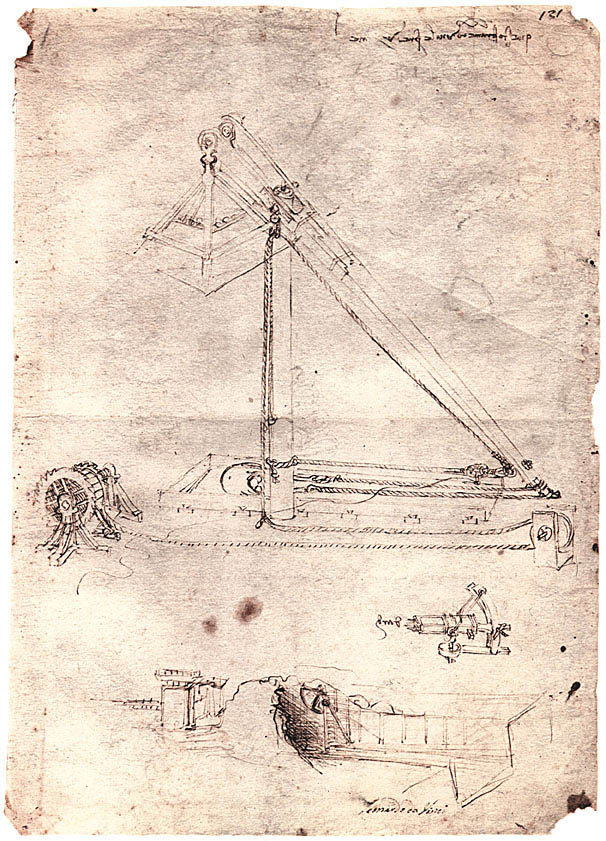
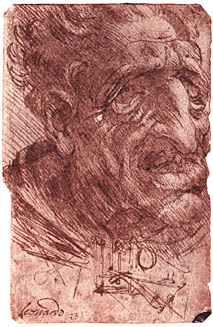
Head of an old man and sketch for a mechanical device
This drawing does not appear in the publication edited by the Commissione Vinciana, but is considered autograph by the leading critics, who converge on a date between 1490 and 1499. There are doubts as to whether to define it as a caricature or rather as a realistic, albeit crude, depiction of old age. The execution is compact and holds up even under strong magnification, which is useful for observing the machine drawn at the bottom.
Leonardo da Vinci — Head of a woman in profile, facing left
The unfortunate retouching appears on the forehead, on the nose and chin. The single hairs that can be seen among the well-detailed masses are executed in white, with the point of a very fine brush, elaborate and refined, as if the artist had put himself to the test in a contest of style and technique.
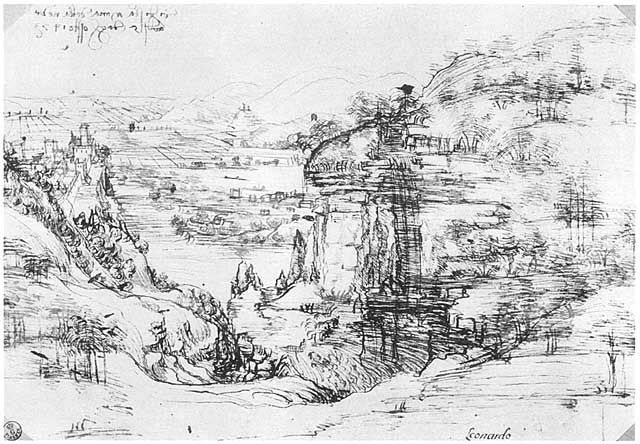
Leonardo da Vinci — Rocky landscape with a castle to the left and a wide valley in the background
In the upper left corner the date can be read, written by Leonardo: 5 August (“Aghossto”) 1473. It seems to be a note taken during an excursion, perhaps in the Valdarno. The landscape is detailed and precise, not imaginary. For Berenson it is a drawing executed with an almost Japanese lightness of touch, with the pen rarely lifted from the paper.
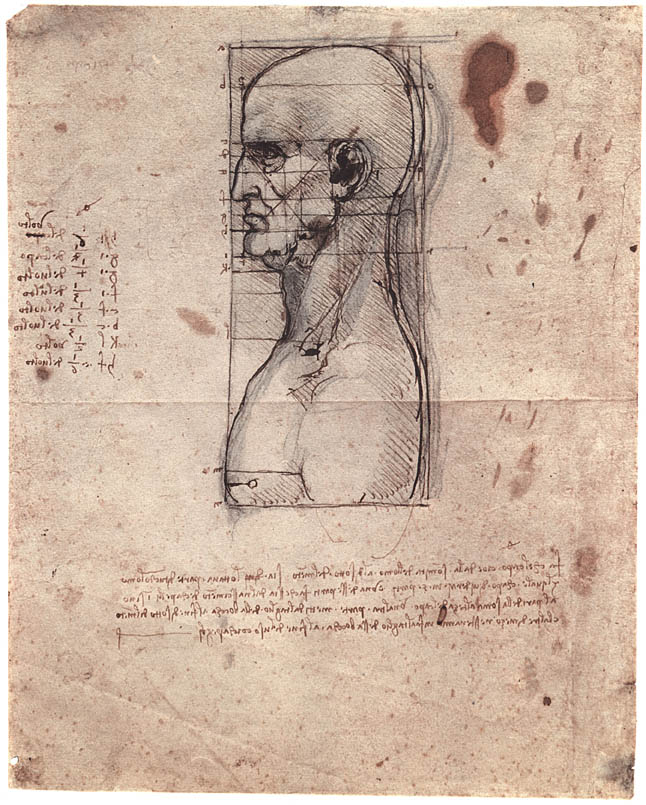
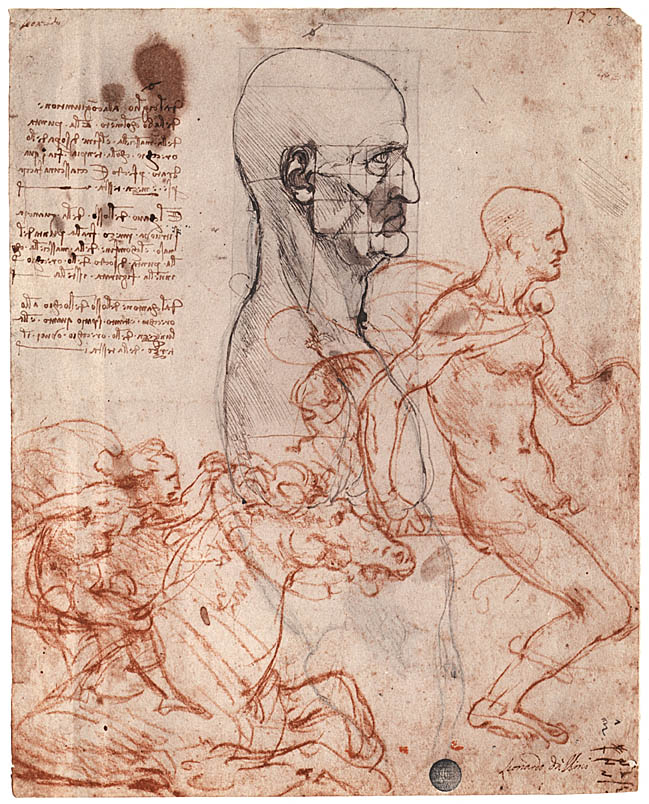
Leonardo da Vinci — Recto: bust of a man seen in profile with a scheme for the measurements of the human head, study of a horse and horsemen.
In his catalogue Berenson is more precise: speaks of a bald old man, in profile to the right (for the recto) in charcoal gone over in pen, with the face squared, and of a young man galloping, plus a nude in the attitude of riding, in red chalk. Also of interest on these sheets are the notes, by Leonardo’s hand, on the proportions that govern the human face.
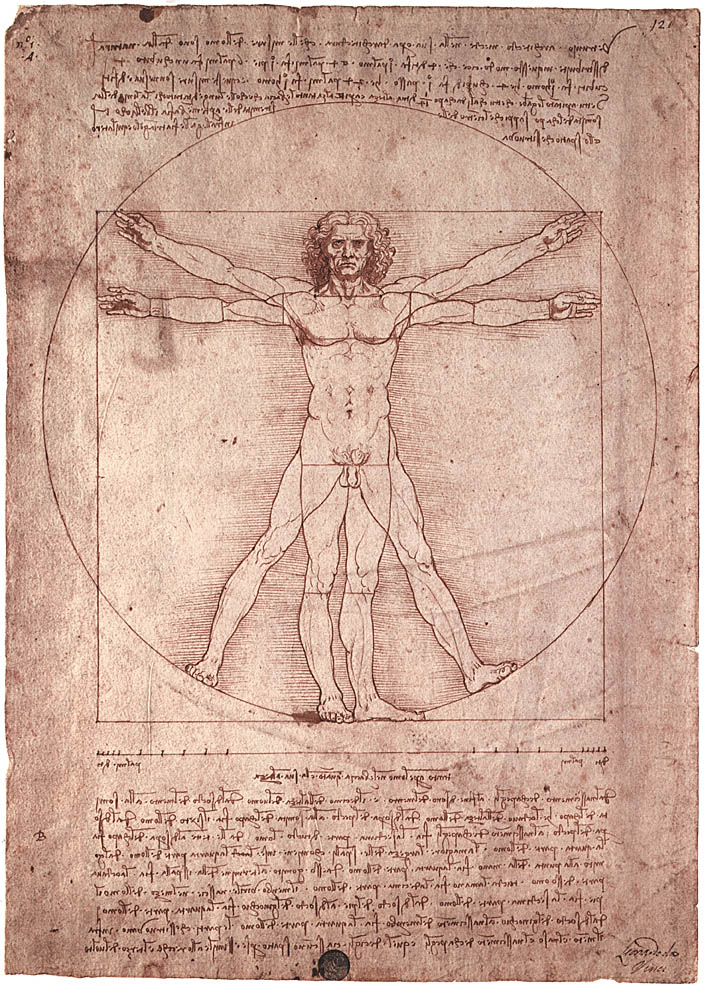
The proportions of the human body
The inscription begins with “Vetruvio architetto mette nella sua opera d’architettura che le misure dell’omo...” and continues with the description of the relationships between the various parts of the body. Datable around 1490. The study of the human body is also a study of architecture, in particular of the classical ideal in the centrally planned buildings of the fifteenth century.
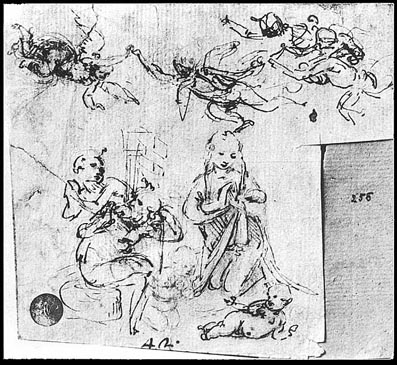
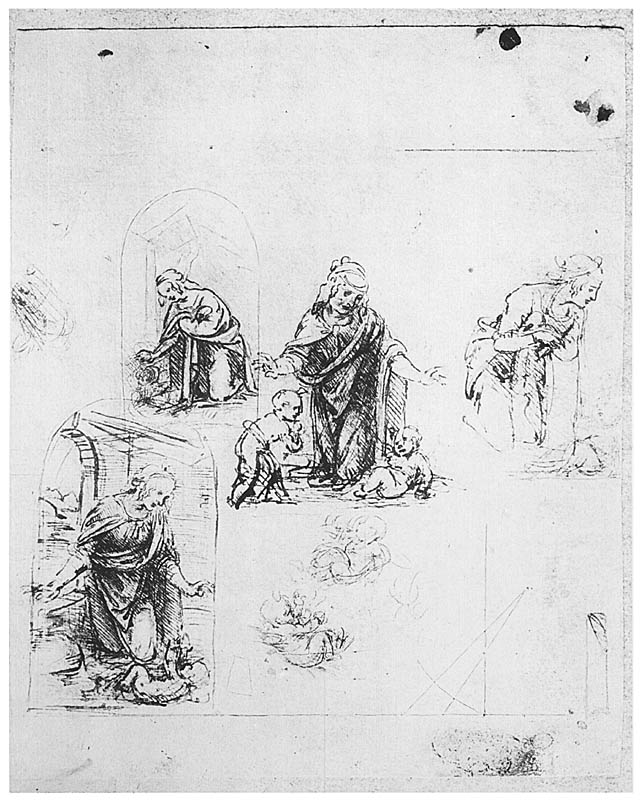
Four studies, two of which are inscribed in a frame, for a kneeling Virgin in adoration of the Child, and two sketches for the Child lying on the ground
- Studies for a Nativity, compositional exercises. The one at the bottom left and even more the one in the centre, with the young St. John, seem to anticipate the famous Virgin of the Rocks. The figures of the Child and the young St. John are curious, as they seem to be playing hide-and-seek behind the Virgin’s drapery.
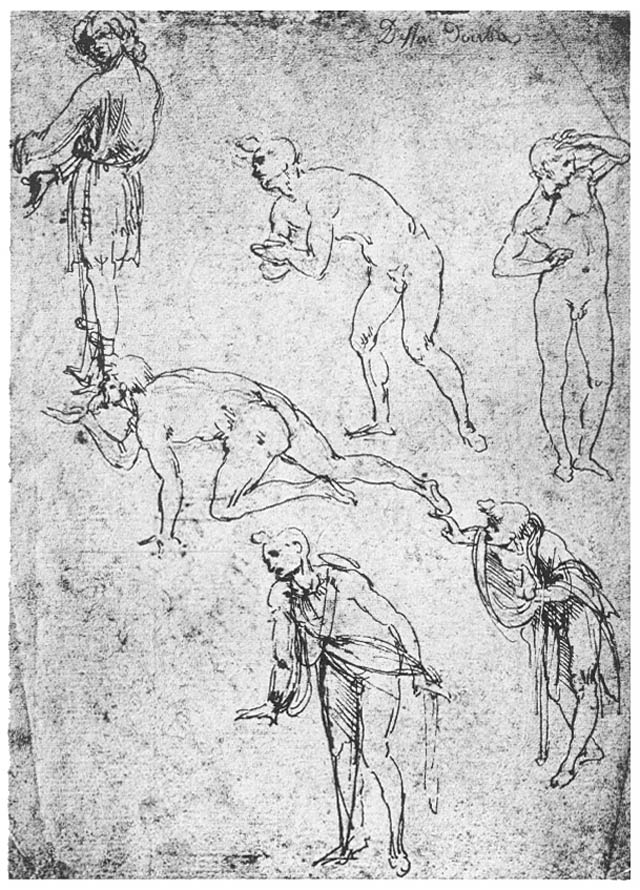
Leonardo da Vinci — Recto: six male figures, mainly nudes
These studies are related either to a Last Supper or to an Epiphany; according to Berenson both hypotheses are correct. The figures in conversation are sketches for an Epiphany, the nudes at the table and the isolated figure (almost certainly Christ), also at the table, are evidently studies for a Last Supper.
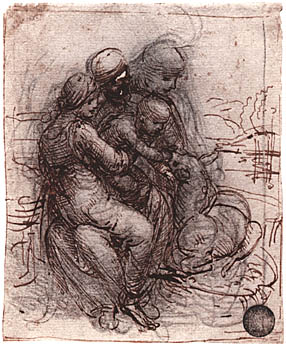
Saint Anne, the Madonna and the Child playing with the lamb
Wasserman does not attribute this drawing to Leonardo, contrary to general opinion. It is probably a study for the Holy Family in the Louvre. Here, however, the heads of the Madonna and St. Anne are close together, and the Child is held in her arms. The landscape fading into the distance is interesting.
Head of Christ with a hand grasping his hair
A drawing so original that it has aroused considerable perplexity, even if accepted as autograph by Leonardo scholars. Loeser had rejected it, judging it a “real defamation”. The strange sparkle of the image is perhaps due to the use of a gold point.
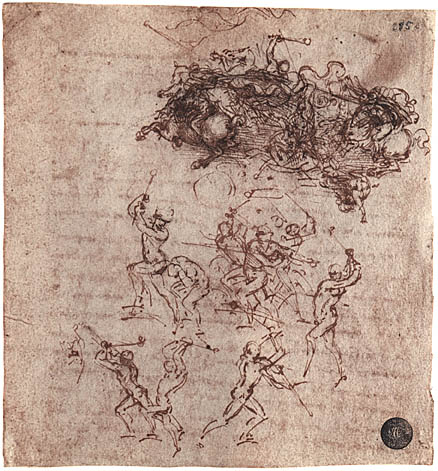
Leonardo da Vinci — Recto: fight between soldiers on horseback and studies of foot soldiers - Verso: autograph inscription
A splendid example of graphic technique, with great assurance of line in the nude figures of the combatants, and of compositional skill, especially in the mêlée in the upper part of the sheet, almost a fresco enclosed within a few centimetres. The inscription on the verso deals with the motion of bodies and the various lines of movement.
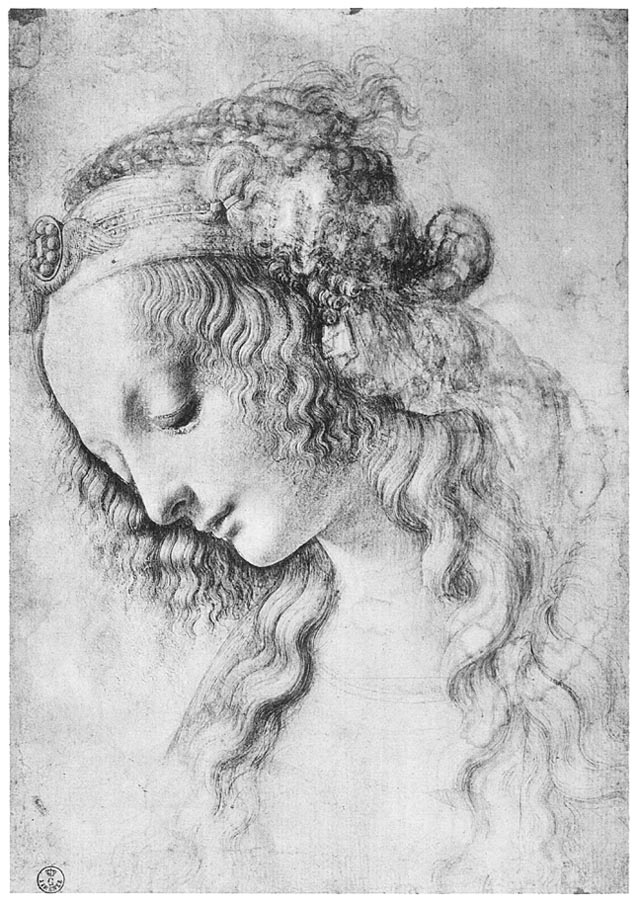
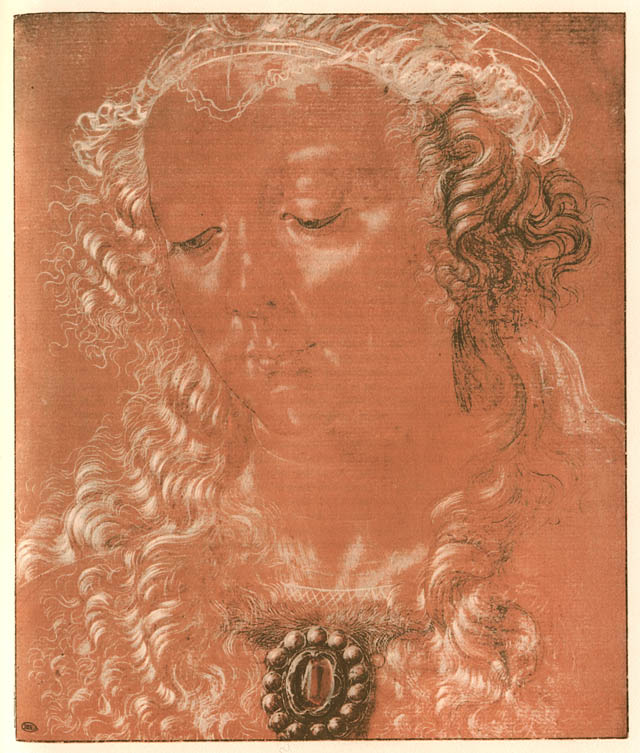
Leonardo da Vinci — Head of a young woman turned slightly to the left, with a lowered glance and hair collected in an elaborate hairstyle
Early work, attributed by some to Verrocchio. To be compared with the head of a woman in the Uffizi (entry no. 11): the same virtuosity in the hair detail, almost a test of calligraphic ability.
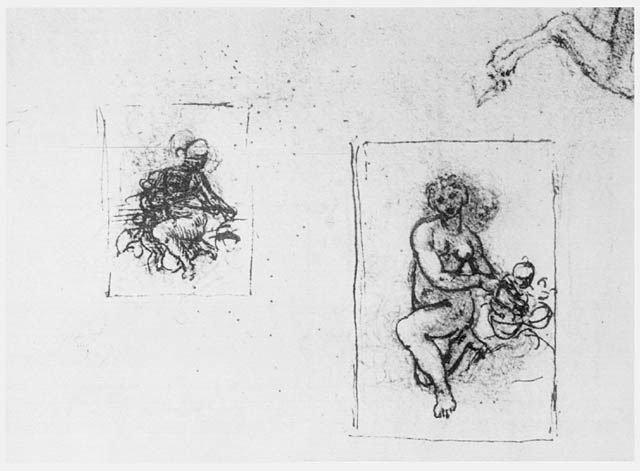
Leonardo da Vinci — two studies of a half-kneeling female nude, with a child, inscribed in rectangles; in the upper right-hand corner, a rearing horse; below the horse, rapid sketch of a female nude
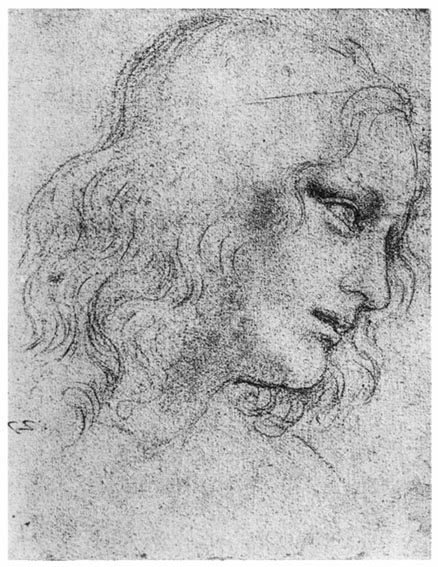
Leonardo da Vinci — Head of a youth, almost in profile, facing right
Study for St. Philip in the Last Supper. Unlike other preparatory portraits for the famous fresco, this handsome, delicate young man seems to be invented.
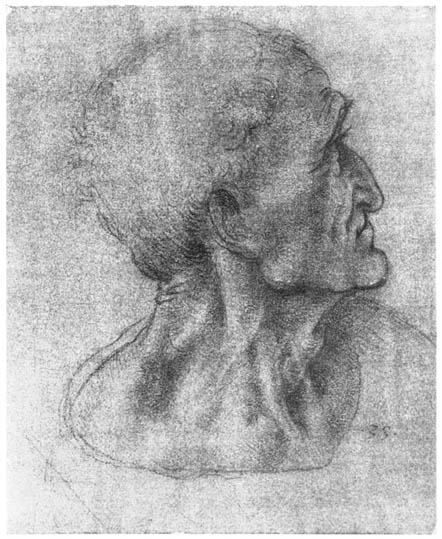
Leonardo da Vinci — Bust of a hawk-nosed man, in profile facing right
Study for Judas in the Last Supper, with all the characteristics of a real-life portrait.
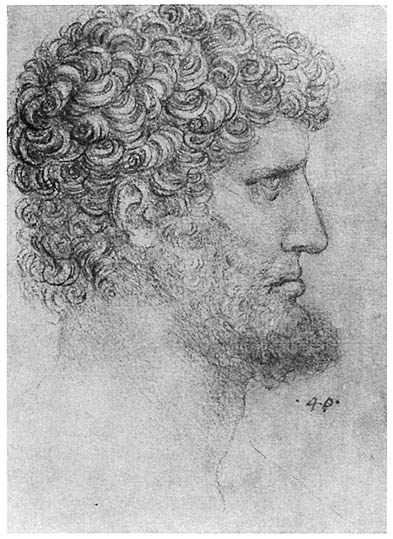
Leonardo da Vinci — Profile of a curly-haired man with a short beard
Study for the apostle Matthew in the Last Supper. It was most probably taken from the Hellenistic bust of Lucius Verus, and is reproduced almost without modification in the fresco of the Last Supper.
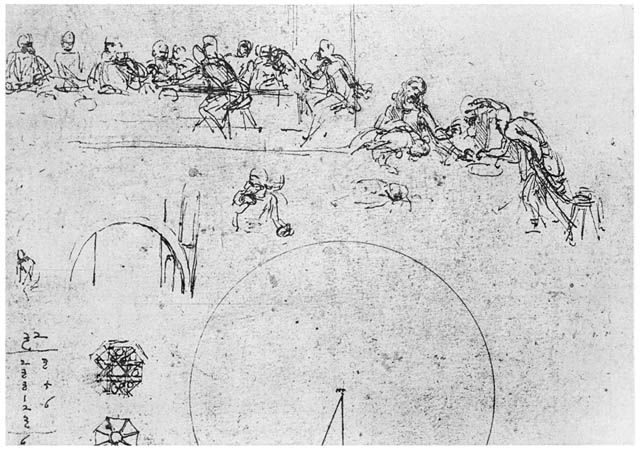
Leonardo da Vinci — Two studies for the Last Supper, with an arch, geometrical figures and numbers in columns for a sum
Important for the architectural sketch; however rapidly sketched, shows the studied, but still traditional, research into the placing of the various apostles, with Judas isolated and St. John slumped on the table with Christ’s hand on his shoulder (a detail repeated to the right of the group)
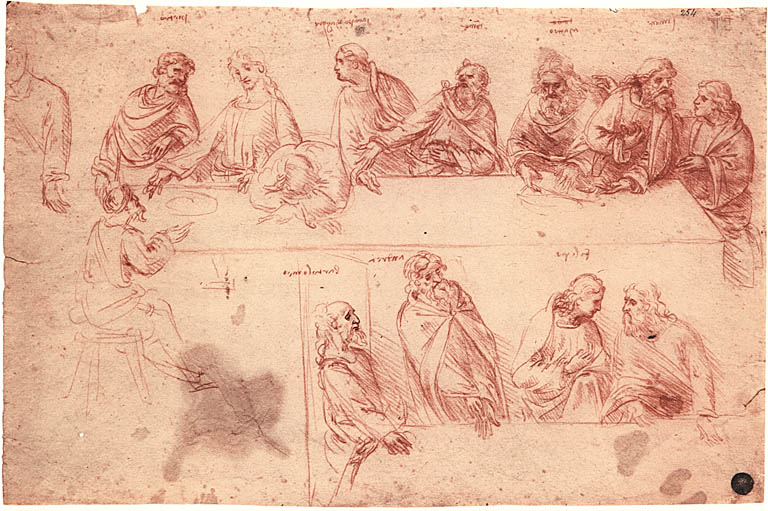
Leonardo da Vinci (?) — Study for the Last Supper
A work whose attribution is as controversial as few others. While Berenson calls it “the famous red chalk drawing in Venice, in which the grouping of the figures approaches the clear and rhythmic articulation of the finished work”, Loeser speaks of a “vulgar parody of the grandiose composition”. Today it is considered a copy made by a pupil; the names of the apostles written above each of them seem to be in Leonardo’s handwriting, but they are… too legible.
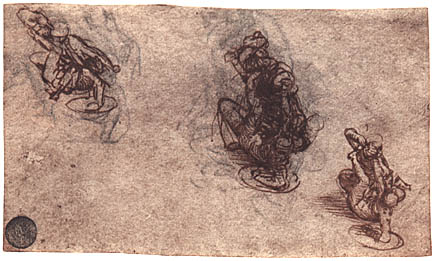
Three groups of fighting men
According to some critics it is to be related to the Battle of Anghiari, according to others it is later (1505-1506). There may be additions made at different times. The prudent Berenson proposes 1502-1505.
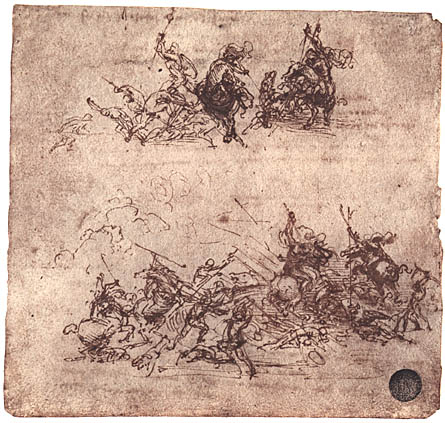
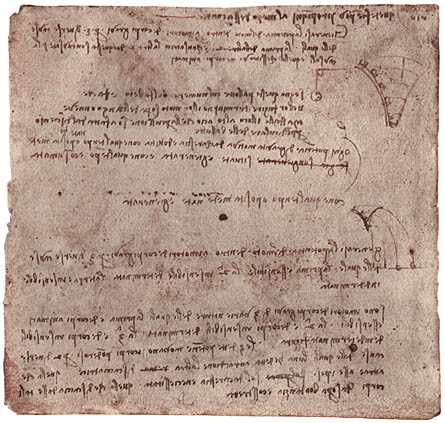
Recto: two skirmishes between horsemen and foot soldiers Verso: autograph inscription
For this drawing all scholars agree on the dating (1503-1505) and on its nature as a study for the Battle of Anghiari. Apart from the composition of the two groups of fighters, the hints of landscape are noteworthy.
Fight between horsemen and foot soldiers, a bridge, two isolated figures
A further study for the Battle of Anghiari, with the same date as the previous one. The fresco, commissioned from Leonardo in 1503 for the Hall of the Great Council in Palazzo Vecchio, Florence, has unfortunately been destroyed.
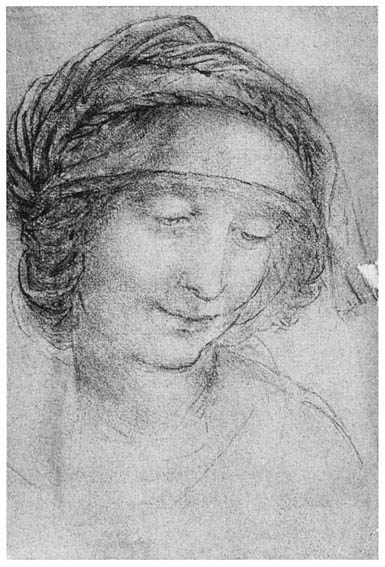
Leonardo da Vinci — Veiled female head, with eyes lowered towards the right
A study for the face of St. Anne, for the group of the Virgin with St. Anne in the Louvre. Some doubts, however, because it looks like the portrait of a young and lively person, in contrast with the composure of the elderly Anne. It might be a preparatory work for the Virgin, even if there is no sign of it in the finished canvas.
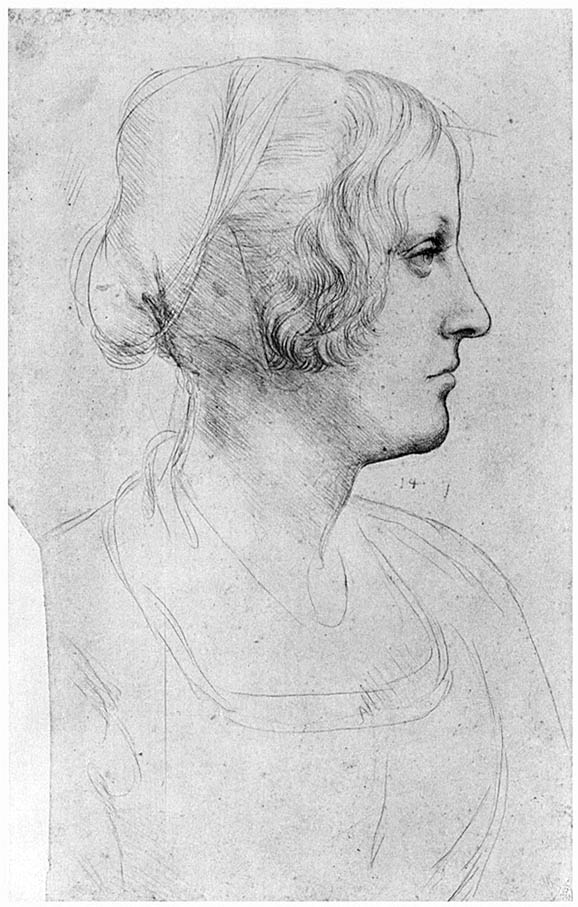
Leonardo da Vinci — Bust of a lady with her head turned in profile, facing right
Study for a portrait, beginning of the first Milanese period (1482-99). Profile of a woman somewhat advanced in years, but early, whose execution reminds Berenson of the angel in the Virgin of the Rocks.
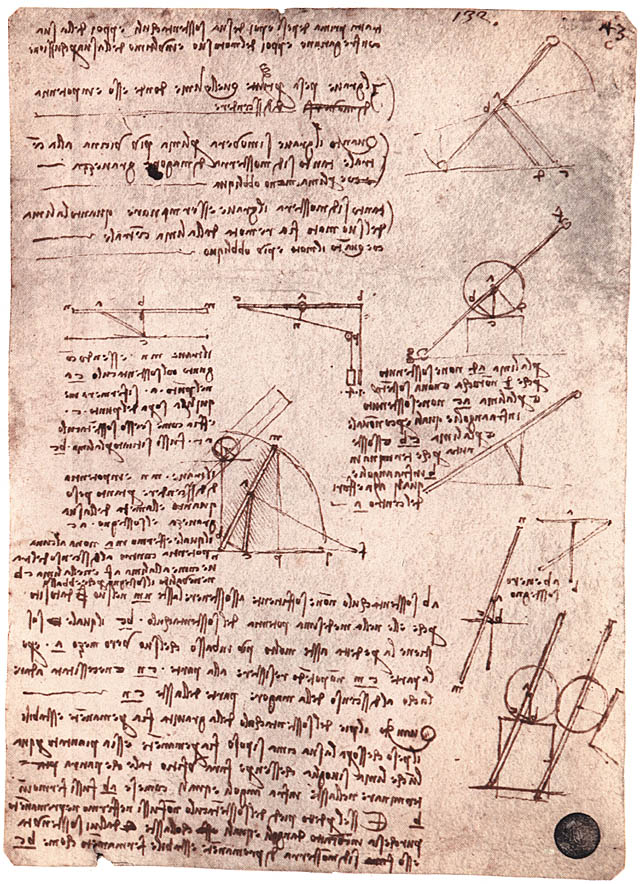
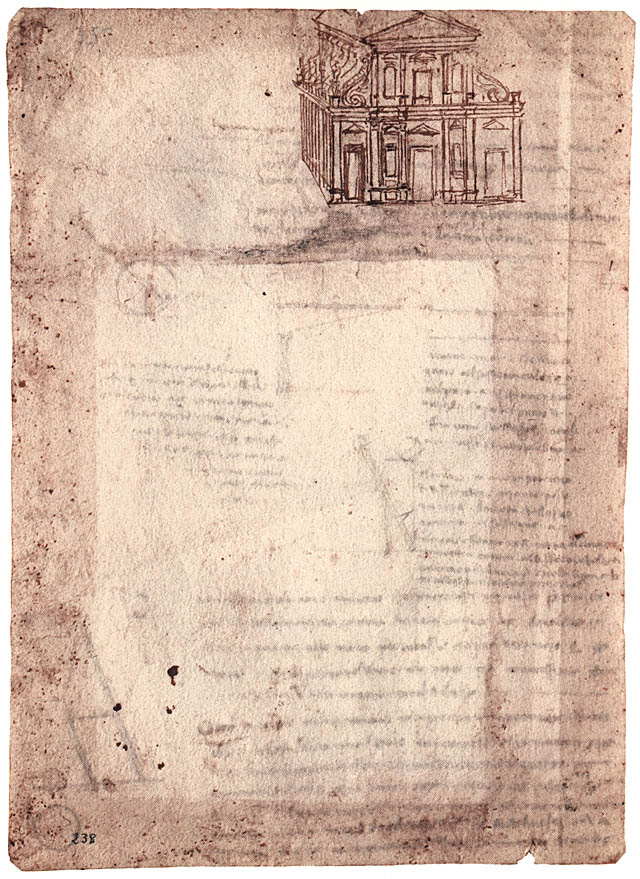
Leonardo da Vinci — Recto: studies of technical problems interspersed with passages of writing verso: design for a church
The technical problems concern the construction of efficient supports, with beams and levers; the sheet must have been part of the preparatory studies for the Treatise on Mechanics. The church on the verso has been identified by many scholars as the Duomo di Pavia, which Leonardo visited (together with Francesco di Giorgio) at the invitation of Ludovico il Moro while it was under construction, to give his opinion on certain problems concerning the stability of the dome. Others propose the church of San Lorenzo in Florence as the model; others still do not consider it a drawing from life but an elaboration of Leonardo’s own. The various dates proposed also diverge, ranging from 1490 to 1515.
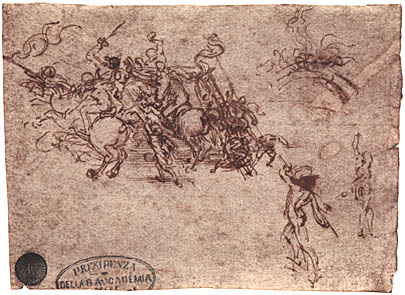
Leonardo da Vinci — Study of a horse and two figures
The Commissione Vinciana does not include this drawing in its catalogue; Berenson mentions it only in the third edition (1961) of the Florentine Painters and relates it to the Battle of Anghiari. It seems a late work, given the heavy forms of the horse and the figures rendered almost in chiaroscuro, and recalls the drawings of Cesare da Sesto, of the school of Leonardo.
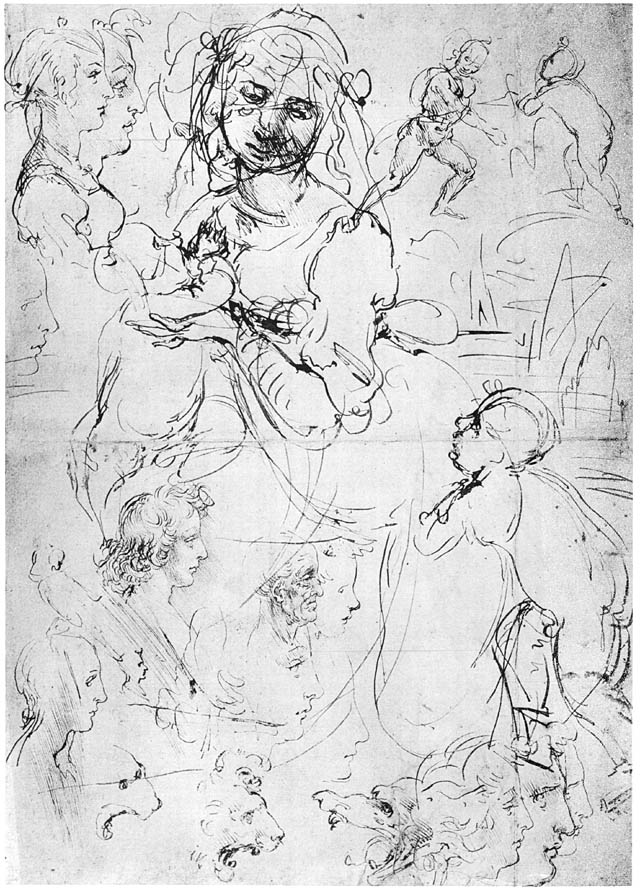
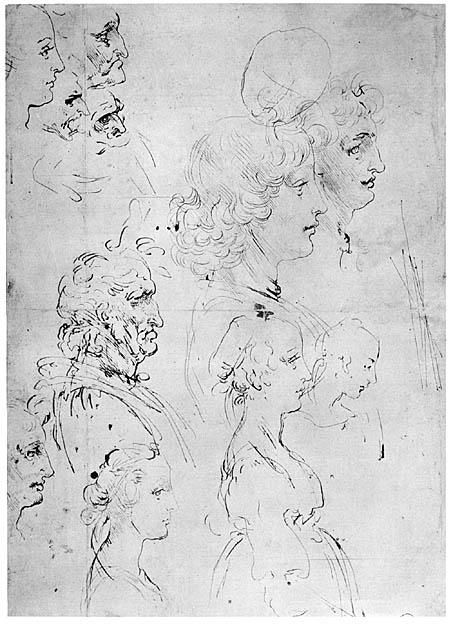
Leonardo da Vinci — Recto: Madonna nursing the Child, with the young St. John in adoration; thirteen human profiles; three profiles of wild beasts; a small male nude and the infant St. John repeated on a smaller scale at the top right. verso: eleven male and female profiles
Windsor, Royal Library The recto is decidedly crowded, but the main subject is the Madonna, which recalls the unfinished Epiphany in the Uffizi. This drawing may have inspired Raphael for his Madonna of the Meadow, and Brescianino for the Madonna with the Infant St. John, now in Naples, in the Galleria Nazionale di Capodimonte.
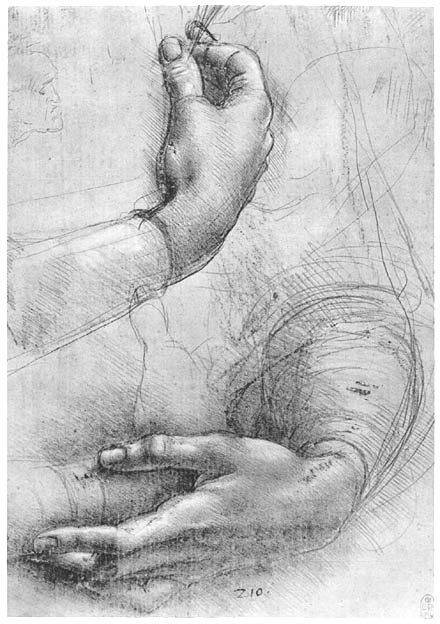
Leonardo da Vinci — Study of two hands resting in the lap and of a hand resting on the breast holding a flower
Very accurate studies, almost anatomical. The bony, delicate hands rule out, according to Berenson, a reference to the Mona Lisa; the critic places the drawing in the period of the Virgin of the Rocks.
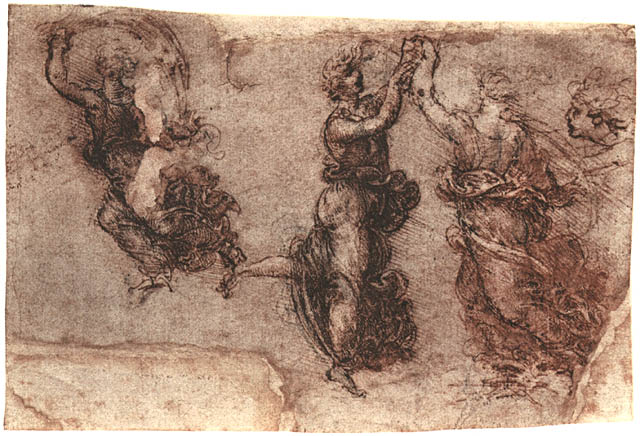
Leonardo da Vinci — Three dancing female figures and a head
According to Selvatico (1854), it is a “pen sketch that shows great knowledge of human movement. The fluency of the line and the form of the folds of the draperies recall the mature manner of Raphael, so much so that some expert connoisseurs attribute the present drawing to him.” There is no doubt about its authorship, and Leonardo seems to have drawn inspiration from Mantegna’s Parnassus, or else from sculptures of the Hellenistic period.
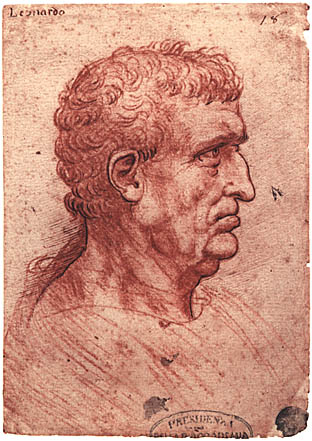
Leonardo da Vinci (?) — Head of a man in profile
Probably of the Leonardesque school, even though considered autograph by various scholars, including Loeser and Berenson. It is precisely the inscription (which is not a signature) that suggests it is a copy of a drawing kept at Windsor, of much higher quality, which portrays a curly-haired old man in the same profile.
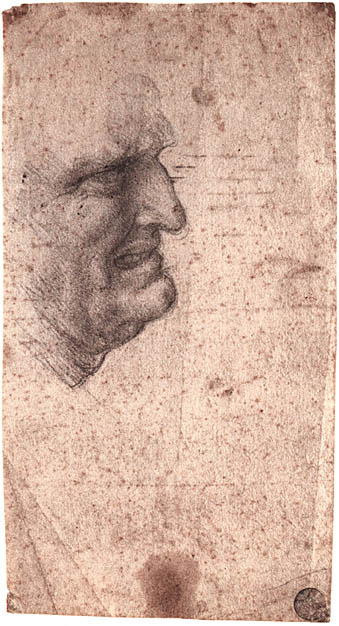
Leonardo da Vinci (?) — Head of a man almost in profile
This drawing is not published by the Commissione Vinciana. Berenson considers it to be by Leonardo, who however observes: “I am not entirely convinced of the authenticity of the profile of an old man, in the Accademia in Venice, because of its poorer quality; but if it were, as is probable, by Leonardo, it served for the head between the two warriors brandishing their swords” in the Battle of Anghiari.
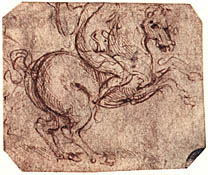
Leonardo da Vinci — Nude on horseback charging to the left, trampling a prostrate enemy.
Probably a study for the Sforza Monument, 1489-93. But it could also be the pendant of a horseman facing right, prefiguring the central group of the Battle of Anghiari; but the hatching, according to Berenson, reveals execution at a later date. For others it is simply a study for “a classical motif dear to the artist.”
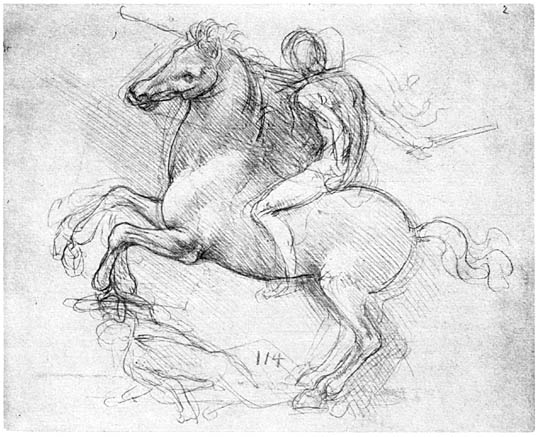
Circle of Leonardo da Vinci. Horse and rider
For Selvatico it “seems to be a first idea for one of the figures of the cartoon of the Battle of Anghiari.” For Berenson it is “a sketch of little account”, for others a copy of very good quality. It is certainly the work of a follower of Leonardo, who must have seen the Windsor drawing mentioned in the previous entry.
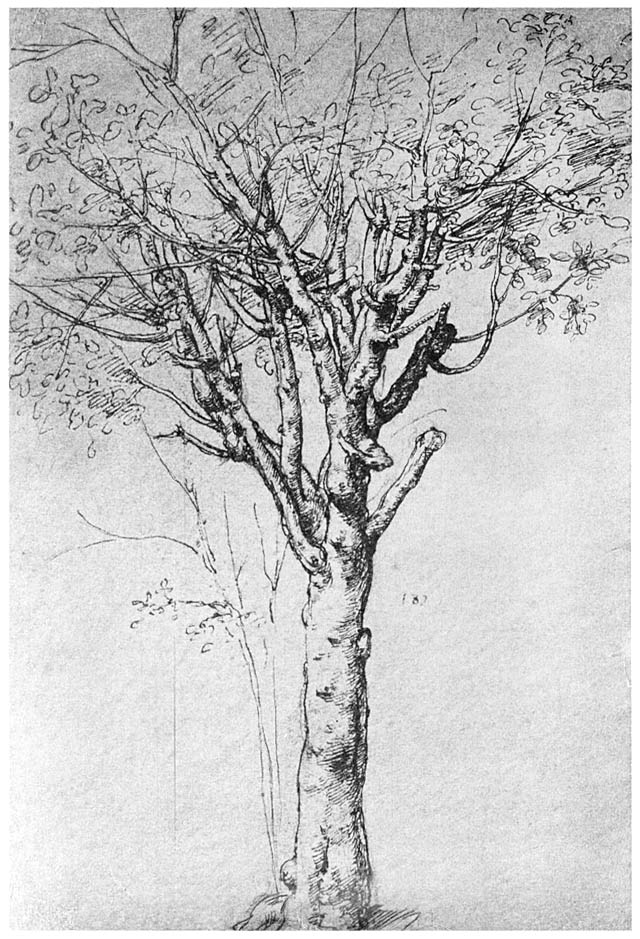
Leonardo da Vinci — A tree
The finishing in pen is by the hand of a pupil; the drawing has also been attributed to Cesare da Sesto, because this follower of Leonardo draws his trees in the very same way. For Berenson “the foliage has the airy lightness of the best Chinese artists of the Sung period.”
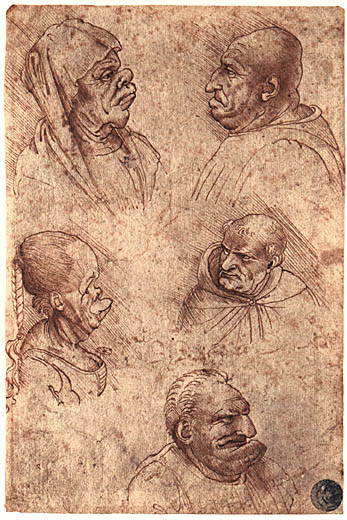
Five caricatures of heads
Selvatico considered this drawing autograph, whereas it is almost certainly the work of a copyist. Technique and measurements match those of a sheet by a pupil of Leonardo kept in the British Museum in London. Berenson proposes, with caution, the name of Melzi, because of some affinity with one of his drawings in the Biblioteca Ambrosiana in Milan.
Seven caricatures of heads
By the same hand as the previous drawing, entry 42. Selvatico considered this one too to be by Leonardo, but the general inclination is to regard it as an imitation of originals by Leonardo, or of his school. As with the preceding one, Berenson tentatively proposes the name of Melzi.
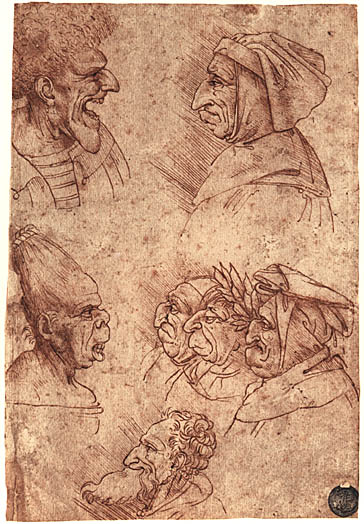
Circle of Leonardo da Vinci. Bust of a young man
Bossi attributes it to Cesare da Sesto, specifying: “Head of a young man with curly hair, taken from a drawing in red chalk believed to be by Cesare da Sesto.” It is a drawing of good quality, as shown by the fact that the stamp of the collector Sir Joshua Reynolds was applied to the recto, characteristic of the finest sheets.
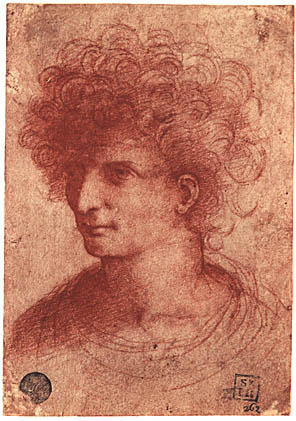
Imitator of Leonardo da Vinci. Head of a man
Together with a drawing kept at Windsor, it is considered a copy of a lost work by Leonardo; another similar drawing is in the Louvre. They may be pupils’ exercises.
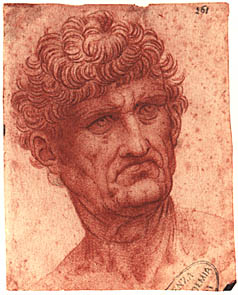
Imitator of Leonardo da Vinci. Caricature of an old woman in profile
A rather modest copy, perhaps not even from a drawing by Leonardo; however, evidence of a certain mannerism that arose on the fringes of Leonardo’s school.
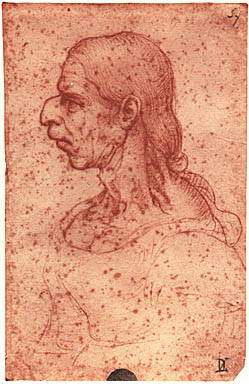
From Leonardo da Vinci. — After Leonardo da Vinci. Anatomical drawing
Probably executed in the second half of the 16th century, in line with Leonardo’s anatomical drawings, a great innovator in this practice (even though he boasted that he could draw muscles without dissecting corpses).
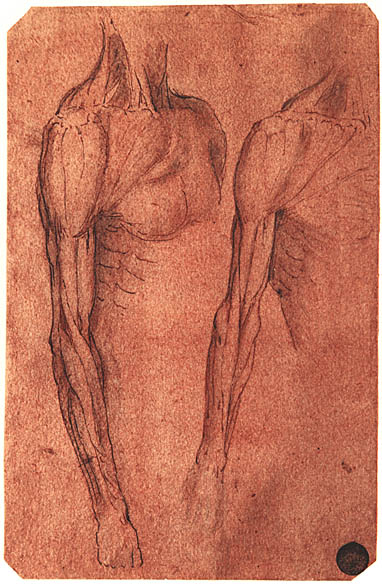
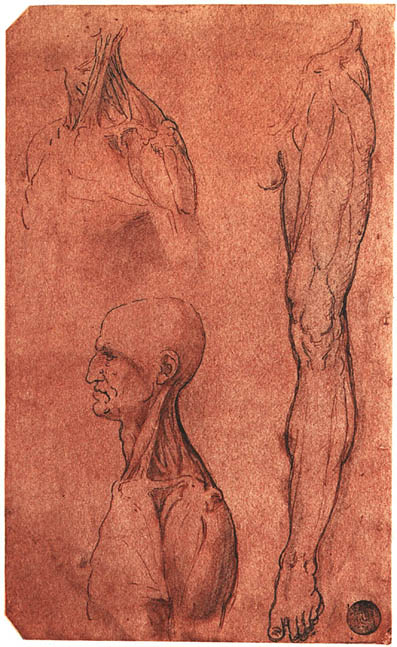
From Leonardo da Vinci. — After Leonardo da Vinci. Anatomical drawing
By the same hand as the previous drawing, entry 47. Leonardo’s influence is more noticeable in the face in profile.
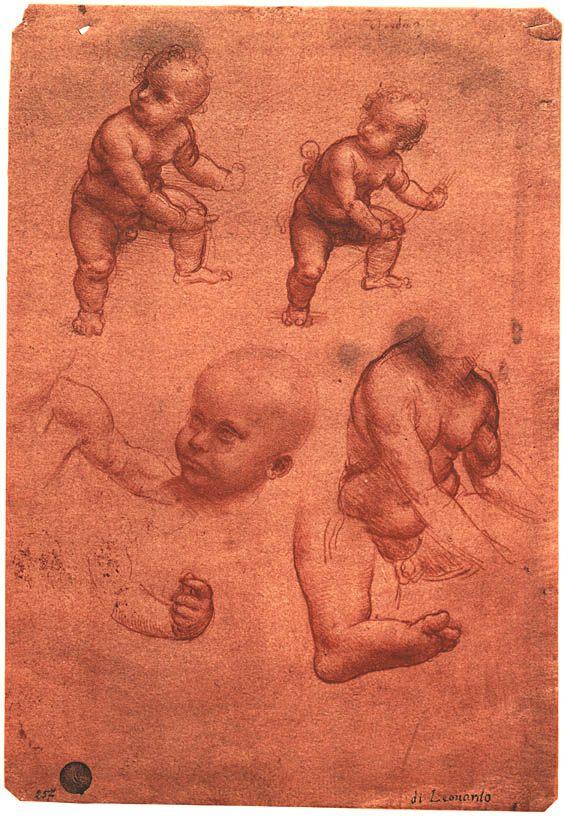
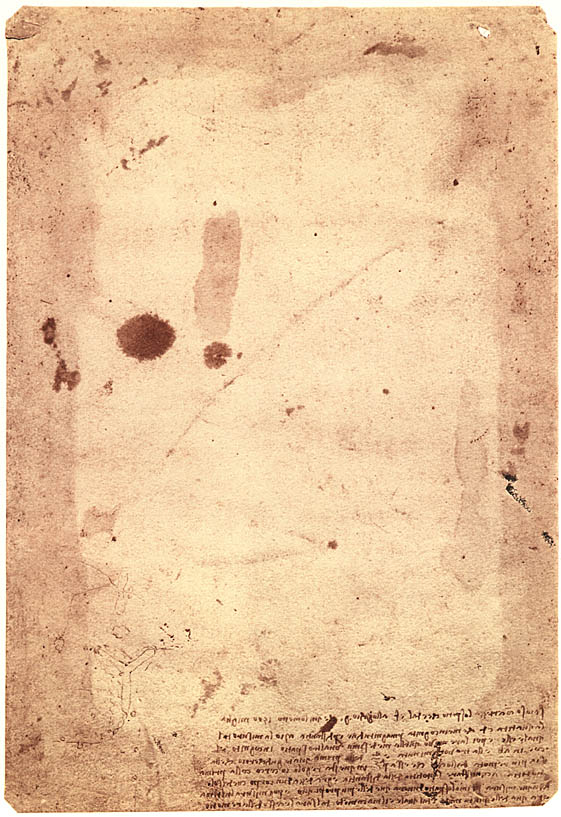
Recto: studies of putti, of arms, of a foot, of a male torso. Leonardo da Vinci. Verso: inscription and sketch
A drawing considered by Selvatico to be by Leonardo and related to the Virgin and Child with St. Anne in the Louvre. Generally attributed to Cesare da Sesto, it nevertheless bears the inscription “anbroso” in Leonardo’s hand, which would point to the authorship of Ambrogio de Predis. Berenson’s position is a singular one: “today (1938) I am old enough to doubt that a great master can always remain at his highest level, and I am inclined to believe that the drawing is by our great artist, at a moment when, like old Homer, he was nodding.”
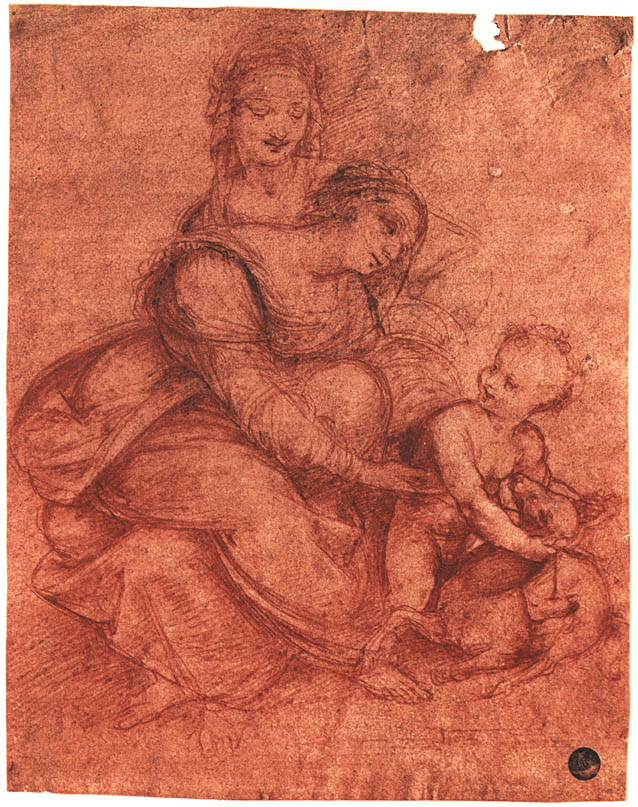
Cesare da Sesto. — Madonna and Child with St. Anne
Catalogued by Selvatico as an autograph Leonardo and related to the panel in the Louvre, it is in fact a “very weak copy of the Louvre composition, taken, however, not from the painting, but from a preparatory drawing for the cartoon” (Heydenreich). There is a remarkable similarity to the painting by Cesare da Sesto in the Museo Poldi Pezzoli in Milan, in which the figure of St. Anne is missing.
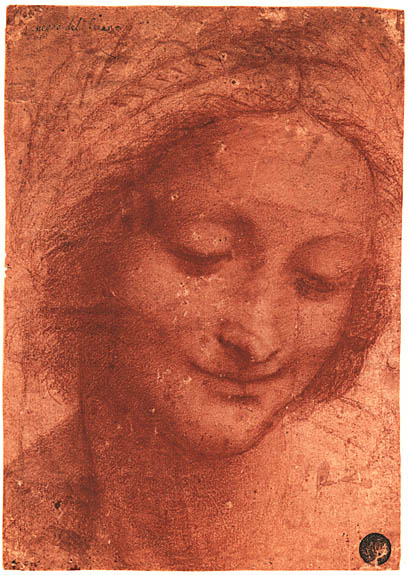
Cesare da Sesto. Head of St. Anne
Other names have been put forward for this drawing, from Leonardo himself to Francesco Melzi, to Cerano and to Salaino. It should be compared with the preceding drawing, entry 50, which seems a first sketch of an idea; here we are faced with a drawing that represents a definitive version, to be transferred immediately into the painting.
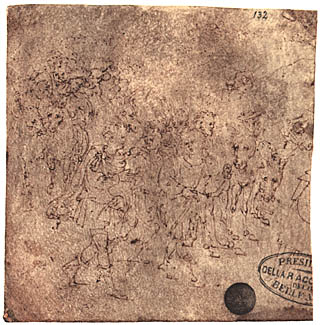
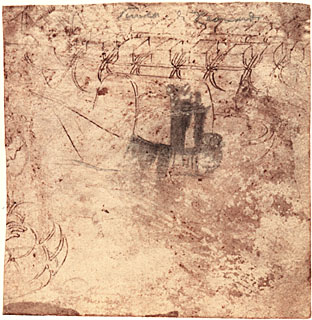
Cesare da Sesto. — Study for an Adoration of the Magi Verso: a boat; head and a hand pushing a large bundle
Venice, Gallerie dell’Accademia The minuteness of the line testifies to the relationship between Cesare da Sesto and the Flemish milieu. The theme of the Adoration was always dear to Leonardo’s followers.
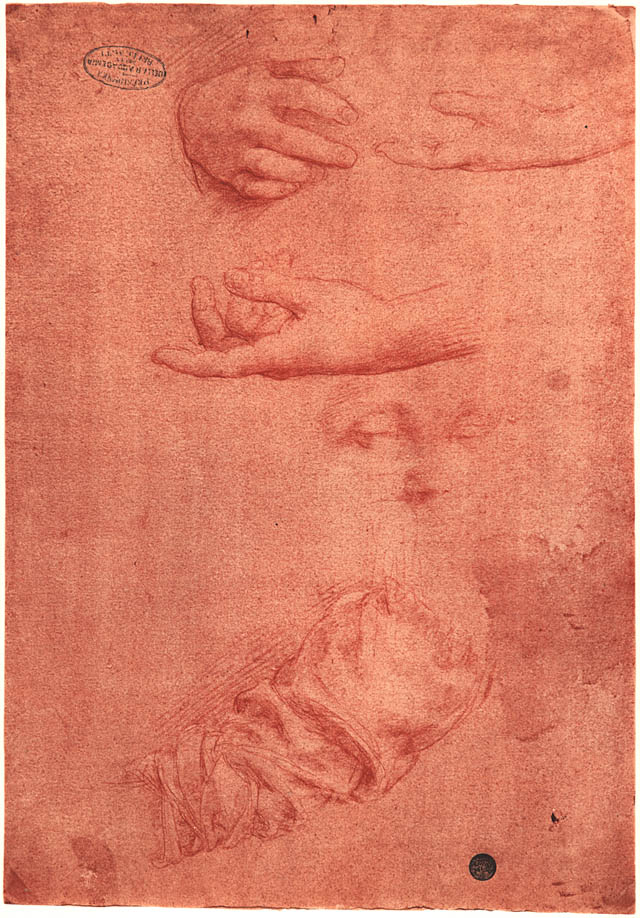
Cesare da Sesto. — Study of hands, of an arm and of a face
Preparatory drawing for the Madonna and Child in the Pinacoteca di Brera, in Milan, which is the most Leonardesque of Cesare’s paintings. Observing these hands, however, some have noted that the artist was also looking to Raphael, whom he had met in Rome, as well as to Leonardo. It can be dated to around the first decade of the 16th century.
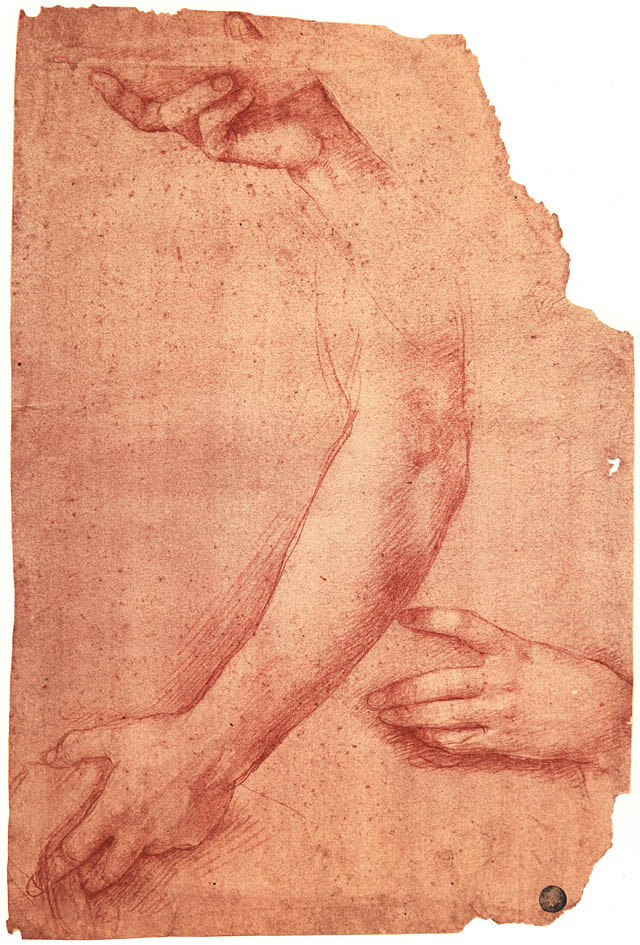
Cesare da Sesto. — Study of hands and arms
Study for the Baptism of Christ in the Gallarati-Scotti collection in Milan, a work in which only the figures are certainly by Cesare’s hand, while the landscape is to be attributed to Bernazzano. As with the preceding drawing, a Raphaelesque influence can be seen.
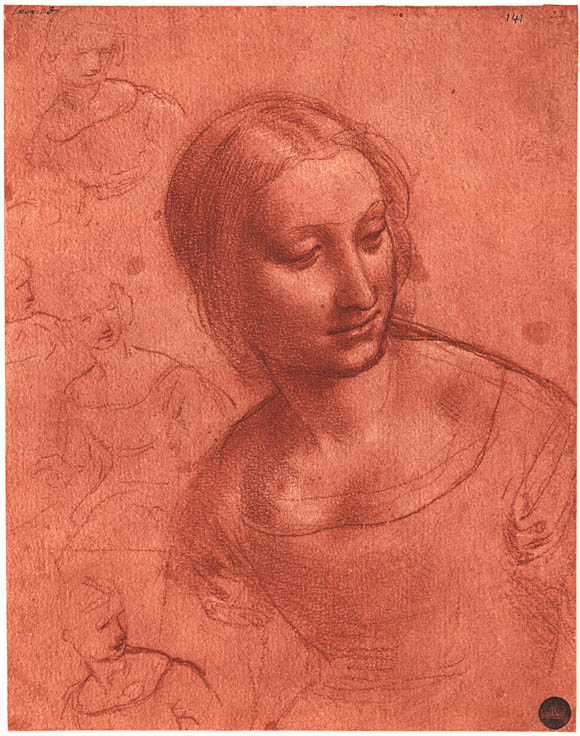
Cesare da Sesto. — Half-length female figure and other sketched figures
Formerly attributed to Leonardo and also to Bernardino Luini, it is characteristic of Cesare da Sesto in its style and in the technique of preparing the sheet with pinkish tones. The inscription “Leonardo” appears in the upper left corner; it may be a copy of Leonardo’s studies for the Madonna of the Yarnwinder. One of the sketches shows the same position of the head in relation to the bust as is found in the drawing by Leonardo kept in the Biblioteca Reale in Turin.
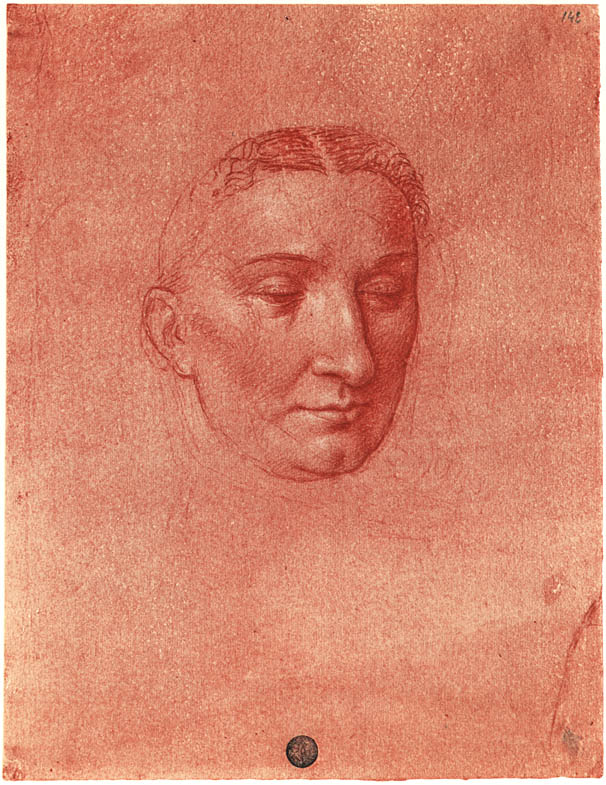
Cesare da Sesto. — Female Head
Selvatico describes it as “admirable for its truth and life.” It testifies to Cesare’s considerable interest in portraiture, together with other fine female heads, and confirms an influence from Raphael.
Cesare da Sesto. — Study for a putto
Selvatico and Berenson include it among Leonardo’s drawings, but the latter also suggests the hand of Melzi, who shows an almost identical child in a Holy Family. It is in any case too modest a drawing to be attributed to Leonardo; note the pentimenti in the drawing of the foot, repeated in the study for St. Christopher (entry 58).
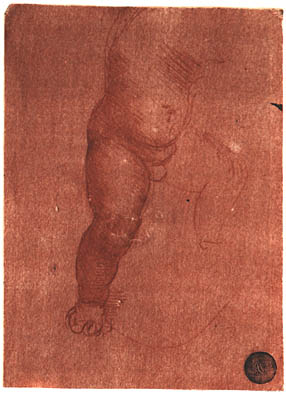
Cesare da Sesto. — Study for St. Christopher
A work certainly by Cesare da Sesto, to be linked to the St. Roch polyptych in the Museo del Castello Sforzesco in Milan, painted in 1523. It is therefore a late work.
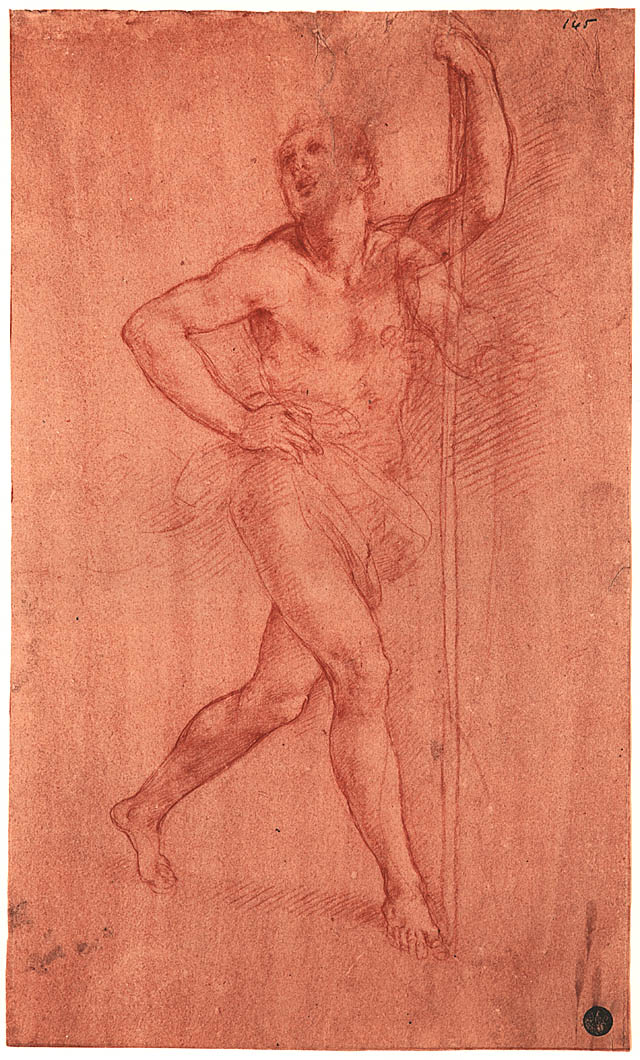
Cesare da Sesto. — Study for an Adoration of the Magi
One of Cesare da Sesto’s finest drawings, in which he harmonises the teaching of Leonardo with that of Raphael. It can be dated between 1515 and 1517
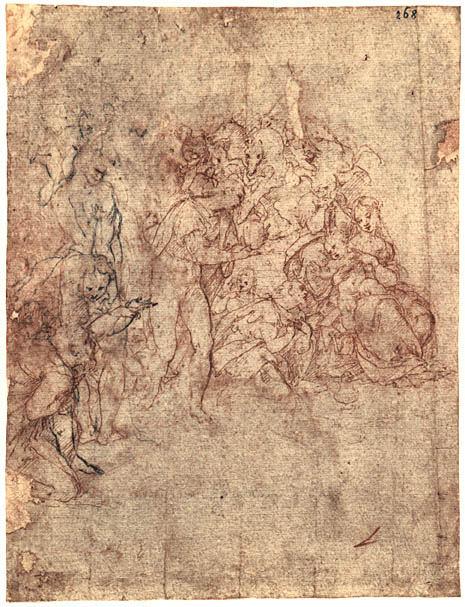
Cesare da Sesto. — Study of a shoulder and arm and a caricature
Attributed to Beccafumi by Selvatico, while the other scholars have no doubts in ascribing it to Cesare da Sesto. It may be a preparatory drawing for the St. Jerome in the Pinacoteca di Brera, in Milan. It is a late work, with a fluent handling that links it to the St. Christopher in entry 58.
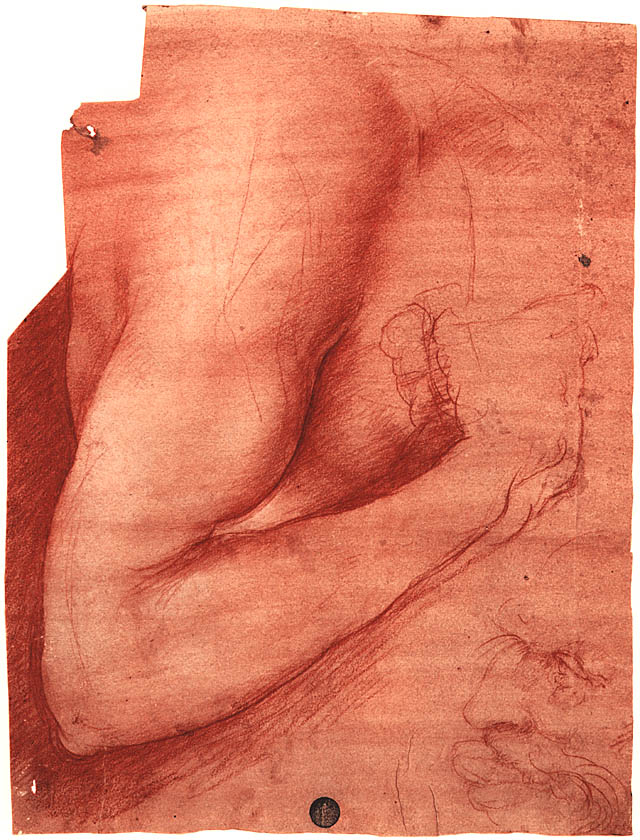
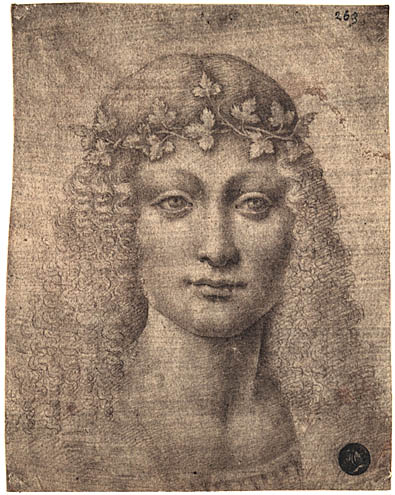
Circle of G. A. Boltraffio (1466/7 – 1516). Head of Bacchus
A drawing of highly uncertain authorship: the names put forward include those of Leonardo, by Boltraffio, of the Pseudo-Boltraffio and of Birago (the latter known for his technical skill as a miniaturist, which can be seen here in the curls of the hair). Attributed to Boltraffio in an exhibition in Florence, in 1961.
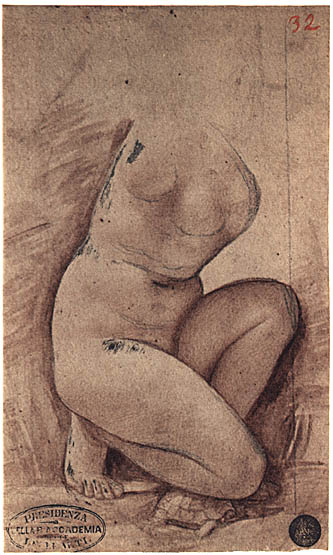
Giampiero Rizzi known as Giampietrino (?) (first half of the 16th century). Figure of a headless woman
It is probably a Leda, taken from a Hellenistic sculpture or a Roman copy. In the early 16th century bronze copies of ancient originals were common. It is possible that a statue like this also inspired Leonardo for his Leda.
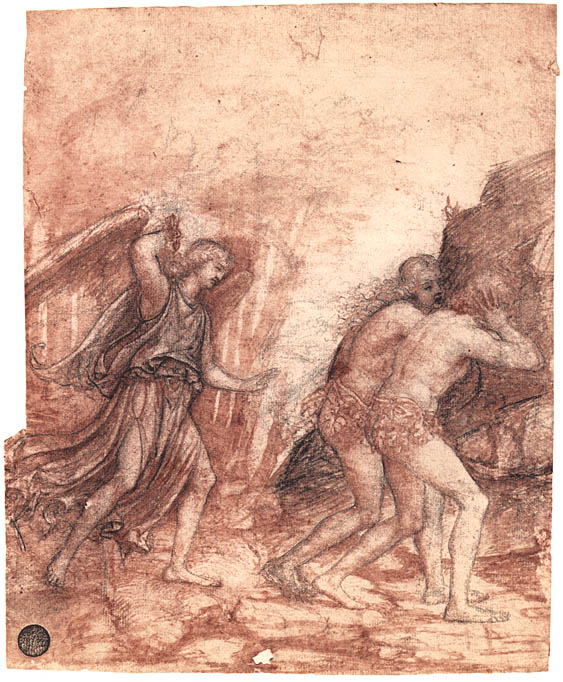
Bernardino Luini — Expulsion from Paradise
To be regarded as one of Luini’s finest drawings; only Fogolari had considered it to be from his school. The colouring is particularly delicate.
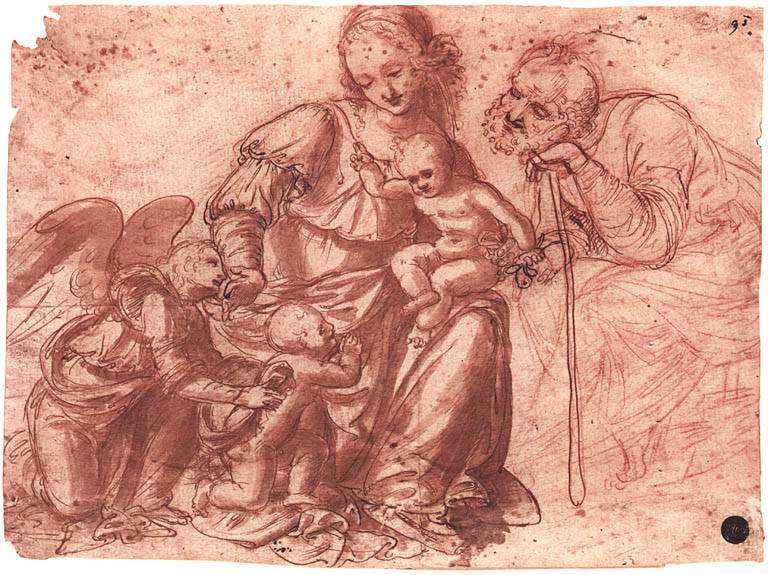
Marco d’Oggiono — Holy Family with the infant St. John and an angel
Catalogued by Selvatico as by an unknown follower of Leonardo, it was attributed to Marco d’Oggiono by Suida, in his 1929 work on Leonardo and his circle. The theme of the Holy Family is among those dearest to Leonardo’s followers.
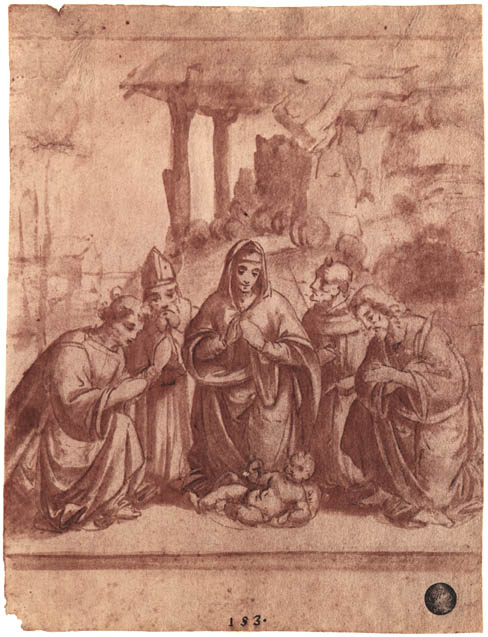
Marco d’Oggiono. — Nativity
To be related to the panel of the same subject kept in the Louvre.
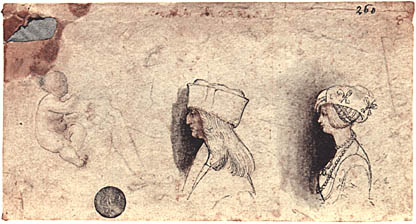
Ambrogio De Predis. — Emperor Maximilian, Bianca Maria Sforza and a putto
At the top there remain traces of the inscription “Leonardo”, to whom Selvatico had attributed it. De Predis, miniaturist and portraitist, had been commissioned by the Emperor Maximilian to strike coins; the size of the figures suggests an artist used to working on a small scale.
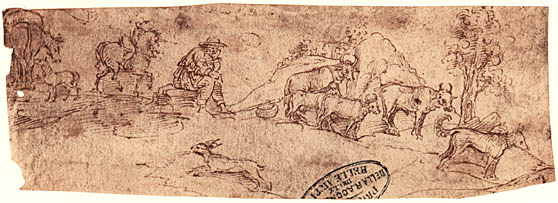
Andrea Solario — Landscape study with animals and figures
The Milanese Andrea Solario is also known by the surname Solari. This drawing is catalogued at the Accademia as a Lombard work of the early 16th century; the attribution is by Cogliati Arano (1966), on the strength of the great interest in landscape shown by Solari, as shown by the glimpses of nature in his Deposition.
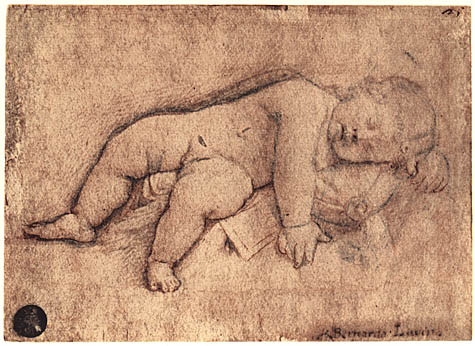
Andrea Solari. — Sleeping child
Early work, to be related to the sculptural works of his brother Cristoforo, with whom Andrea Solario frequently collaborated. It recalls Michelangelo’s Sleeping Cupid; perhaps Cristoforo was prompted to carve a similar work by the fame enjoyed by Michelangelo’s. The child’s features are characteristic of the putti drawn by Solario.
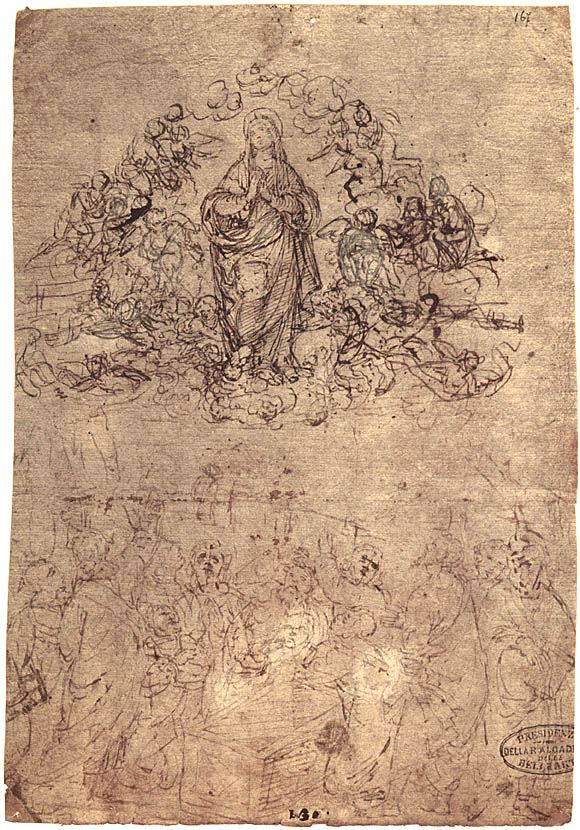
Andrea Solari. — Study for an Assumption
It was previously attributed to Marco d’Oggiono. It is a preparatory work for the panel on the altar of the new sacristy of the Certosa di Pavia, not a copy of that work, as Selvatico believed. This is shown by the variations in the Certosa panel; the drawing may have been completed in the upper part, after a first draft.
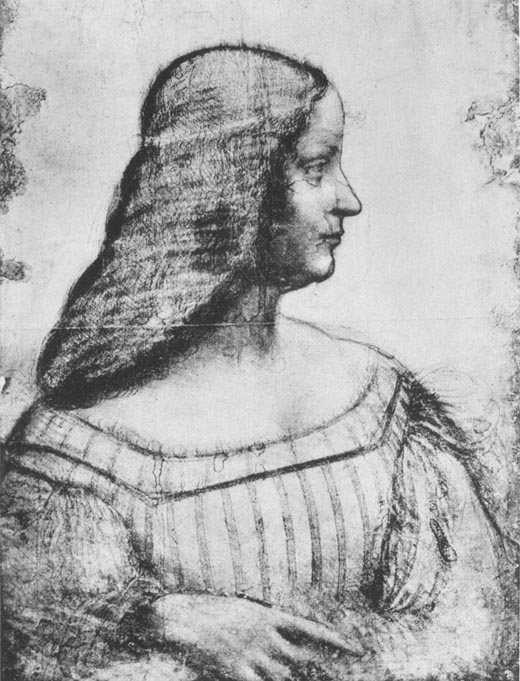
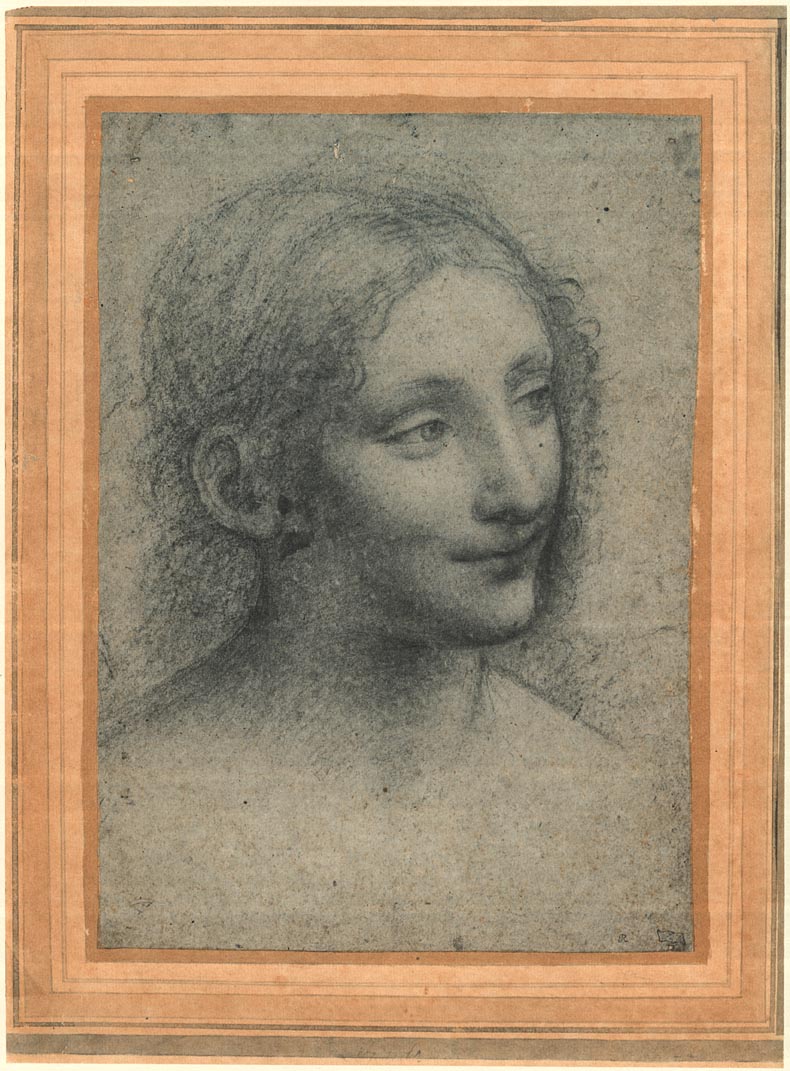
Leonardo da Vinci - Bust of a lady in profile to the right.
According to Berenson, Leonardo “faithfully recorded the vision that appeared before his eyes and did not even attempt to embody in it, as in the Mona Lisa, dreams nurtured throughout his life”. The gaze is simple and natural, not at all enigmatic. The whole cartoon was probably executed in a single sitting. The noblewoman portrayed is Isabella d’Este, who sat for Leonardo in Mantua in February 1500. It is the only (surviving) autograph work containing traces of pastel; most of Leonardo’s drawings are executed in pen; charcoal and white lead were reserved for the final stages of preparation.
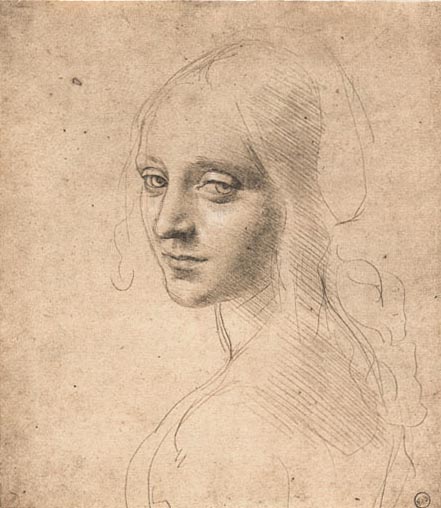
Leonardo da Vinci - Portrait of a young girl, presumed study for the angel in the Virgin of the Rocks.
Study from life. Judged by Giulia Brunetti “perhaps more attractive than the painted version” and one of Leonardo’s finest creations for the assurance and complexity of the line, which passes from the flying, indistinct peripheral strokes to the highly elaborate chiaroscuro of the face. For Robert Wallace it is a “deceptively simple” work. Datable around 1483-5.
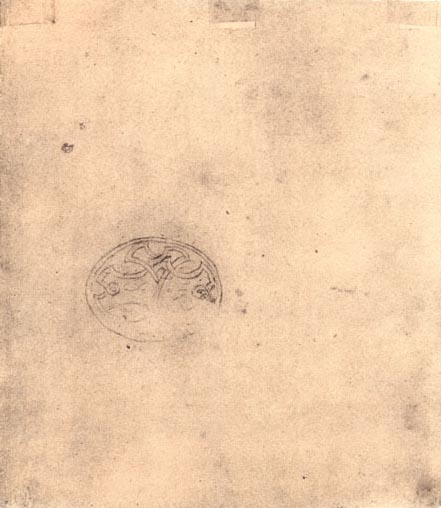
Leonardo da Vinci - Sketch of interlacing within an oval.
The ornamental motif was drawn with the sheet turned 45° to the left. The interwoven ribbons are more evident on the left half. At the top centre, a hint of a plant motif, perhaps a leaf. There are no parallels in other drawings by Leonardo; it is probably a study for an impression on a book cover.
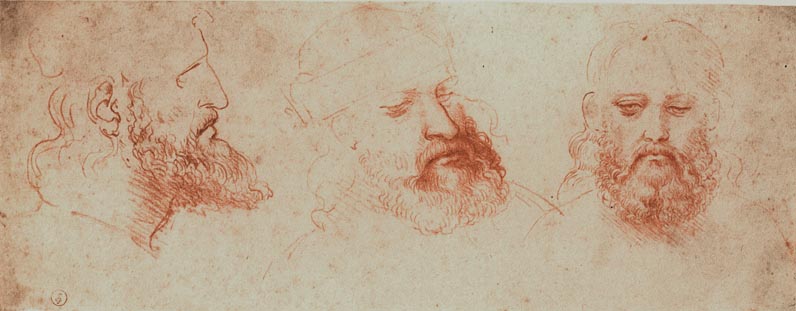
Leonardo da Vinci Three views of a bearded head, presumed portrait of Cesare Borgia.
The identification with the fearsome condottiere has been much debated. The mild, reflective appearance of the three faces is hard to reconcile with the resolute and unscrupulous character of Borgia, in whose service Leonardo was in 1502. It is true, however, that the Borgias looked more Nordic than Mediterranean, almost Düreresque, and that Cesare was proud of his flowing beard. It can be dated to around 1500-2.
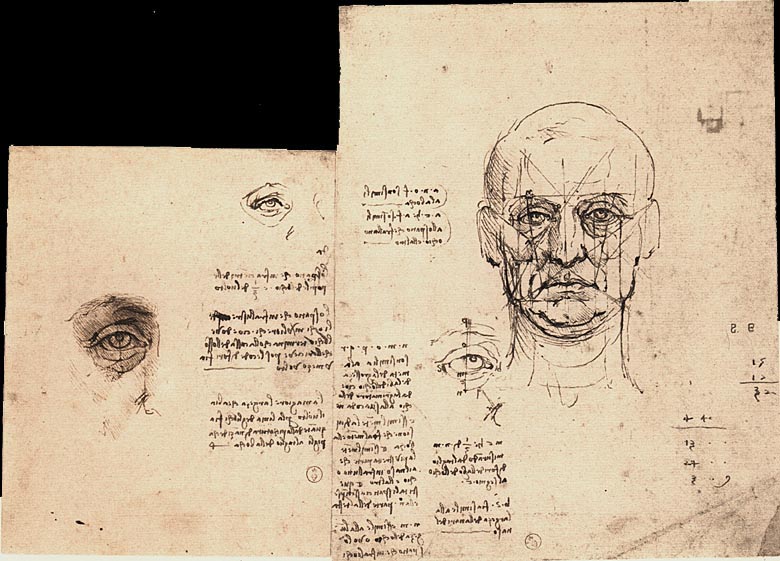
Leonardo da Vinci - Studies of the proportions of the face and the eye.
A drawing made up of two fragments joined on a single sheet as they originally were: on the right, proportions of the eye and the head; on the left, proportions of the eye. The head is drawn schematically, frontally, with axes and proportion lines indicated; the left eye has reference points explained in the note beside it. Some arithmetical operations appear on the right. The eye on the left, with part of the nose, is also accompanied by notes illustrating the relationships between the various parts of the face. It can be dated to around 1489-90.
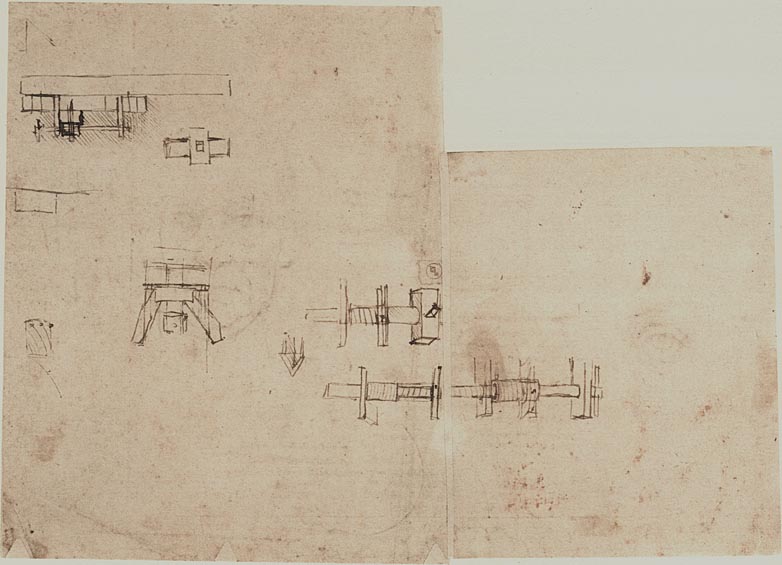
Leonardo da Vinci - Technological studies.
At the top, upside down, schematic drawing and details of a device similar to a drill; in the centre, the right way up, detail of a scaffolding. On the right, detail of a machine for making screws.
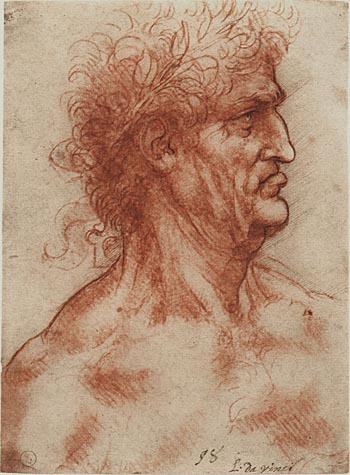
Leonardo da Vinci - Male head in profile crowned with laurel.
The shoulders and chest, in three-quarter view, emphasise the powerful musculature of the neck. The drawing, probably, it is a study for an idealised hero. The details of the neck betray an anatomical interest. The pen retouching and the hatching of the background do not seem to be by Leonardo’s hand, but later additions. Datable around 1506-8.
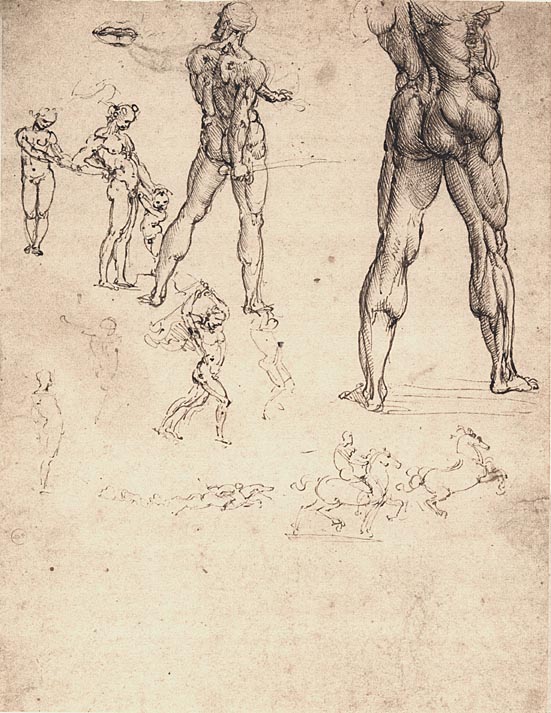
Leonardo da Vinci - Muscular nudes for the Battle of Anghiari and other figure studies.
Besides the two warriors standing with legs apart, one of them without head and arms, the sheet shows two female nudes, one in three-quarter view and one seen from the front, a child with outstretched arms, four sketches of nude fighters (one of which, more finished, wears a fluttering cloak and is about to strike a blow); finally, three horses and riders and, at the top left, a study of a mouth. Note the different gaits of the horses: one galloping, with a hint of the dust raised by its hooves, one advancing majestically, almost like an equestrian monument, and one rearing, without a rider. It can be dated to around 1505.
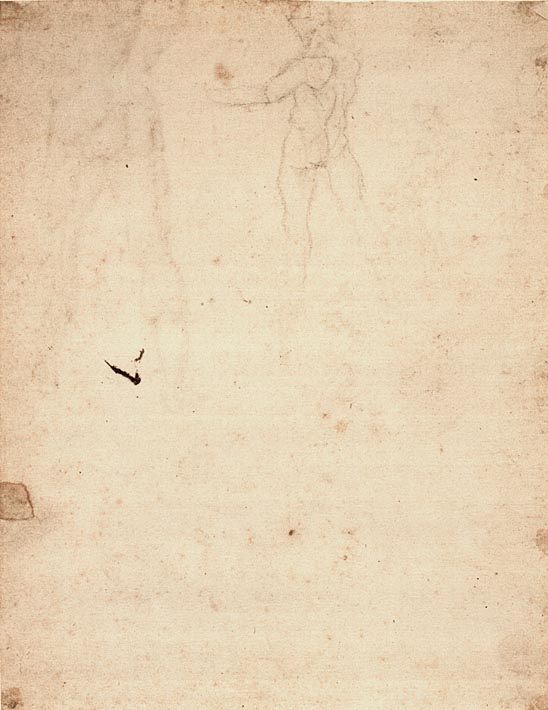
Uncertain attribution — Uncertain attribution Sketch of a standing male figure, nude, seen from behind.
The drawing is very approximate, almost certainly not by Leonardo. It seems to be a rough tracing, made against the light, of the figure of the warrior with the sword that appears on the recto.
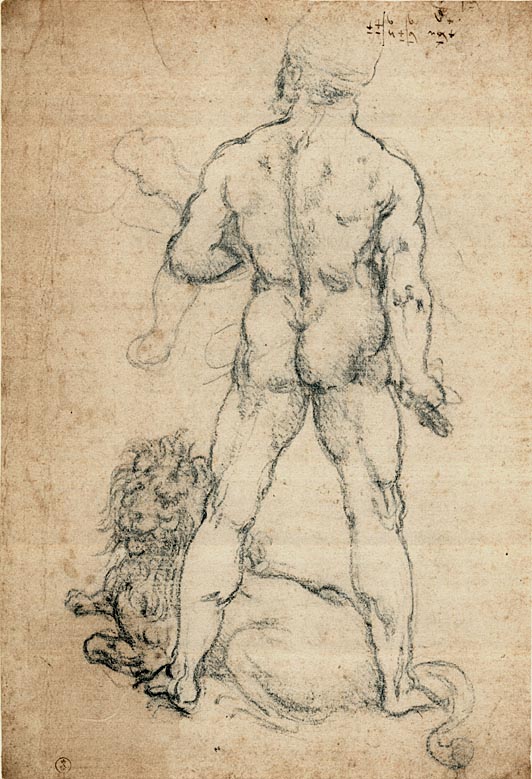
Leonardo da Vinci - Hercules with the Nemean lion.
A drawing whose attribution is complex, although it is accepted today. Rejected by Berenson, it has been judged by others (Brizio) to have a “heavier and more laboured line than Leonardo’s autograph drawings”. It is not well preserved: the charcoal line has been altered by a tracing made with a metal point to transfer the drawing to another sheet. Leonardo’s hand can be recognised in the rapid “pentimenti” indicating the position of Hercules’ arms. The dating is also uncertain: around 1505-6, or later, around 1508.
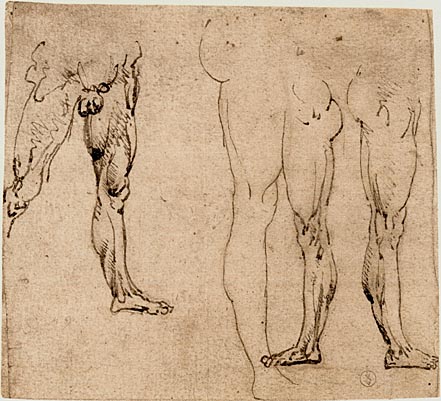
Leonardo da Vinci - Studies of male legs.
According to Berenson these would be studies for the Battle of Anghiari, and therefore datable to around 1503-5. Comparisons with similar subjects in the Codex Trivulzianus lead to an earlier date of 1490. The curious mirror symmetry of the two legs on the right might derive from copying the figures of prisoners at the sides of the windows of the Torre di Boezio in Pavia, still standing in Leonardo’s time, which he could have visited during his stay in that city in 1490.
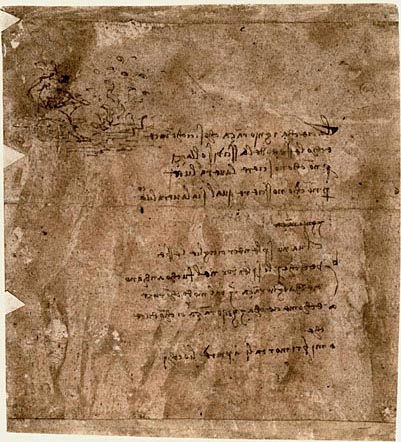
-5. Leonardo da Vinci - Allegorical sketch and poetic composition
At the top left appears a figure, probably female, in the act of throwing brushwood, to feed a fire over which butterflies are circling. The verses explain the allegory: the butterflies are victims of the blind ignorance that prevents us from knowing the true light. Datable around 1483-5.
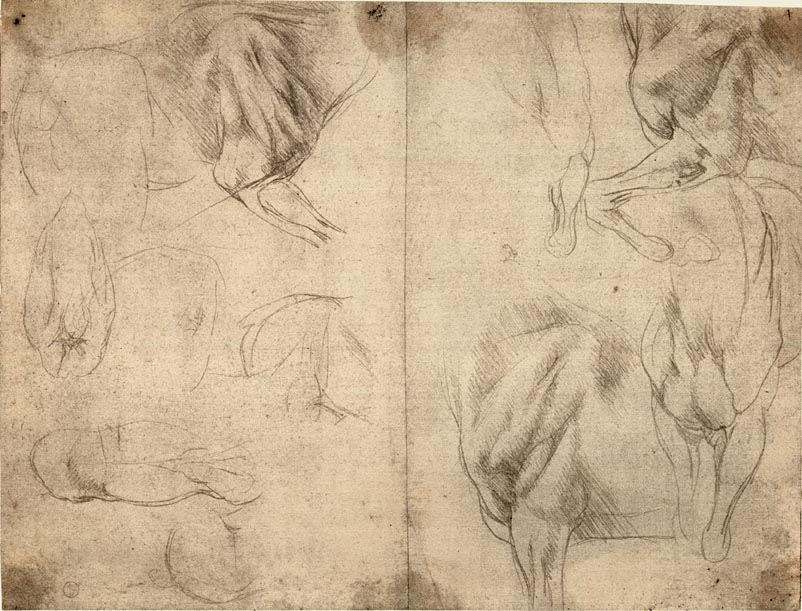
Leonardo da Vinci - Studies of the forelimbs and other parts of the horse.
The detail showing the left foreleg raised and bent at the knee suggests a study for the equestrian monument to Francesco Sforza, on which Leonardo worked between 1490 and 1492. The sheet is made up of two small sheets joined and slightly overlapping in the centre; among other things, the drawing shows details of the horse’s pectoral muscles, on the right, and sketches of views from above on the left. The verso bears a study of ecclesiastical architecture drawn in metalpoint, practically invisible except under raking light.
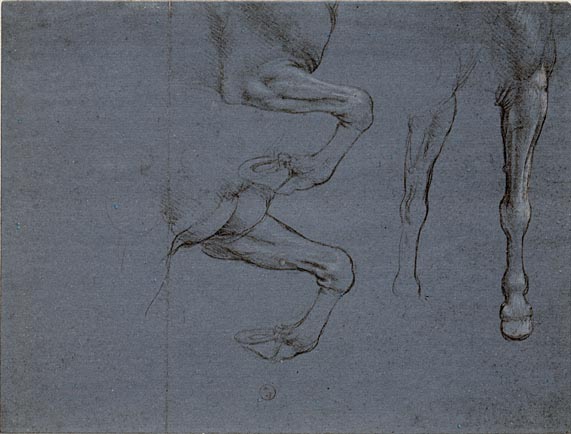
Leonardo da Vinci - Study of the forelegs of the horse.
In the centre, two studies of the forelegs, seen from the side, with an indication of the pectoral muscles. On the right, two studies of the left foreleg, in front view and slightly turned to show the inner side with its typical callosity. Probably a study for the Sforza monument, and therefore datable to around 1490.
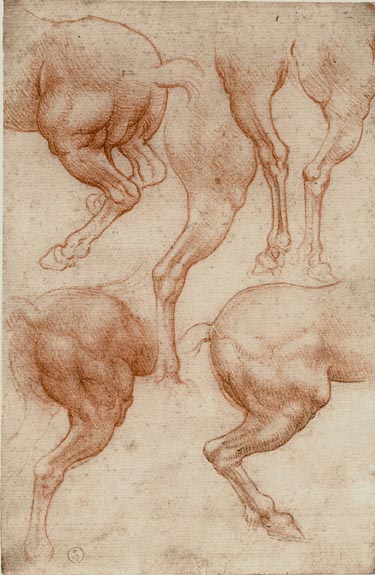
Leonardo da Vinci (?) - Studies of the hind legs of the horse.
Hardly attributable to Leonardo; probably by Melzi, or entirely gone over by him. Perhaps a copy of the preparatory work for the aforementioned Sforza monument. Datable around 1508.
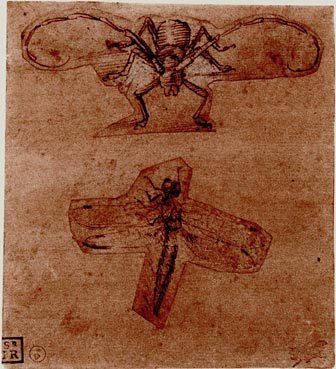
Leonardo da Vinci - Studies of insects
At the top is a longhorn beetle seen from the front, with one pair of legs erased; at the bottom, an antlion. The latter differs from a dragonfly in its stockier body and longer antennae. They look like entomological drawings, in which movement is suppressed and all the emphasis is given to the structure of the insect (note the veining of the wings). The sketch at the top can be dated to around 1480, the one at the bottom to around 1503-5.
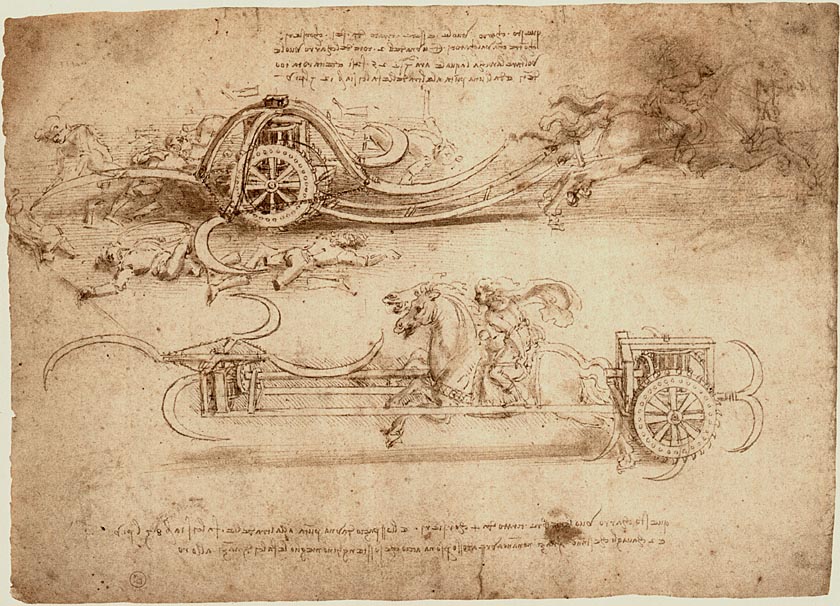
Leonardo da Vinci - Two designs for assault chariots fitted with scythes.
It belongs to a series of designs for war chariots to be found at Windsor, in the British Museum and in the Codex Atlanticus. The gruesome details of the severed legs recall that Leonardo observed how these scythed chariots “were often no less harmful to friends than to enemies”. Precise construction measurements are given beneath both sketches.
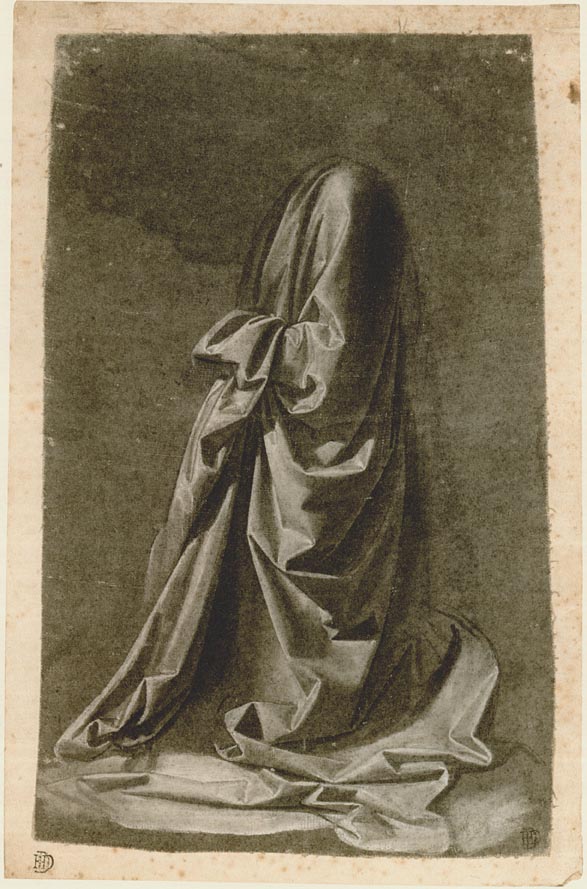
Leonardo da Vinci - Study of drapery for a kneeling figure
Leonardo did not make many drawings with the unusual technique of brush on linen; two can be seen in Paris (at the Louvre and at the Fondation Custodia) and another in the Uffizi in Florence. Vasari writes that, when he was in Verrocchio’s workshop, Leonardo sometimes prepared clay models and draped them with rags soaked in plaster, then reproduced them meticulously on canvas with the point of a brush, “with marvellous results”. The whole figure is a study of light and shade; it belongs to Leonardo’s first years of training and can be dated to around 1475.
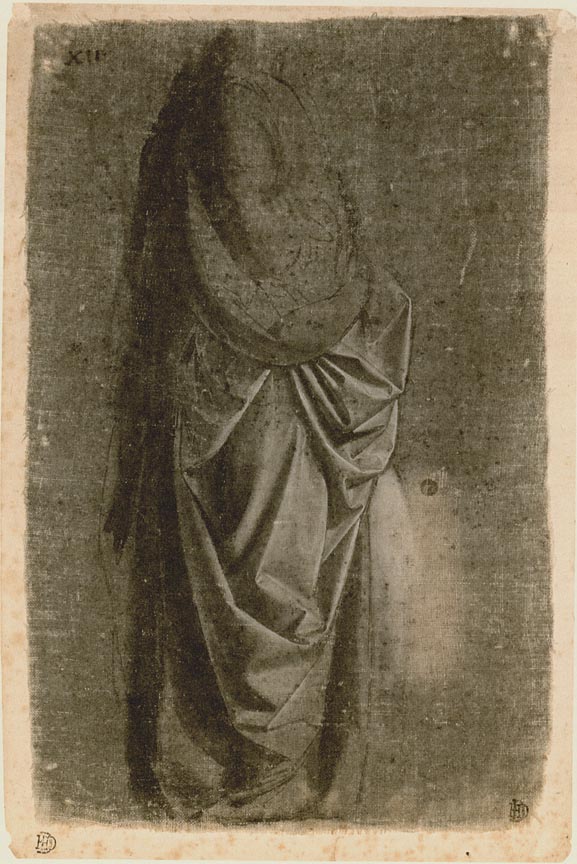
Leonardo da Vinci - Study of drapery for a standing figure
The fabric forms a cloak that falls in particularly elaborate folds thanks to the device of the arm holding up one edge. The study is devoted to the use of highlights to bring out the relief of the folds. Like the previous drawing, it may be a copy from an artificial model, from a clay support covered so as to obtain a highly complex drapery; the dating is the same.
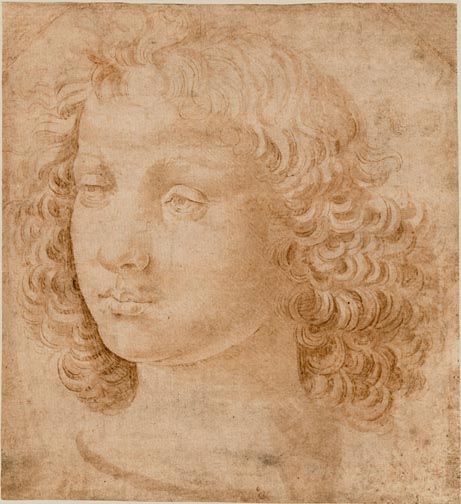
Leonardo da Vinci - Head of a young man with curly hair
Carlo Pedretti, one of the most authoritative Leonardo scholars, has shown that the X-ray of the head of the Virgin in the Uffizi Annunciation is an exact copy of this drawing, even though there is no doubt that the subject is a young “man”. The same boy, seen in profile rather than in three-quarter view, appears in a fragment at Windsor. The shading, clearly by a left-handed artist, seems rough and suggests an early work. The date may be around 1478.
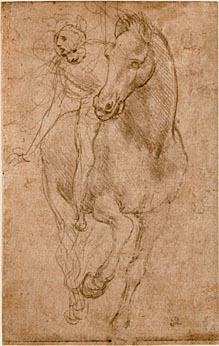
Leonardo da Vinci - A horseman
The horse is caught ambling, its legs raised on the same side; a gait that is not natural but the result of training. The rider’s head is doubled: one face looks down, the other to the left. In this drawing Leonardo’s attention is directed more to movement than to anatomy. The horse’s round eye is unnatural, joints and muscles are merely suggested, while the action flows freely and the mount seems to advance towards the viewer. It is thought to be a “copy from the antique” and not from life; the original model may have been the Horses of St. Mark’s. Other studies of horses similar to this drawing belong to the preparatory work for the Adoration of the Magi in the Uffizi (1481); the proposed date is around 1480.
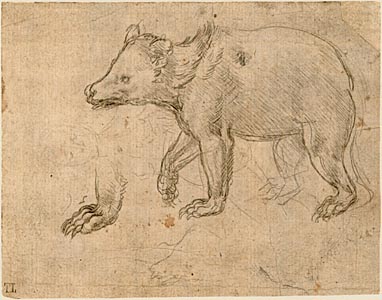
Leonardo da Vinci — Studies for a moving bear, detail of a front paw, and seated female nude
The bear was drawn twice, first with a fine point and then with a thicker one. Its gait is an amble. The female figure is rapidly sketched and can be seen beneath the bear by turning the sheet. The bear’s anatomy has been criticised for the sparse fur, the hairs of the paw pointing upwards rather than hanging down, and the posture of the paw, which looks like that of a canid rather than a plantigrade. In 1495 Leonardo had mentioned “terrible bears” in Valchiavenna, in the Lake Como region, but it is not certain that he saw them at close quarters. The drawing is, however, dated between 1487 and 1490.
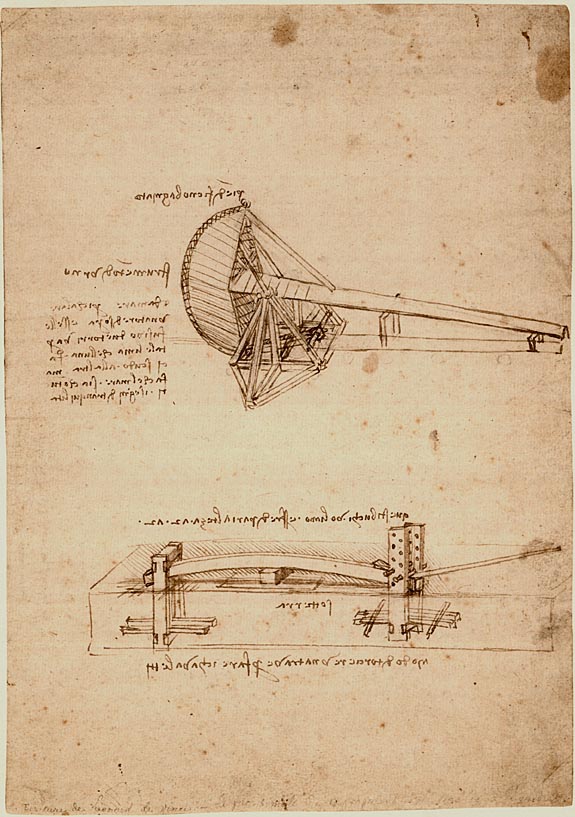
Leonardo da Vinci - Two technological studies
The upper drawing shows a kind of ladder to be mounted on the bow of a ship for attacking sea fortifications (“towers”). The inscription says that the crescent-shaped counterweight must be filled with wet hay and serve, when at rest, as protection against impacts. Once released, the ladder rises, imitating the movement of a catapult. To be used in calm seas. The second drawing shows an apparatus, firmly anchored to the ground, for bending beams intended for the construction of roofs. The bending is obtained by progressively lowering the position of the pegs in the holes on the right-hand side of the machine.
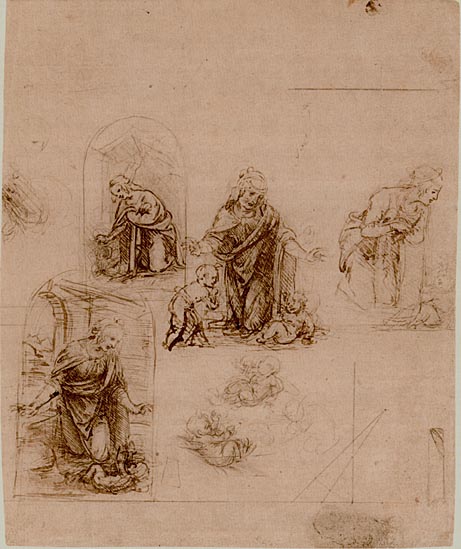
Leonardo da Vinci - Four studies, two of which are inscribed in a frame, for a kneeling Virgin in adoration of the Child, and two sketches for the Child lying on the ground
Studies for a Nativity, compositional exercises. The upper drawing, in metallic point, shows a pointed roof above the Virgin. The one at the bottom left and even more the one in the centre, with a young St. John, seem to anticipate the famous Virgin of the Rocks. The figures of the Child and the young St. John, in the centre, are curious, as they seem to be playing hide-and-seek behind the Virgin’s drapery. One of Leonardo’s most frequently reproduced drawings. Dated to around 1490, though some date it back to the beginning of the previous decade.
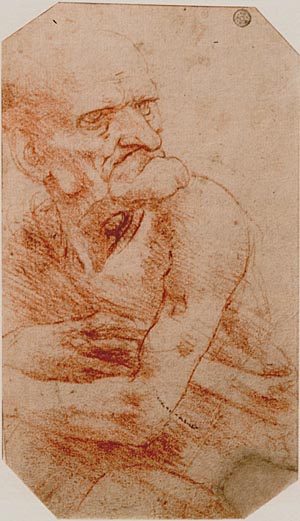
Leonardo da Vinci - Recto: bust of an old man with a caricatured face
Three-quarter view of an emaciated old man with a hooked nose and a grotesquely prominent chin. The drawing would belong to the last years of Leonardo’s first Milanese period (1482-1499). The pose of the figure has reminded many scholars of that of the charming Cecilia Gallerani, the celebrated Lady with an Ermine in Kraków. Perhaps Leonardo, while studying the complex postural relationships of head, neck and shoulder, took a rest by turning to caricature.
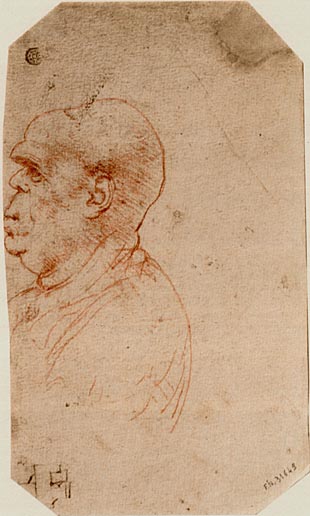
Leonardo da Vinci - Verso of the preceding sheet: left profile caricature of a bald man
The profile might reflect Leonardo’s studies for the apostles of the Last Supper. The protruding forehead is also found in the Windsor profiles. The small sketch of a wedge in the lower left corner confirms that the sheet was part of a larger one, containing technological drawings.
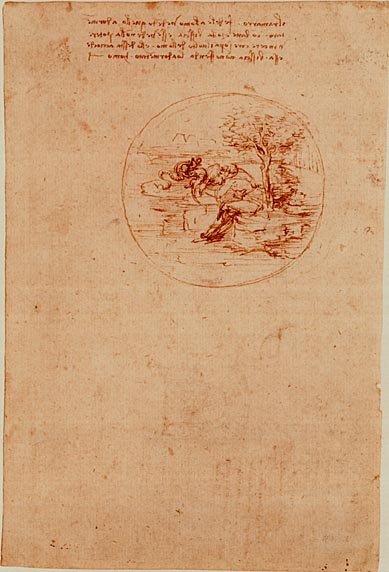
Leonardo da Vinci - Recto: sketch, set in a roundel, of a sleeping young man with a lizard fighting a snake beside his bowed head.
The scene is said to be an allegory of fidelity, as the lines of text explain: “The green lizard – faithful to man, seeing him asleep – fights the snake…”. Realising that it cannot defeat the snake, the green lizard runs over the man’s face to wake him. More striking than the human figure and the animals are the rapid strokes of the tree above the young man and the hints of landscape, with a suggestion of a lake and low mountains. It might be the design for a medal, 7 cm in diameter, close to Pisanello’s standard (8 cm). Around 1494-96.
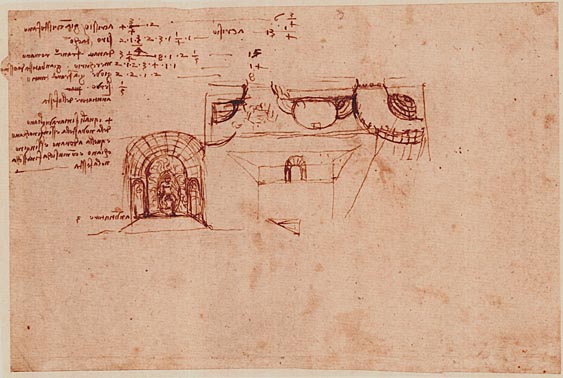
Leonardo da Vinci - Verso of the preceding sheet: a niche with three figures, an architectural plan and lines of writing
This is a sketch for the staging of a theatrical performance, the Masque of Danaë by Baldassarre Taccone, chancellor of Lodovico Sforza. The inscriptions give the names of the actors and of the characters they play; the figures joined by unequal lines are still a mystery, as they could indicate lines of dialogue, timings or movements, according to schemes known only to Leonardo. The lines of writing beside the drawing of the niche are instructions for the finale of the work: the actors “marvel at the new star, and adore it, kneeling, and with music the festivity comes to an end”.
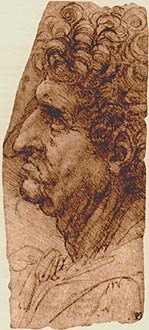
Leonardo da Vinci - Left profile of a man with tousled hair and an aquiline nose
Also catalogued as a “heroic profile” (and Vasari compared it to that of a warrior on a sheet kept in the British Museum), also seems to be an anatomical study. It is evident that Leonardo devoted himself more to the study of the facial muscles and the twist of the neck than to the rendering of the hair. It is dated around 1495.
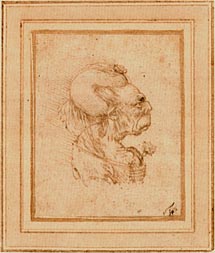
Leonardo da Vinci - Caricature of an old woman with a carnation
The old woman, seen in profile, is a succession of receding planes. The elaborate headdress, fastened with a jewelled clasp, tightly contains the hair and ends in a veil tucked into the dress. The forehead descends in two ledges onto a humped and then steeply sloping nose, from which the toothless mouth drops away above a non-existent chin. Some find this image humorous: perhaps it is somewhat tragic and certainly sour, and what is (atrociously) amusing is the carnation sprouting from the décolleté. Around 1495.
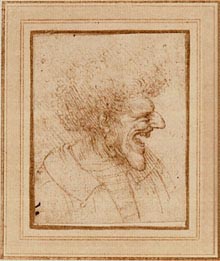
Leonardo da Vinci - Caricature of a laughing man, with thick hair
Profile facing right, shoulders in three-quarter view. The curly hair is bushy; the nose, which shares with the chin the role of the face’s main feature, is large and humped. The half-open mouth reveals a certain scarcity of teeth. Expressions such as laughter are rare in Leonardo’s caricatures: here the concavity of the mouth, besides revealing the missing teeth, serves to emphasise the convexity of forehead, nose and chin. It can be dated to around 1495.
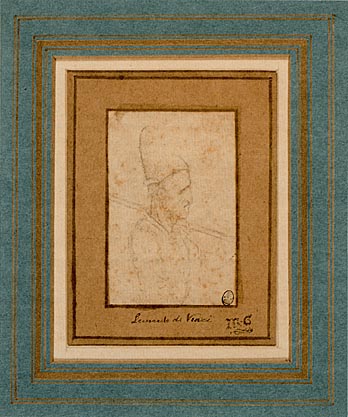
Leonardo da Vinci - Profile of a man
Head and bust of a man in profile to the right, with a tall conical hat and a stick over his shoulder. Of rather controversial attribution, this drawing is recognised as being by Leonardo’s hand by Pedretti, who sees in it an attempt to bring into focus a confused vision in which vitality is given by the touch of the sunken eyes. Circa 1495.
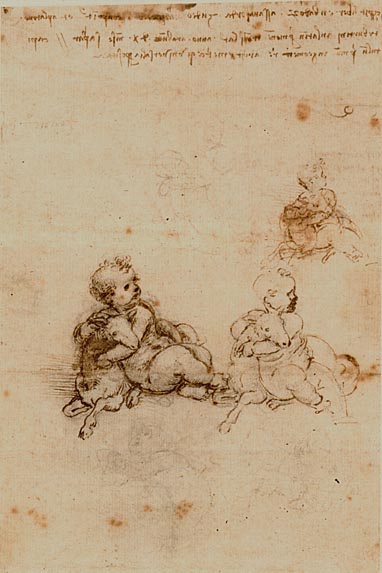
Leonardo da Vinci - Recto: studies of a child with a lamb; outline of a Virgin and Child
The sheet was used at different times. The inscription at the top is dated to around 1500, a period in which Leonardo, according to a letter from Father Novellara to Isabella d’Este, “was obsessed with geometry, and very little satisfied with the brush”. The text begins: “incipit of the Book of Areas of Savasorda the Jew...”. The astronomer known as Savasorda was in reality the Arab Abraham ben Hiyya. The sketches of the Child are considered preparatory for the St. Anne in the Louvre. The Virgin and Child is so faded as to be almost invisible, in the centre of the sheet, immediately below the inscription. Around 1497-1500.
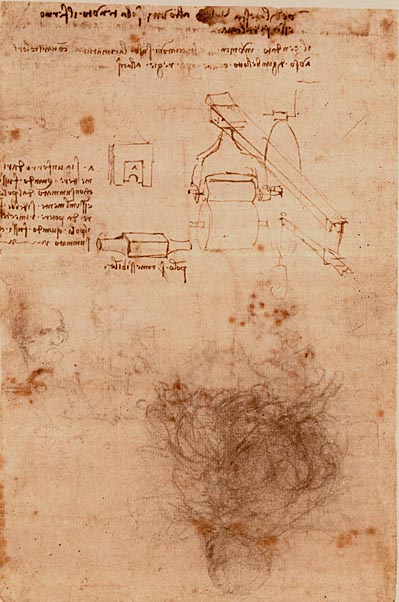
Leonardo da Vinci - Verso: technological studies, small head of a man, a tiny leaf, and a child with a lamb
Below the inscription at the top appears the drawing of a roller press, probably for treating fabrics, with the detail of a part to be replaced when worn. The caption mentions “zendado”, a light silk fabric. The head of an old man is on the left side of the sheet, below the middle; lower down, a tiny leaf made with a single stroke of the pen. The child with the lamb can be seen by turning the sheet upside down, and has been gone over many times.
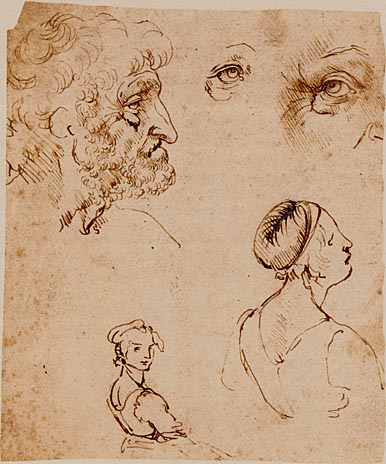
Leonardo da Vinci - Studies of figures
Recto: five sketches, of an old man and a young woman, arranged in two rows. The bearded old man, in profile to the right with shoulders in three-quarter view, who appears in the upper left corner does not belong to the category of the grotesque: the prominent lower eyelid is a symptom of disease, specified in the detail on the right. A basalioma, a degeneration of the epithelial cells. The female figures are seen from behind, both with their hair gathered in a net. The third female figure, mentioned for the sake of completeness, is in fact visible only under raking light, because it is the result of the pressure of a metal point; a young woman seen from behind, reaching out her hand towards a door (in)scribed in perspective. It is perhaps one of Leonardo’s latest drawings, datable between 1508 and 1510.
Leonardo da Vinci - Verso of the preceding sheet: very rapid sketches of five figures, particolari.
The most visible figure is the one in the centre, a woman wrapped in a cloak, seen frontally from the knee up. In front of her head there is a male torso and two details of legs. On the left edge appear traces of a larger leg. The attribution to Leonardo has been debated, but the most visible figure recalls the Scapiliata, a sketch preserved in Parma and dated 1508, and shows a face that is decidedly not banal in its gaze and in the tilt of the head. The hand, however, looks like a desperate addition.
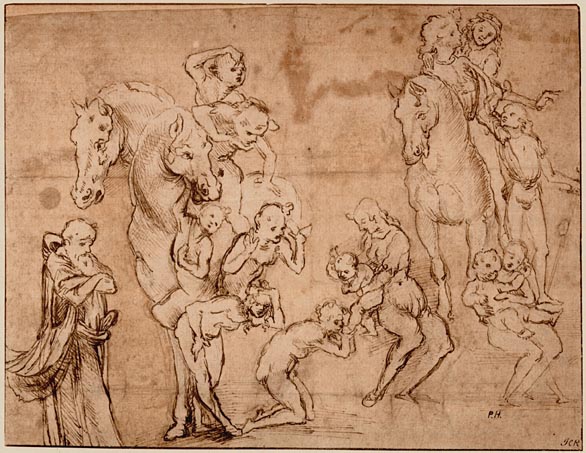
Attributed to Leonardo - Studies for the Adoration of the Magi in the Uffizi
An unknown hand has (heavily) gone over the original drawing, which was probably already very faded before the intervention with ink, so much so that one of the central figures (the man with the raised arms) has no legs. Apart from the solitary figure of the old man with the beard, the rest of the drawing shows Leonardo’s passion for “cinematic sequences”. The various characters gathered around the horse on the left seem to be successive phases of a single action. The attribution is based on the appearance of numerous figures – and horses – very similar to these in the Adoration of the Magi.
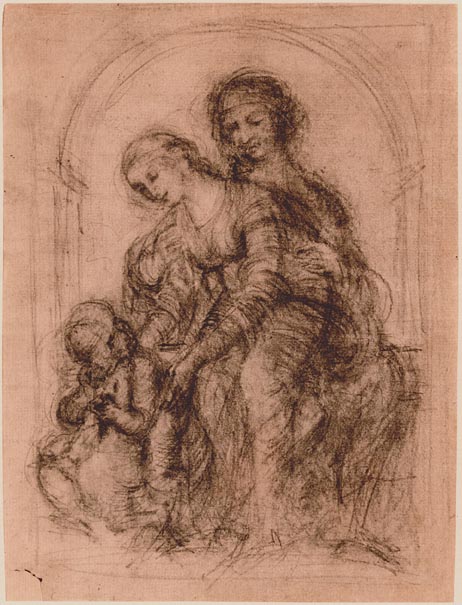
Attributed to Leonardo - Virgin and Child with St. Anne and a lamb
The group is seated below an arch or a niche. The Virgin sits on St. Anne’s knees and leans towards the Child, who embraces a lamb. The participation of one of Leonardo’s pupils is established. Apart from the head turned upwards towards his mother, the pose of the Child recalls the sketches on the sheet mentioned in entry 15 (recto). The drawing contains some references to the St. Anne in the Louvre, if the image is turned upside down and the arch is replaced with a background landscape; dated around 1501.
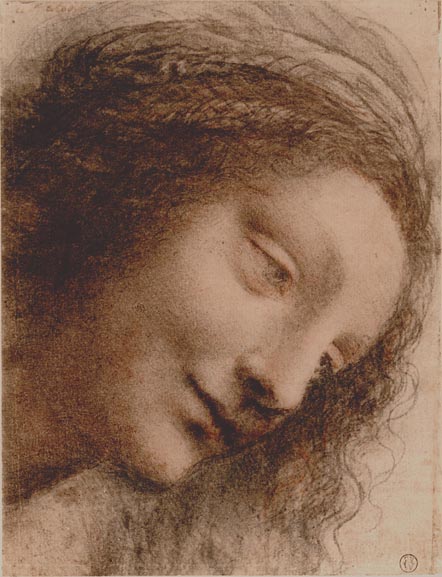
Attributed to Leonardo - Study for the head of the Virgin in the St. Anne in the Louvre
This was drawn by someone left-handed, and may be compared to the head of the Virgin in the St. Anne in the Louvre. Attribution was made difficult by major later interventions, notable above all in the outlines from the nostrils to the chin. An alternative name to that of Leonardo has been that of one of his late followers, Bernardino Lanino. For Berenson it is an autograph drawing, and dates it 1501.
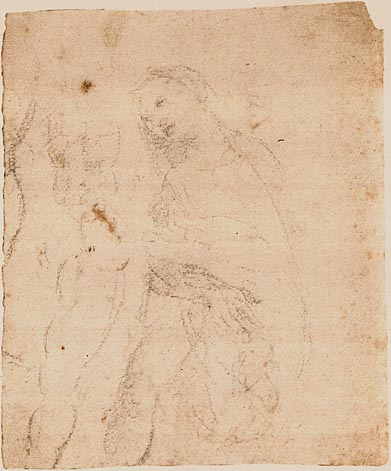
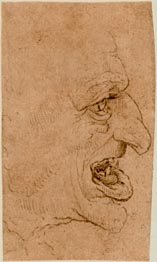
Attributed to Leonardo - Head of an old man, in profile facing right
Old man with his mouth wide open, of whom only the face is sketched, with few traces of the ear, of the hair and of the neck. The lower lip seems to hang open to show a gum swollen with inflammation and few teeth. Even the eyelid is lowered; it might be a para-anatomical drawing. Uncertain dating, early 1500s.
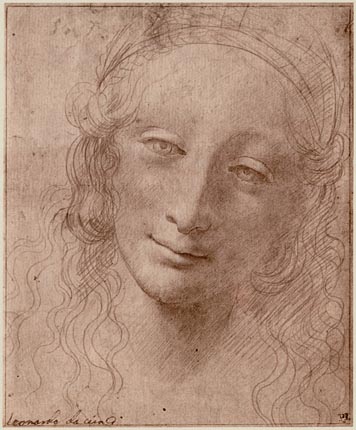
Giovanni Antonio Boltraffio (1467-1516) - Head of a woman
Head leaning slightly to the right, hair divided at the centre and flowing. All Boltraffio’s Madonnas have lowered eyes, from which it may be supposed that this drawing was a study for a portrait or for a mythological theme. Whilst the hairstyle and veil are elaborate and “drawn”, the planes of the face are left to the play of light. Datable to the end of the 1400s.
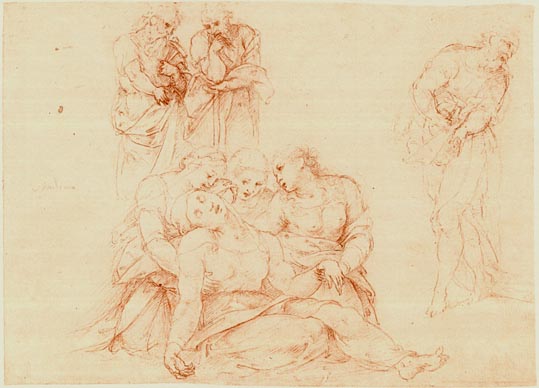
Cesare da Sesto (1477-1523) - Recto: studies for a scene of the Passion
An unconscious female figure lying on the ground is supported by three kneeling women. Above this group are two seated men, one of whom holds a hammer and a large nail; to the left, a man in motion. The most probable reference is to a Virgin before the Crucifixion. The two seated, meditating men closely recall the type Leonardo preferred for the same figures. The position of the fainting woman is strikingly reminiscent of that of Jacques-Louis David’s Death of Marat. The drawing is dated between 1515 and 1517.
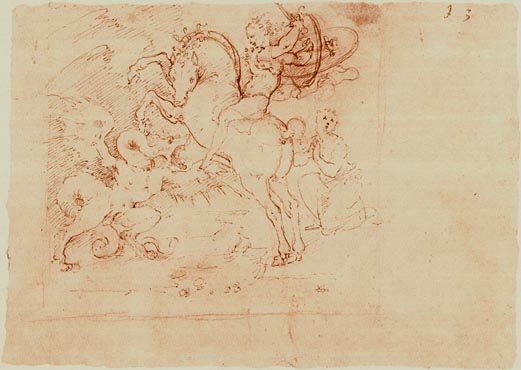
Verso of the preceding sheet: studies for St. George and the dragon
The horse’s position, apparently unnatural, is due to the attempt to capture the movement of the animal as it pulls back, terrified of the dragon; Giovanni Paolo Lomazzo, art writer as well as painter, praises the result in his Treatise on the Art of Painting (1584). The figure of the Virgin is based on Leonardesque types; note, in St. George, the double position of the arms holding the sword and the shield. Dated between 1512 and 1513.
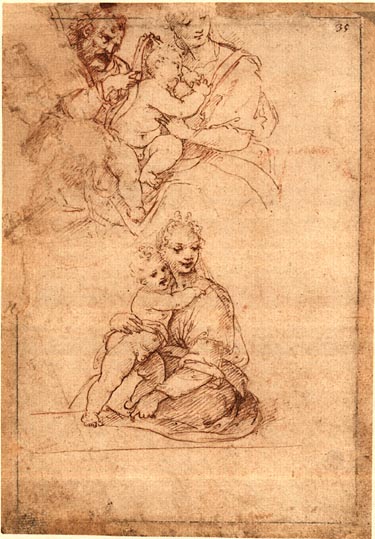
Cesare da Sesto - Studies for a Holy Family and a Virgin and Child
This drawing shows the application of one of Leonardo’s pieces of advice: “Quickly sketch the plan of your figures and first dedicate yourself to the movements appropriate to the mental state of the creatures that make up your picture, rather than to the beauty and perfection of their parts.” The position of the Child in the upper drawing recalls that in the studies for a Madonna by Leonardo kept at Windsor. The lower drawing, however, is taken from Raphael’s Madonna of the Tower; but Cesare has reconstructed it mentally rather than copied it. It is dated around 1513.
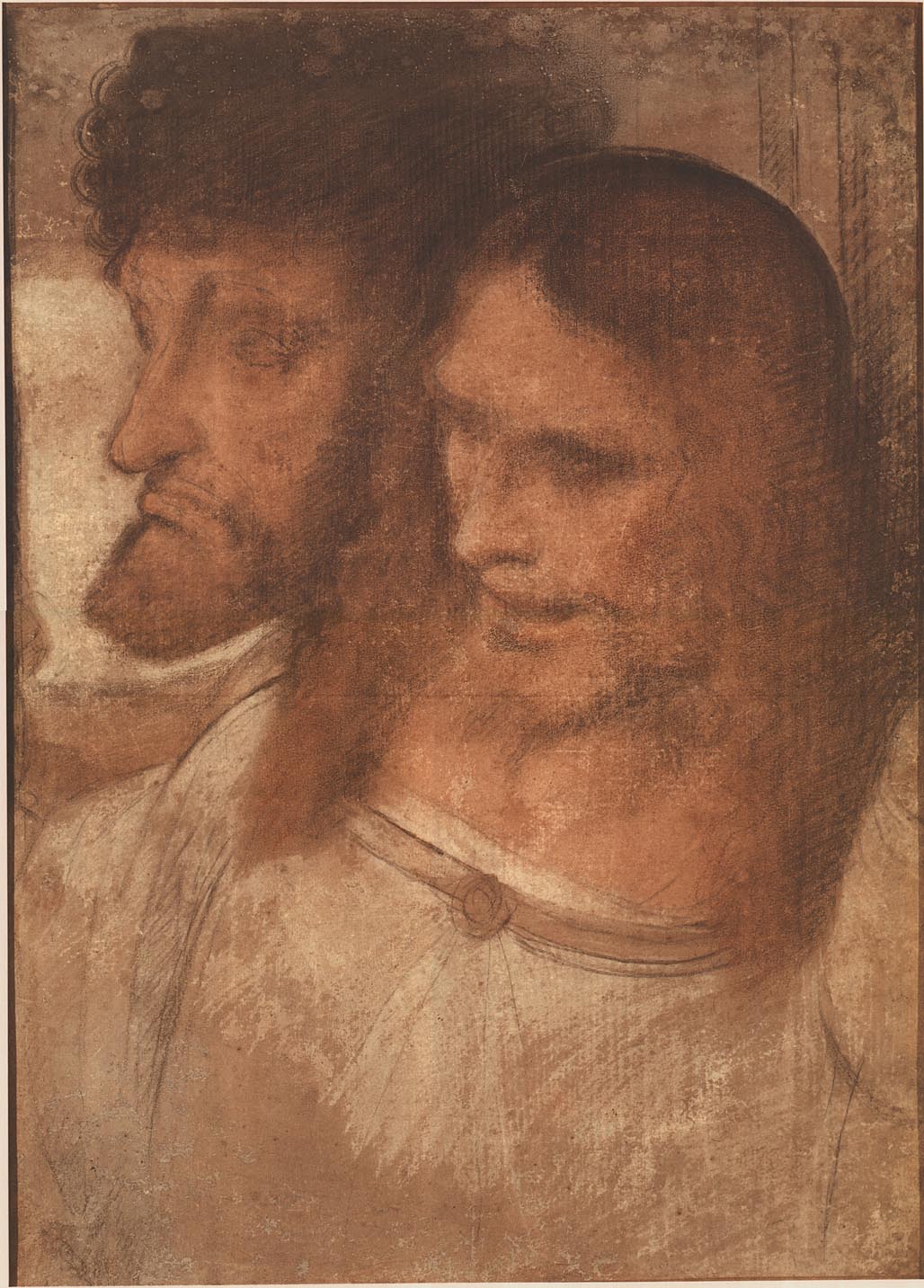
Anonymous — Anonymous - Heads of St. Thomas and St. John
This is a copy of the Last Supper. The two apostles are shown half-length; the one on the left, with a beard and short hair, has a mouth that expresses perplexity, whilst the other has long hair parted in the centre. Lomazzo, already mentioned, speaks of “excellent and miraculous” pastel drawings by Leonardo, and some critics have attributed this cartoon to him too. There is, however, no doubt that it is a copy, datable around 1500.
Anonymous — Anonymous - Head for a Virgin
Female head with lowered eyes and a veil over the forehead and hair that forms a kind of turban. The drawing is to be related to the Madonna of the Yarnwinder, on which, according to a letter by Pietro da Novellara, Leonardo was working in 1501. The turban is almost the same. It has been attributed to the school of Leonardo by Pedretti and Suida; others have put forward the names of Sodoma and Luini. Datable around 1510.
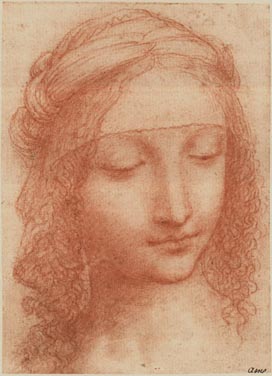
Bernardino Luini (c. 1485-1532) - Head of a young girl
Head of a young woman in three-quarter view to the right, with curly hair parted on the head and tied behind the nape of the neck. The general type derives, reversed, from that of an angel in the Virgin of the Rocks, whilst the hairstyle is close to that of a nymph in a fresco by Luini. Some attempts to restore the drawing, which is very worn, have produced imbalances such as the squint and the misplaced setting of the ears. Dated around 1523.
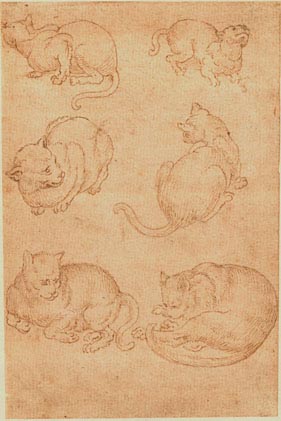
Anonymous Milanese — Anonymous Milanese - Six studies of cats
These are copies of Leonardo’s late studies of cats, which are at Windsor, probably part of a treatise on the movement of animals. The firm and almost rough line seems to be due to tracing. Pedretti attributes the sheet to Melzi; the date is uncertain, placed in the mid-1500s.
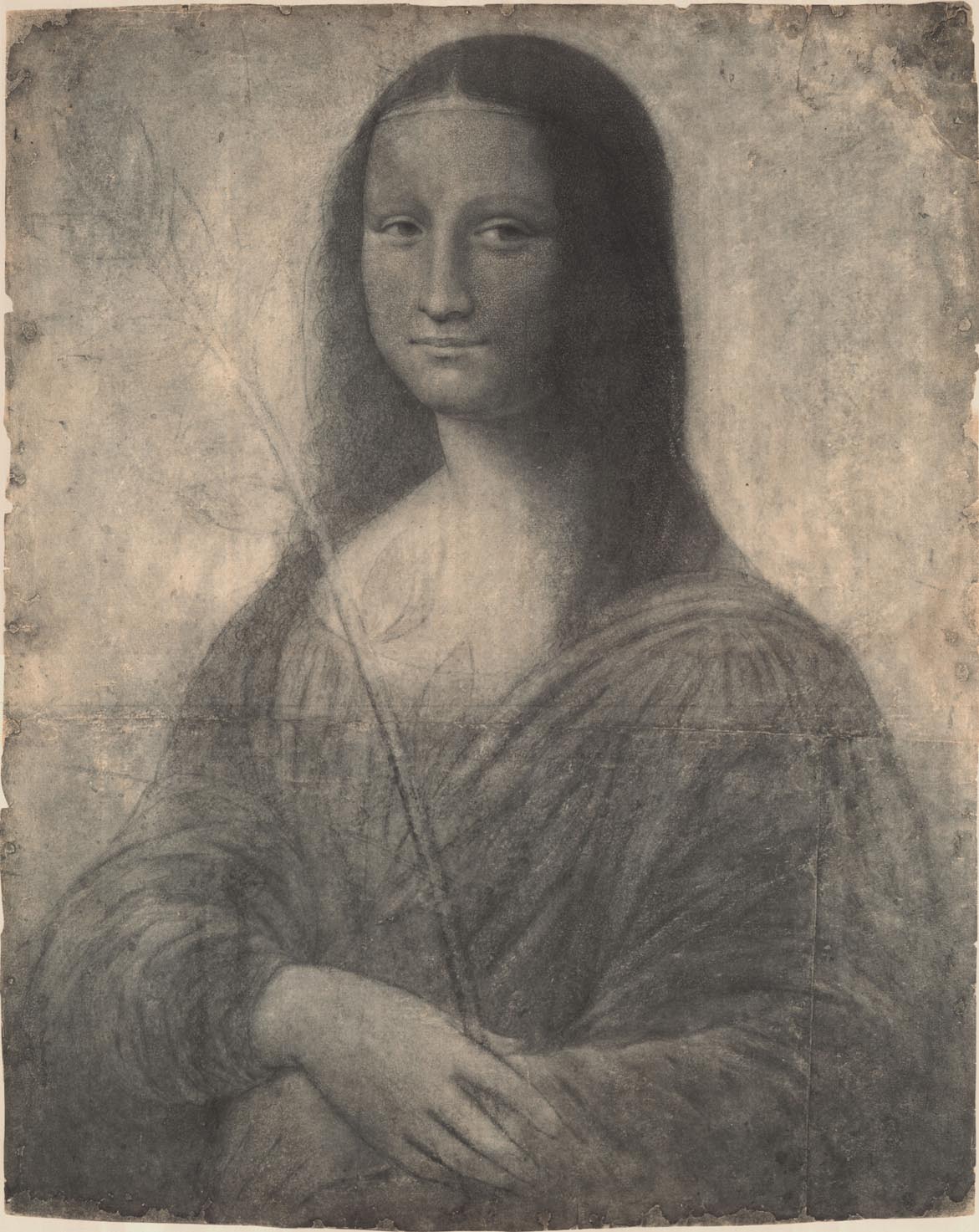
Attribution undetermined - “Mona Lisa Cartoon”
Copy of the Mona Lisa (same dimensions), apart from the absence of the background landscape and the presence of a laurel branch in the woman’s hands. Very heavy restorations warn against attributing this drawing to Leonardo; it was still being worked on in the 1800s, as the use of graphite shows. The impression that the lines were drawn by a left-handed hand may be due to the paper-making process, which used diagonal fabric as felt. Datable to the early 1500s.
Drawings by Raphael
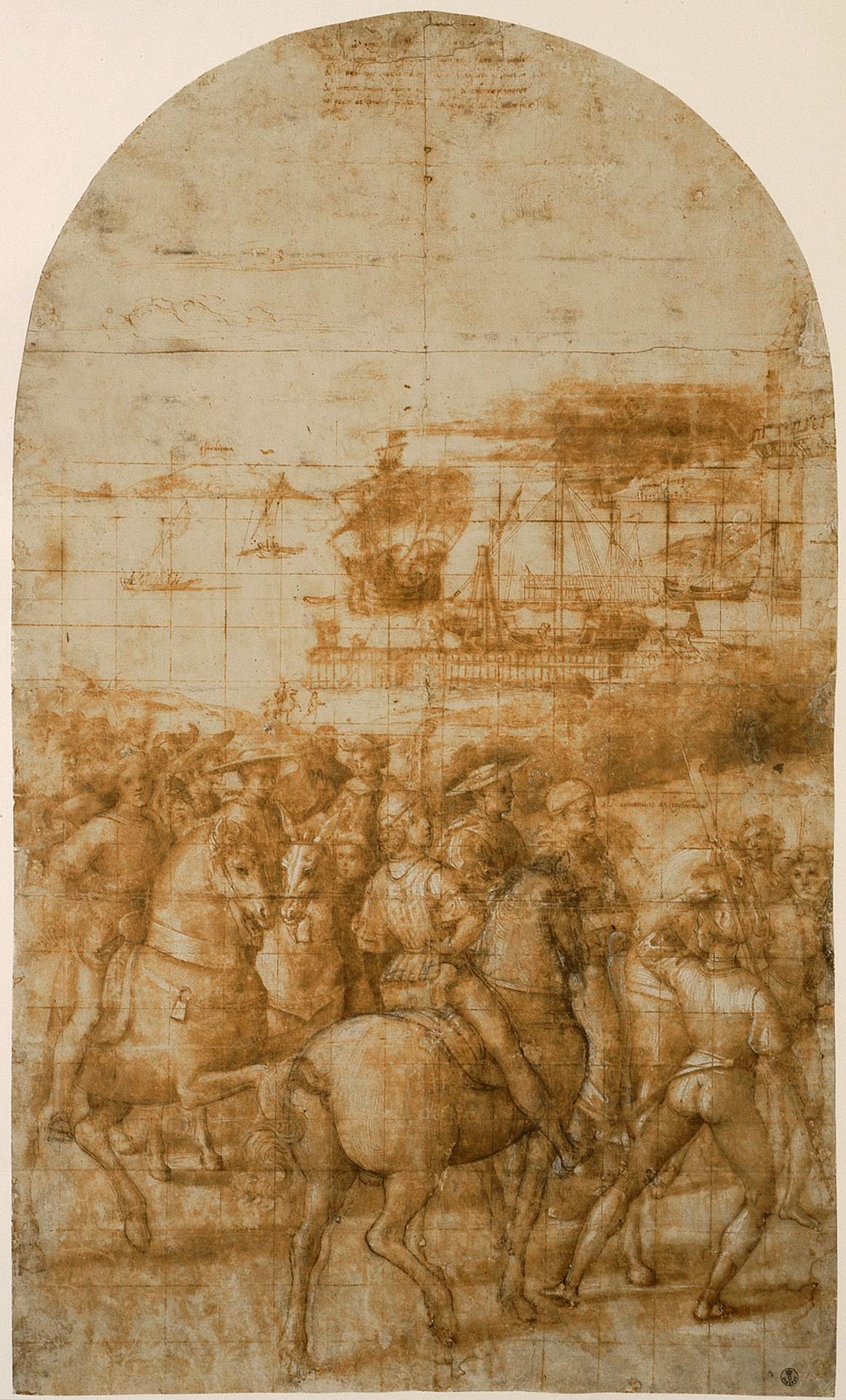
Raphael — Model for the Pintoricchio fresco depicting the Departure for the Council of Basle, in the Libreria Piccolomini in Siena
Florence, Galleria degli Uffizi Illuminating, also for the purposes of attribution, is the comparison with the work of Pinturicchio, who stifled the spatial openness of Raphael’s drawing and excessively schematised the steep walled city in the background. The costumes of the various protagonists also differ, and the rendering of the impending storm, barely indicated in Raphael’s drawing, is dramatised by Pinturicchio. The hypothesis that the drawing is a copy of the fresco cannot be upheld, so many are the structural and compositional differences, nor that it is by Pinturicchio himself, as some scholars have suggested, rejecting the account of Vasari, according to whom Raphael supplied his friend with “the sketches and cartoons” for the Siena fresco. At the top the drawing bears a long caption telling the story of the adventurous journey of Cardinal Enea Silvio Piccolomini, the future Pope Pius II, and it can be dated towards the end of 1503.
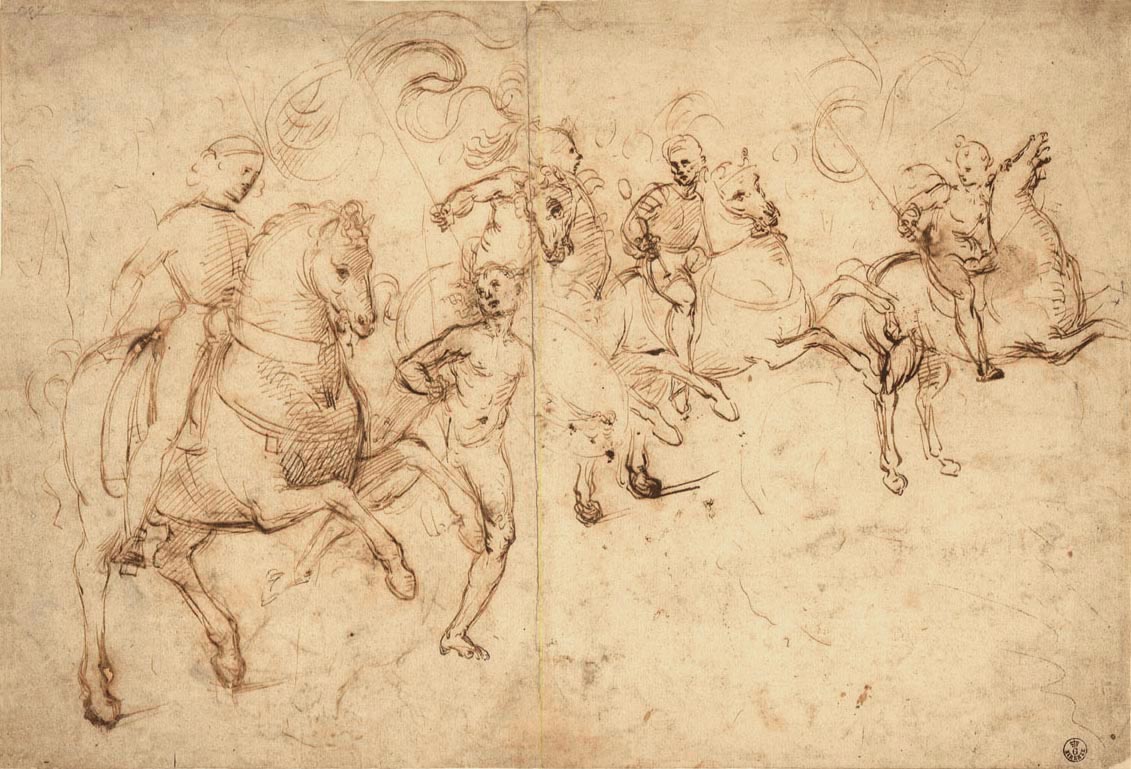
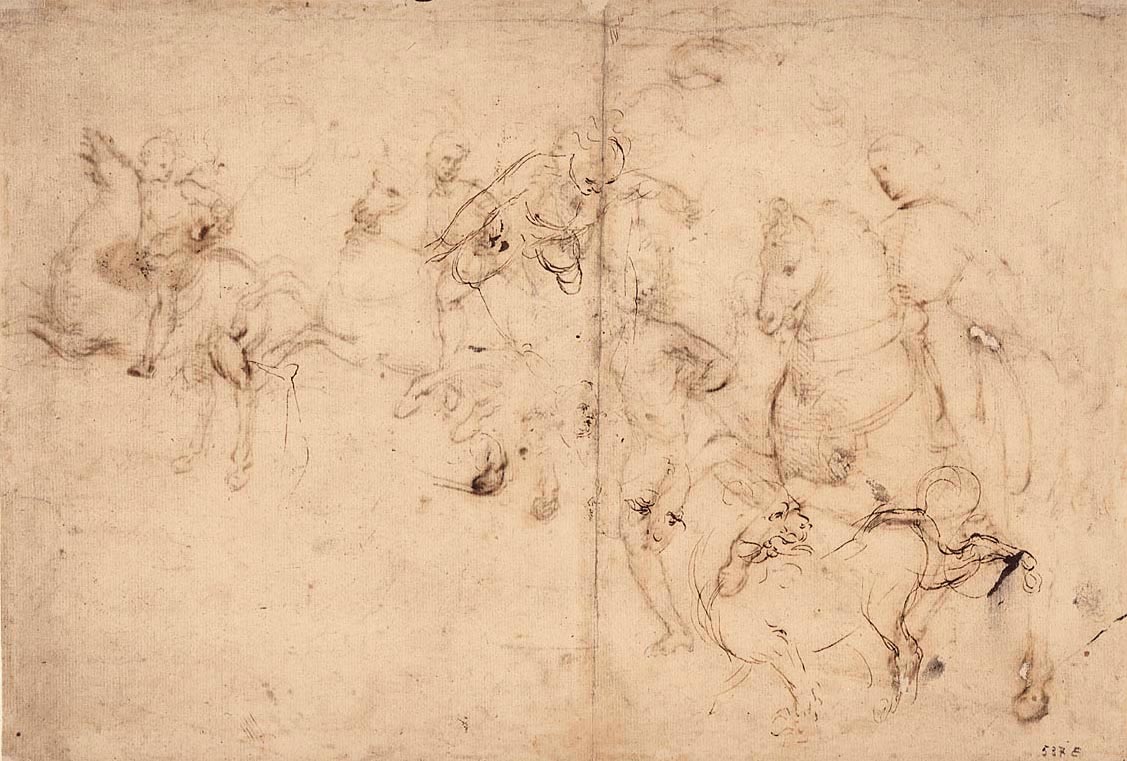
Raphael — Study of four horsemen and a foot soldier (recto)
These sketches are considered preparatory studies for the “model” of Pinturicchio’s fresco, although only the first rider on the left is identical to the one in the drawing in entry 1. The group of the rider with a running warrior beside him is taken from two figures in the background of Pollaiolo’s Martyrdom of St. Sebastian, of 1475, in the National Gallery in London; the horse on the right repeats the movement of one of the horses in the group of the Dioscuri on the Quirinal. They therefore seem to be exercises in composition and movement.
Raphael — Sketches of a reclining figure, foreshortened, of a lion and two heads (verso)
Rapid sketches that seem to be studies of bodies in movement like those that appear on the recto of the sheet; the head of the child in the centre recalls that of a Christ Child in a drawing by Leonardo for an Adoration of the Shepherds. The quality of the line, not yet fully fluid, and other considerations date this sheet between the end of 1503 and the beginning of 1504.
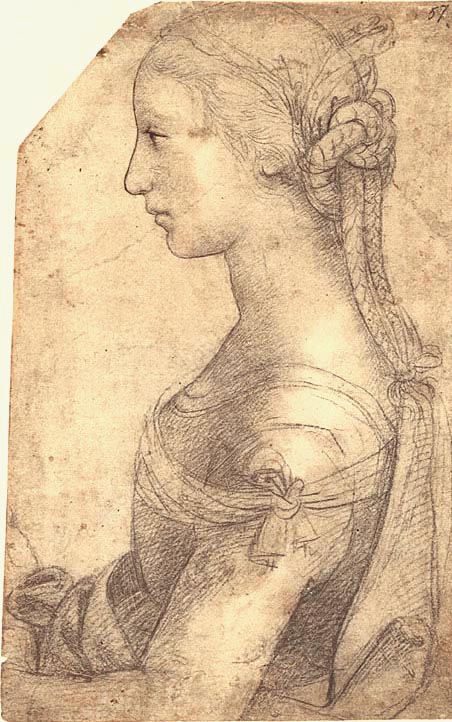
Raphael — Female bust in profile
A very meticulous drawing in the features, the hairstyle and the details of the clothing; a true portrait rather than a preparatory study, although there is a resemblance (especially in the pose) to the girl carrying the doves in the Presentation in the Temple in the predella of the altarpiece of the Coronation of the Virgin in the Pinacoteca Vaticana. Considered autograph by all scholars, it can be dated to 1504.
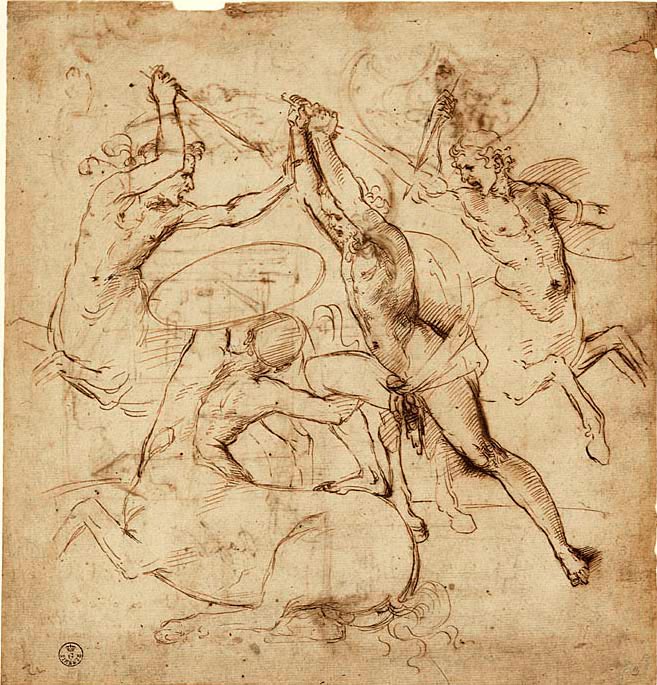
Raphael — Hercules fighting three centaurs (recto)
The outermost parts of the centaurs’ figures are only roughly sketched, and this has led to the supposition that it is a drawing taken from a hexagonal panel, probably of the school of Pollaiolo. Note the symmetrical position, almost a mirror image, of the two centaurs in the background, which recall the horse on the right in the drawing presented in entry 2.
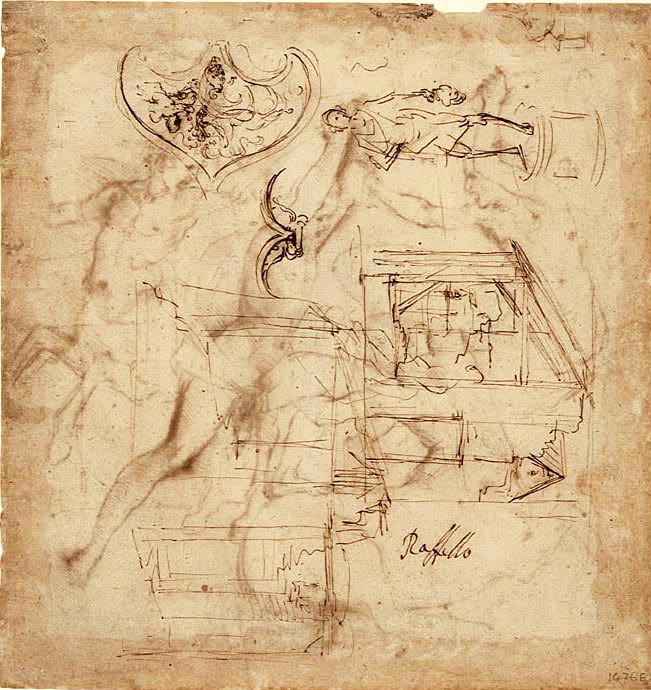
Raphael — Sketches of ruined buildings, of a statue of David and parts of the hilt of a sword (verso)
The ruined buildings may be studies for the Adoration of the Magi in the predella of the Coronation of the Virgin in the Pinacoteca Vaticana; the hilt of the sword, with a barely sketched decoration of putti on the inside, corresponds in outline to the hilt of St. Paul’s sword, again in the Coronation of the Virgin. Various scholars propose a date around 1504.
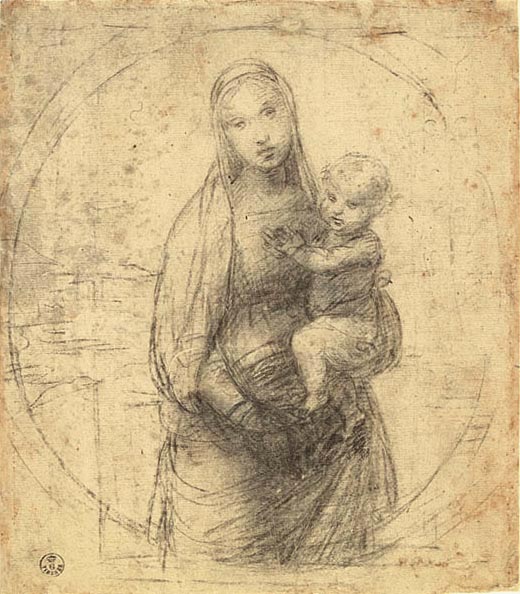
Raphael — Madonna and Child
The figure of the Virgin is framed in an oval, and in the background some farmhouses are barely sketched within a landscape. In fainter lines, barely visible, a rectangular frame is drawn that excludes the outer parts of the landscape. The drawing is a study of two possible compositional solutions for the Madonna del Granduca, now in Palazzo Pitti in Florence. The painting presents several variations: the landscape has disappeared, replaced by a dark background, relatively exceptional for Raphael; the viewpoint is no longer almost from below; the hands of the Madonna and of the Child are in different positions. Although the drawing shows some second thoughts (in the hands, for example), quite a few critics have judged it superior to the painting for its coherence and compositional simplicity, and for the very beautiful female portrait. The Madonna del Granduca was painted between the end of 1504 and the beginning of 1505, and the drawing may date from 1504.
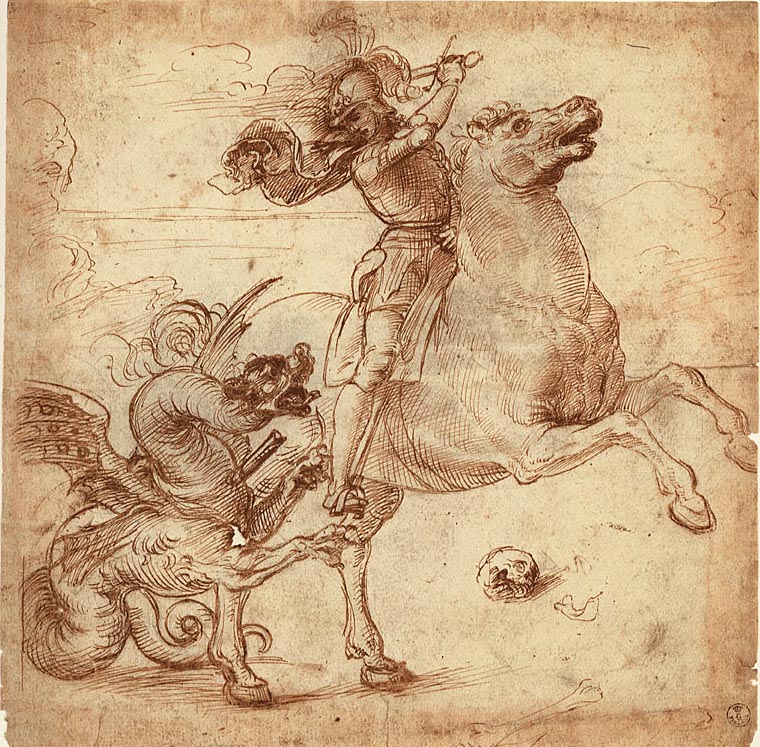
Raphael — Saint George and the Dragon
The figures of the saint on horseback and of the dragon are the same size as in the painting of the same subject in the Musée du Louvre, and the traces of pricking confirm that the sheet was used as a cartoon for the picture. The dragon is already pierced in the neck by a fragment of the lance; in the painting three broken pieces of lance will replace the macabre details of the skull and the tibia, the fleeing princess will appear and the landscape will be more carefully finished. Datable to around the first months of 1505; the attribution to Raphael has never been questioned, and the rearing of the horse once again recalls the group of the Dioscuri (see entries 2 and 5).
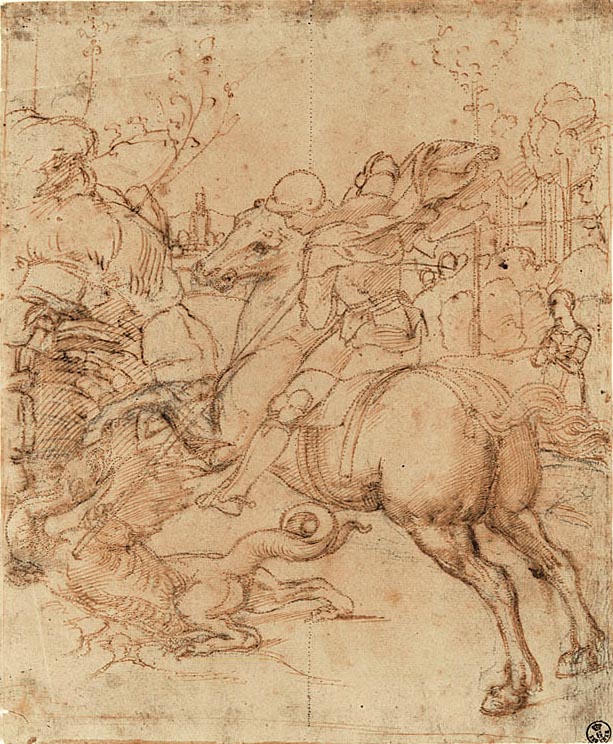
Raphael — Saint George and the Dragon
Saint George, on a rearing horse, pierces the dragon with his lance; to the right the princess is praying, set in a well-defined landscape (the Torre delle Milizie in Rome can be recognised). The pin-marking shows that the composition was transferred in its entirety to the panel now in the National Gallery in New York, although the painting shows considerable variations. The attribution to Raphael is not in question, whereas various hypotheses have been put forward for the date of the painting, and therefore of the preparatory drawing. In any case, the picture was commissioned after the conferral, in 1504, of the Order of the Garter on Guidobaldo da Montefeltro, as a gift of thanks to Edward VII of England. The garter can also be seen in the drawing, on the saint’s left leg, which seems deliberately placed at the centre of the composition; in the panel the gold ribbon bears the word “Honni”, from the motto of the Order.
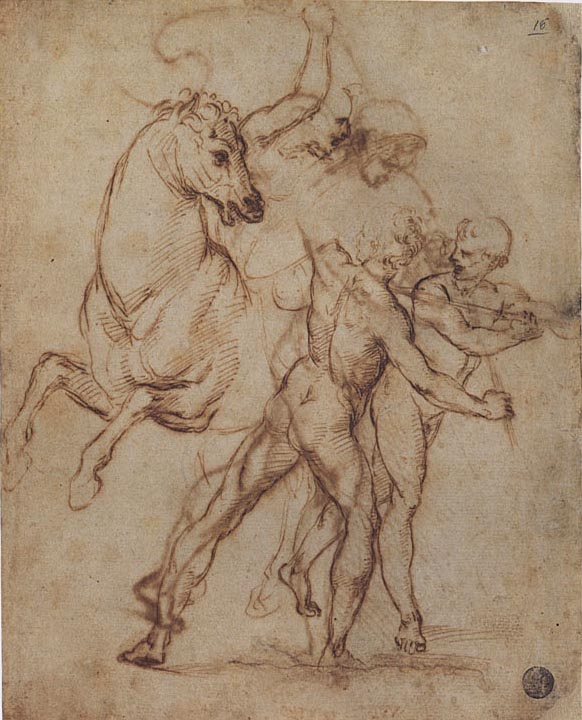
Raphael — Warrior on horseback fighting with two standing nudes (recto) Standard-bearer (verso)
Watermark with tailor’s scissors. Venice, Gallerie dell’Accademia Both drawings are connected with the so-called Siege of Perugia in the Louvre, and can be dated to around 1504-1505. The nude warriors seem to be Raphael’s response to the themes proposed in the same years by Leonardo and Michelangelo, with a very dynamic outline and a freer treatment of the nude. An interesting feature is that the figures are no longer isolated, but grouped, overlapping and interacting. The study of the horse is of much less interest, as can be seen in the reluctantly sketched head.
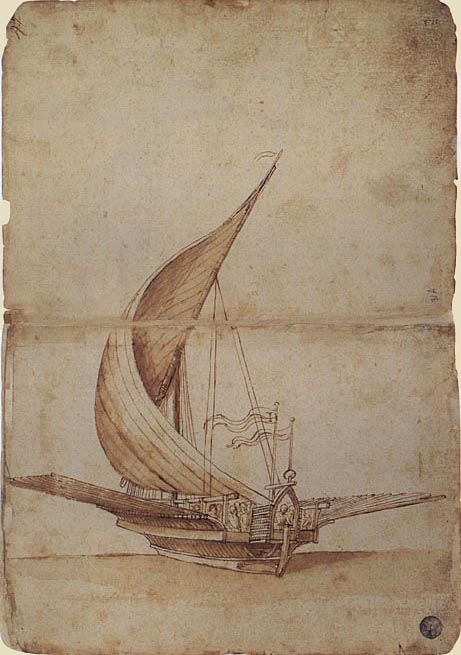
Raphael — Study of a galley Anonymous Raphaelesque artist of the early 16th century
Venice, Gallerie dell’Accademia A stock drawing, almost comic-strip-like (as in the best artists of that genre) in its precision, useful to the painters who devoted themselves to producing the front panels of chests. The connection with Raphael is rather arbitrary, but he had certainly made some himself, as is shown by a cartoon for the Libreria Piccolomini in the Uffizi in Florence.
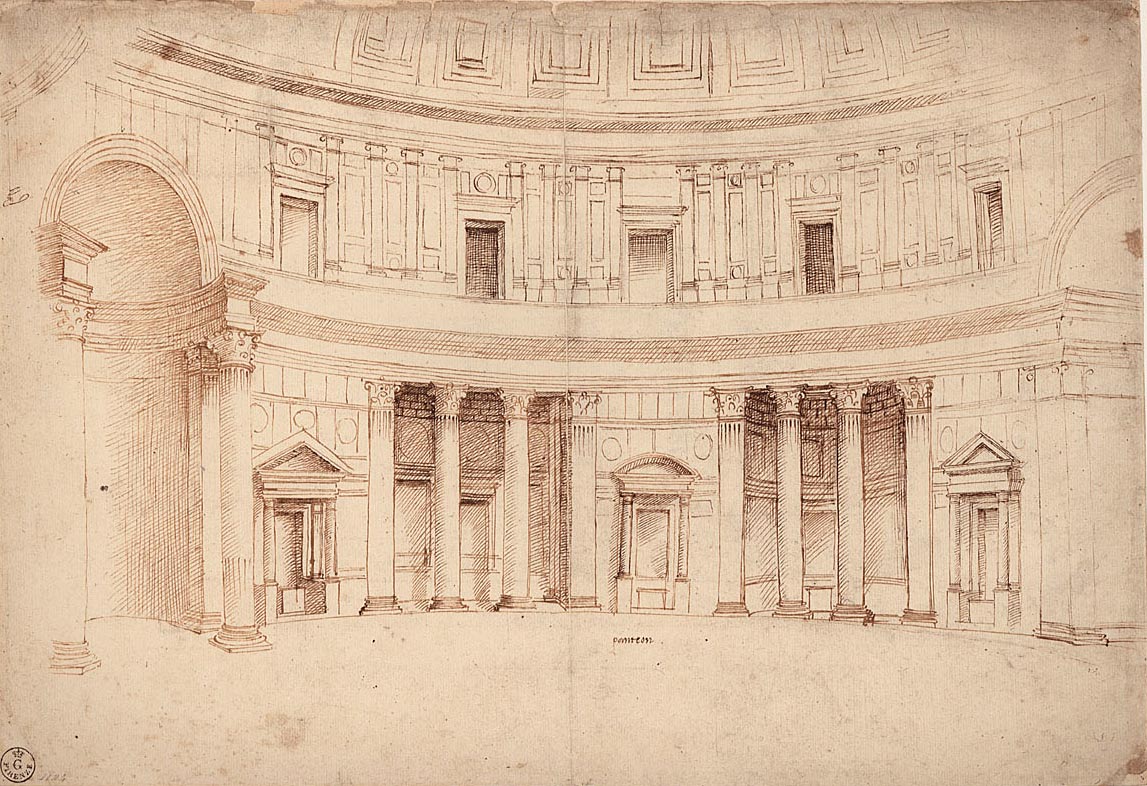
Raphael — View of the interior of the Pantheon (recto) Two different pens with different inks on white paper; folded in half vertically;
Florence, Galleria degli Uffizi The view of the interior of the Pantheon is not true to reality and has an excessively wide angle of view, such as can be obtained in photography with a wide-angle lens. This is easily explained by the presence of two different hands on the same sheet, as the different colouring of the inks also shows. Most of the drawing is by Raphael, while a second artist is thought to have added the tabernacle furthest to the right and the vestibule, also intervening in other areas of the sheet. The attribution to Sanzio has been the subject of much debate, given the many inaccuracies, but the observation about the “two hands” makes it possible to regard a large part of the drawing as autograph, datable to around 1506.
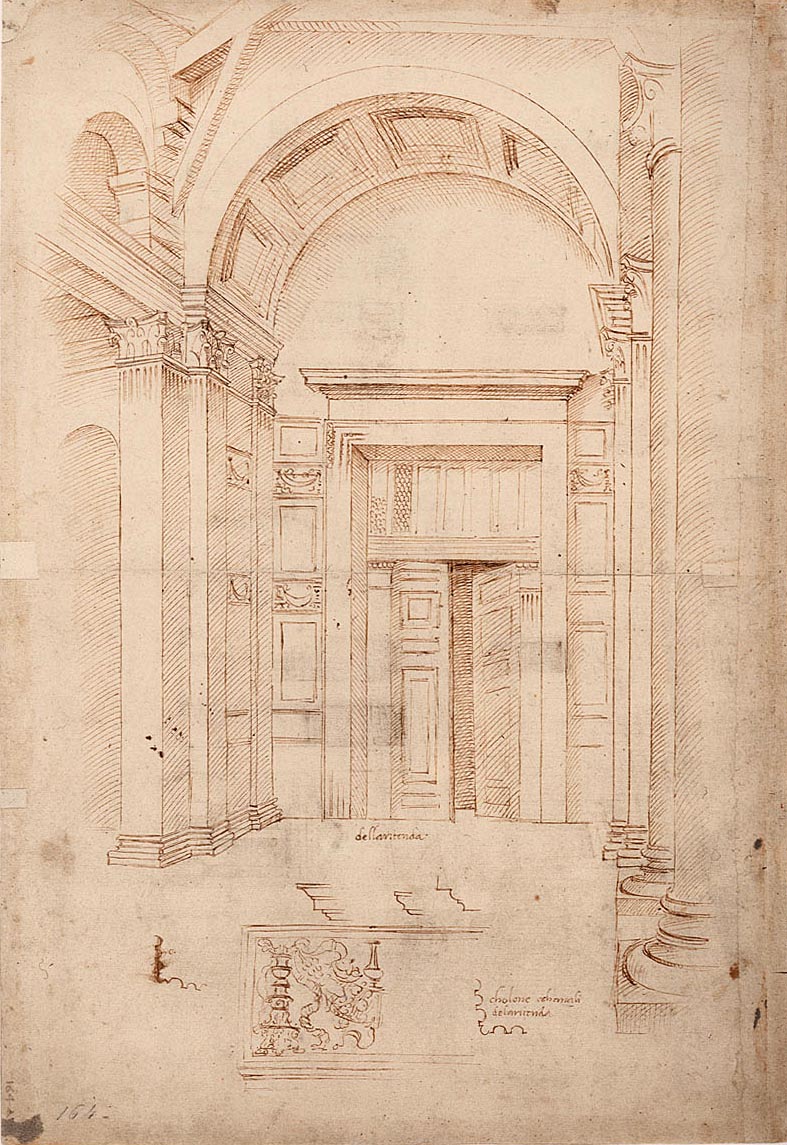
Raphael — View of the vestibule of the Pantheon (verso)
Florence, Galleria degli Uffizi The drawing seems to be a fair copy of an earlier sketch, executed not freehand but with set square and compasses. There is an inscription (“cholone a chanali dela ritonda”) written with the same pen and the same ink that traced “panteon” on the recto, considered to be in Raphael’s hand. The studies of architectural details in the lower part are sketches drawn from life
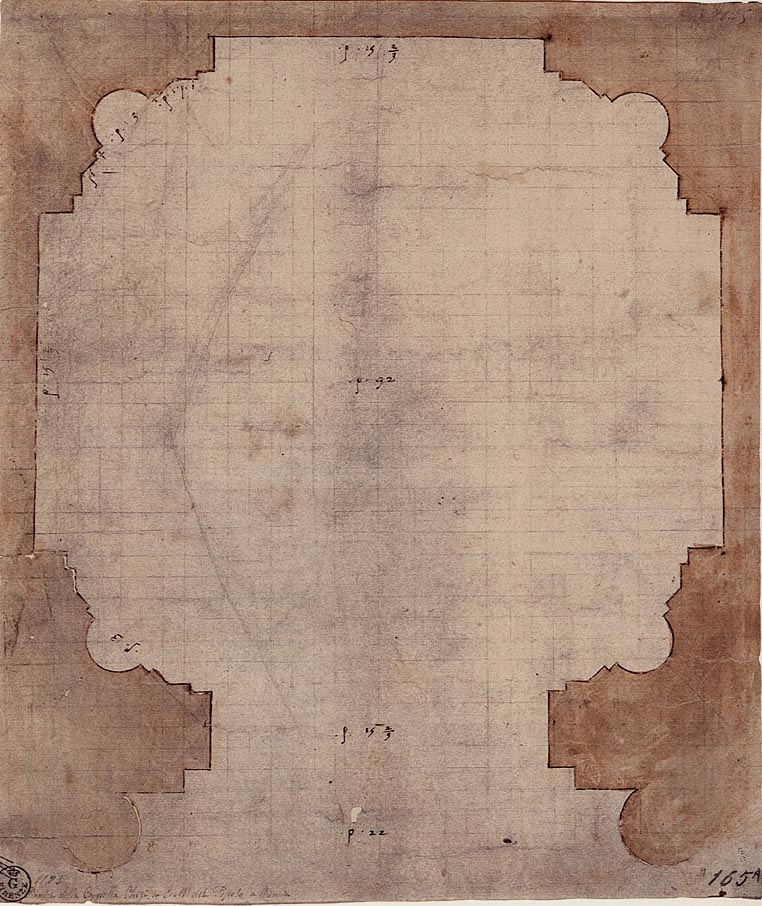
Raphael — Plan of the Chigi Chapel in Santa Maria del Popolo in Rome
Florence, Galleria degli Uffizi Placed alongside the previous drawing is this architectonic one dating from 1512-1514. The attribution of this drawing is controversial even if from the documentation and Vasari’s testimony it appears that the building was constructed and decorated following a project by Raphael. Conclusive proof comes from indication of the measurements supposed to have been written by Sanzio himself.
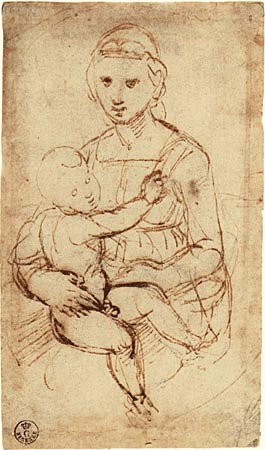
Raphael — Madonna and Child
Florence, Galleria degli Uffizi The group of the two figures, set within a hint of a circular frame visible at the top left and bottom right, appears somewhat timid and awkward. In the Virgin’s left arm a pentimento can be recognised, an extended position reaching as far as the Child’s foot. References to various works are possible, all with more differences than similarities: the Orléans Madonna, the Colonna Madonna and the Madonna del Baldacchino; but it is more likely that the drawing was a study in its own right, from which Raphael later drew inspiration for various works.
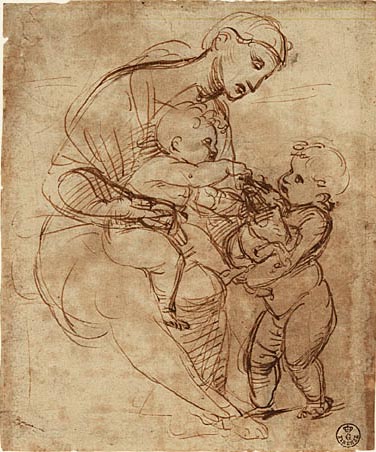
Raphael — Madonna and Child with a young St. John
Florence, Galleria degli Uffizi The Child plays with a lamb held in the other child’s arms; this is one of Leonardo da Vinci’s themes that Raphael used in various drawings and paintings from 1506-7, often emphasising the more tender and affectionate aspects of the theme. The Virgin’s face shows traces of reworking in pen that make the profile much more rigid.
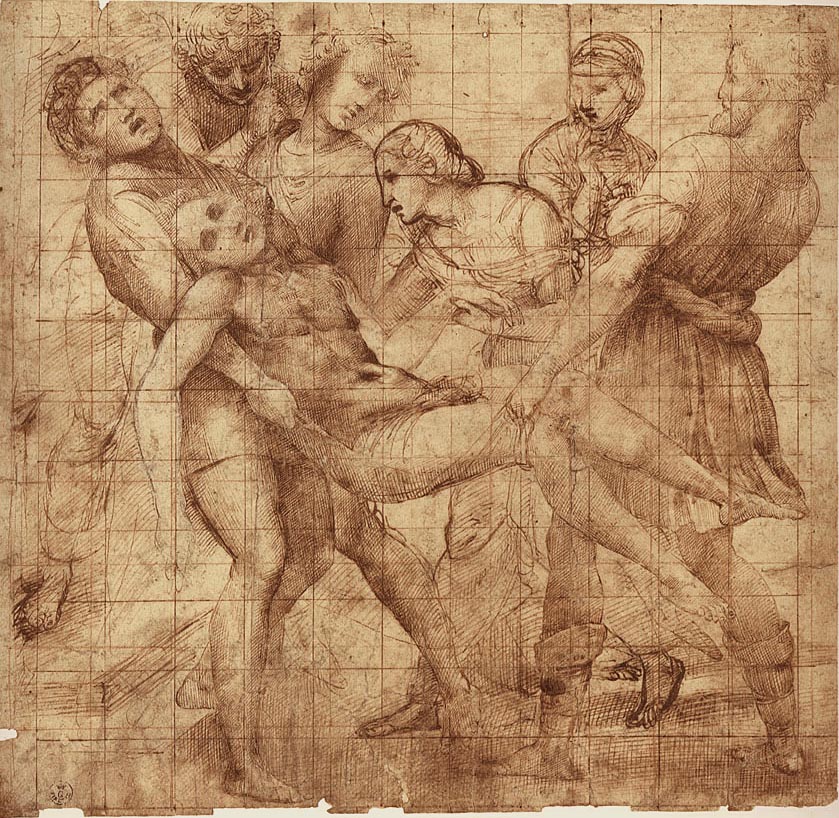
Raphael — Study for the Transport of Christ to the Sepulchre
Florence, Galleria degli Uffizi Drawing made during the last phase of the elaboration of the main group of the painting now in the Galleria Borghese in Rome, dated 1507. The Virgin supported by the holy women is missing, but the squaring shows that the drawing was by then ready to be transferred to the cartoon. Some areas are highly finished and others simply sketched, as was usual, according to the variations of light in the future painting, for drawings intended for cartoons.
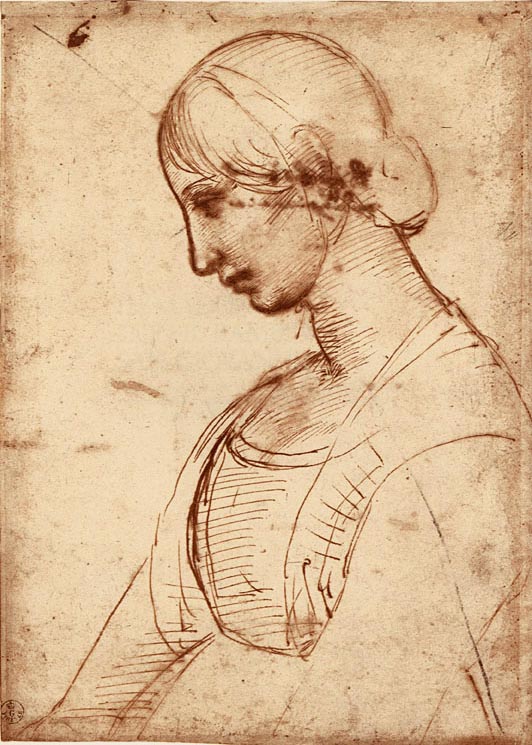
Raphael — Bust of a young girl in profile
Florence, Galleria degli Uffizi Even if some details of the hairstyle and the dress are roughly sketched, this drawing has all the characteristics of a portrait. The face might be identified as a young girl of the Baglioni family, who commissioned Raphael to paint the Transport of Christ to the Sepulchre. Apart from the inclination of the bust and the more suffering expression, this drawing repeats the figure of Magdalen on the previous folio. There has never been any discussion as to whether or not it was by Raphael. It was drawn between 1506 and 1507.
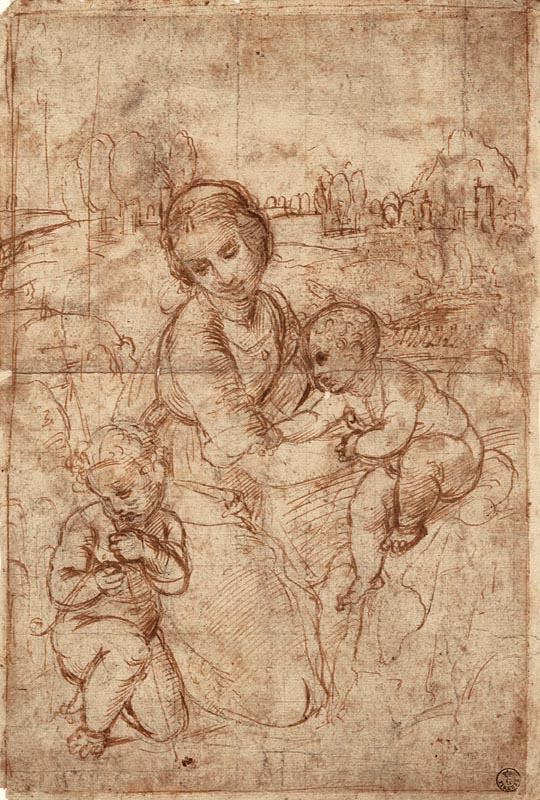
Raphael — Madonna and Child with a young St. John
Florence, Galleria degli Uffizi The three figures are composed within a pyramidal scheme enlivened by opposing rotary movements and are set in a hilly landscape, with trees and buildings only sketched in. The drawing was used as a cartoon for the Esterhazy Madonna, now in the Museum of Fine Arts in Budapest. In the painting the most significant variations are the introduction, in the landscape, of freely grouped Roman buildings, which led to the belief that the drawing too dated from the time of Raphael’s move to Rome, at the end of 1508; but the painter had already visited the city in 1506. As in other sheets, the inspiration of Leonardo is evident in the rhythms and compositional schemes.
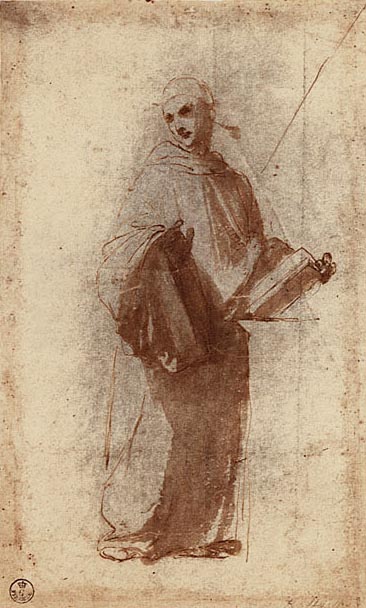
Raphael — Study for the figure of St. Bruno in the Madonna del Baldacchino
Florence, Galleria degli Uffizi The figure drawn on this sheet corresponds exactly to that of the Saint in the altarpiece known as the Madonna del Baldacchino in Florence. An excellent example of a study, at once lively and accurate, belongs to a very advanced preparatory phase, immediately preceding the execution of the cartoon, and can therefore be dated between 1507 and 1508.
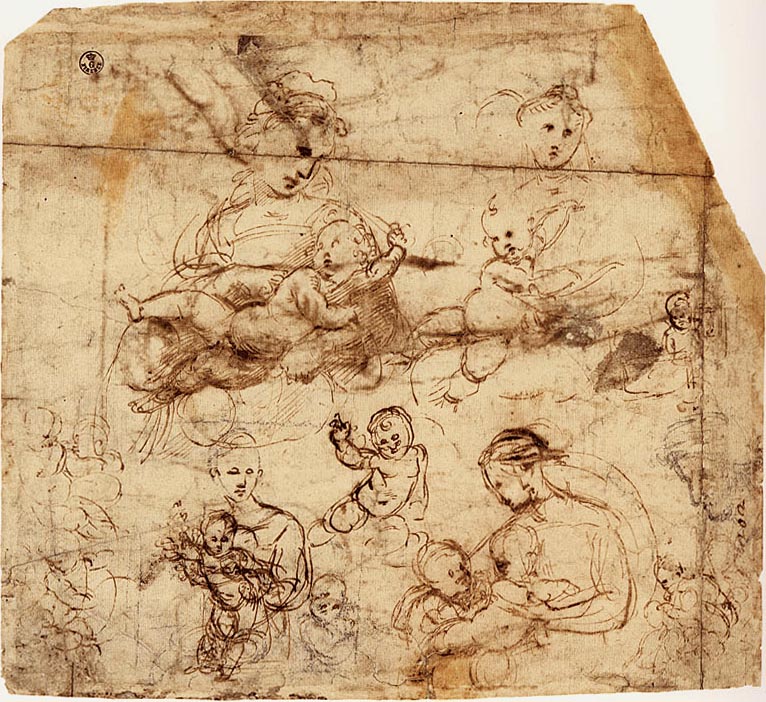
Raphael — Studies of a Madonna and Child (recto)
Florence, Galleria degli Uffizi Around the larger compositions a host of sketches develop and intertwine, making the reading of this sheet a pleasant undertaking. The group of the Madonna and Child with the young St. John, at the bottom right, recalls Michelangelo’s Taddei Tondo, with the motif of the Child drawing back almost in fright before the little Baptist, who clutches a goldfinch in his hand. Many sketches are variants or modified details of the same theme.
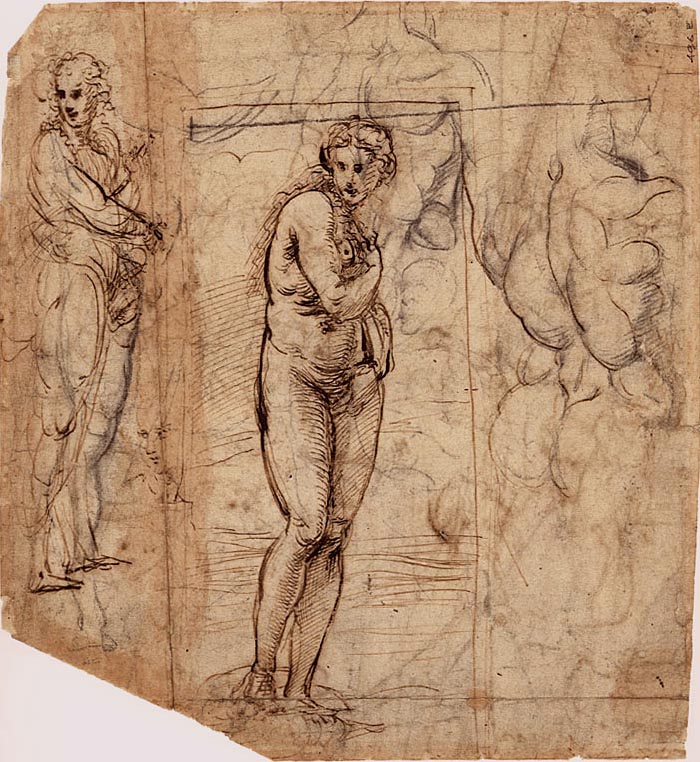
Raphael — Studies of a figure of Venus, of a figure for the Disputation of the Holy Sacrament, of a small head and a male torso (verso)
Florence, Galleria degli Uffizi Most critics agree in attributing these drawings too to Sanzio; they were formerly considered the work of one of his pupils who, according to Fischel, had “mangled” the master’s inventions. The Venus rising from the waters, against the background of a seascape, may be taken from the statue of the Medici Venus; the lower part of the body reappears in the Eve of the Original Sin frescoed in the Stanza della Segnatura in the Vatican.
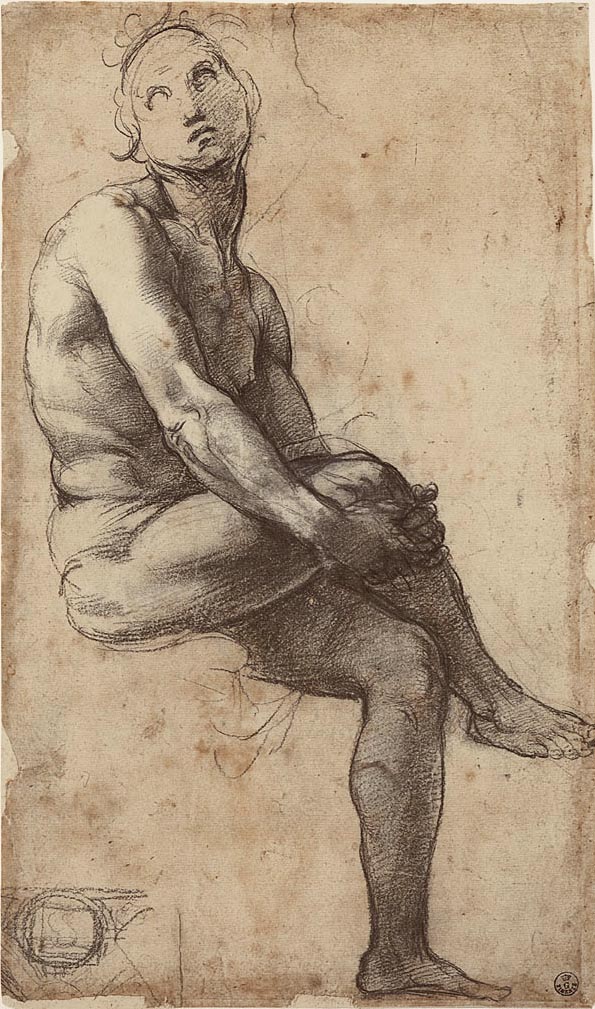
Raphael — Study for the figure of Adam in the Disputation of the Holy Sacrament and small architectural sketch (recto)
Florence, Galleria degli Uffizi The nude figure is a preparatory drawing for the fresco of the Disputation of the Holy Sacrament in the Stanza della Segnatura in the Vatican, and precisely for the second figure from the left. The use of a soft black pencil made possible a precise modelling rich in chiaroscuro effects, with very carefully rendered anatomical details. It must have been executed at an advanced stage in the preparation of the cartoons for the fresco, and therefore around 1508.
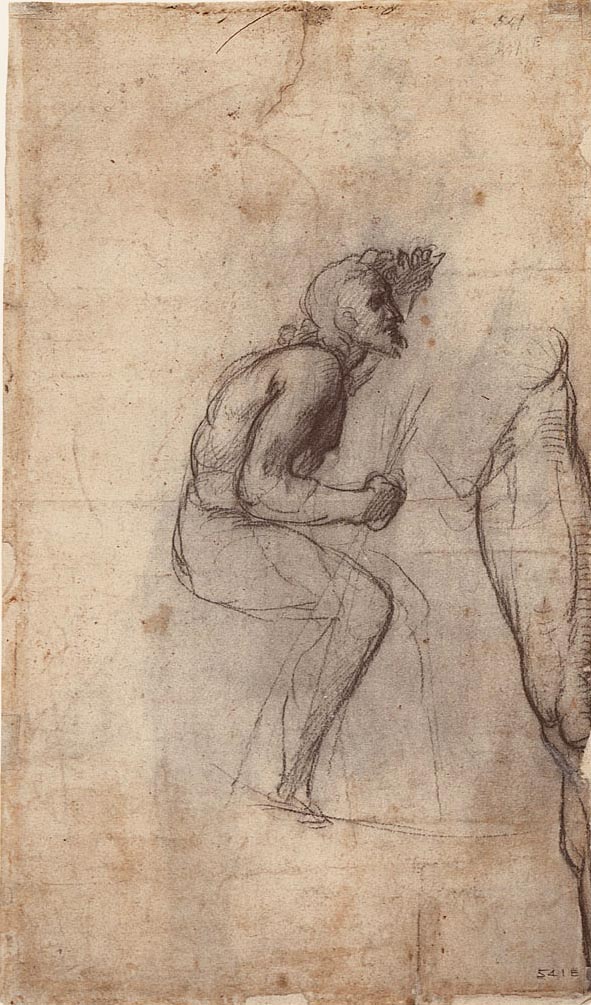
Raphael — Study of a seated figure and a leg (verso)
Florence, Galleria degli Uffizi The seated figure holds a stick, sketched from three different angles, and shields its eyes as if not to be dazzled. Together with the study for a leg, reveals clear Leonardesque origins.
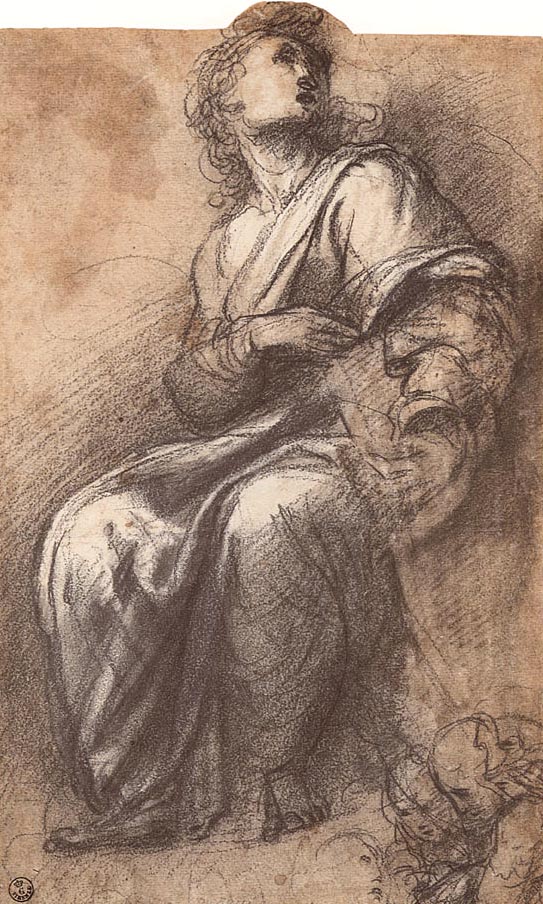
Raphael — Study for a figure in the Disputation of the Holy Sacrament and sketches of heads
Florence, Galleria degli Uffizi In the fresco the saint (fifth figure from the right in the upper tier) has been identified both with St. Stephen and with St. Lawrence. The drawing is accurate as regards the pose and attitude of the saint, but differs greatly from the final figure in the clothing and the position of the hands. The heads drawn at the bottom could be sketches for the angels that appear among the clouds at the saints’ feet in the fresco.
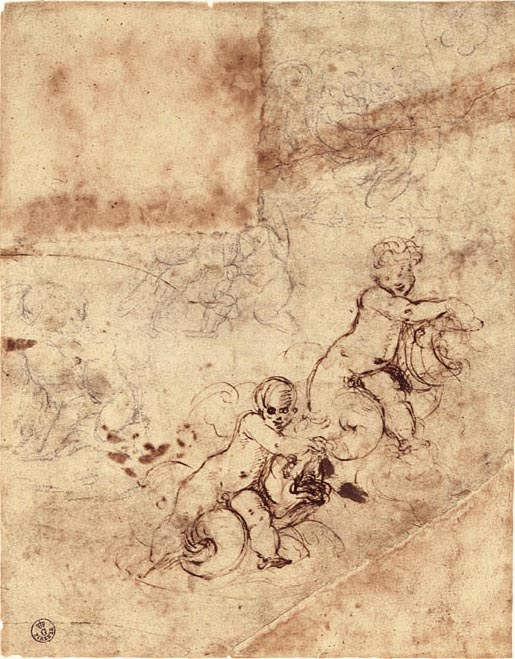
Raphael — Study of putti with an eagle and a dolphin (recto)
The heaviness of the pen studies almost prevents the reading of the pencil sketches, drawn with a lighter hand and worn by time. These are the most interesting, visible by looking carefully diagonally from top to bottom and from left to right. The dolphin whose jaws the putto holds wide open could also be a mythological dragon. It is believed that these sketches were intended for the making of a fountain for the garden of the Villa Chigi.
Raphael — Architectural studies and figures of putti (verso)
The drawing confirms the hypothesis of the previous entry concerning the Villa Chigi: it shows architectural studies with measurements in which the plan and section of the Chigi Stables have been recognised.
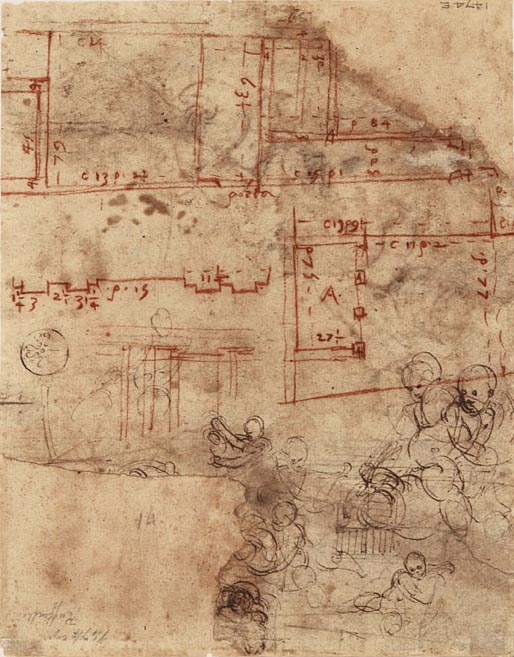
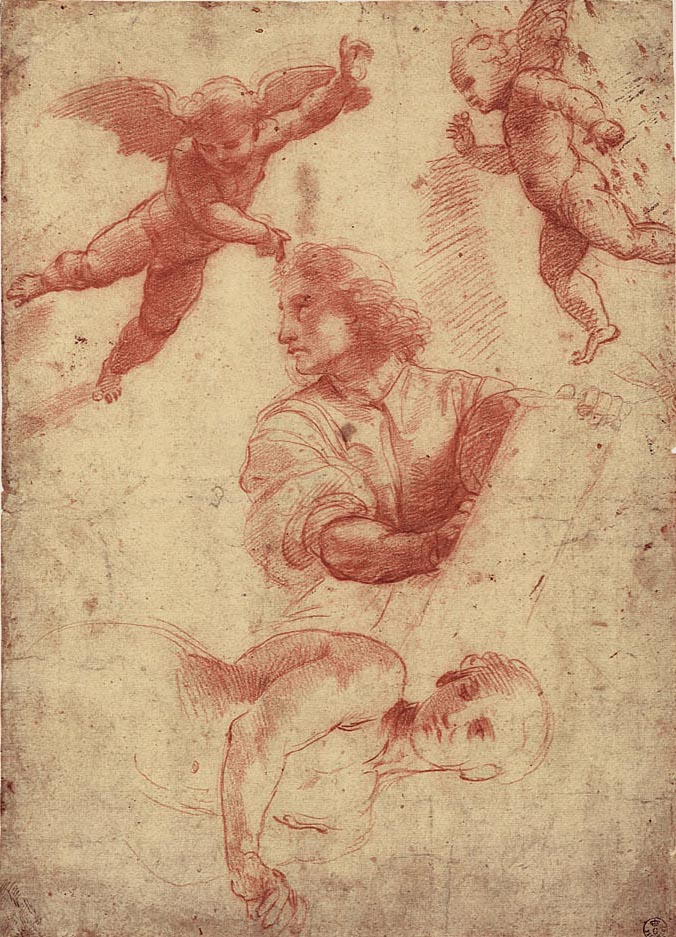
Raphael — Studies for the frescoes in the Chigi Chapel in Santa Maria della Pace in Rome
The figure in the centre of the sheet is a study for the prophet Daniel, faithfully reproduced in the fresco. Even the other figure and the two angels appear in the upper part of the fresco in Santa Maria della Pace. Note the intensive use of the paper, with the figure drawn crosswise.
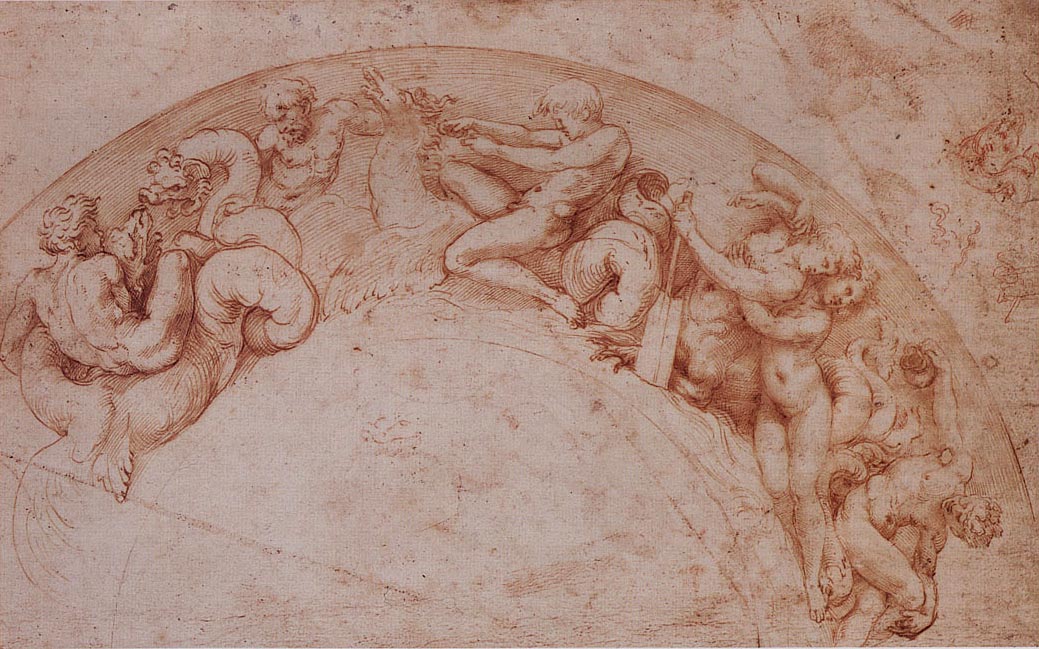
Raphael — Study for the border of a plate
The scene depicts tritons, nymphs and sea creatures. There is fighting among animals and between humans and animals, while the nymph clings to the shoulders of a triton holding a paddle. The plate was intended to be made in bronze; the thin curved lines indicate the areas without relief, while the muscular figures (or sinuous ones, like the nymph) have firm outlines and sharp shading. Some have seen, besides Raphael’s hand, that of an assistant too, but there is no doubt about the attribution to Sanzio. Datable to 1511-1512.
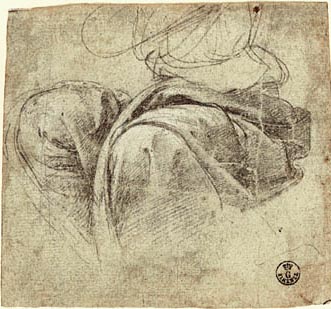
Raphael — Study of drapery
Although the technique used for this drawing is rather unusual for Raphael, and references to specific works are lacking, critics are almost unanimous about the attribution. It is not known whether it is a preparatory work or an exercise, perhaps taken from Michelangelo’s Persian Sibyl in the Sistine Chapel. The effects of light and the hint of movement in the whole figure are interesting. The date proposed is 1512.
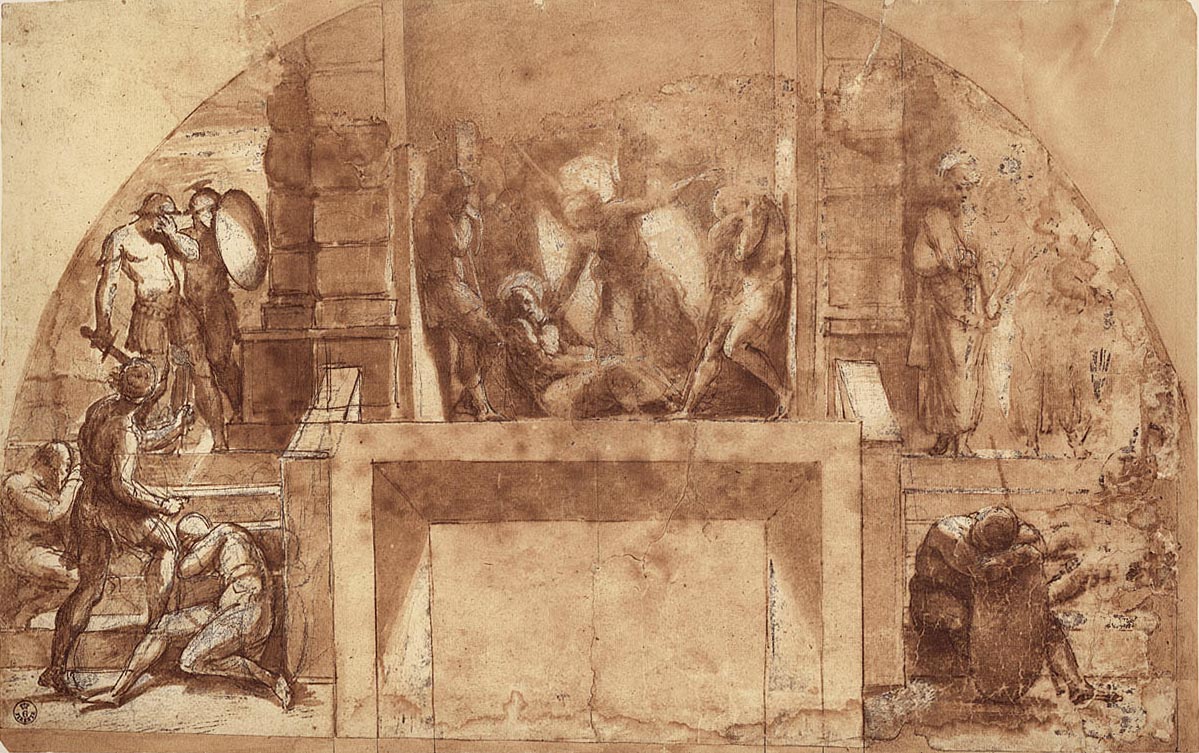
Raphael — Model for the Liberation of St. Peter from prison
Model presenting numerous variations with respect to the fresco in the Stanza di Eliodoro in the Vatican. The drawing also shows several pentimenti, particularly in the figures of the soldiers and in the light sources. The dating is uncertain: 1511 has been proposed, but also 1513, the probable year in which the fresco was painted. The model would be a reworking of an earlier project, closer to the one used for the cartoon of the Liberation of St. Peter.
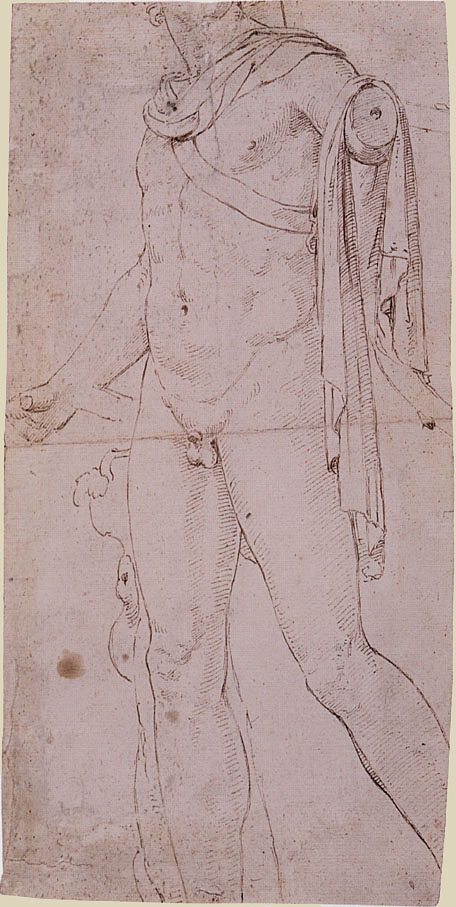
Raphael — The Apollo Belvedere (recto) View of the Belvedere spiral staircase (verso)
The drawing on the recto has been attributed to a “follower of Raphael” and also to Giulio Romano. Today it is considered an original; it is not complete, having been cut on all four sides. The Apollo appears in the condition prior to the restoration of 1522-23, which restored the right hand. With great economy of line the complexity of the musculature is rendered and the idea of movement suggested, and this ability is typical of Raphael, whereas Giulio Romano tends to draw flat, undynamic figures. Moreover, Sanzio often drew inspiration from classical statues for his compositions. The fine glimpse of architecture on the verso (partially reproduced) captures the staircase at the point where the columns pass from the Ionic to the Composite order. Datable between 1513 and 1515.
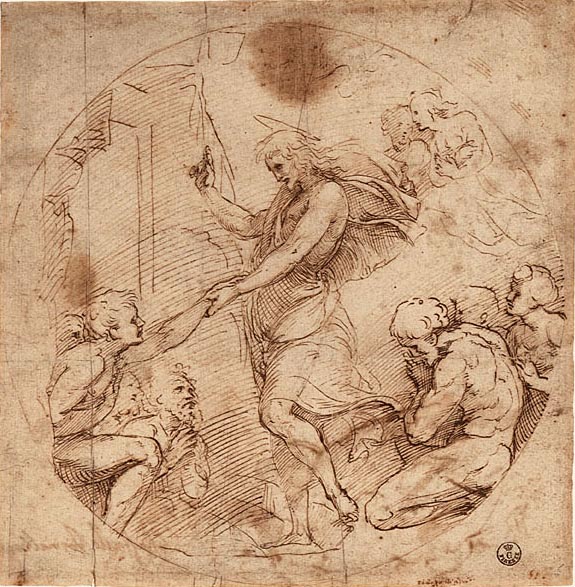
Raphael — Descent of Christ into Limbo (recto) Study of a male torso (verso)
Florence, Galleria degli Uffizi The drawing on the recto is a model for a bronze relief intended for the Chigi Chapel in Rome, but which ended up in the Abbey of Chiaravalle near Milan. As in the sketch for the plate in entry 23, the curved lines indicate the areas without relief; the musculature of the figure in the right foreground appears particularly carefully drawn. The torso drawn on the verso is probably taken from an ancient statue. At the bottom left there is an inscription in pen: “Raffaello originalissimo”. The sheet can be dated to around 1514.
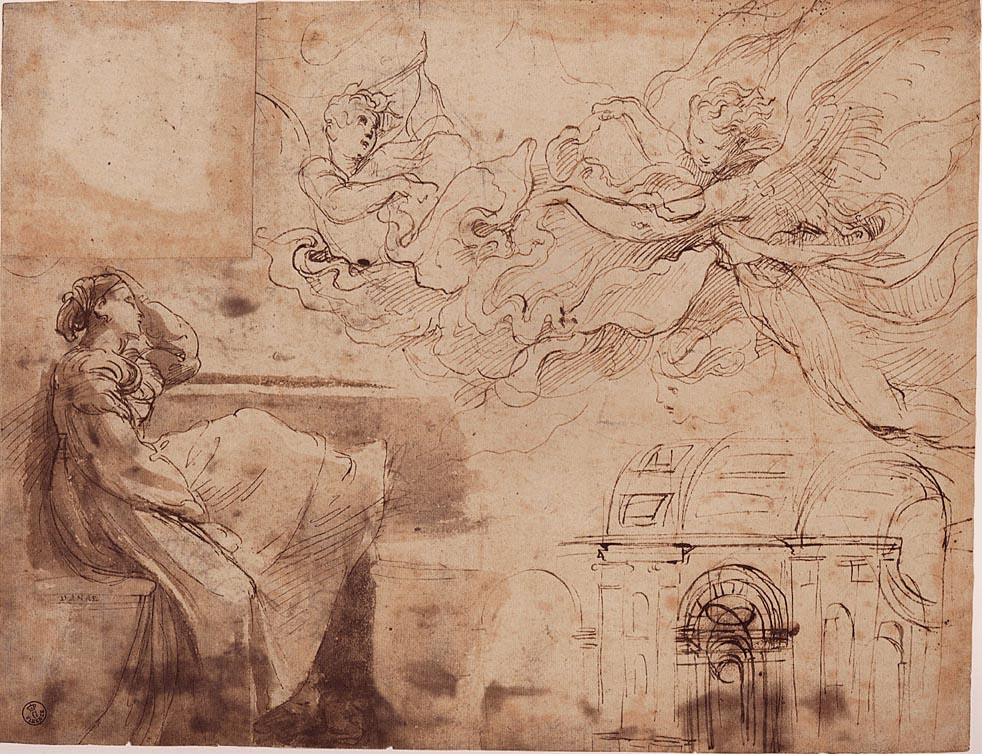
Raphael — Studies of a sleeping woman, of flying angels and architecture (recto)
It may be a study from life, with the model in a pose inspired by a funerary stele. Paolo Veronese drew on this drawing for his Vision of St. Helena. The flying angels correspond to those that appear in the Burning Bush, while the architectural sketches at the bottom right are a study for the nave of St. Peter’s, with its coffered vault. Raphael was appointed architect of St. Peter’s in 1514, and the drawing is to be dated to that year.
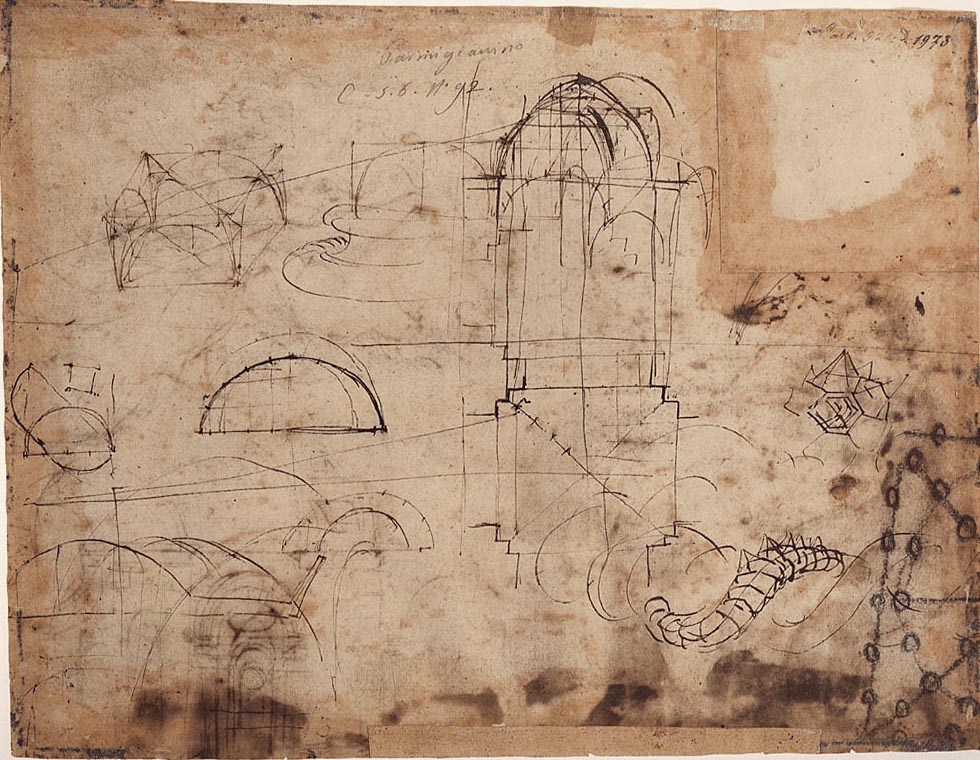
Raphael — Architectural sketches and decorative motifs (verso)
They are sketches of arches, vaults and architectural details, to be connected with the work on the basilica of St. Peter’s.
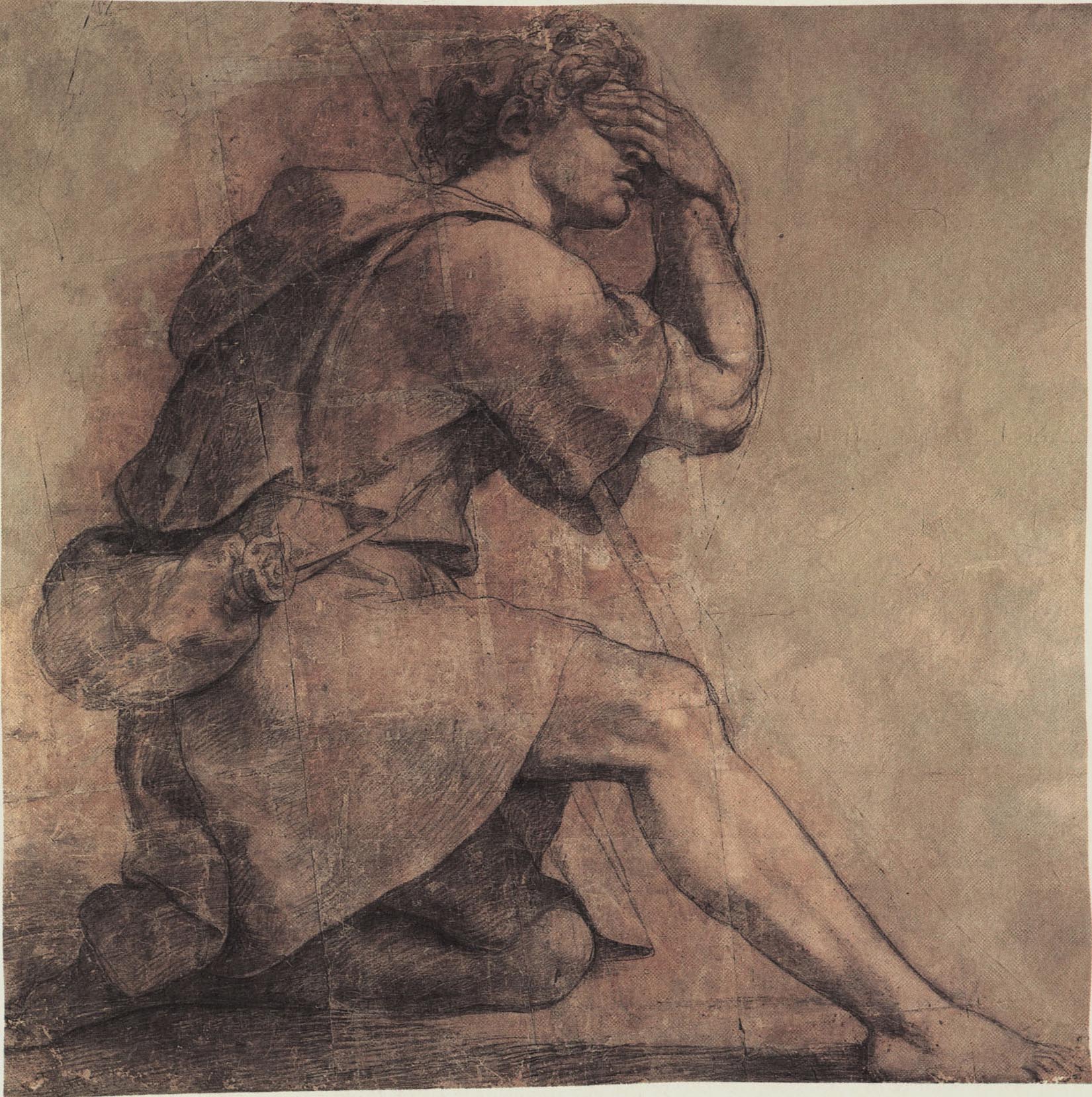
Raphael — Moses and the Burning Bush
Fragment of the final cartoon, ready to be transferred onto the plaster of the fresco in the Stanza di Eliodoro in the Vatican. The drawing has been slightly damaged by a restoration, and although it has been attributed to various artists, it is today recognised as an autograph work by Raphael: clear, incised outlines, soft chiaroscuro with areas highlighted with the lead point. Datable 1513-14.
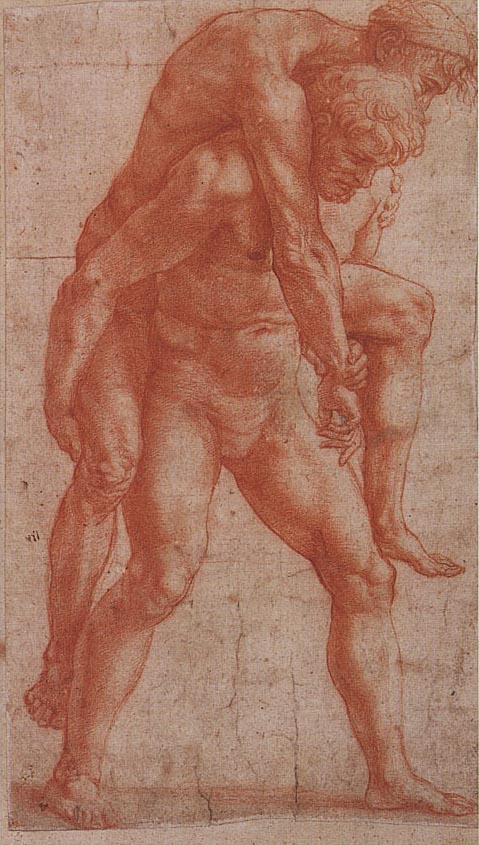
Raphael — Young man carrying an old man on his shoulders
Vienna, Graphische Sammlung Albertina Study for the group of Aeneas and Anchises in the fresco of the Fire in the Borgo in the Vatican, in the room of the same name. The sanguine, although used in thick strokes, omits no detail of the young body of Aeneas or of the doubly decrepit one of Anchises. The intertwining of arms and legs suggests a portrait from life. Few doubts about the attribution (only some suggestion of a possible copy after the fresco); around 1514.
Raphael — Young nude grasping a wall
Vienna, Graphische Sammlung Albertina At the bottom left appears the inscription (not autograph) “Rafaello”. Study for a figure in the act of lowering himself from a wall, as found in the aforementioned Fire in the Borgo. For this drawing too it has been argued that it was a copy after the finished fresco, from which it differs especially in the facial expression; but for originality of line and force of movement it is judged almost unanimously to be autograph. Datable to around 1514.
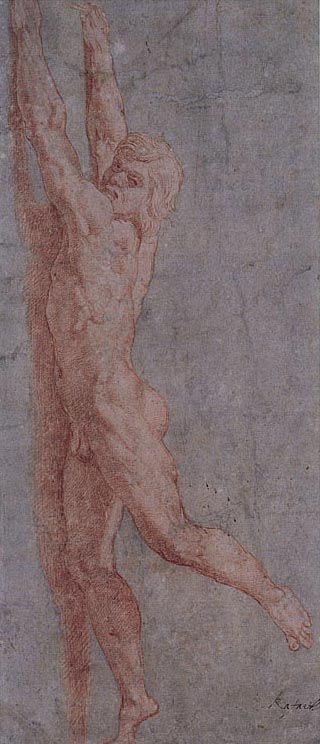
Raphael — Two women with a child
Study for a group of figures placed at the centre of the fresco of the Fire in the Borgo. The child is merely sketched in, and this has suggested the work of a pupil based on a preparatory sketch by Raphael. Compared with the two previous drawings (entries 37 and 38), this one is less detailed and shows numerous pentimenti, as well as differences from the fresco.
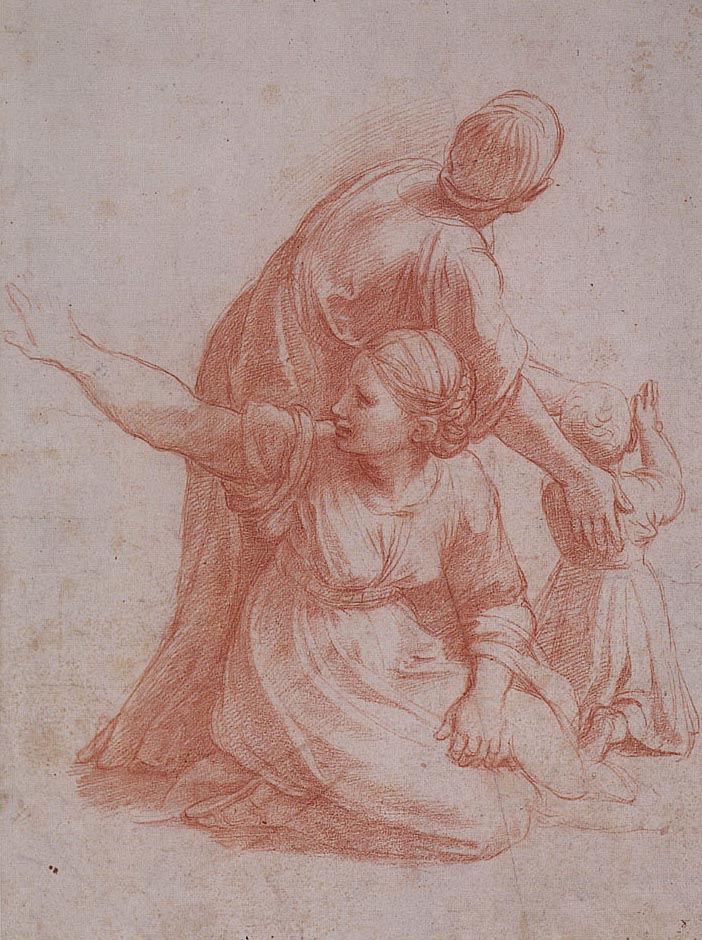
Raphael — Study for the Madonna of the Fish
First sketch for the composition now in the Museo del Prado in Madrid. The figures around the Madonna are the young Tobias, the angel Raphael and St. Jerome, while the Child in the Virgin’s arms and the lion at the feet of St. Jerome are missing. The inscription on the step of the throne (“Raf. Urb.”) is in a sixteenth-century hand. Sheet and painting can be dated to 1513-1514.
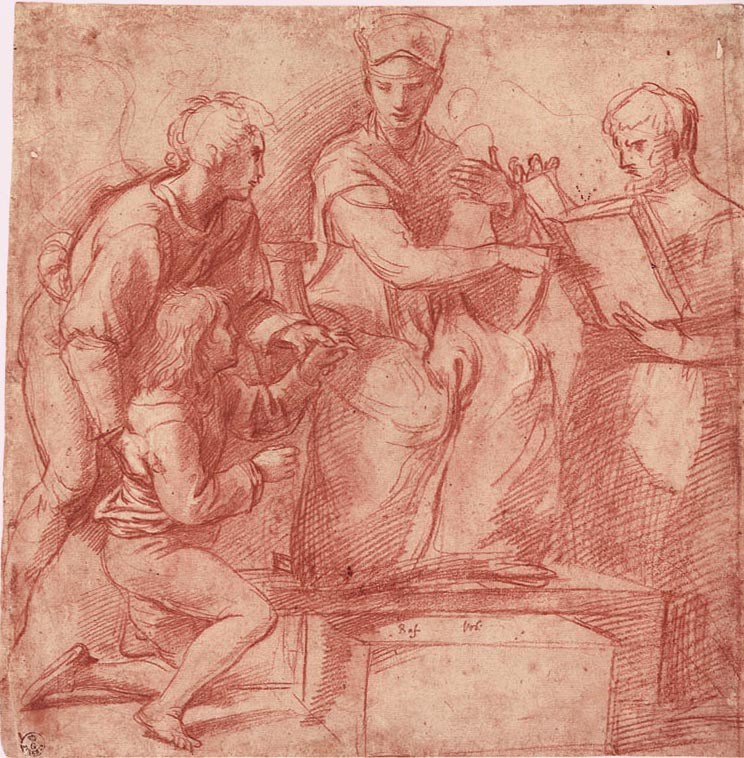
Raphael — The miraculous draught of fishes with a crowd in the foreground
Sketch for the tapestry of the Miraculous Draught of Fishes in the Sistine Chapel. The central focus of this drawing is the spectators, men discussing and women with children. Other figures appear, barely indicated in charcoal, almost as if to fill the whole area. Raphael worked on this project during 1514.
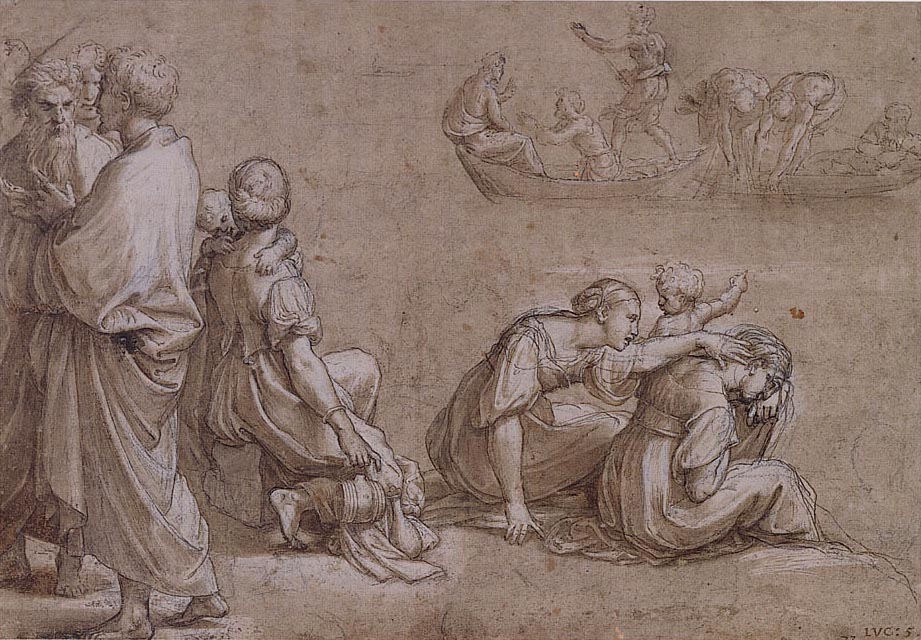
Raphael — The miraculous draught of fishes
It corresponds fairly closely to the upper part of the drawing on the recto, although the stroke is very rapid and full of pentimenti. The poses are very relaxed and extremely lively, like a kind of jotting of ideas.
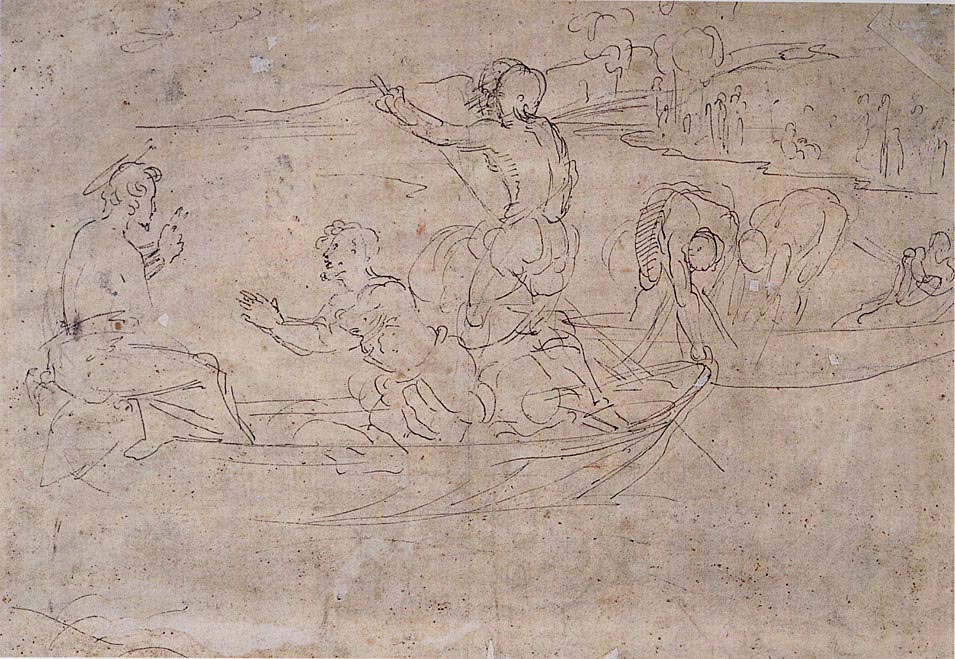
Raphael — Model for the Plague of Phrygia, or the Morbetto
Drawing intended for an engraving, of very doubtful attribution, also attributed to Perin del Vaga and Giulio Romano; it has been related to Raphael’s studies for the frescoes of the Stanza di Eliodoro in the Vatican. Despite the very poor state of preservation, this sheet can be recognised as a drawing of high quality; if recognised as by Raphael, it can be dated no later than 1514-1515.
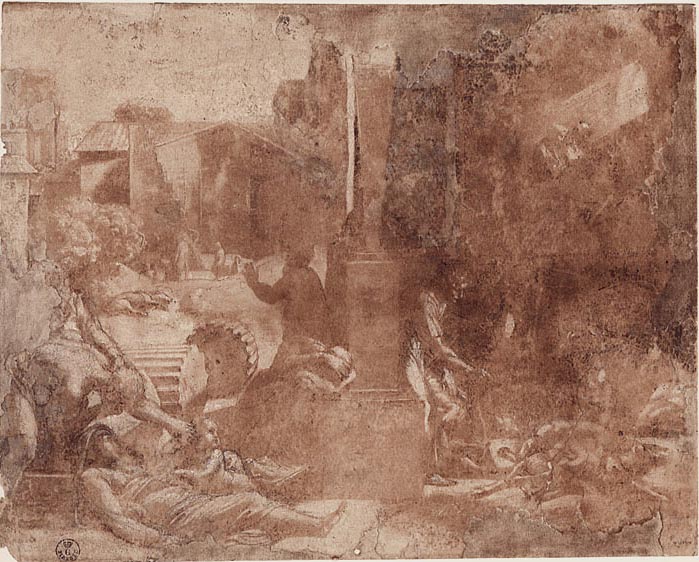
Raphael — Study for the cartoon of the Preaching of St. Paul in Athens
The figures were initially outlined in metallic point, and are partly nude. There are considerable differences from the finished cartoon, prepared for a tapestry: in particular the figure of Dionysius, on the right, which will be much lowered. Some critics have judged it too weak a drawing, and attributed it to pupils of Raphael.
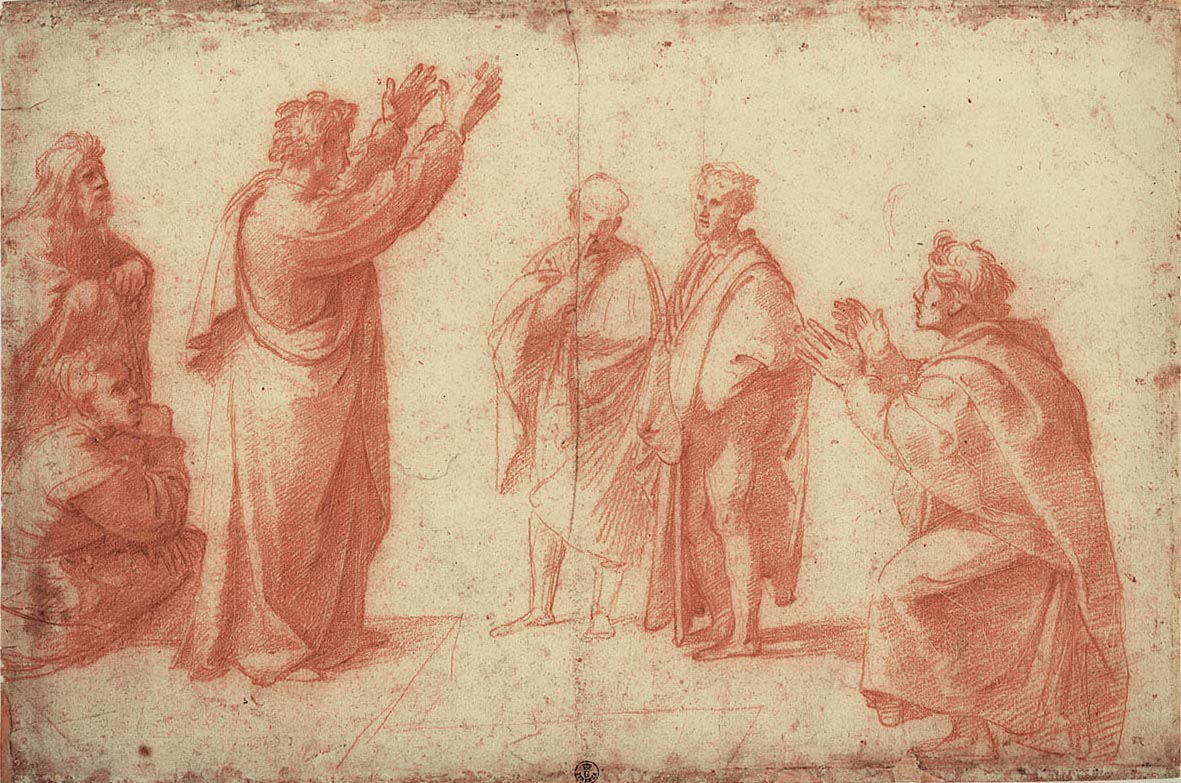
Raphael — Abraham and the three angels
Model for a fresco in the Vatican Logge. The angels still seem to be in motion, in the act of approaching the kneeling Abraham. The one in the centre, the angel who is speaking, resembles the Apollo Belvedere; half hidden behind the door of the hut appears Sarah. In the background, a mountain landscape and a barely indicated watercourse. Raphael began planning the frescoes of the Logge in 1516.
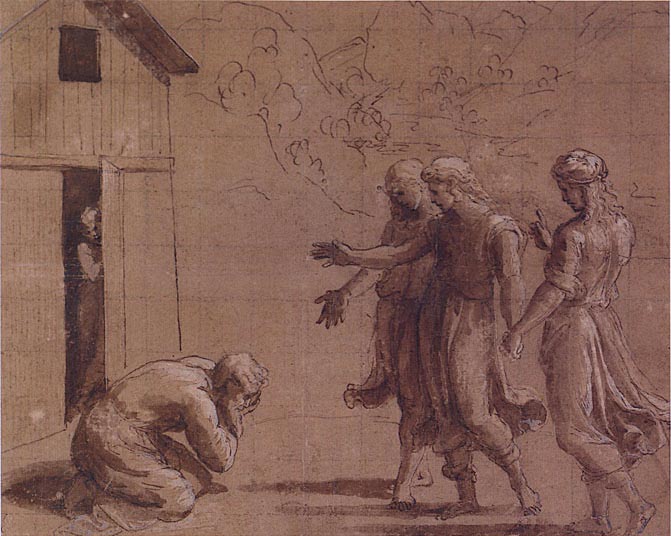
Raphael — Study for a St. Luke
Preparatory study for a fresco on the south wall of the Sala dei Chiaroscuri in the Vatican. It largely corresponds to the finished work, but allows us to see the “work in progress” function of the drawings. The rear part of the bull, for example, is barely sketched; also because it was intended to be cut, in the fresco, from a door. Executed between 1515 and 1516.
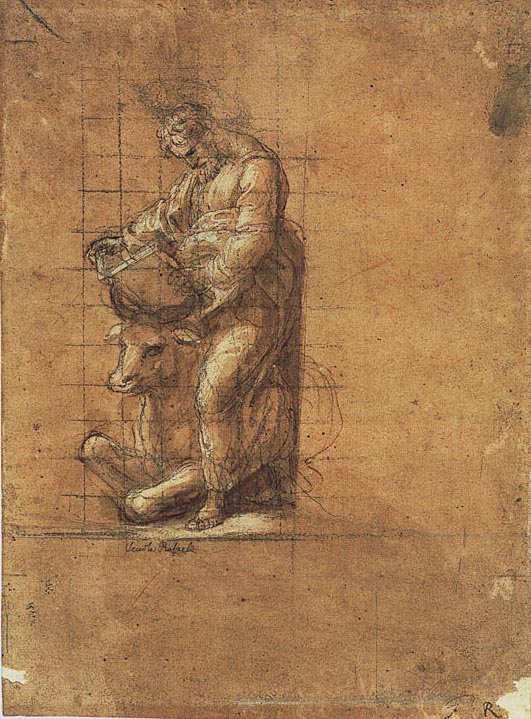
Raphael — Study for the Triumph of Bacchus in India
Long attributed to Perin del Vaga, then to Raphael’s workshop, it was recognised as autograph in 1986. The fresco was commissioned from Raphael by the Duke of Ferrara, Alfonso I d’Este, in 1517, and in September of that year the painter had already sent a small drawing to Ferrara, followed later by a second version. One of Sanzio’s most crowded drawings.
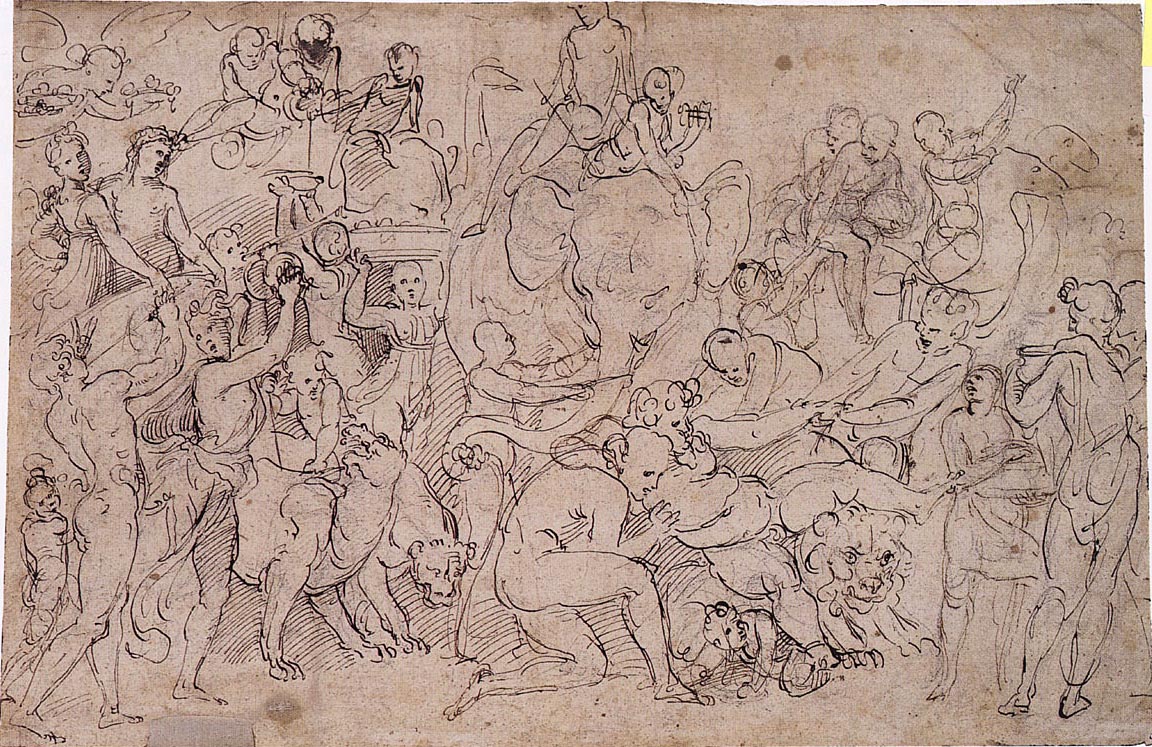
Raphael — Studies of figures for the Spasimo di Sicilia
The painting in question is the Way to Calvary, painted in 1517 for the church of Santa Maria dello Spasimo in Palermo; hence the name by which it is commonly known. The picture is now in the Museo del Prado in Madrid. The drapery of the figures, crisp and at times summary, recalls the studies for the Fire in the Borgo.
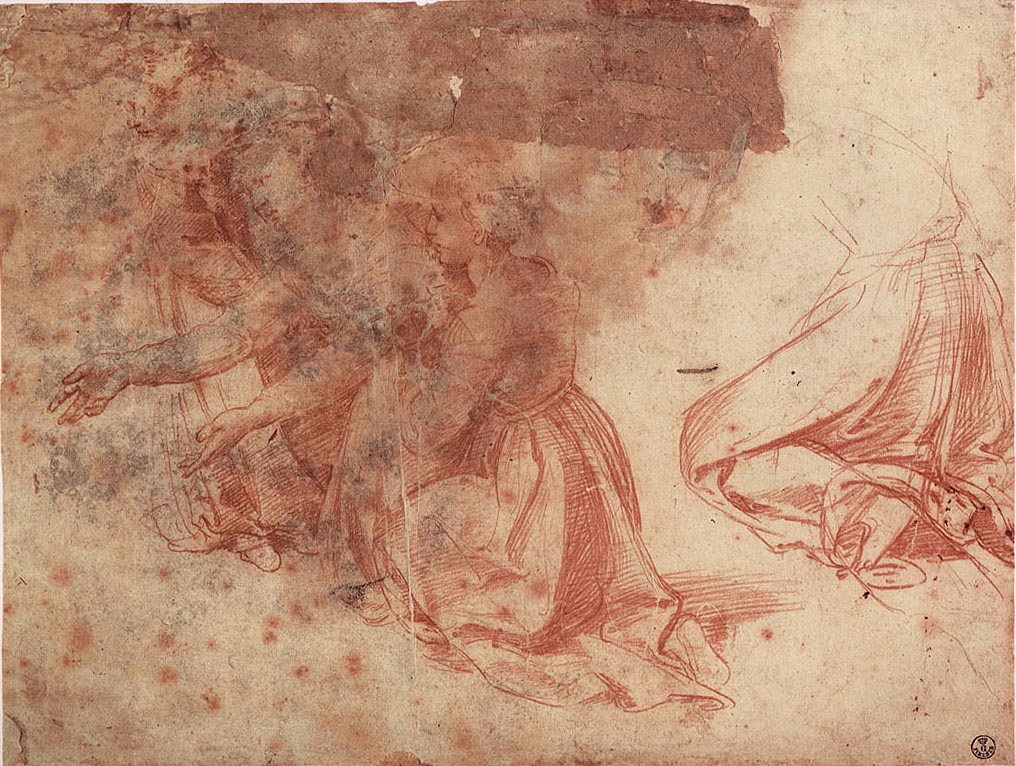
Raphael — Studies for the Madonna of Francis I
The so-called Madonna of Francis I (Paris, Louvre) is in fact a Holy Family with the young St. John, Elizabeth and two angels. Only the true protagonists of the scene appear in this drawing; at the top right a variant for the Madonna’s drapery is sketched. The position of the Virgin’s leg seems to be a reworking of that of one of the figures on the sheet for the Spasimo di Sicilia (entry 48).
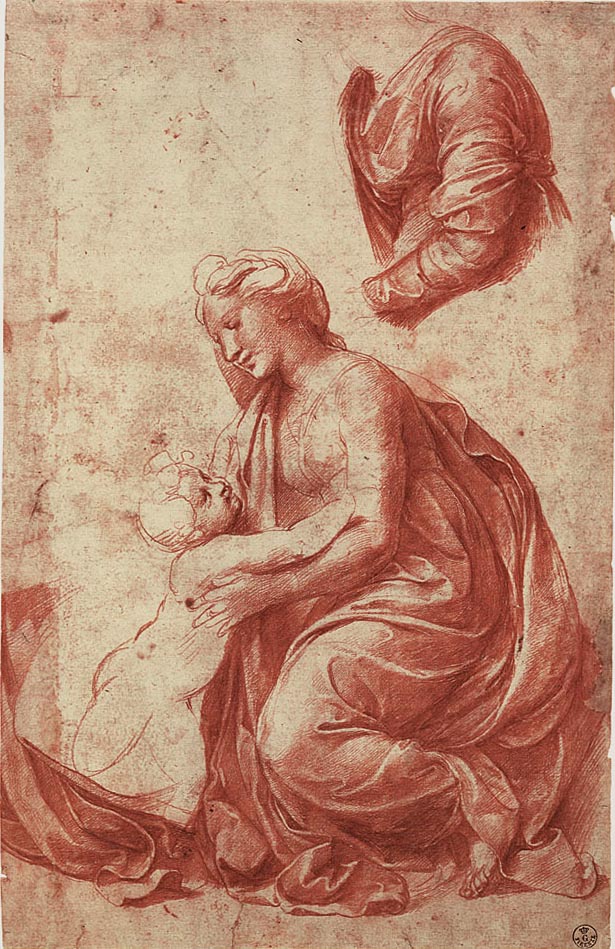
Raphael — Study for the figure of Jesus in the Madonna of Francis I
The figure of the Child had only been sketched rapidly in the drawing of entry 49; here it is executed with particular attention to the effects of light. The positions of the left arm and the right leg are slightly different. As with the preceding sheet, some critics have attributed the drawing to Giulio Romano.
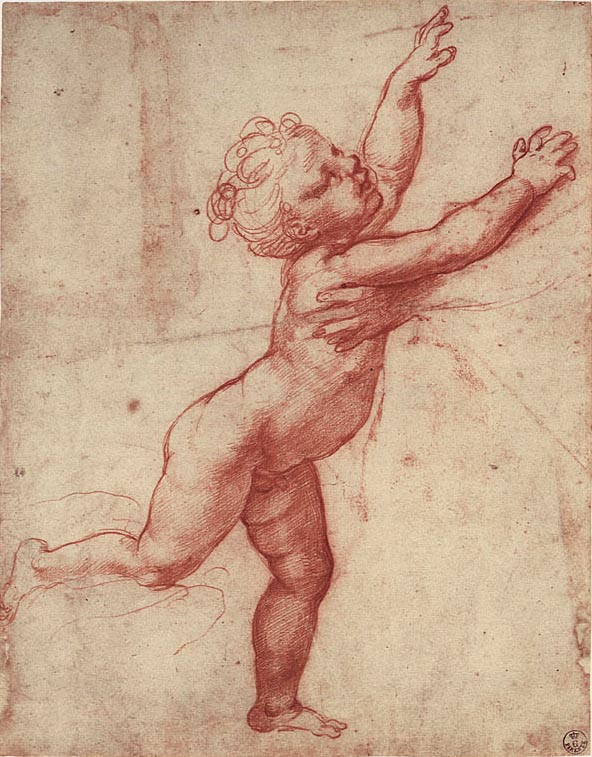
Raphael — Study for Mercury and Psyche in the Council of the Gods
A work of highly controversial attribution, with scholars divided between Raphael, Giulio Romano and Penni. The face of Psyche, receiving the cup of immortality from Mercury, closely recalls that of Roxana (see following entry) welcoming Alexander as her husband; but her body is somewhat too muscular. The movements of the drapery, however, suggest Raphael. Probable date, 1517.
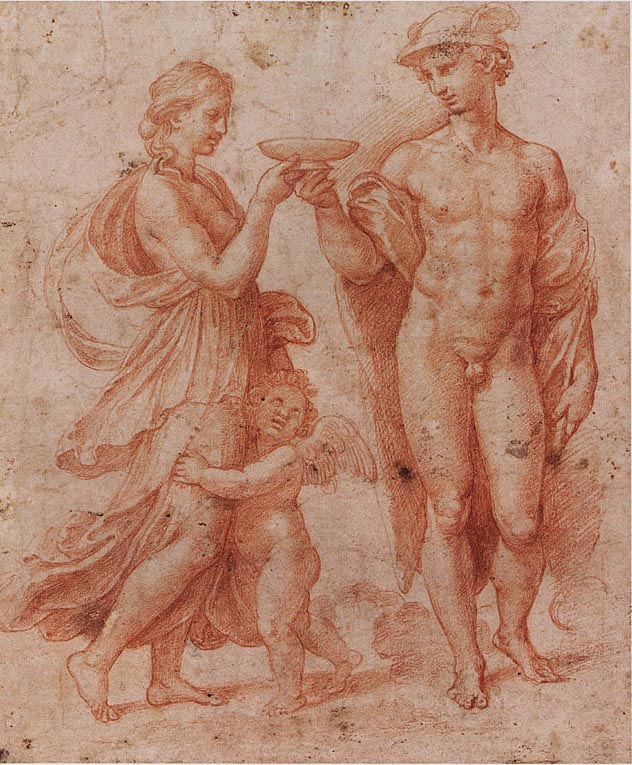
Raphael — Study for the Marriage of Alexander and Roxana
The fresco had been commissioned by Agostino Chigi on the occasion of his marriage to Francesca Ordeaschi, to decorate a bedroom. Raphael did not get as far as executing it; the work was entrusted to Sodoma. Roxana’s body appears lighter, lit by a barely indicated torch held by Hephaestus. The male bodies are in strong chiaroscuro; the group of children playing with the weapons abandoned by Alexander is full of movement. On the basis of style and the conception of the figures, the drawing is dated between 1517 and 1518.
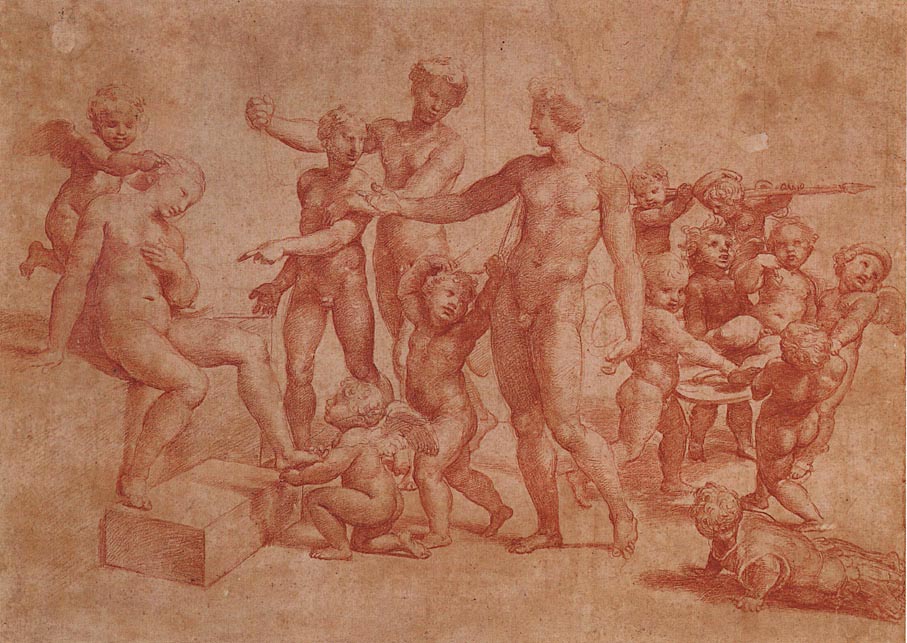
Raphael — Study of a figure for the Vision of the Cross in the Sala di Costantino
The fresco in the Sala di Costantino, in the Vatican, was painted by Raphael’s pupils after his death in 1520. The drawing can be dated to around 1518 and has the characteristics of the graphic style of Sanzio’s last years, a geometric simplification of features and limbs combined with ease in handling the effects of light. The name of Giulio Romano has also been proposed; on the verso there is a female profile that is certainly by him.
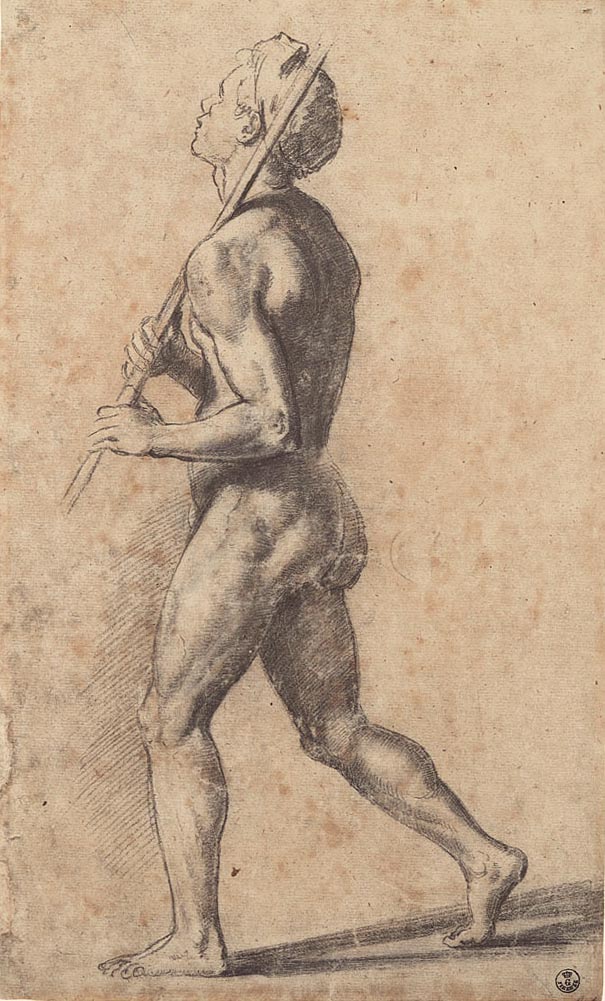
Raphael — Pope in the gestatorial chair
This drawing has been considered a design for the fresco on the north wall of the Sala di Costantino, on which Giulio Romano later painted the Donation of Constantine. Raphael seems to have drawn the procession group from life; the faces have an almost portrait-like vitality, obtained with a few rapid strokes. A major novelty is the use of chalks of various colours, which Raphael used in only one other drawing, a Portrait of a Cardinal. The presence of the squaring makes it possible to date the sheet between 1519 and 1520.
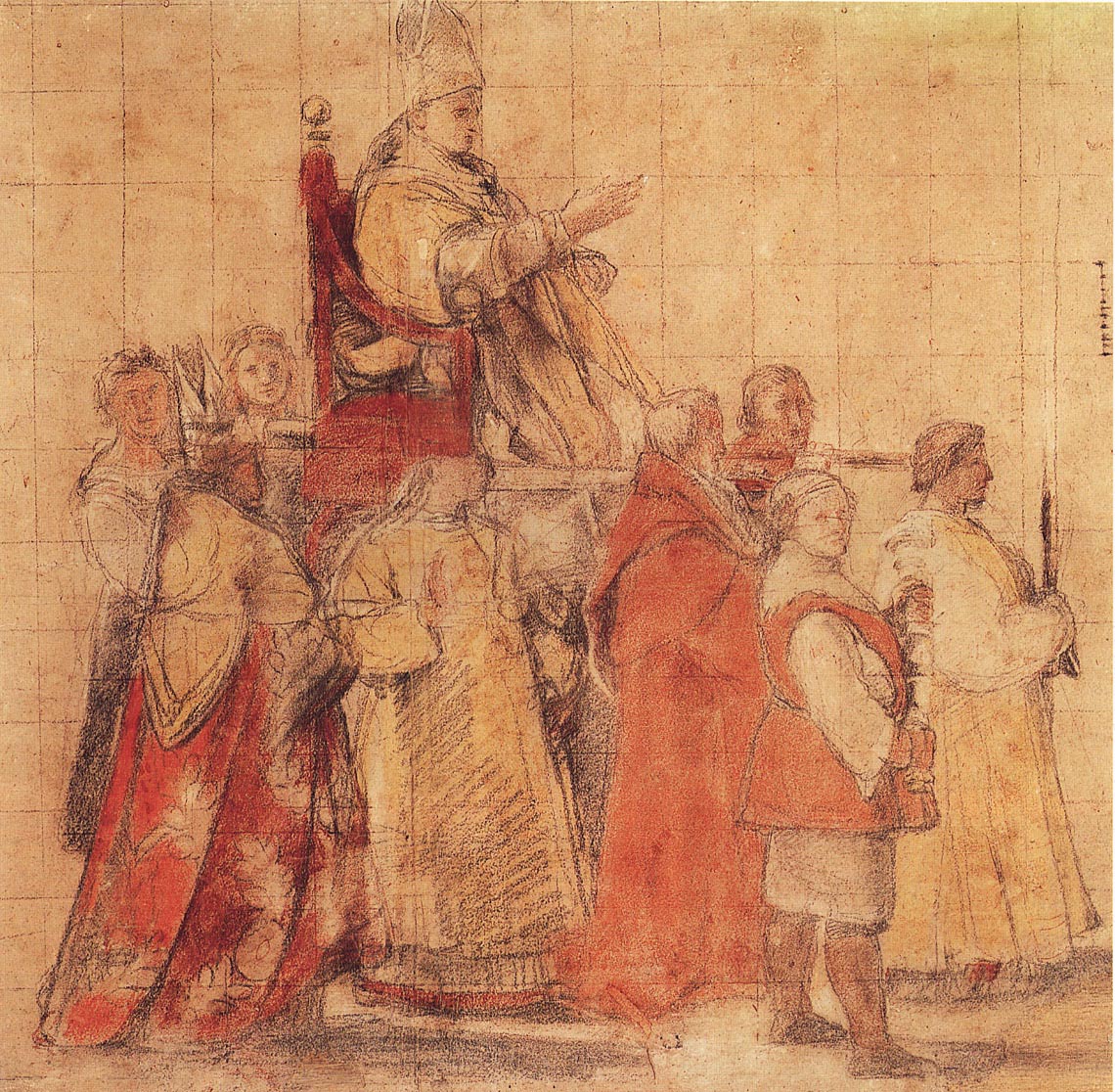
Raphael — Study of figures
Preparatory study for the three apostles depicted in the Coronation of the Virgin, a painting executed by Raphael’s pupils for the convent of Monteluce near Perugia (now in the Vatican Museums). The figures are only summarily indicated; the painter’s interest lies in movement in relation to light and shade. The garments are sketched with long, simple lines and the faces are outlined with simple, rather heavy strokes. Datable to around 1519.