Rome
ROME. Rome, the famous and unique name by which the CITY was called in every age and by every nation – the city which was always, in its various aspects, queen of the universe, and which, among the immense host of its praisers, Athenaeus did not hesitate to describe with a fine periphrasis as Orbis compendium; and vain proved the design of some proud emperor to renew its title, for either the ancient one prevailed, or the generic word Urbs, without any addition, sufficed to denote it par excellence. Rome, metropolis of the Catholic faith, capital of the States of the Church and chief town of the comarca of the same name, stands at lat. N. (at the Collegio Romano) 41° 53’ 54” and long. E. (at the same point) 10° 9’ 32”. It lies in the S. of the Ecclesiastical State, on both banks of the Tiber, 5 leagues from the mouth of that river in the Tyrrhenian Sea, 40 leagues N.W. of Naples and 250 leagues S.E. of Paris. It is the residence of the Pope and the seat of the Sacred College of cardinals; it has a supreme court of cassation, called the Segnatura, and two courts of appeal, one called the tribunal of the Apostolic Camera and the other the tribunal of the Rota. – The Tiber, flowing from N. to S., divides Rome unequally, the eastern part, situated on the left of the river, being the more considerable. The circuit of the city, marked by a wall, is little more than 5 l., and the length of the enclosure measures 1 league 113, from N.W. to S.E., and its greatest width less than 1 league from N.E. to S.W. Two thirds of this space, to the E. and S., are occupied by vineyards, wheat fields and country houses with their gardens. Of the seven hills on the left of the Tiber on which ancient Rome was built, the Capitoline alone is covered with houses; the Quirinal, Viminal and Esquiline are so only in part, and the Palatine, Aventine and Caelian remain almost bare. The mass of dwellings is today enclosed between the Tiber to the W., the Quirinal to the E., the Palatine to the S. and the Pincio to the N.E. The part on the right of the Tiber, resting on two hills, the Janiculum to the S. and the Vatican to the N., offers only two main groups of houses, one to the N.W., the other to the S.E.; there is much cultivated land on the upper parts of the hills. – The best-built portions of the city are the N. end of the division on the left of the river, and the Borgo quarter, in the N.W. of the division on the right bank. There are in general many superb houses in Rome honoured with the title of palaces; but the eye is at times unpleasantly offended by the contrast they form with the mean little houses that surround them; on the other hand, everyone is filled with wonder and a kind of reverence at the sight of the numerous ancient and modern monuments so picturesquely scattered over those hills and in the valleys, which, as a judicious artist observed, seem to have been arranged so as to allow architecture to display all that is most beautiful in it. This ancient queen of the world has a grave, sad and almost funereal air, nor does it resound with the movement and din of a great capital. – The Tiber, swift in its course and turbid in its waters, has an average width in Rome of 300 feet and forms 2 bends there, the more northerly turned to the W. and the more southerly to the E.; it encloses the island of S. Bartolammeo and is crossed by 4 bridges: to the N., the Ponte Sant’Angelo or Elio, of modern and elegant construction and surmounted by marble statues, facing the Castel S. Angelo; in the middle, the Ponte Sisto; to the S., the Ponte Quattro-Capi or Fabrizio and the Ponte Cestio or S. Bartolammeo, which join the island of that name to the mainland. The remains of 3 ruined bridges can be seen: the Ponte Vaticano to the N., and the Ponte Palatino or Rotto and the Ponte Sublicio to the S. There are few embankments properly so called. On the right bank, towards the S., there is a rather long port which they call the port of Ripa-Grande, and on the left bank, in the N., are the ports of the Legna and of Ripetta. – The streets of Rome are in general rather wide, and in the quarters where narrow and irregular ones are found, the air is not at all unhealthy, owing to the low height of the dwellings; many are long and straight, and often end in an obelisk, a fountain or a church. The three most notable leave, diverging, from the Piazza del Popolo, situated at the N. end of the eastern part of the city: the Strada di Ripetta heads S.W., the Strada del Babuino, continued by the Piazza di Spagna and the Via de’ Due Macelli, S.E., and the Strada del Corso S.: this is the principal promenade of Rome and the theatre of the carnival festivities, and it measures about ¼ l. in length. Among the other streets of the same part, one notes the Via Maggiore, continued by the Via S. Lorenzo Pane e Perna; the Strada de’ Condotti, which runs from the Strada del Corso to the Piazza di Spagna; the Via Giulia, which skirts the left bank of the Tiber; and finally the long street which runs from N.W. to S.E. under the names of Sistina, Via Felice and Via delle Quattro-Fontane, and is continued, amid fields and vineyards, as far as the S.E. extremity of Rome. In the part on the right of the Tiber one observes the Via della Lungara, parallel to the river, with the Borgo Pio and the Borgo Vittorio, which run from E. to W. in the N. of the Borgo quarter. The houses of Rome are partly of stone, partly of brick, and frequently covered with stucco; marble is less common there than in the cities of the N. of Italy. (...) – And, to speak first, with the aforementioned Castellano, of ancient and pagan Rome, the Palatine hill points to its cradle. Around this hill, where a cluster of hovels called Pallantia is said to have existed earlier, the founder, whether Romulus or some other leader of a motley band, traced the humble ditch that formed its enclosure, which was gradually enlarged when, after the peace with the Sabines, Titus Tatius shared the kingdom, so as to include the nearby Saturnian hill – a double slope so called from the pre-existing city, one of whose summits was afterwards called Tarpeian (today Caprino) from the virgin who was cast down from it, and both of which were later made immortal by the auspicious omen drawn from the human head dug up there, whence it is called Campidoglio, capitolium – and a part of the Aventine, still covered by the sacred grove where the flight of birds supplied matter for the augural portents. As the destruction of Alba Longa doubled the nascent population, Tullus Hostilius was led to enclose the hill called Querquetulanus from its thick oaks, and afterwards Caelius from a powerful Etruscan leader who chose it as his dwelling. Then Ancus Marcius, after peopling the rest of the Aventine with the conquered neighbours, not for want of room but to deprive the enemy of an advantageous position from which the Romans were often harassed, occupied part of the Janiculum, where it is believed that in remote times a Janus had reigned in another city called Antipolis. Thus, once the Tiber had been crossed by means of the first bridge, made of joined beams, called Sublicius and made memorable by feats of war, began the district of Trastevere on Etruscan soil, and the most ancient Roman strongholds were seen to rise on the heights. Yet the steady prosperity and the growing multitude of Rome required a far greater increase. Servius Tullius therefore included within the enlarged perimeter the two hills of the Quirinal and the Viminal, whose division, no longer visible, was marked by the ancient Porta Collina, and from there the king went on to enclose the forked Esquiline, the first branch of which reached from Trajan's Forum as far as the Porta Esquilina, while the other extended from the modern Liberian basilica as far as the celebrated Via Labicana, which separated the double Esquiline hill from the Caelian; and in the hollow between the two branches rose the height of the Suburra. Such was the city then called the city of seven hills, because its new turreted walls entirely enclosed precisely seven of them, not counting the walled part of the Janiculum beyond the river. (...) Ancient Rome was divided into fourteen regions, which took their names from the Porta Capena, the Caelimontana, the temple of Isis and Serapis Moneta, the Via Sacra, the Esquilina, the Alta Semita, the Via Lata, the Roman Forum, the Circus Flaminius, the Palatine hill, the Circus Maximus, the Piscina Publica, the Aventine hill and Trastevere. One of the most splendid magnificences of Rome was the Palatium, that is, the dwelling of Augustus, to which were joined the temple of Apollo and the rich Palatine library. The succeeding Caesars vied with one another in embellishing and enlarging this palace of theirs, but the greatest splendour was displayed by the emperor Nero, from whom it received the title of Golden House. His colossal marble statue adorned its vestibule; three thousand columns supported the great portico, and in the countless rooms sculptures, metals and gems were lavishly displayed. Gardens, baths and a lake, all surrounded by fine buildings, varied its delightful appearance; nor did the Palatine alone suffice for so vast a structure, which, entered from the Via Sacra, extended across the whole plain between the Caelian and the Esquiline, together with part of the latter hill, the gardens of Maecenas having been joined to it. The emperors who followed confined it once more to the Palatine, and Vespasian and Titus made use of the buildings destroyed beyond that limit to erect the Baths, the Colosseum and other public monuments. Of such greatness barely the memory remains, for ivy and moss cover those abandoned ruins, and many of them lie within the nearby Farnese gardens, the Villa Spada, now owned by the Englishman Mills, and the adjoining garden of the English College, so that the original area of the city may be said to be now entirely deserted. Rome counted 17 forums, among which the Roman Forum, the Forum Boarium and Trajan's Forum stood out for their size and the crowds they drew; there were 29 main roads, whose convenience and solidity are still admired in many remains, the most notable being the Appia, the Flaminia, the Cassia, the Aurelia, the Tiburtina, the Praenestina, the Ostiensis and the Nomentana; 36 triumphal arches, mostly built of marble with fine chisel work; 11 basilicas where justice was administered, the most famous of all being the Ulpia, also for its rich library; 133 temples sacred to the fanciful, countless host of gods brought from Greece, the main ones erected to Jupiter, among them the admirable Pantheon of Agrippa, to Venus, to Mars, to Janus and to Juno under several names, and two to Fortune, besides many altars and a great number of what were called Aedes sacrae and Aediculae; 9 circuses, namely the Circus Maximus between the Palatine and the Aventine, the Circus Flaminius to the N.W. of the Capitol, the famous Circus Agonalis or of Alexander, the Pincian circus of Sallust, that of Flora in today's Piazza Barberina, that of Elagabalus on the walls of the Caelian, the other of Caracalla on the outer Via Appia and, outside the city, beyond the Tiber, the circuses of Hadrian and of Nero; 3 amphitheatres, namely the incomparable one of Flavius Vespasian, on the former lake and the Neronian gardens, which was called the Colosseum from the colossus of that emperor brought there from his Golden House, the Castrense near the Horti Variani, and that of Statilius Taurus, whose ruins formed the rise now called Monte-Citorio; 6 obelisks, besides the two famous spiral columns and other smaller ones; various naumachiae for naval combats, the chief being those of Augustus, Nero and Domitian; the theatres of Pompey and Marcellus; the mausoleums of Hadrian and Augustus, built with incredible magnificence on the two banks of the Tiber at the northern end of the city; the tombs of Romulus, Numa, Caius Castius and the Scipios; the very many grand aqueducts and the large reservoirs (Castellum) of the Aqua Marcia, Julia and Tepula. (...)
And first we shall speak of the baths, whose vastness, luxury and splendour were so great that Ammianus Marcellinus, astonished, defined them as: Lavacra in modum provinciarum extructa (Baths built after the fashion of provinces). As many as twelve were counted: (...) immense buildings destined for bathing and for gymnastic exercises. The first part contained within its enclosure the rooms for hot, warm or cold baths, and as many as 3,200 people could bathe together in those of Diocletian. There were also rooms for exposing oneself to the various temperatures of the air, from the open sky gradually up to the sweating room, loconicum; then the places for leaving one's clothes, and finally the anointing rooms. Precious were the decorations of the second part, where everything was to be found that might refresh the spirit: avenues adorned with trees for delightful walks, stadia for spectacles and games, libraries, museums, halls for declamation. To give an idea of the profusion of columns, sculptures, marbles and other exquisite ornaments lavished on them, suffice it to say that the remains dug up from just one of these – palaces rather than baths – have abundantly embellished a great many modern buildings; and as for size, the baths of Caracalla and of Diocletian exceed 4,200 feet in circumference. (...)
On the left of the Tiber lies Rome proper, and bordering that river to the N. are its bastions, which have three gates on that side: the first, called del Popolo, corresponding to the Flaminia, the second the Salara, the third the Pia; to the E., access is given by the three gates of San Lorenzo, Maggiore and San Giovanni; to the S., by the two of San Sebastiano and San Paolo, and not far from the latter the wall reaches the bank of the Tiber at the southern foot of the Testaccio. The right side of the river comprises the Trastevere quarter, extended as far as the beginning of the Leonine City by means of the Via Lungara, which leads from the open arch of the Porta Settimiana to that of the Porta Santo-Spirito. On the S.W. side begins the wall that closes its circuit, interrupted by two gates, namely the Portese and that of San Pancrazio; it then continues, widening considerably towards the W., and ends with the fortifications of Castel Sant'Angelo, set to the N.W. on the same Tiber; on this flank, anyone walking round the pomerium can see the traces of the other two intermediate gates, which were walled up at various times. The perimeter is, as we have said, about 5 leagues; but the inhabited part, which lies entirely to the N.W. in the plain beside the river, does not exceed 2 leagues, the rest consisting of grand villas, elegant gardens and much land given over to market gardening and vineyards. The gradual, imperceptible subsidence of the hills, the frequent ruins of buildings and other such causes arising over the long course of the centuries have raised the level of modern Rome (which now lies at an average height of sixty Paris feet above sea level), as can be seen in the continual excavations made to find, at some depth, the streets, pavements and bases of columns. (...)
Modern Rome retains the same division into fourteen parts made by the emperor Augustus, having changed only their names and boundaries. They are called Rioni, and are named in the following order: Monti, Trevi, Colonna, Campo-Marzo, Ponte, Parione, Regola, Santo-Eustachio, Pigna, Campitelli, Santo-Angelo, all on the left of the river, the other three, Ripa, Trastevere and Borgo, being on the right; the last of these includes the whole of the Leonine City. (...)
A very large square opens out in a circle, and beside the gate, on the left as one enters, stands the church of S. Maria del Popolo, from which the whole district took its name; within, among a thousand rich ornaments, it contains the Ghigi and Cibo chapels, rich in marbles, metals, sculptures and paintings, and it has an adjoining convent of the Hermits of St. Augustine; fine tombs of the 11th century may also be seen there. Facing this building in graceful symmetry, on the opposite side, is a large and handsome barracks recently built, to which is attached the hall intended for the public exhibition of the commended works of young artists. Two hemicycles, adorned with marble sphinxes, form the perimeter of this forum, and at their ends stand the four seasons, skilfully carved by talented pupils. In the centre rises the Egyptian obelisk, 108 palms high, valuable no less for its material, red granite, than for the hieroglyphs with which it is covered; it bears the now undoubted marks of the first age of the Pharaohs and, after adorning Heliopolis, where it stood sacred to the Sun, and then the Circus Maximus in the time of Augustus, it was dug up from those ruins in the reign of Sixtus V and set here to shine once more; it rests on a pedestal 37 palms high, surmounted by four lions that pour abundant water into the basins below – new and splendid ornaments completed in these very days. Opposite open the three main straight streets: the Corso in the middle, Ripetta on the right and the Babbuino on the left. Two majestic churches with matching fronts, adorned with lofty domes and dedicated to the Blessed Virgin under the titles of Monte-Santo and dei Miracoli, divide the three streets and serve to enhance the view. (...)
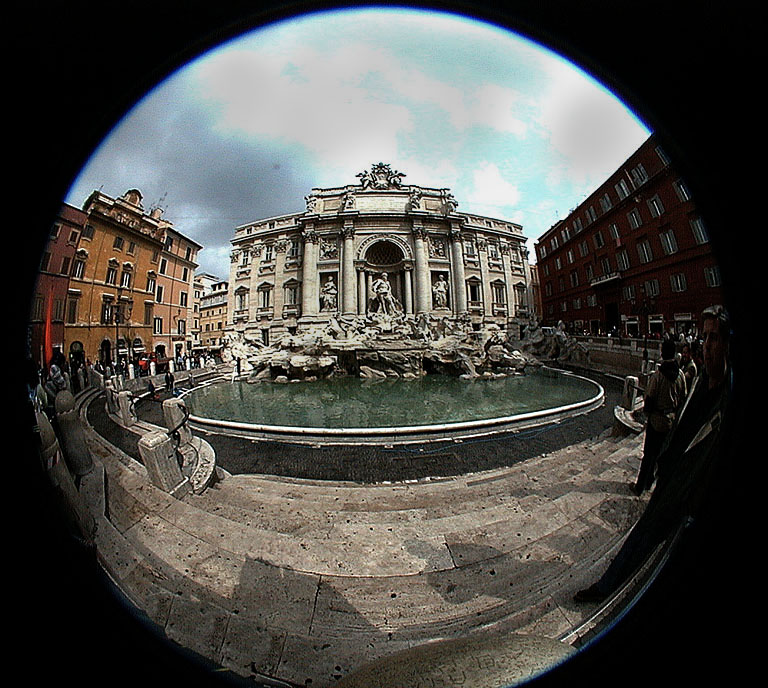
The principal square is the one now called Navona, which was formerly a circus near the ancient Baths of Alexander, afterwards called Agonale, the buildings that surround it having been built on its tiers of seats. It is distinguished by its extraordinary size, which serves for the fine spectacle of the weekly markets, and by the four fountains it contains. Above the two which also boast marble basins, and above the third, called del Moro and restored in 1819, which prides itself on the figure of the Triton carved by Bernini, the great fountain in the middle, built under the auspices of Innocent X, is incomparably admired. In the middle of a large basin stands a rugged rock, 60 palms high, which pours out water abundantly from openings in its sides. Above it, on a granite base 23 palms high and decorated with the gigantic statues of the Danube, the Ganges, the Nile and the Plata, rises a red Egyptian obelisk of the Ptolemaic age, 72 palms high and covered all over with hieroglyphs. With the water of this fountain the square, purposely made concave in the middle, is flooded up to a certain point, to give relief from the great heat in the afternoon hours of summer and to provide the spectacle of numerous carriages splashing about in it. – But Rome has no lack of fountains and spires on every side, for Pope Paul V, emulating the colossal undertakings of the Roman emperors, brought the waters of Lake Sabatinus from Bracciano, 14 leagues away, to the summit of the Janiculum, restoring Trajan's aqueducts and adding new ones where needed; and fine is the front, adorned with five columns of red granite and bearing an appropriate inscription, where the water rushes down from three very large mouths and two smaller ones into the basin below, which not only supplies all the fountains of Trastevere and the Leonine City but also drives the adjoining paper and iron works, as well as several mills. From the celebrated Acqua Vergine, brought to Rome from about 6 leagues away through underground conduits by Marcus Agrippa, Nicholas V drew the main branch to the Trivio, where the great fountain now stands which is for this reason called di Trevi, and not after some town of that name, as the common people mistakenly suppose. To the two Clements XII and XIII is owed the decoration of the colossal statue of Ocean on a great chariot of shells guided by Tritons seated on sea-horses, surrounded by lesser sculptures and bas-reliefs, among which one notes Agrippa on one side and, on the other, the Virgin who, by pointing out the spring to a soldier, indelibly gave her name to the copious waters that are seen gushing forth, in a fine and fanciful form, among rocks and crags. The original name of Sixtus V was likewise immortalised by the fountain which, not far from the Baths of Diocletian, pours out the Acqua Felice, brought there from the Alexandrine springs through new conduits built largely on the old ones of the Marcia and the Claudia; it is commonly called the fountain of Moses, from a statue of that leader which stands above the side bas-reliefs of Aaron and Gideon. Nor, among the other fountains, should one pass over the one that Paul V opened at the head of the fine street called Giulia after Pope Julius II, which, near the left bank of the river, leads in a straight line from Ponte Sisto to Ponte Sant'Angelo; nor the other, called del Tritone from the figure carved on it, which stands in Piazza Barberini. Every square, however, even the lesser ones, and every street abounds in charming fountains, which by themselves would suffice to adorn any illustrious city; and such is the abundance of water that in most houses and workshops it is piped in for daily use without any need to draw it. – Piazza Colonna is the most central, and the one where the people most often gather, since it opens almost halfway along the Corso. It is also the most regular, for, apart from a very small part of the S.W. corner, only four palaces enclose its square. And such an adornment well befits the column called Antonine, so named because it was erected in honour of Marcus Aurelius Antoninus in the forum of Antoninus Pius, of which the present square formed part. The base of the pedestal extends sixteen palms underground, and, including this, the total height measures 217 feet. It is made up of 28 pieces of white marble and is decorated all round with bas-reliefs depicting the victories of Marcus Aurelius, whose statue, placed at the top, Sixtus V replaced with that of the Apostle of the Gentiles. An internal staircase of 190 steps, lit by 41 openings and carved in a spiral in the marble itself, allows one to climb it without effort. The square of Trajan's Column too, a little beyond the end of the Corso, opening at the foot of the Quirinal – which was cut back by that emperor to a considerable height in forming his magnificent Forum, which contained the great Basilica Ulpia and the Ulpian Greek and Latin libraries – is in modern times adorned by two churches with not very dissimilar domes, which form its front to the N.W.
The great Column is made up of 34 pieces of white marble, 23 of which form the column proper, and it rises to 193 and a half palms, corresponding to 132 Paris feet, with a lower diameter of 11 feet 2 inches and of 10 feet near the capital. The victories of Trajan, who is said to be buried there, are masterfully carved in bas-relief on a spiral that winds 23 times around it, containing more than 2,500 human figures and a great many other related objects. The internal spiral staircase of 185 steps, lit by 43 small openings, leads to an iron railing where the statue of the prince of the apostles was set up by Sixtus V in place of that of Trajan, which once stood there in gilded bronze. The piazza of Monte Citorio, too, received from Pope Pius VI the illustrious embellishment of the solar obelisk, 130 palms and 112 in height, surmounted by a bronze globe; dating from the first age of the Pharaohs, it was raised by Sesostris in Heliopolis, and then by the emperor Augustus, who brought it over and set it up in the Campus Martius, where it served as a gnomon; but having later broken, it was excavated from the ruins in 1748 through the care of Benedict XIV. Among the most notable squares is also the one that takes the name of Piazza di Spagna from the residence of the ambassador of His Catholic Majesty. The elegance of the palaces and of the many sumptuous hotels that surround it, the curious fountain of Urban VIII, built in the shape of a boat and therefore called the Barcaccia, and above all the grand flight of steps leading up to the church of the Trinità de’ Monti, raised on the Pincio, from which there is a fine view over almost the whole city, together with the straight street called Via de’ Condotti, which runs from there towards the Tiber, and the other, Via del Babuino, leading alongside to the Piazza del Popolo, give it so cheerful an appearance that nothing can equal it, especially when on winter days it is gilded and warmed by the rays of the rising sun. Two other Egyptian obelisks, taken from the ancient temple of Isis and Serapis and adorned with hieroglyphs, but of no great height, went to embellish, the first, the fountain standing in the remodelled Piazza della Rotonda, and the other, set on the back of a marble elephant, the Piazza della Minerva. – Modern Rome, however, draws its greatest glory, one unmatched by any other city in the world, from the venerable majesty of its many churches. And here, after casting a glance at the fine restorations with which Popes Nicholas V and the two Clements, VII and IX, adorned with sculptures the Pons Aelius, today called Ponte Sant’Angelo, we must go on to admire the miracle of modern architecture, the astonishing Vatican basilica. Everything to be discovered in it bears witness to the most magnificent splendour, and words fail to depict its beauties, even in outline. Three great squares precede the steps of the church, extending altogether to a length of 1561 Roman palms. The first, which bears the name of Rusticucci, is almost square, and has lately been adorned with elegant modern buildings, as befitted the first threshold of the august edifice. From there the eye may rest in contemplation of the second, oval in shape and surrounded by a most superb colonnade divided into two hemicycles, where 284 massive travertine columns are counted, arranged in four rows so skilfully that, seen from one point in the square, they present a single row, the three behind remaining entirely invisible. The portico is surmounted by a balustrade, on which 192 statues 14 palms high are gracefully placed. So great a work does equal honour to Pope Alexander VII, who commissioned it, and to the Cavaliere Bernini, who knew how to carry it out so perfectly. The obelisk that Sixtus V raised in the middle around 1586, although it belongs to the third period, that is, made in Egypt by the Romans in imitation of the ancient ones, has the merit of being the only admirable piece of red granite to have remained intact through the course of so many centuries: 113 palms high without the pedestal and the cross that surmounts it, it was brought to Rome by Caligula, who set it up in his circus in the middle of the Campo Vaccino, whence Sixtus removed it. Two matching, ever-flowing fountains throw abundant jets of the water of Bracciano, brought down from the Janiculum, to a height of 14 palms; it falls first into round basins of oriental granite, each of a single piece, and then into larger ones of travertine. Two covered corridors at the sides of the third square, decorated outside with pilasters and colossal statues, lead to the vestibule of the basilica, while in the middle the two statues of the princes of the Apostles mark the beginning of the marble steps, in three flights, that lead to the foot of the façade, the last work carried out there, to his own not very happy design, by the architect Maderno under the pontificate of Paul V. Beyond the vast inner portico, from which the statues of Constantine and Charlemagne can be seen in the side vestibules, five great doors give entrance to the sanctuary; one of them, which is seen closed, is the one the pope solemnly opens every twenty-fifth year, appointed for the universal Jubilee, and it is called the Holy Door. (...)
Its form is that of a Latin cross with three naves. Marbles, sculptures, paintings, mosaics and gilding abound on every side, and each chapel gathers such a wealth of decoration as would suffice for any other handsome church. At the end of the tribune, above a marble altar, rises the chair of St. Peter, majestically adorned above and supported by four Doctors of the Church, two Latin, Ambrose and Augustine, and two Greek, Athanasius and John Chrysostom, in colossal figures; and this whole enormous mass of gilded bronze, a material of which 219,000 pounds taken from the Pantheon were used, is a classic work by Bernini and encloses the chair of St. Peter, used thereafter for a long time by his humble successors of the first centuries. In the middle of the crossing rises the high altar reserved for the celebration of solemn pontifical masses, covered by a great baldachin supported by four spiral columns, a work entirely in bronze which likewise does honour to Bernini. In front of it is the descent to the tomb, called the Confession of St. Peter, and to the Vatican Grottoes, where the bones of the martyrs gathered there are held in such veneration that the floor was raised by 16 palms in order to preserve them the better. Here the famous Bramante conceived the idea of raising the greatest dome in the world, and to this end he built the four enormous piers; but he could go no further, for death overtook him, though after him the daring of the immortal Michelangelo did not fail. (...)
On the summit of the Caelian stands the Constantinian Lateran basilica, dedicated to the two Johns, the Precursor and the Evangelist, the first church of the Catholic world, and therefore called Urbis et Orbis Mater et Caput, where the pope customarily takes solemn possession of the supreme dignity. The ancient church, with the palace attached to it, was destroyed by fire at the beginning of the 14th century, while Clement V was residing at Avignon; but he at once gathered the alms of the faithful to rebuild it, and the succeeding popes vied with one another in lavishing adornments upon it, to which Pius IV and Clement XII gave the greatest distinction: the former with the side façade, surmounted by two bell towers, and with the portico beneath it, where stands the metal statue of King Henry IV of France; the latter with the main façade, on top of which, on a broad balustrade, rise ten large statues of saints, with that of the Saviour in the middle. The great bronze door, the middle one of the five, was brought there from the Basilica Aemilia, and close to it the Holy Door can still be seen walled up. The church is divided into five naves, and between the piers, in which the ancient columns were encased, stand the statues of the twelve apostles in as many niches. The two columns of giallo antico supporting the organ are admired for their rarity, and the preciousness of its stones makes the tabernacle of the Chapel of the Sacrament highly prized. The other, in the middle, is venerable because the sacred heads of the princes of the Apostles are preserved there; and that of the Saviour, at the end of the tribune, is rich in splendid mosaics. The chapel of the princely Corsini family stands out for its wealth of choice marbles and for its masterly sculptures; it is dedicated to St. Andrew Corsini and contains the tombs of Pope Clement XII and of his kinsman Cardinal Neri Corsini, in the first of which the bronze statue of the pope is set off by the urn, whose base is supported by two columns of the finest porphyry. The tomb of Martin V, in the middle of the great nave of the church, is also a fine work in bronze. Adjoining it is the church of San Giovanni in Fonte, which serves as a sumptuous baptistery and has a basalt font with ornaments of gilded bronze; there are also excellent frescoes, columns of marble and porphyry and two very graceful chapels. Near the basilica, where the ancient Lateran palace once extended to one side, the chapel and the refectory of Leo III, called Sancta Sanctorum for the quantity of relics that pope placed there, were saved from the great fire. Sixtus V adorned it with a noble portico and, between the four staircases built to ascend to it, placed the staircase of Pilate’s praetorium, brought to Rome from Jerusalem, which is venerated under the name of Scala Santa. – The Liberian basilica, on the Cispian summit of the Esquiline, owes its origin to the miraculous snow which, falling there on 5 August 352, traced out its perimeter; today it is called Santa Maria Maggiore, because it is the largest of the 26 churches in Rome dedicated to the mother of the Saviour. The bronze statue of Philip IV, King of Spain, who is hailed as its benefactor, handsomely adorns its loggia. Here too, among the five doors, is the holy one, usually kept closed. The three naves are divided by thirty-six fine columns of white marble, and there are four of granite near the high altar, which is formed by a porphyry urn, as the four columns supporting the baldachin are likewise of porphyry. In the Chapel of the Crucifix too, rich in notable relics, among them the cradle of the Redeemer, columns and pilasters of that precious stone are lavishly used. The splendid form of the church is due chiefly to Pope St. Sixtus III, and Sixtus V adorned the Chapel of the Sacrament, where his magnificent tomb is on the right, while on the left rises the venerable one of St. Pius V. Opposite stands the sumptuous chapel of the Borghese family, where oriental jaspers, agates, lapis lazuli and other precious stones combine to adorn the image of Mary. It contains the tombs of Paul V and Clement VIII, while those of Clement IX and Nicholas IV are found on the two sides of the main entrance. The baptismal font, which Leo XII had remodelled, may likewise be called a masterpiece: above it various statues of gilded metal set forth the holy mystery, and an enormous porphyry basin receives the waters. In front of the church is a square, in which stands the fluted marble column taken largely from the Roman basilica now called the Basilica of Constantine, popularly the Temple of Peace, surmounted by a sculpted image of the Virgin Mary. The side façade too has great merit, and there rises an Egyptian obelisk which Pope Sixtus V had brought from the mausoleum of Augustus.(...)
– It would take long merely to mention one by one the very many churches of Rome, none of which lacks some singular adornment. The principal ones, however, which it would be an injustice to leave unnamed, are the following: Sant’Agostino, where various paintings can be seen and a miraculous image of the Virgin, carried away from Constantinople at the time of the Muslim occupation: in a chapel of this church lies the body of St. Monica, mother of St. Augustine, brought from Ostia, where it was found under Martin V; the church is covered by the oldest dome ever built in Rome and is served by the Augustinian Hermits. Sant’Andrea della Valle, endowed with one of the finest travertine façades and a most beautiful dome, built with three naves, with fine pictures in the principal chapels and several frescoes by Domenichino: it is served by the Theatine Clerks Regular; near this spot stood the Curia and the theatre of Pompey the Great, before whose statue Caesar was stabbed on 15 March of the year 44 before the Christian era. Santi Apostoli, a fine church with three naves, which contains the tomb of the last Constable Colonna, a work by Pozzi, and two outstanding works by Canova, namely the mausoleum of Clement XIV, above the door of the sacristy, and, in the atrium, that of the celebrated engraver Giovanni Volpato: it is the seat of the Conventual Friars Minor, and was given a modern façade, surmounted by several statues, by Duke Giovanni Torlonia. The Aracoeli, formerly called Santa Maria de Capitolio, divided into three naves by 22 granite columns, with fine pictures and many tombs of the Savelli family: it is in the care of the Friars Minor Observant; the temple of Jupiter Capitolinus, the most sumptuous of ancient Rome, stood on this very summit, which is reached by a spacious flight of 124 steps. Santa Bibiana, where Bernini laboured to embellish the façade and to carve the statue of the saint placed on the high altar, and in which there are good frescoes and 8 valuable columns. The Santissima Concezione, a church built by Cardinal Francesco Barberini, a Capuchin, for the benefit of his fellow friars who are established there; simple in its decoration, its pictures are the work of very skilful brushes. San Carlo al Corso, the church of the Lombard nation, in which the dome, the façade and the Chapel of the Conception are magnificent. – San Carlo ai Catinari, built at the beginning of the 17th century by Cardinal Leni, boasts a remarkable dome, a fine façade and several paintings: it belongs to the Clerks Regular of St. Paul, called Barnabites, and in it can be seen the monuments of Cardinals Gedil and Fontana, an honour to that congregation. Santa Cecilia, held by the Benedictine nuns, built on the site where her house stood, at the beginning of the 3rd century, and restored in the 9th by Paschal I: the marble baldachin of the high altar, the rich shrine of the saint’s body, adorned with precious stones and with appropriate sculpture, the ancient mosaics and the Laconicum, or sweating room, venerated because she suffered martyrdom there, form its chief glory. San Clemente, a very ancient church, in which rest the bodies of the successor of St. Peter and of Ignatius, the martyr of Antioch, and where, near the central altar, can be seen the fine marble tomb of Cardinal Roverella. Santa Croce in Gerusalemme, one of the 7 basilicas, called the Sessoriana, built in the Horti Variani of Elagabalus and remodelled by Benedict XIV: here an urn placed at the foot of the high altar contains the bodies of the holy martyrs Caesarius and Anastasius; descending a few steps one enters the chapel of St. Helena, who, by placing there a large part of the Cross, gave the church its present name: it is the home of the monks of the Cistercian order. The Gesù, which is the professed house, Sant’Ignazio or the Collegio Romano, and Sant’Andrea a Monte Cavallo for the novitiate, are the three magnificent churches of the Society of Jesus: the first was erected by Cardinal Alessandro Farnese to designs by Vignola, and exceedingly splendid is the right-hand chapel of the transept, dedicated to St. Francis Xavier; but beyond all comparison is the one opposite, dedicated to the holy founder, whose precious remains it preserves in a jewelled bronze urn; built by the celebrated artist Pozzi, a member of the Society, it is adorned with the finest marbles and the rarest stones, among them a globe, representing the world, made of a single piece of lapis lazuli, the largest known; in this church can also be seen the celebrated tomb of Cardinal Bellarmine: the second was built by Cardinal Ludovico Ludovisi to designs by Domenichino reworked by the Jesuit Grossi, and with a façade by Algardi; the two chapels of the transept are superb and matching, and in the right-hand one can be seen the excellent bas-relief representing St. Aloysius Gonzaga, whose body is venerated there; grand is the mausoleum of Gregory XV, placed near the side door: the third, finally, was built by Prince Don Camillo Pamfili, nephew of Innocent X, to a design by Bernini; it is oval in plan and entirely faced inside with good marbles: particularly outstanding is the chapel dedicated to St. Stanislaus Kostka, whose altarpiece was painted by the famous Maratta, and a precious lapis lazuli urn holds his mortal remains. San Gregorio, a church built on the ruins of the house of the Anicii, to which that great pope belonged, and served by the Camaldolese monks. San Lorenzo in Damaso, renowned for the antiquity of its chapter and for the mausoleum of Annibal Caro. San Luigi, the church of the French nation, adorned with fine paintings by highly accomplished artists. Santa Maria dell’Anima, built by the German nation, rich in marbles and paintings, with the tombs of Adrian VI, of Cardinal Andrew of Austria, of the Duke of Cleves and of Lucas Holstenius. Santa Maria degli Angeli, which is the great hall of the Baths of Diocletian converted into a majestic church by Michelangelo and restored by Vanvitelli; admirable are its 8 granite columns, 62 palms high and 23 in circumference: in the round vestibule that serves as the entrance are the tombs of Cardinals Paolo Parisio and Francesco Alciati and of the artists Carlo Maratta and Salvator Rosa; it is the seat of the Carthusian monks, who look after the meridian line traced in the marble pavement by Monsignor Bianchini at the beginning of the 18th century. Santa Maria in Cosmedin, called the Bocca della Verità from a great mask carved in the portico, was once a pagan temple of Ceres and Proserpina, converted into a church as early as 772 by St. Adrian I; here one admires the fine marble columns, the pavement of hard stones and the high altar of red granite, with columns of the same stone supporting the baldachin; the image venerated there with great devotion was brought from Greece. The nearby temple of Vesta recorded in the Regionaries, faced with good marbles, was likewise turned into the church of Santa Maria del Sole, and the very ancient temple once erected by Servius Tullius to Fortuna Virilis was also dedicated to the Blessed Virgin. Santa Maria sopra Minerva, which may be called a museum of excellent paintings: the best chapels are those of the Aldobrandini, the Caraffa and the Altieri; in it can be seen the mausoleums of Popes Leo X, Clement VII, Paul IV and Benedict XIII, as well as those of Pirro Ligorio, of the painter Blessed Giannangelo da Fiesole, of the archaeologist Raffaele Fabretti and of Paolo Manuzio, son of Aldo, and the inscriptions in praise of Cardinals Casanti and Mamachi, who deserved so well of that church and of letters: under Gregory XI this church passed from the nuns of Campo Marzio to the Order of Preachers. Santa Maria in Domnica, or della Navicella, built on the house of the matron Cyriaca, contains 18 granite columns and 2 of porphyry, with noteworthy paintings. Santa Maria della Pace, raised from its foundations by Sixtus IV after concord had been obtained among Christendom: the façade has a semicircular portico in very good taste, as is likewise the octagonal dome; it has many fine pictures, a bronze bas-relief and some incomparable frescoes by Raphael: after being served by the Lateran Canons Regular and then by the Irish Dominicans, it is now served by a congregation of secular priests, who carry out devotional exercises there in a most exemplary manner. Santa Maria della Vittoria, given by Paul V to the Discalced Carmelites, contains on the high altar a jewelled image of the Blessed Virgin, to whose intercession various victories won by the Catholics against the Ottomans were attributed: Bernini’s masterpiece is the group of St. Teresa in the act of being pierced by an angel, and among the many paintings there are two pictures by Guercino and Guido. San Martino, a church built by Pope St. Symmachus and later adorned with a profusion of marbles and divided into three naves by 24 ancient columns, with elegant landscapes by Gaspard Poussin: in an underground altar are the bodies of the holy popes Sylvester and Martin, and from there one passes into an ancient church below, said to have been built by St. Sylvester: it is served by the Calced Carmelites. Santa Maria in Vallicella, called the Chiesa Nuova, built by St. Philip Neri under the auspices of Gregory XIII and Cardinal Cesi: the façade is magnificent, frescoes adorn the vault, the dome and the tribune; marbles, paintings and gilded stuccoes decorate every part, while precious stones add to the adornment of the chapel of the holy apostle of Rome and founder of the Congregation of the Oratory established there, whose sacred remains are venerated in it, and the mosaic picture is taken from Guido’s original, kept in the rooms once lived in by the saint: adjoining it is the Oratory, which does not lack its own particular ornaments, and its flat vault, 83 palms long and 53 wide, is remarkable. Sant’Onofrio, a church on the Janiculum, served by the Hermits of the Congregation of St. Jerome, prides itself on having preserved the ashes of Torquato Tasso, to which the Italians are about to make honourable amends for their forebears’ neglect by erecting a splendid monument there: the lyric poet Alessandro Guidi is also buried there. Venerable for the chain that bound the prince of the Apostles is the church of San Pietro in Vincoli, supported by majestic ancient marble columns: in the tomb of Julius II is Michelangelo’s famous statue of Moses, and in one chapel can be seen the St. Margaret by Guercino; here too are the tombs of the Pollaiuolo brothers, celebrated engravers in bronze of the 15th century, and of Clovio, famous among the miniaturists of a somewhat later age: the church is served by the Lateran Canons Regular. Santa Prassede, a fine church with three naves, with 26 granite columns and 4 of porphyry supporting the baldachin: the steps of the stair leading to the tribune are the largest pieces known of the finest rosso antico; a large fragment of a column brought there from Jerusalem is believed to have been sanctified by the scourging of the Redeemer, and in the hollowed-out stone in the middle the holy woman is said to have preserved the blood of the Christian heroes who perished for the faith. San Lorenzo in Lucina and Santi Vincenzo ed Anastasio, both served by the Clerks Regular Minor: the former, proud of Guido’s famous Crucifix, preserves the tomb of Nicolas Poussin, for whom a fitting mausoleum will soon be seen erected, and in the other are kept the hearts and entrails of all the popes from Sixtus V onwards, except those of Pius VI, which were given to the city of Valence. We have already spoken of the church of Santa Maria ad Martyres, which is the ancient Pantheon, a perfect model of ancient architecture, where the busts of Dante, Petrarch, Poussin, Metastasio, etc. can be seen. Santo Stefano Rotondo, which replaces a temple raised in honour of the emperor Claudius, and which is adorned by 56 ancient columns. Santa Maria del Popolo, where there are fine tombs of the 11th century. San Pietro in Montorio, which contains Raphael’s famous picture of the Transfiguration. Among the many convents of Rome we shall mention only that of the Carthusians, near the church of Santa Maria degli Angeli, notable for its great square cloister formed by a hundred travertine columns. – Rome possesses to the north-west, on the right bank of the Tiber, a fortress called Castel Sant’Angelo, Moles Hadriana. To rival the magnificence shown by Octavian Augustus in erecting the grand mausoleum on the left bank of the Tiber intended for the imperial tombs, the emperor Publius Aelius Hadrianus, on the opposite side, towards the beginning of the 2nd century, raised a superb monument which was called the Mausoleum of Hadrian. (...)
Turning to the palaces, the first place for sumptuousness and size cannot be denied to the papal palaces of the Vatican and the Quirinal, since the Lateran palace, although rebuilt by Sixtus V after the fire, is no longer inhabited by the sovereigns. The Vatican should be called a collection of most noble buildings rather than a single great palace. The main royal staircase leads to the great hall, where the two great papal chapels are found: the Sistine, so named after Sixtus IV, which contains the masterpiece of fresco painting, namely Michelangelo’s Last Judgement, and various other subjects filling the vast vault; and the Pauline, so called after Paul III, also adorned with paintings and with a fine tabernacle of crystal ornamented with gold. From the first floor of the celebrated Loggias of Raphael one goes to the Borgia Apartment, where paintings and ancient monuments are gathered in abundance, and then passes into the great Vatican museum, which is divided into the Pio, the Clementino and the Chiaramonti. One begins by walking along the Corridor of Inscriptions, the richest collection imaginable of ancient inscriptions, set out in fine order by the most learned Monsignor Marini; nearby is the Vatican Library, extremely rich in manuscript codices, papyri, medals and prints, and adorned with the deeds of Sixtus V painted in fresco. Pius VII presented it with the two superb candelabra from Paris, made at the Sèvres factory. One then passes into the Museo Chiaramonti, whose first corridor follows that of the inscriptions, and about halfway along one enters what is called the Braccio Nuovo, opened in 1822, and then the Egyptian and Attic Museum, which form the hemicycle of the Belvedere. Next comes the Museum called the Pio-Clementino, because its founders were Clement XIII and Clement XIV, and Pius VI, who raised it to its present renown. Its parts consist of the Square Vestibule, the Round Vestibule, the Room of Meleager, the portico surrounding the Belvedere courtyard, the Hall of the Animals, the Gallery of Statues, the Rooms of the Busts, the Cabinet, the Hall of the Muses, which has a fine floor of ancient mosaic, the Round Hall, where there is the porphyry basin with a circumference of 62 palms and the floor of old mosaic found at Otricoli, the Hall of the Greek Cross, the main staircase of the Museum supported by 22 granite columns, with the round Room of the Biga, from which one passes into the Gallery of Maps and from there into the Room of the Tapestries made from Raphael’s cartoons, and to the four rooms painted entirely by Raphael himself, which take their names from the subjects depicted in them, namely the Room of the Fire in the Borgo, that of the Disputation of the Holy Sacrament, that of Heliodorus and the Hall of Constantine. One then goes up to the second floor of the loggias called Raphael’s, because he directed all their paintings, and then to the third, also embellished by the maps of the Dominican Ignazio Danti, from which there is access to the collection of classic pictures returned from Paris and arranged in six large rooms by the famous Camuccini. Numerous, and all very spacious, are the apartments situated here and there, and enchanting is the large garden, to which access is given by a vestibule corresponding to the Room of the Biga in the Museum; the first section is called the Garden of the Pigna, because the bronze pine cone that once stood on the top of the Mausoleum of Hadrian is there. The second is embellished by a small villa and by the pedestal of the column of Antoninus Pius, brought there. - (...)
The palace called the Cancelleria, because the cardinal vice-chancellor of the Holy Church resides there, and which forms a single building with the church of San Lorenzo in Damaso, also demands special mention among the public buildings; it is built entirely of travertine and marble, to a fine design by Bramante, at the end of the fifteenth century, but to the detriment of the ancient monuments, and especially of the Colosseum, from which the materials were taken. (...)
It is also called the Flavian Amphitheatre or Amphitheatre of Vespasian, and lies between the Palatine, Caelian and Esquiline hills: it is an immense oval building, built of blocks of travertine, still entirely intact on the outside on the north side but ruined towards the south; it could hold 107,000 spectators: its outer circuit is 1,641 Paris feet and its height 157 feet; the arena on which the gladiators fought measures 285 feet in length by 182 in width; the two upper orders are formed of Corinthian half-columns and pilasters; the lowest order is Doric, and the one above it Ionic; the Emperor Vespasian began this amphitheatre on his return from Judaea, Titus completed it and dedicated it in the year 80 AD; in 526 the barbarians led by Totila wrecked various parts of it to seize the bronze that held the stones together; then, for fully ten centuries, the wealthy Romans had materials taken from it to build their houses. (...) – The elegant buildings that make up the modern Campidoglio give that hill, whose renown still resounds from one end of the world to the other, an aspect of particular charm. (...) – The only one of the countless bronze equestrian statues that adorned ancient Rome stands in the middle of the square and represents the philosopher emperor Marcus Aurelius, its gilding still visible. Opposite stands the Palazzo Senatorio, reached by two flights of a grand staircase adorned in the centre by a fine fountain where, between the statues of two rivers, stands that of Minerva, excavated long ago in the senatorial fief of Cora. A tall tower rises above the building and serves as a bell tower with a clock. From its top the eye ranges on one side over all the old ruins, on the other over the whole of the present-day inhabited city of Rome. Two other palaces stand at the sides, and the one on the right houses the famous Museo Capitolino, which was begun by Clement XII and, enlarged by his successors, was brought to its present perfection under the pontificate of Pius VII through the care of the immortal Consalvi. In the entrance courtyard stands the celebrated colossal statue of Ocean, known to the common people by the name of Marforio because it was taken from the Forum of Mars (e martis foro), and the rest of the atrium, too, abounds in other sculptures and inscriptions; the atrium leads into three ground-floor rooms, the first of which is called the Room of the Canopus and contains statues in imitation of the Egyptian style; in the second is a valued collection of 122 imperial inscriptions in stone or terracotta; the third, besides some monuments, has a fine sepulchral urn, covered on three sides with excellent bas-reliefs, which is believed to have held the ashes of Alexander Severus in the glass vase now called the Portland Vase, kept in the British Museum, and it is therefore called the Room of the Urn. The staircase is adorned with the remains of the ancient plan of Rome excavated in the Via Sacra at the temple of Remus. The long gallery is likewise filled with statues, and on its right one enters the room that takes its name from a very beautiful vase of Pentelic marble excavated near the tomb of Cecilia Metella. There is another vase, in bronze, of Greek origin, and some sarcophagi and busts, together with the remarkable archaeological monuments of the Iliac Table, which depicts the events of the Trojan War, and of the mosaic doves found in Hadrian's Villa. Two rooms on the left are called, the one the Room of the Emperors, the other the Room of the Philosophers, because they contain their busts; then come the three halls crammed with admirable statues, among which are to be noted the Faun in rosso antico in the second and, in the third, adorned with the rarest pieces, the famous Dying Gladiator, which the most careful critics consider rather to be a warrior of Gaul, the Venus emerging from the bath, rival of the Medici Venus, the Antinous and the head of Marcus Brutus. – The other palace, which fills the left side, is called the Palazzo dei Conservatori, and among the many sculptures and monuments scattered about the courtyard, the first to be admired at the entrance are the statues of Julius Caesar, portrayed from life, and of Augustus. (...)
These grand public buildings are worthily crowned at every turn by the princely palaces of the Roman nobility, which it would take long merely to list. Those of the Farnese, however, cannot be passed over: it was built with travertine taken for the most part from the Colosseum, decorated with the three orders, Doric, Ionic and Corinthian, set one above the other, and adorned with twelve columns of Egyptian granite supporting its vestibule; Sangallo, Buonarroti and Della Porta had a share in its architecture, and the interior, which may be called a complete museum, bears witness to the genius and magnificence of Paul III, from whom the present monarchs of Naples inherited it, keeping the royal Embassy there and opening a wide field there for the ingenious work of the pensioned artists of their kingdom. That of the Barberini, no less magnificent than vast, built by Urban VIII, where the fine frescoes of the great hall and the copious collection of precious paintings that decorate the apartments are to be noted: in the adjoining garden stood the Aedicula sacred to Jupiter, Juno and Minerva, which, later renewed in the temple of Jupiter Capitolinus, caused the site of this older one to be given the name of the old Capitol. That of the Chigi, built for the nephews of Alexander VII, is remarkable not only because one side of Piazza Colonna is adorned by it, but also for the sculptures, paintings and original drawings it preserves. That of the Sciarra, of very fine architecture and enriched by one of the most superb and complete Roman galleries. That of the Doria, made up of three grand buildings joined together and erected by the Pamfili princes, from whom the present owners inherited them: the interior matches the outward appearance in its decoration, and the precious objects of the large and choice gallery bear witness to patrician splendour. That of the Rospigliosi, erected over the remains of the Baths of Constantine on the Quirinal by Cardinal Scipione Borghese, and then passed by purchase to the Bentivoglio, to the Mazzarini and finally to the present owners: besides its collection of superb pictures, it has on the vault of the lower hall the celebrated Aurora, the incomparable masterpiece of the immortal Guido Reni. That of the Colonna, which Martin V and the later princes of his house raised on the outermost slope of the Quirinal, is distinguished for its size, its gallery and its garden. That of the Borghese, called the Cembalo (Harpsichord) from its outward shape, which Paul V brought to its present magnificence: the 96 granite columns supporting the arches of the vast courtyard give it an air of singular sublimity, and the profusion of paintings sets off the sumptuousness of the apartments all the better. That of the Braschi, which we have seen rise in our own day to rival the most admirable Roman buildings for its splendid architecture and interior ornaments, has the particular merit of its marble staircase, adorned with fine columns and pilasters of very fine red granite: the ancient statue of Menelaus supporting the body of Patroclus, which, from the first man who thought of posting satirical writings on it, was called Pasquino and gave these the name of Pasquinades, stands on an outer corner. That of the Massimo, notable for the elegant portico felicitously devised by Peruzzi, supported by six columns and giving access to the inner courtyards; nor does it lack painted decoration, besides the statue of the Discobolus, and on its rear façade, facing the Circus Agonalis, it has the famous chiaroscuro paintings by Daniele da Volterra. (...)
Villas and gardens likewise form one of the finest ornaments of present-day Rome and its immediate surroundings. Pre-eminent within the city are: the Villa Medici, on the Pincio, which today belongs to the Royal Academy of France and took its name from Cardinal Alessandro de’ Medici, later Leo XI, who had acquired it from Cardinal Ricci, its founder. Its circuit exceeds ½ league, its palace is magnificent, and its superb garden completes the delight of all who turn their gaze on it from the nearby Pincian promenade. The Villa Ludovisi, which occupies part of the Gardens of Sallust and whose three casinos abound in valuable sculptures and paintings, among them the Aurora, the famous masterpiece of Guercino. (...)
Two basilicas rise outside the Roman walls. One is that of San Sebastiano, on the Via Appia, rebuilt by Cardinal Scipione Borghese, whose portico is supported by granite columns, while 4 columns of verde antico support the high altar. The other is that of San Lorenzo, on the Via Collatina or Tiburtina, on the site of the Campo Verano. The pavement of the tribune is of ancient mosaic in hard stones, and numerous columns of pavonazzetto, with 6 of porphyry, two of which are green in colour, form its distinctive ornament, together with two ancient marble pulpits (Ambones) placed at the sides and the underground confessio where the bodies of Sts. Stephen and Lawrence are venerated. (...)
To these outlying churches correspond as many ancient cemeteries which, extending far underground, were called Catacombs, being originally nothing other than pozzolana quarries chosen by the early Christians to hide from persecution and there to practise the sacred rites and bury their dead. The largest cemetery is that of Callixtus, which is entered from the chapel of San Sebastiano; it extends for 2 leagues 215 and was made venerable by having received the body of that holy Martyr, of many pontiffs and of several thousand Catholic athletes. From an underground chapel of San Lorenzo one descends into the cemetery of the Roman matron St. Cyriaca. The other cemetery, beneath her church, takes its name from St. Agnes, and the very ancient one of San Pancrazio takes its name from St. Cleopodius. – The principal port of Rome on the Tiber is that of Ripa Grande, near Porta Portese, and a lighthouse erected there by Pius VII points it out to those coming up the river from the Mediterranean. That spot is memorable because it is there that the marvels of Cocles, Scaevola and Cloelia are said to have taken place. (...)
At the other port, that of Ripetta, not far from Porta Flaminia, founded by Clement XI, the trade is chiefly in coal and other fuels, as well as in wine and oil, which the Umbrians and Sabines land there, and here, too, a customs house has been established, with its Governor. (...)
Among the places intended for public entertainments, the theatres take first place. For size, the one called the Aribert, after the man who built it, stands out; it serves chiefly for popular dances and is not far from Piazza di Spagna. Next come those of Argentina and Tordinona, and then the Valle, smaller but livelier. The area of the Mausoleum of Augustus, whose dome has collapsed and whose ornaments have perished or been removed, now serves as an amphitheatre, with loggias and tiers of seats built at a later date, for bullfights, horse games, shows of wild beasts and firework displays, which in the summer season are most entertaining. Near Palazzo Barberini is the place set aside for the game of pallone, of which the Romans are particularly fond. (...)
The history of the events of which Rome was the theatre is so generally known, and would at the same time be so long, that we cannot undertake a summary of it here. We shall therefore content ourselves with a simple chronological list of the most outstanding facts and of those most closely connected with geography, not without adding that, with regard to Roman history, much has been torn down, and much has been attempted to be built up, in contrast to the most widely accepted accounts, by Niebuhr, whose work deserves to be studied.
752 BC. Foundation of the City.
509. Formation of the Republic.
388. Capture and destruction of Rome by the Gauls.
AD 64. The fire of Nero.
307. Rome is besieged in vain by Galerius.
330. It is abandoned by Constantine, who establishes the seat of the Empire at Byzantium.
364. It becomes the capital of the Western Empire.
387. it is sacked by Alaric, king of the Visigoths.
455. It is taken by Genseric, king of the Vandals.
472. Ricimer, king of the Goths, takes it and sacks it.
476. Odoacer, king of the Heruli, makes himself master of it; Ravenna having become the seat of imperial power in Italy.
527. Siege by Vitiges, king of the Goths.
536. Entry of Belisarius, general of Justinian.
546 e 549. Rome is taken by Totila, king of the Ostrogoths.
533. It is taken by Narses, general of Justinian.
568. Establishment of the Duchy of Rome, which extended between Ostia, Orte and the mouth of the Marta.
578. The Lombards lay waste the territory.
593. The city is besieged by Agilulf, who lays waste its surroundings.
755. Aistulf, king of the Lombards, raises, on the advance of Pepin, king of France, the siege. Beginning of the temporal power of the Popes.
800. Charlemagne crowned emperor.
846. Sack of the Vatican by the Saracens.
1081. Fruitless siege by the Emperor Henry IV.
1084. Capture of Rome by the said emperor, who besieges Pope Gregory VII in Castel Sant’Angelo, freed by Robert, Duke of Apulia.
1036. Passage of an army corps led by Hugh of France and bound for the First Crusade.
1305. Clement V transfers the papal see to Avignon.
1375. Gregory XI, brings it back to Rome.
1494. Entry of Charles VIII, king of France.
1527. Sack of Rome by the troops of the Constable of Bourbon, general of Charles V.
1703. Earthquake; the great flooding of the Tiber.
1798. Rome occupied by the French.
1809 e 1810. It is incorporated into the French Empire, of which it is declared the second city; it becomes the chief town of the department of the same name; Pope Pius VII is taken to France; the first-born son of Napoleon receives the title of King of Rome.
1831. Many insurrections promptly suppressed.
Street fountains
Babuino Fountain
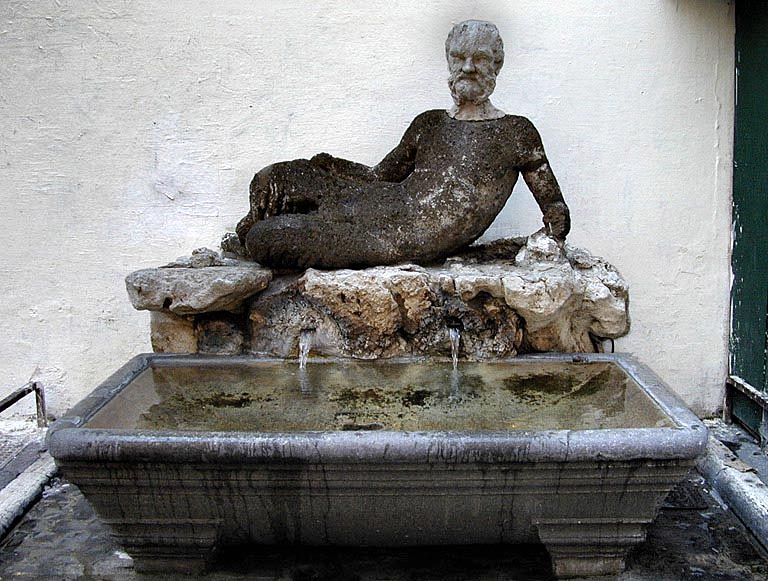
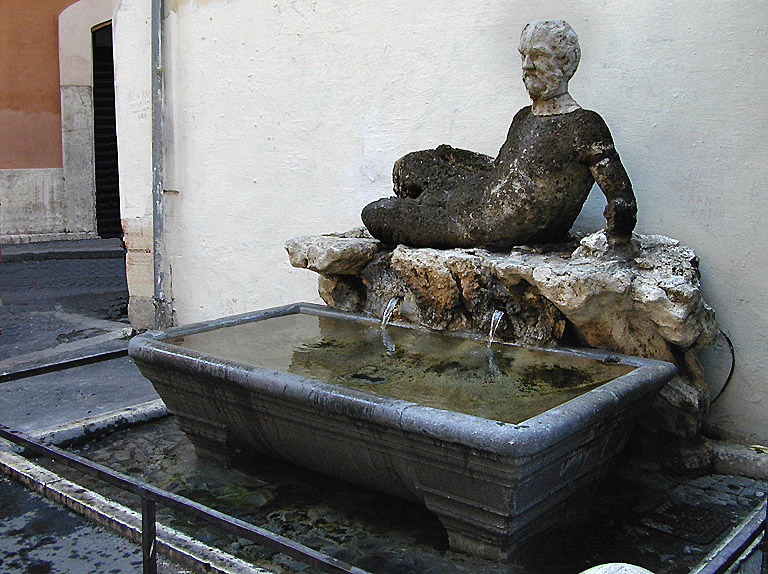
Via del Babuino Babuino Fountain It was Pope Pius IV Medici (1558-1565) who established the custom of the so-called “semi-public” fountains: when the pope granted water to a private individual, the latter undertook to build, at his own expense, a public fountain against the wall of his property. The name Via del Babuino was given to Via Paulina at the end of the sixteenth century, when a rich merchant from Ferrara, Patrizio Grandi, having obtained water for his house and gardens, built a public fountain for the people of the area. The statue of the Satyr above the rectangular Roman bath basin of grey granite, donated by Grandi, was not at all liked by the people, who saw in it the features of “a baboon”: and so, from 1581, the old Strada Paulina changed its name and became Via del Babuino. The Babuino is one of Rome's famous “talking statues”.
Botte Fountain in Via della Cisterna
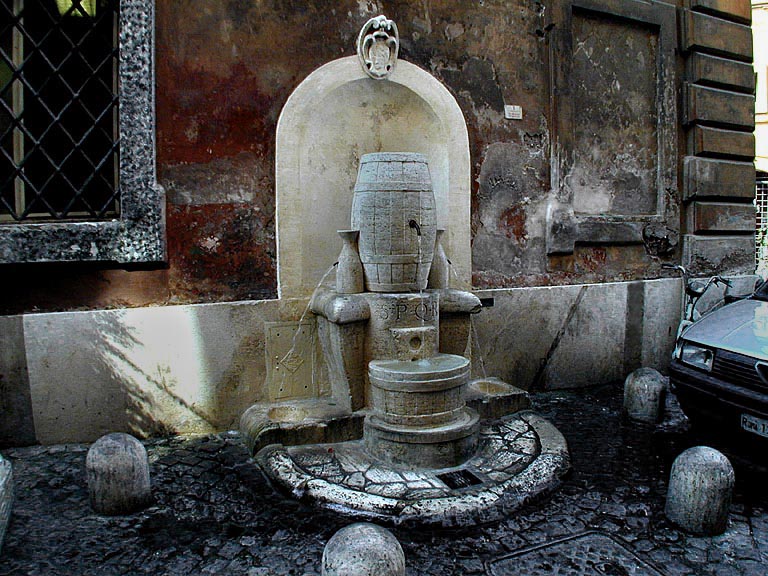
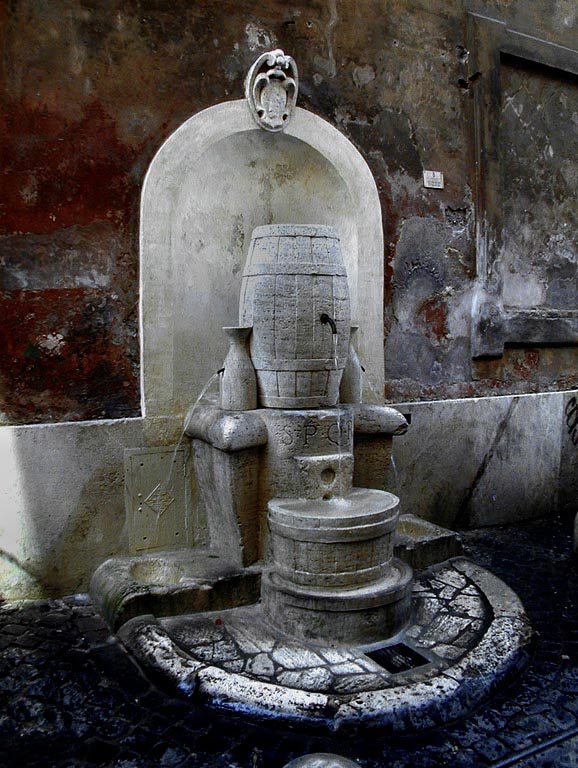
Via della Cisterna Botte Fountain In the Trastevere district, at the corner of Via della Cisterna and Via San Francesco a Ripa there was built, in 1927, the Botte Fountain, the work of the architect Pietro Lombardi, conceived to highlight the traditional presence of taverns and wine shops in this area.
The barrel, set upright on a base, is the typical “caratello” (used in the past to carry the wine of the Castelli Romani), from a hole in its centre the water flows out and is collected in a half-vat below. On either side of the barrel are two wine measures, of the kind still used in Roman taverns, from which water also flows, collecting on the ground in basins made for the purpose.
Prigione Fountain
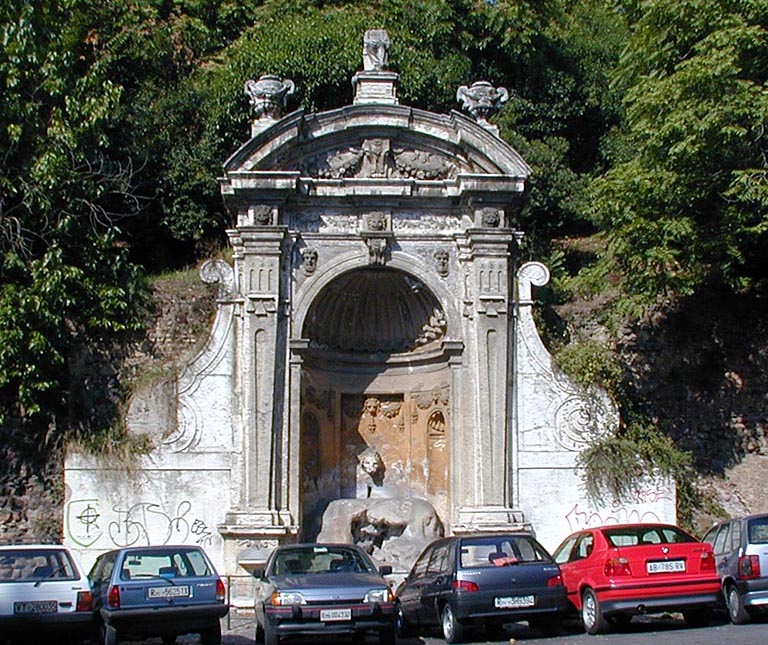
Via Goffredo Mameli Prigione Fountain The Villa Montalto, the estate of Sixtus V Peretti (1585-1590) on the Esquiline hill was the largest private property within the city walls, but at the end of the 19th century, in 1877, to be precise, the whole area was divided into building lots to make way for Termini station, Piazza dei Cinquecento and other modern districts.
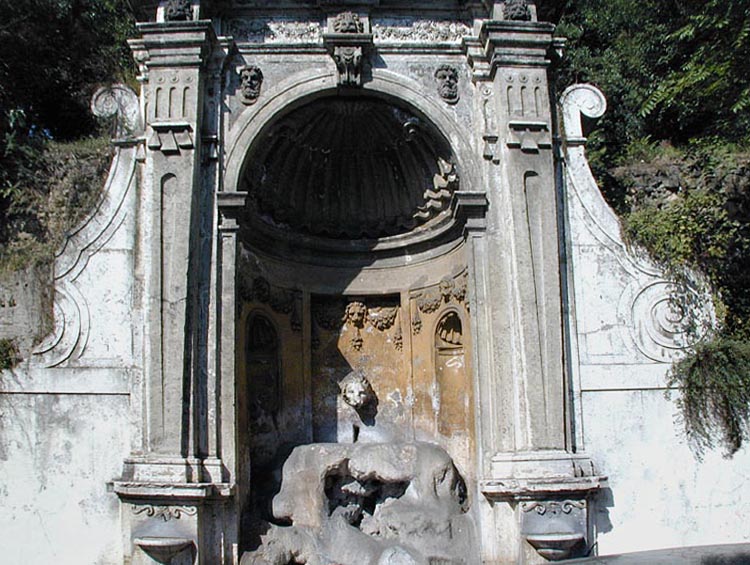
The only fountain to survive the destruction of the villa, also the work of Domenico Fontana, was rebuilt in 1938 on the slopes of the Janiculum as a backdrop to Via Manara.
Today the fountain has a large niche (framed by two pilasters and surmounted by a richly decorated pediment), in the centre of which water flows from a lion's head and collects at ground level in a basin protected by six small columns. The statue of the prisoner that gave this fountain its name has been lost over time.
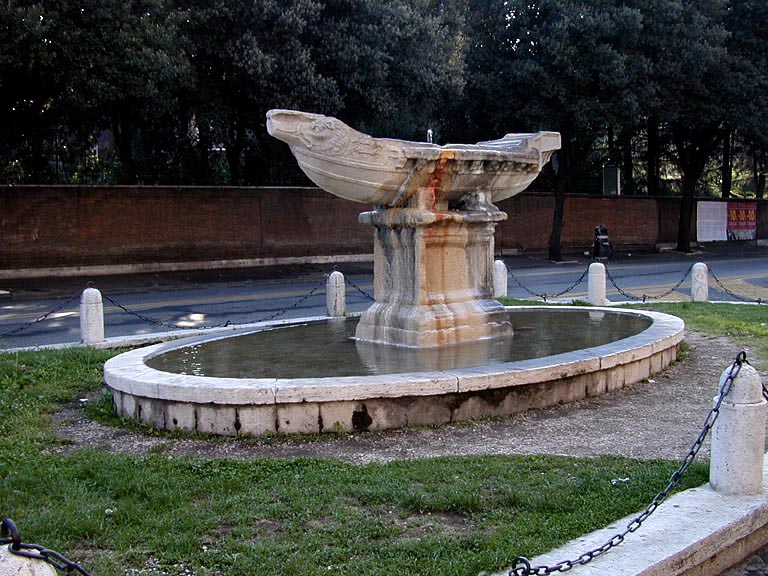
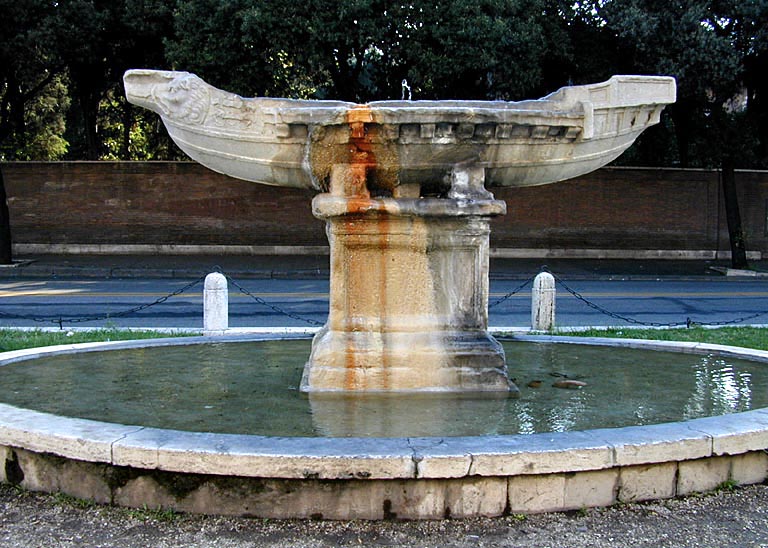
Navicella Fountain
Via della Navicella Navicella Fountain On the Caelian hill, in front of the church of Santa Maria in Domnica, also known as “in navicula”, which was restored by Cardinal Medici (later pope with the name of Leo X) and on whose ceiling several small boats appear adrift among the waves, stands the so-called Navicella Fountain, probably designed by Sansovino and dating from the early sixteenth century (1518-19).
The marble boat, representing a Roman galley, is said to have been inspired, according to legend, to an ex-voto offered by sailors to Isis, protectress of sailors; from the centre of the deck of the little ship, which stands on a base adorned with the coats of arms of Leo X,, rises a jet of water that is collected in the oval travertine basin below.
Cannonball Fountain
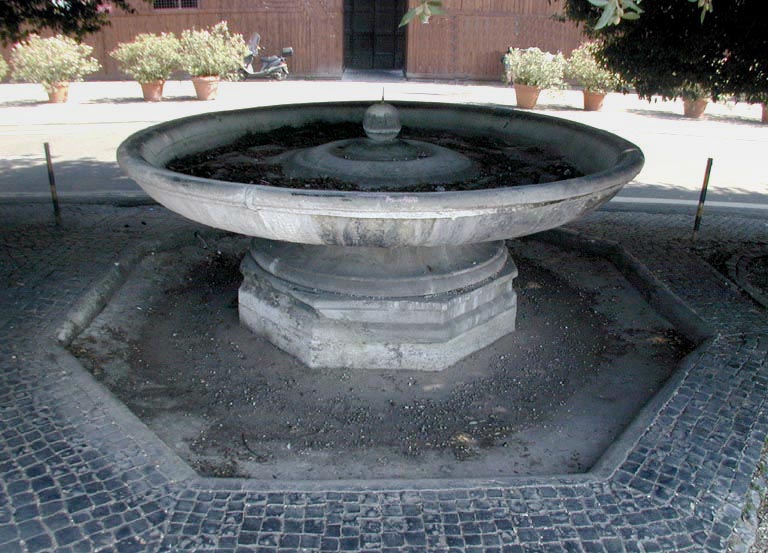
Viale della Trinità dei Monti Cannonball Fountain The Cannonball Fountain in Viale della Trinità dei Monti.
Simple but decidedly elegant in the perfection of its proportions is the small fountain at the edge of the open space in front of the majestic Villa Medici.
Commissioned by Cardinal Ferdinando Medici in 1589 and executed by Annibale Lippi, the fountain has passed into legend, for it is said that the white marble sphere set in the centre of the circular granite bowl, from which the jet of water rises, was fired at the door of Villa Medici by Christina, Queen of Sweden. She, who came to Rome in 1655 on a visit and stayed for 34 years, that is, for the rest of her life, was a highly cultured woman of bold temperament.
The fountain, made up of ancient finds, has an octagonal basin in the centre of which a sturdy pillar supports the beautiful circular bowl with rounded edges, in the centre of which is the “cannonball” itself.
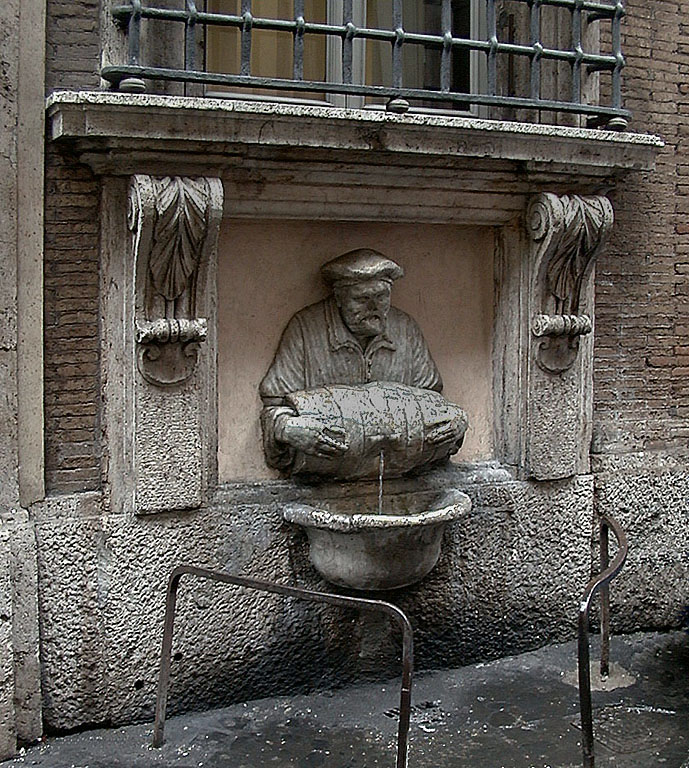
Facchino Fountain in Via Lata
One of the best known “talking statues” (its interlocutor being the famous and caustic Pasquino), the so-called Facchino represents a water-carrier in his characteristic costume. According to others, however, it is dedicated to the wine porters and portrays the features of a certain Abbondio Rizzio, renowned for his strength and his ability to drink large quantities of the wine he carried. The work, of uncertain origin, has been attributed to Jacopo Del Conte, who is thought to have made it between 1587 and 1598.
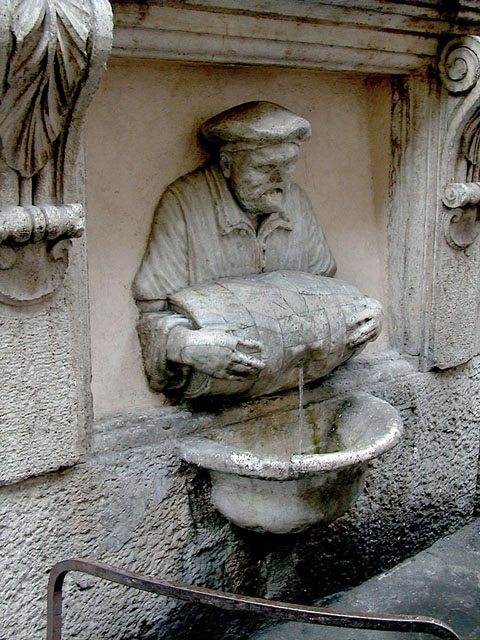
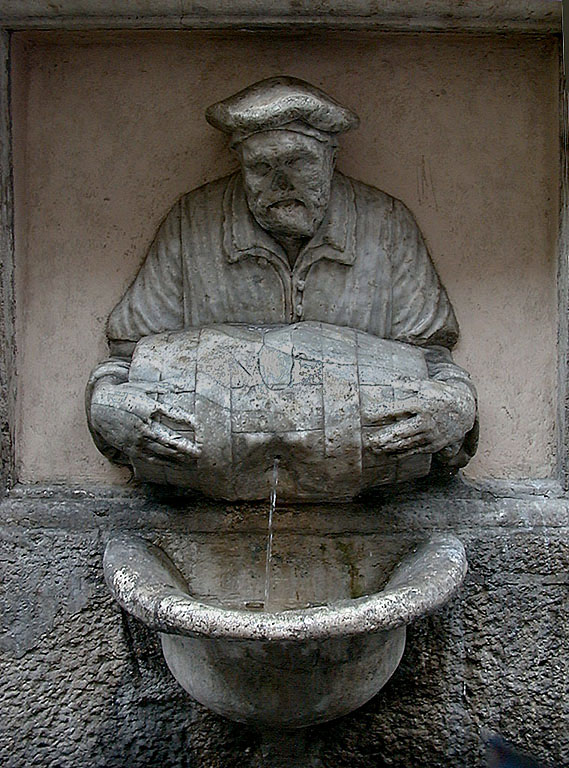
via margutta — Fountain of the Artists in Via Margutta
Designed by the architect Pietro Lombardi, it was built in 1927 and represents a collection of the symbols of artists. From an original triangular base rise two painter's easels, on whose ledges rest the two masks, one sad, the other cheerful, underlining the changing fortunes of the profession.
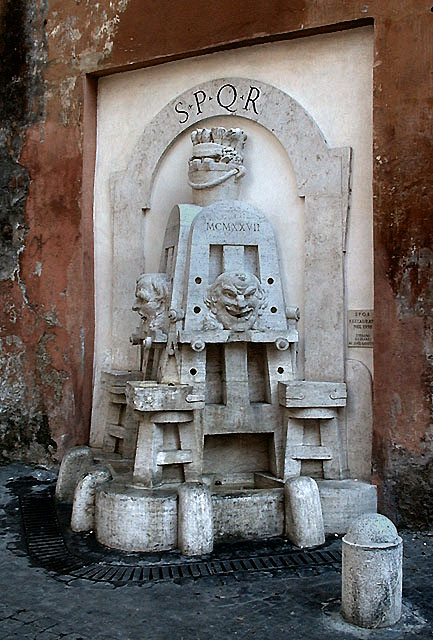
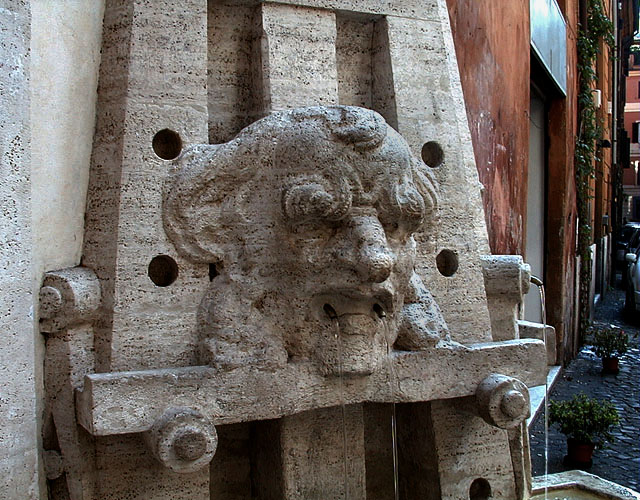
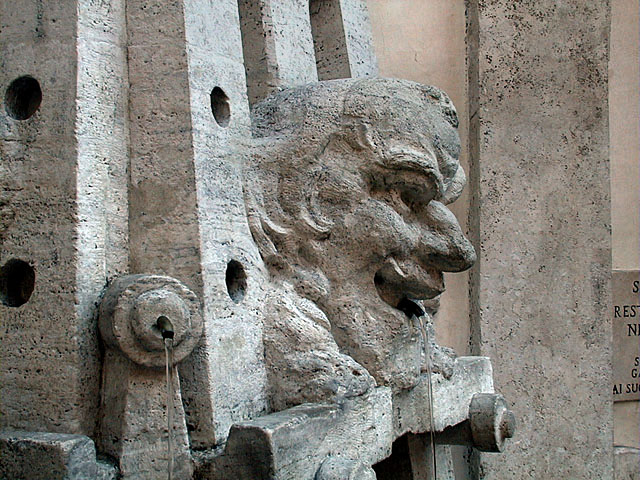
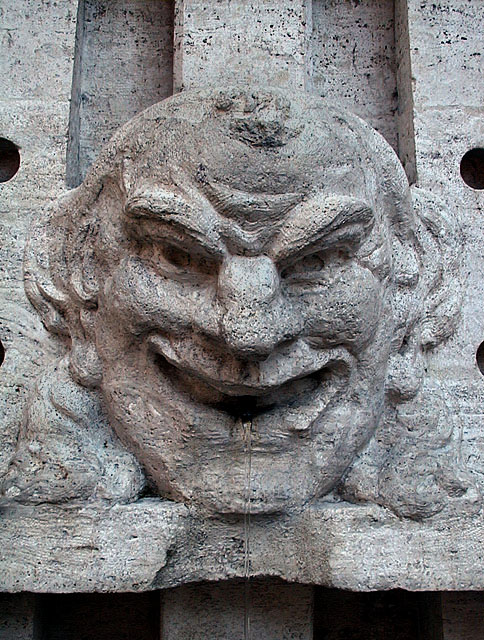
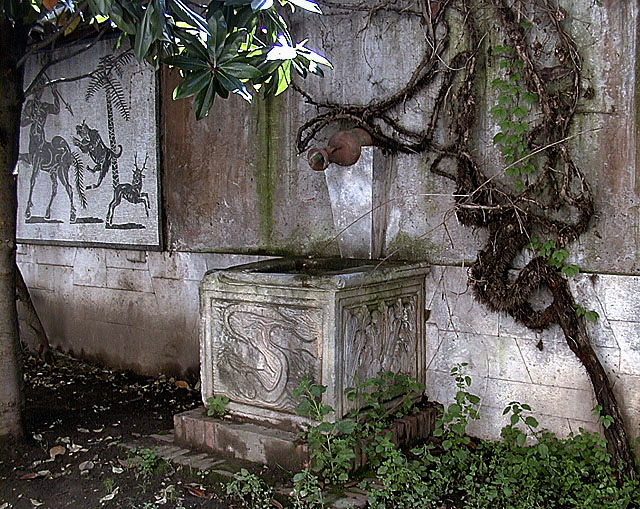
via margutta — Courtyard Fountain in Via Margutta
The tilted terracotta amphora, pours water into a square white marble basin of the Roman period.
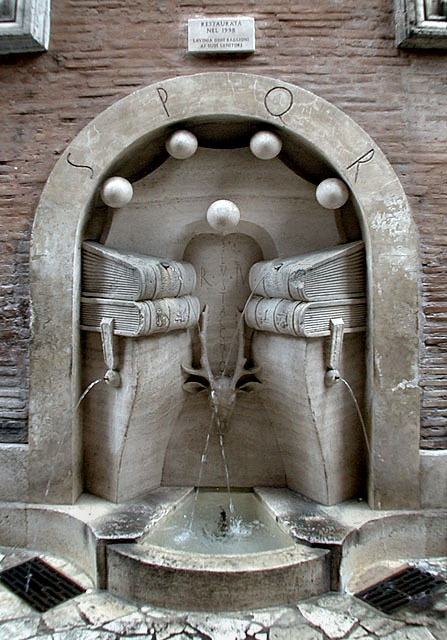
Fountain of the Books in Via Straderari
The Fountain of the Books was made in travertine in 1927 to a design by Pietro Lombardi for the rione of Sant'Eustachio, which is why the emblem of the rione, a stag's head, appears in the niche, surrounded by four antique books, perhaps as a reminder of the nearby Sapienza University. Inside the basin, the inscription with the name of the rione bears a wrong number: IV instead of VIII.
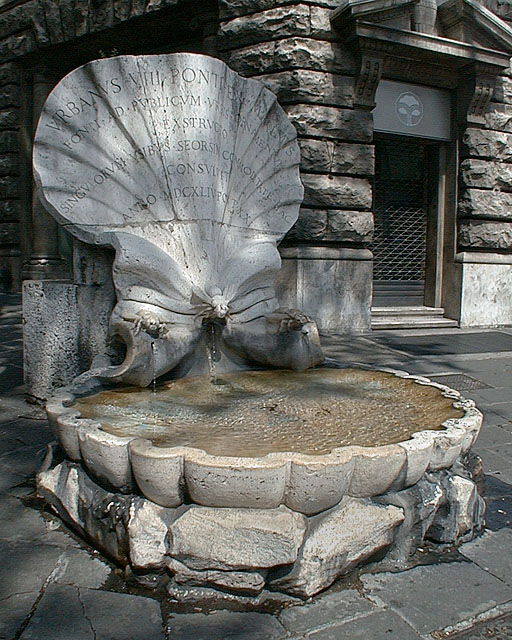
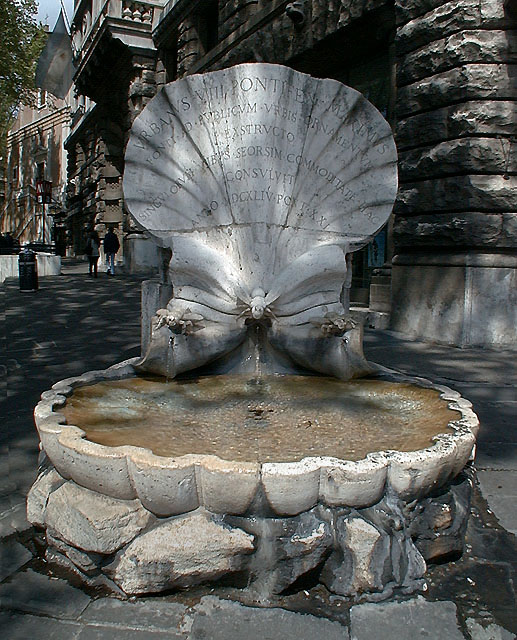
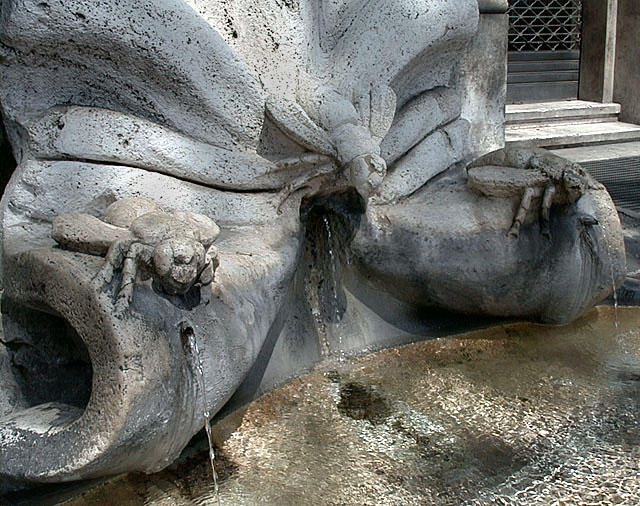
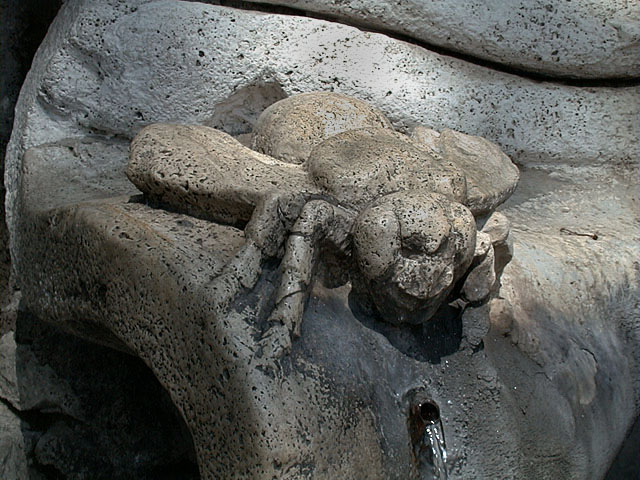
Fountain of the Bees in Via Vittorio Veneto
Immediately after the completion of the Triton fountain, Bernini was commissioned in 1644 to make a small fountain for watering horses, as it was customary to build one beside monumental fountains. The work, a brilliant example of the Roman Baroque, was dismantled in 1867 and taken to one of the municipal storehouses at Testaccio. In January 1916, under pressure from scholars, it was reassembled with the few original pieces that had been found, in a far from faithful execution (a glance at the drawing made in 1665 by the Dutchman Lievin Cruyl is enough to see this).
Fountain of the Winged Victories in Villa Borghese
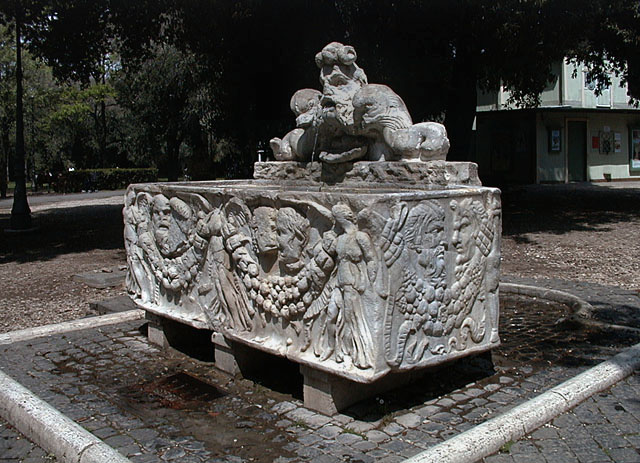
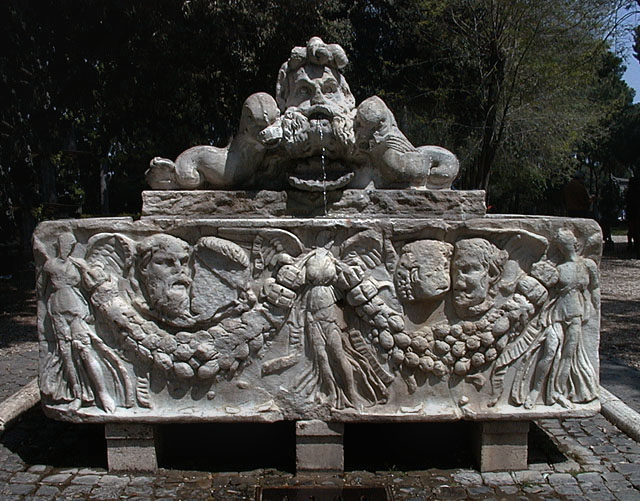
It consists of a Roman sarcophagus, on which winged Victories are depicted among festoons of fruit and masks, and of two dolphins placed on either side of a large mask that pours water into the basin below. The mask (by Della Porta) is one of the four from the fountain in Piazza della Rotonda, moved here at the end of the nineteenth century. The other three are probably stored in some municipal warehouse.
Square fountains
Acea, Acea Fountain
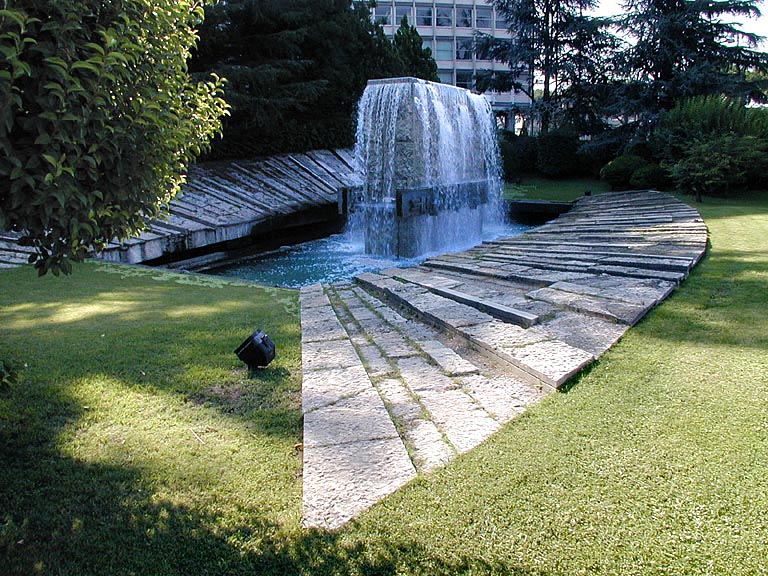
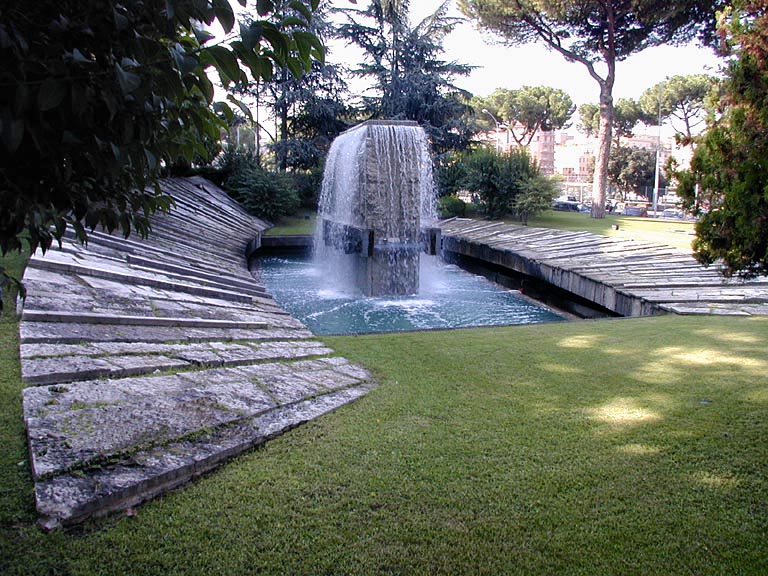
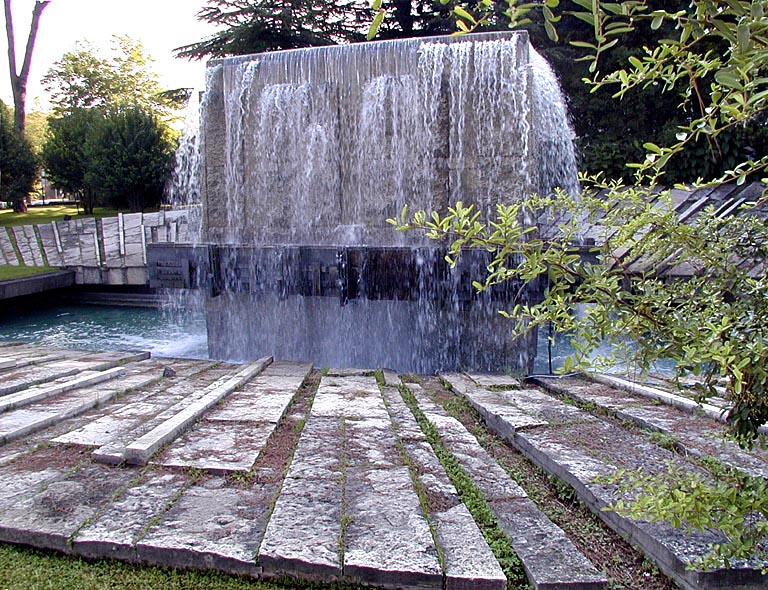
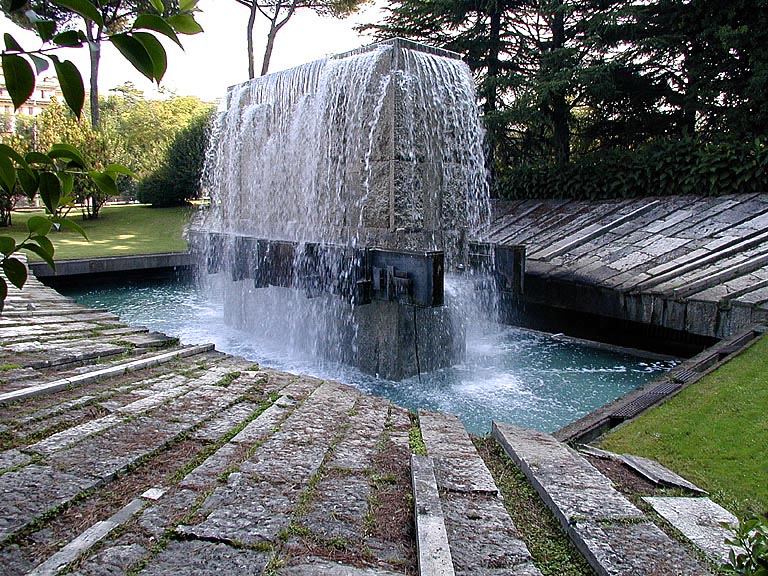
Piazzale Ostiense Acea Fountain In front of the headquarters of Acea (the municipal energy and environment company), one can admire a modern fountain set in a large green space, built in 1962 to designs by the architects Ugo Macrì, Giorgio Quaroni and Americo Romitelli, winners of a competition held specifically for the purpose. Above a large oblong basin rise vertical structures decorated with bas-reliefs, from the top of which water gushes out and falls back in a cascade. The fountain is particularly striking at night, when it is skilfully illuminated.
Acqua Acetosa Fountain
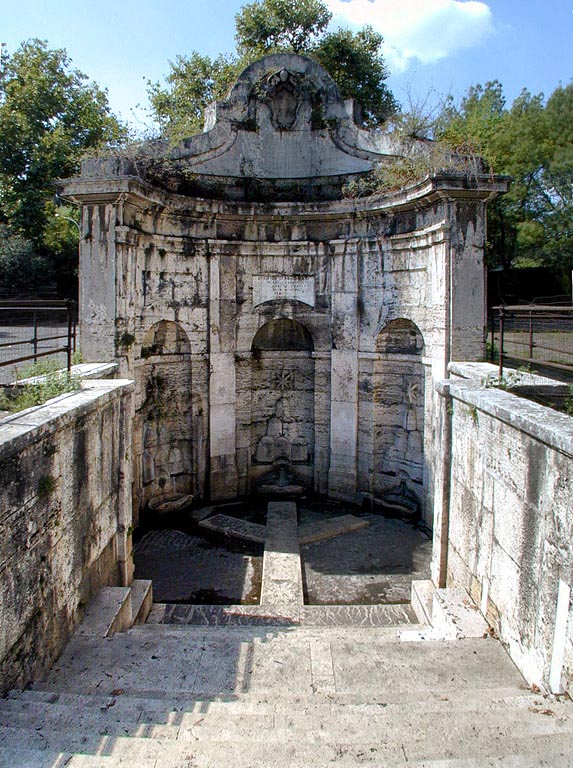
Piazzale dell'Acqua Acetosa Acqua Acetosa Fountain At the beginning of the 17th century (1613) Pope Paul V Borghese (1605-1621) had a simple fountain built in the open countryside, along the right bank of the Tiber near Tor di Quinto, at the spot where a spring of acidulous, ferruginous water rose that was considered “good for the kidneys, stomach, liver, spleen and a thousand other ills”. It was, however, the “town-planner” pope Alexander VII Chigi (1655-1667) who had the handsome nymphaeum fountain with its enveloping lines, which has survived to this day, designed and built. The design of this delightful work, worthy of the finest private park, was long attributed to Bernini; it seems instead to be the work of a painter, Andrea Sacchi, who for the drawings enlisted the collaboration of the architect Marcantonio de Rossi. After the Acqua Acetosa spring was found to be polluted (at the end of the 1950s) the fountain was long abandoned; today this fine and elegant Baroque fountain has at last been restored, but it no longer pours out Acqua Acetosa, only ordinary drinking water.
Fountain in Piazza Sant'Andrea della Valle
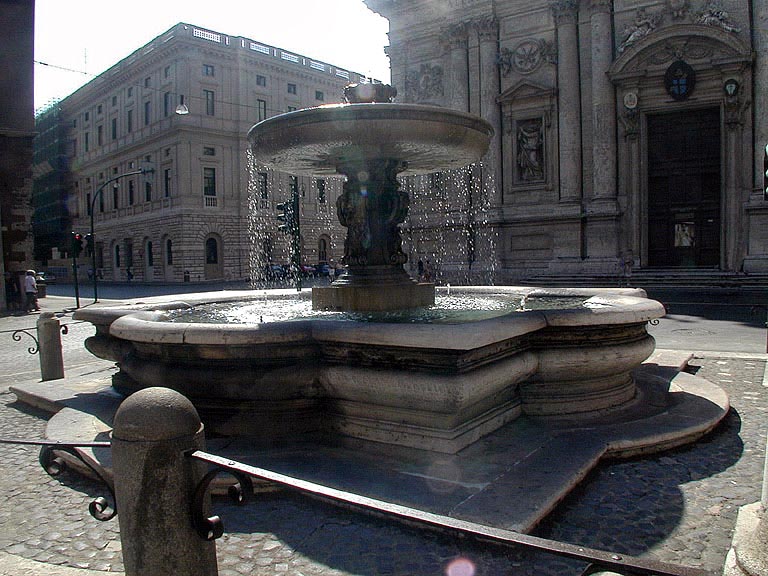
Piazza Sant'Andrea della Valle Fountain of the Square Commissioned by Pope Paul V Borghese (1605-1621) for the square of the church of Santa Maria in Traspontina, the fountain, built to a design by the architect Carlo Maderno, takes up classical motifs: it consists of an elegant mixtilinear basin resting on a base that repeats its shape. In the centre of the basin, supported by a base decorated with dragons and eagles (the emblem of the Borghese), is a circular bowl, now in cement, which reproduces the marble original, sadly lost. A jet of water rises above the bowl and falls back into the basin below, where four more jets rise from the surface of the water.
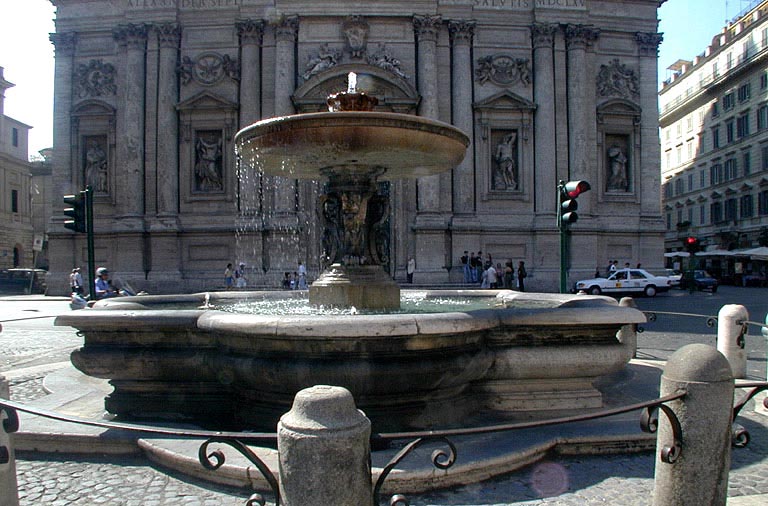
Fountain in Piazza Aracoeli
Towards the end of the 16th century, in 1589, during the pontificate of Sixtus V Peretti (1585-1590), Giacomo della Porta created the harmonious fountain in Piazza d'Aracoeli, at the top of which four putti, back to back, pour water from the amphorae they hold in their hands. During a 19th-century restoration of the fountain, which stands at the foot of the Campidoglio, the large original oval basin was replaced by the present circular one; at that time the two steps shaped to follow the lines of the basin above were also removed. The designer had intended them not for those who wished to draw water, but as a pedestal for the fountain, which appeared to rise from the waters of the wide oval basin.
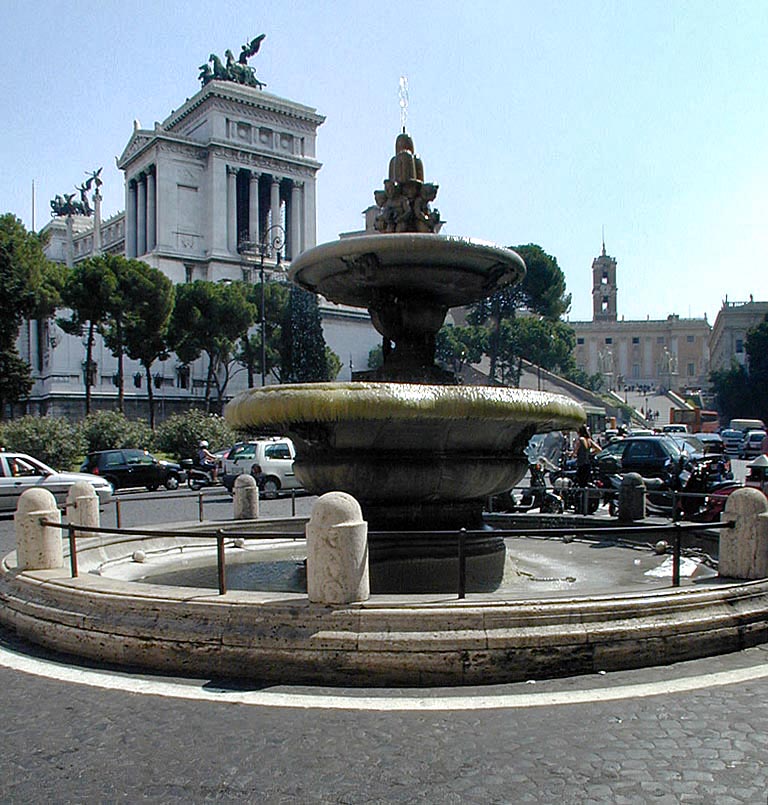
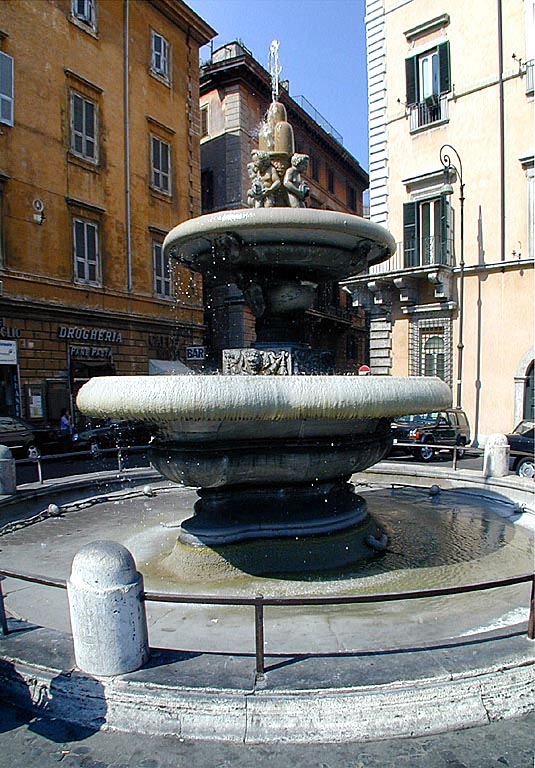
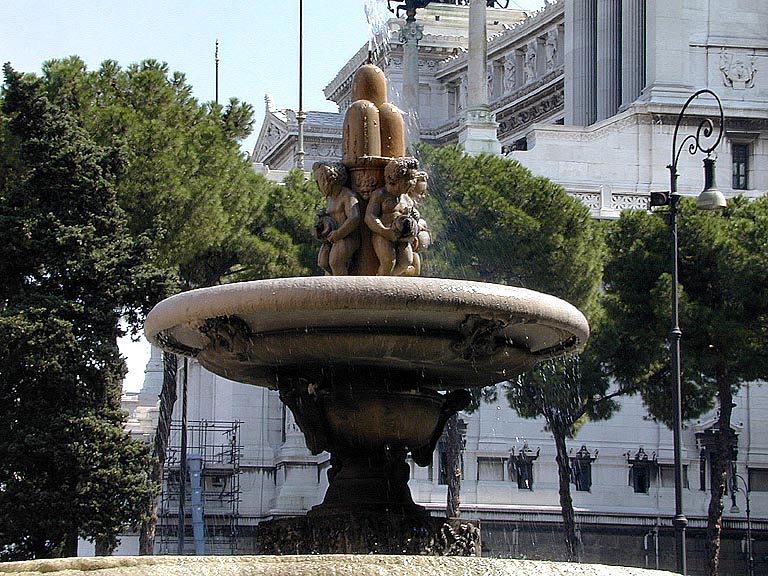
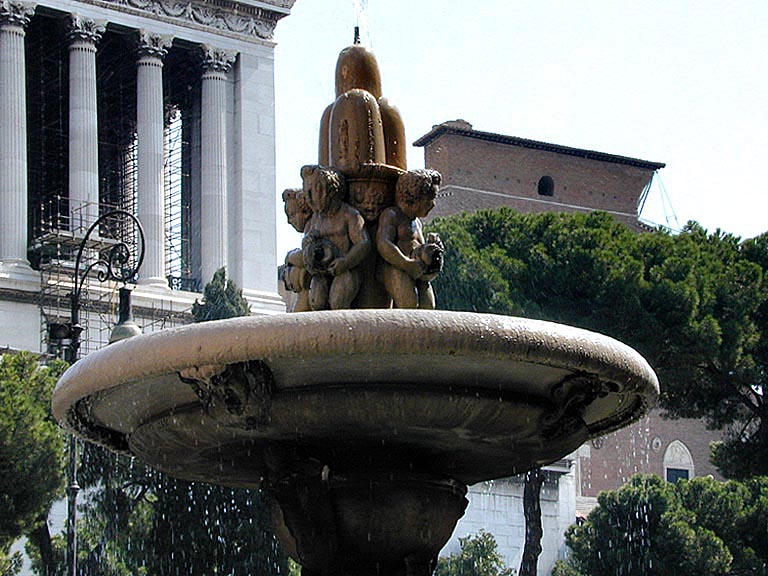
Fountain of the Tritons
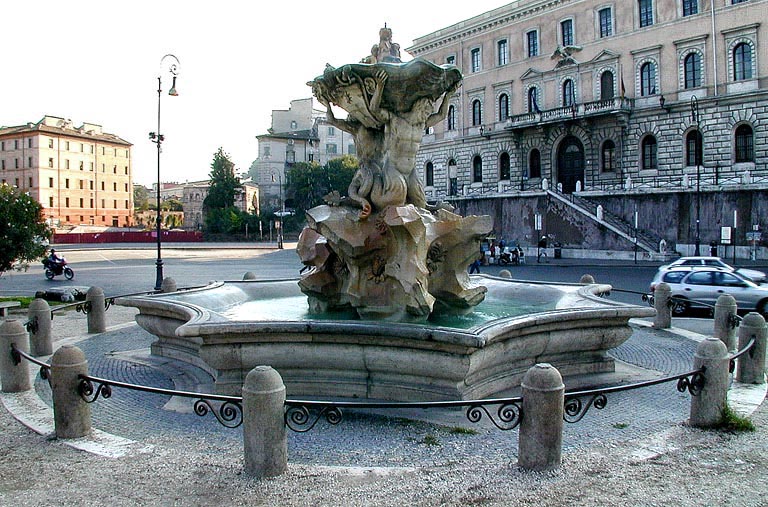
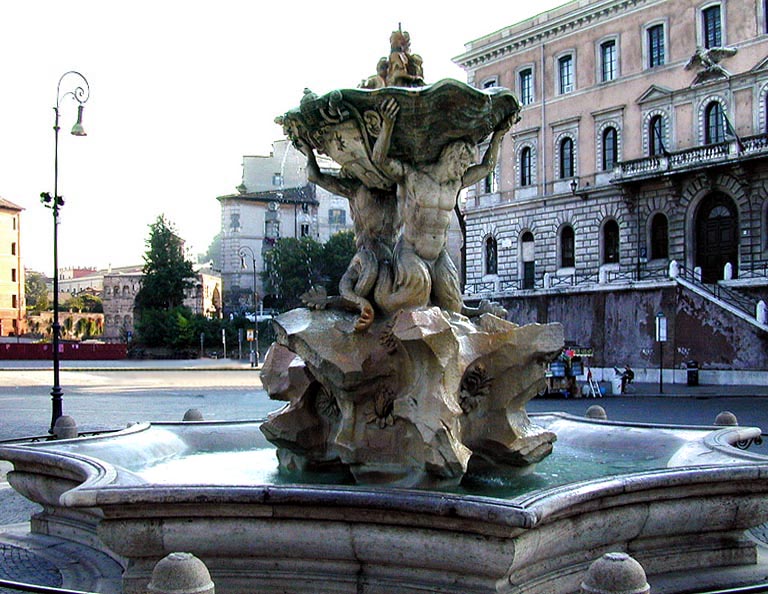
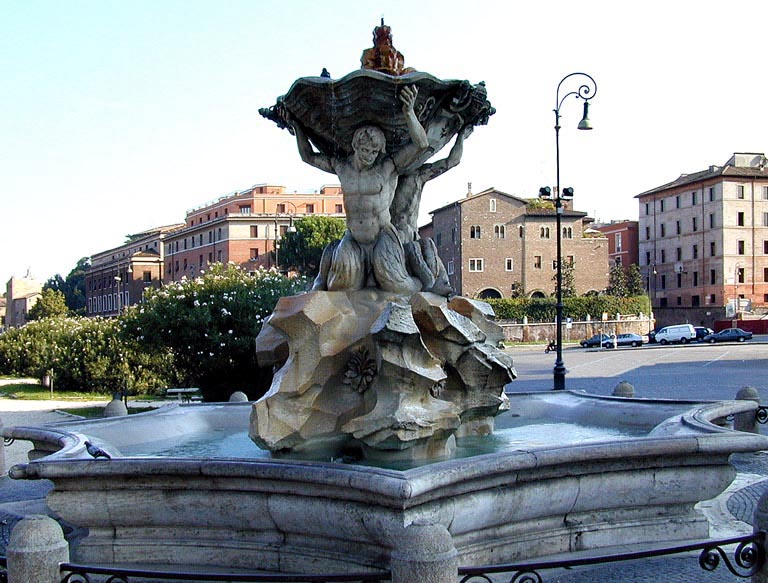
Piazza della Bocca della Verità Fountain of the Tritons This 18th-century fountain, also known as the fountain “of the tritons”, was built in 1717 to a design by the architect Carlo Bizzaccheri, who conceived the star-shaped basin in honour of Pope Clement XI Albani (1700-1721), whose coat of arms indeed shows an eight-pointed star above a symbol representing three mountains. In the centre of the basin, on some rocks, two tritons placed back to back with their tails intertwined support a shell-shaped bowl bearing the papal arms. The fountain, which stands in an evocative setting, has unfortunately always suffered from a shortage of water. Clement XI deserves to be remembered as a pope who did much for the town planning of Rome.
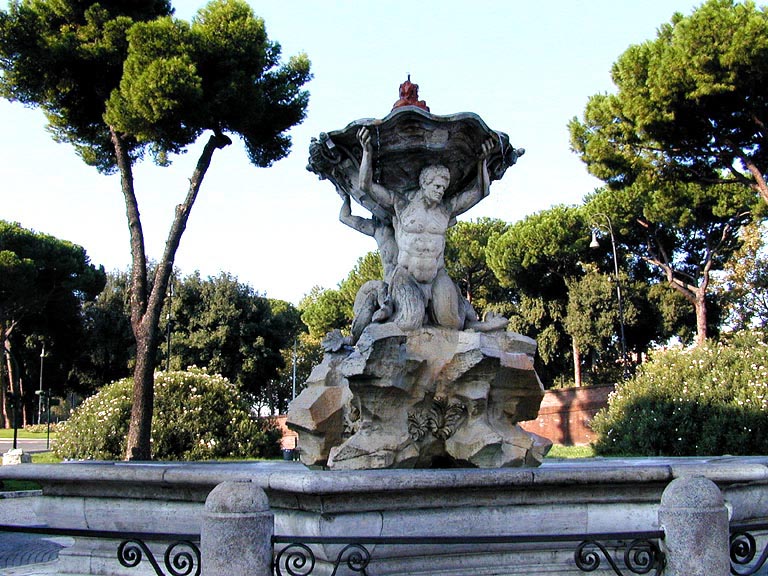
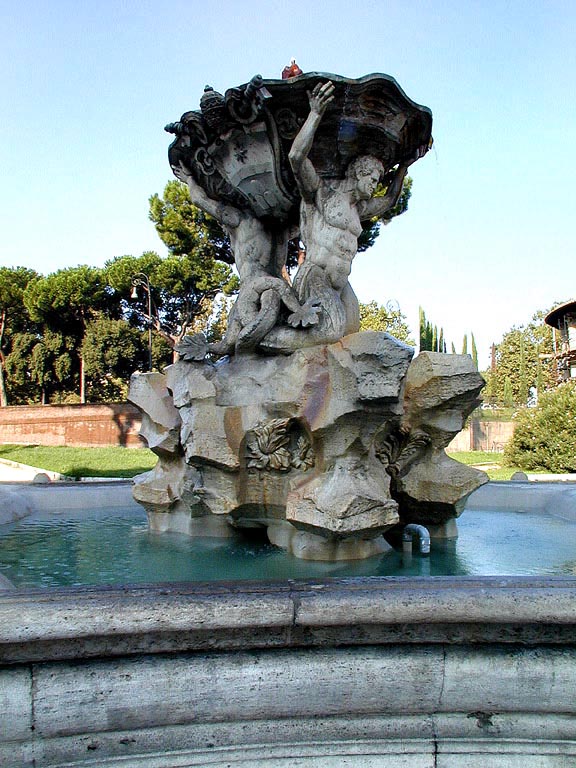
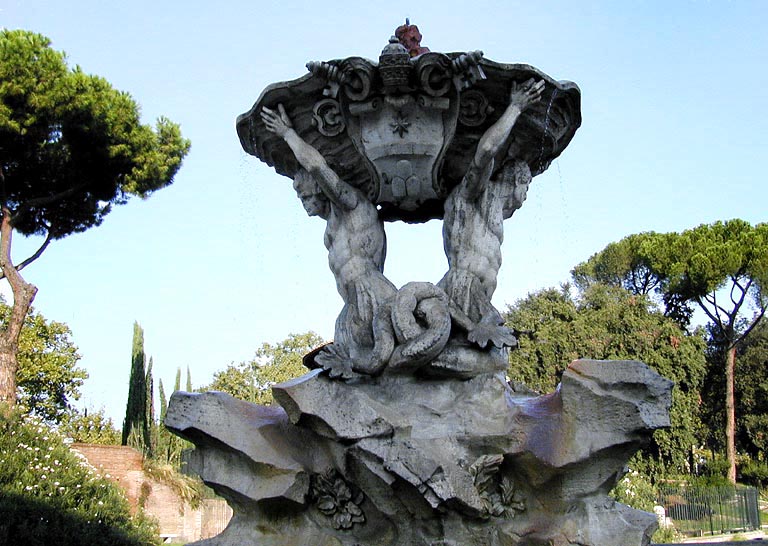
Piazza del Campidoglio — Fountain of the Goddess Roma
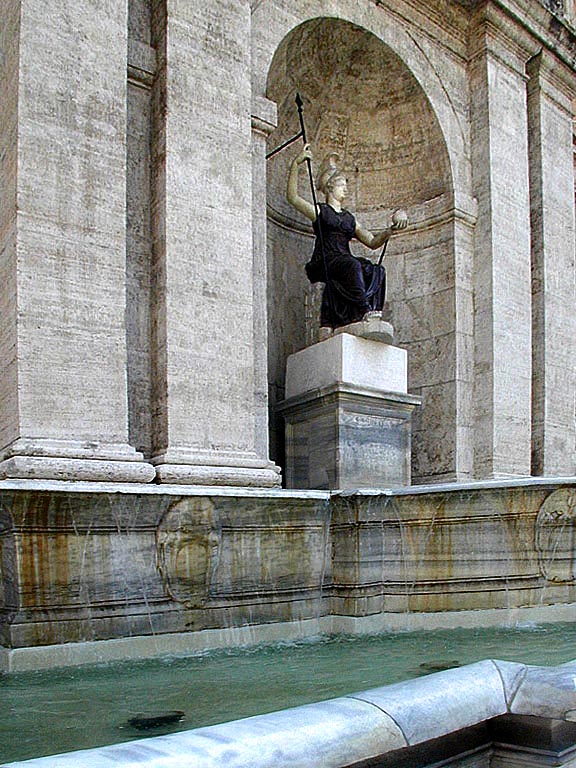
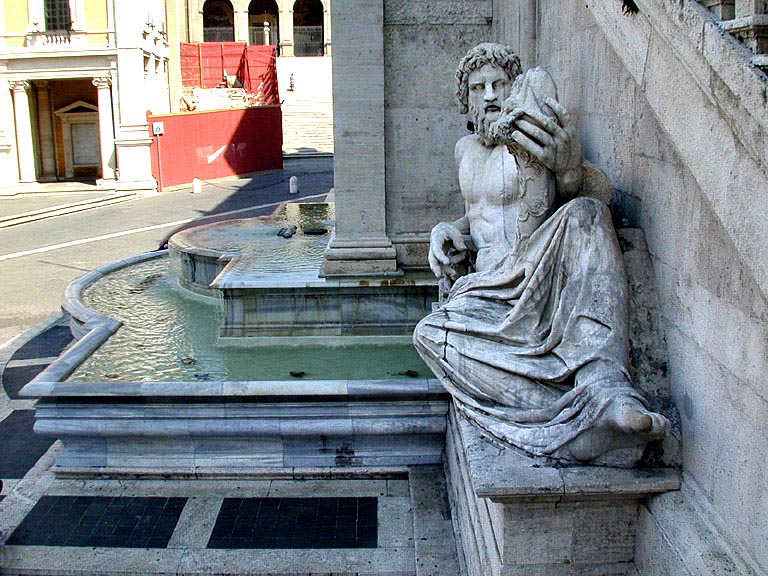
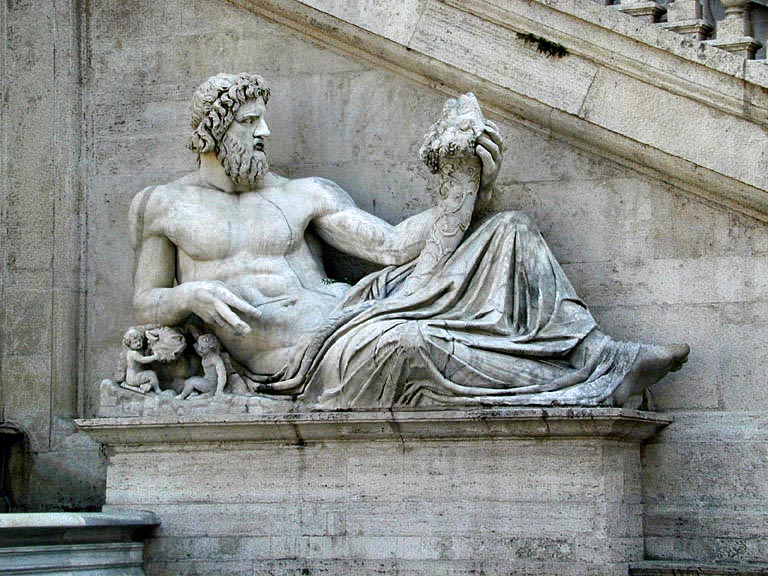
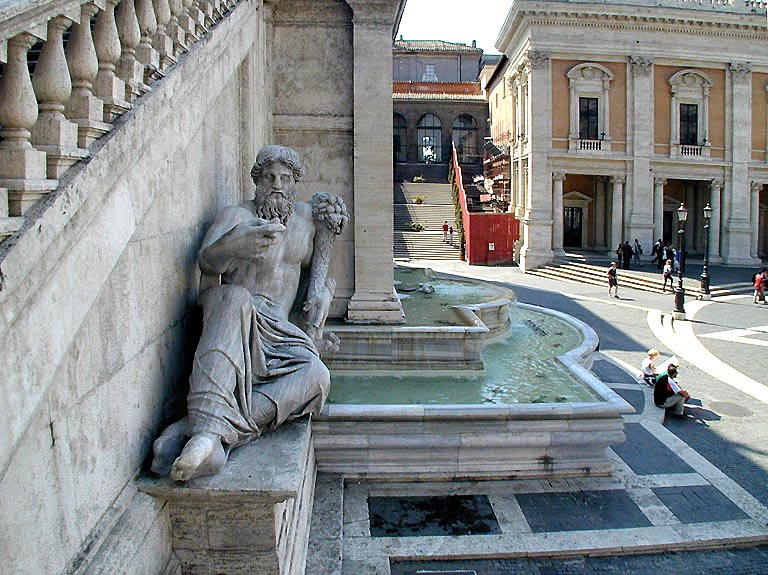
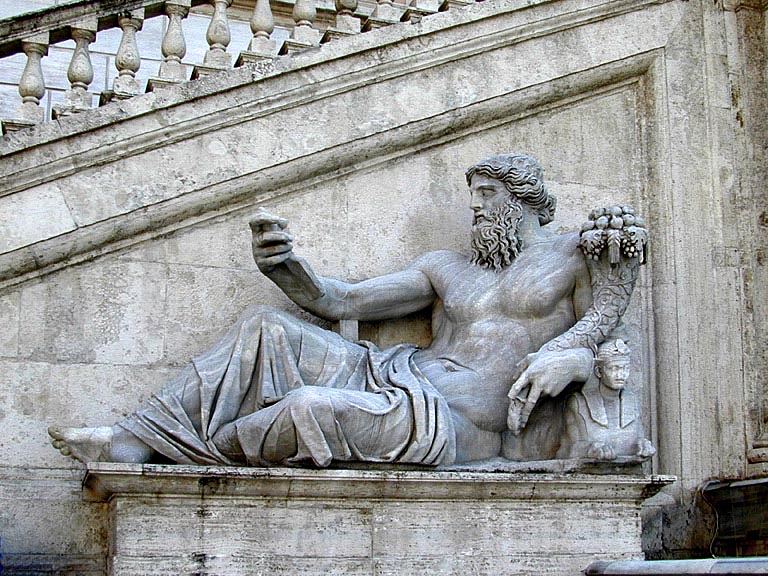
Fountain of the Goddess Roma The fountain on the Campidoglio, also known as the fountain “of the Senatorial staircase” and “of the abducted Pallas”, was conceived by Michelangelo around 1536 not as a fountain (water reached the Campidoglio some fifty years later) but as a superb ornament for the square. In the niche at the centre of the staircase Michelangelo planned to place a colossal statue of Minerva (now in the courtyard of the Museo Capitolino), which was installed in 1583 but remained there for only a decade; it was then replaced by the present, smaller statue of the goddess Roma triumphans. The statue of the goddess Roma, raised on no fewer than three bases, has its face and extremities in white marble, while the drapery is in porphyry. On either side of the large niche, in the panels of the staircase, Michelangelo placed two enormous statues representing the rivers Nile and Tigris, which originally adorned the Baths of Constantine on the Quirinal Hill. The Romans wanted to turn the Tigris into the Tiber, and so they changed the tiger into a she-wolf and placed Romulus and Remus beside it. To adapt the whole complex of the Senatorial staircase as a fountain, an idea that the architect Giacomo della Porta vigorously opposed, a competition was held (a unique case among the many Roman fountains of the 16th century); amid much controversy, it was won in January 1588 by Matteo Bartolani of Città di Castello.
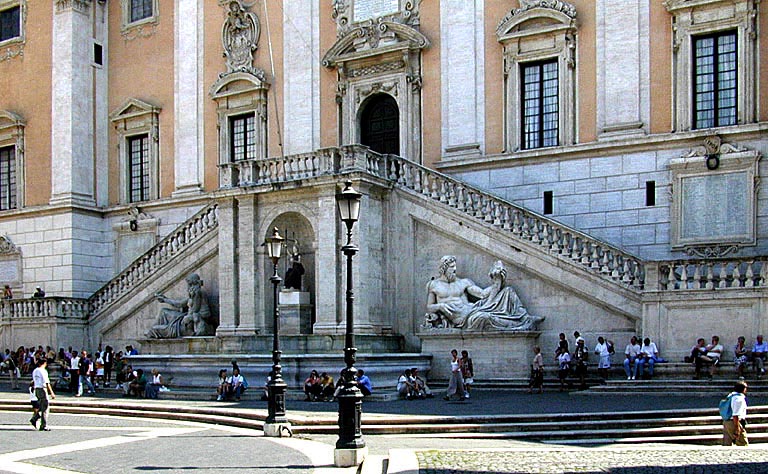
Piazza del Campidoglio — Fountain of the Lions
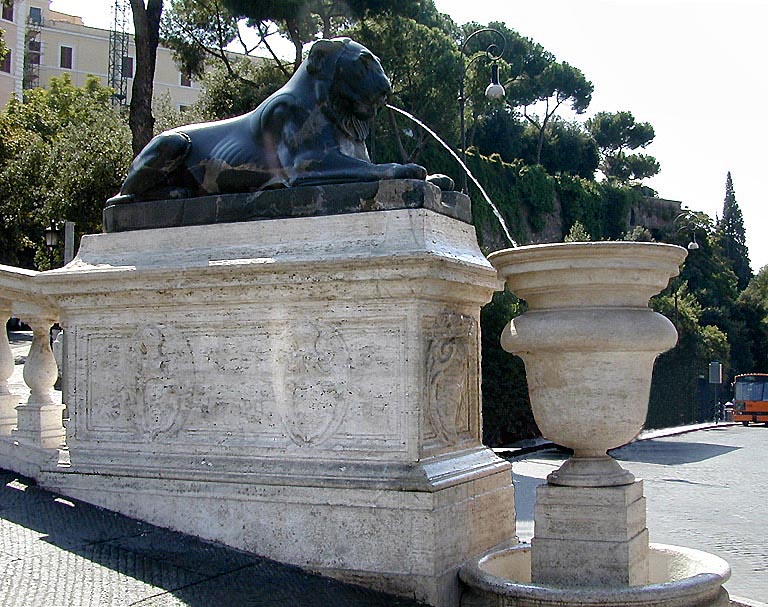
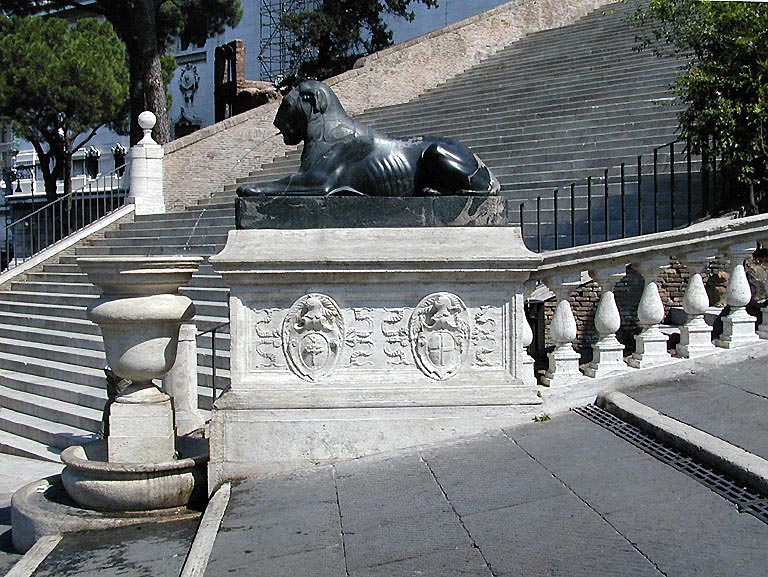
Fountain of the Lions At the foot of the steps leading up to Piazza del Campidoglio, two Egyptian lions in black Numidian basalt, which had previously adorned the entrance of the church of Santo Stefano del Cacco, were placed in 1562 on bases designed by della Porta. In 1587, when the Acqua Felice was brought to the Capitoline Hill, which had been left without running water after the interruption of the Aqua Marcia aqueduct, the two lions were modified and adapted as fountains: in 1588 the stonecutter Francesco Scardua, to a design by Camillo Rusconi, made two basins to collect the water poured from the spouts inserted in the lions' mouths. On at least two occasions, for the election of Pope Innocent X Pamphili (1644-1655) and of Pope Clement X Altieri (1670-1676), white wine and red wine instead of water were made to flow from the spouts of these fountains.
Fountain known as the “Terrina”
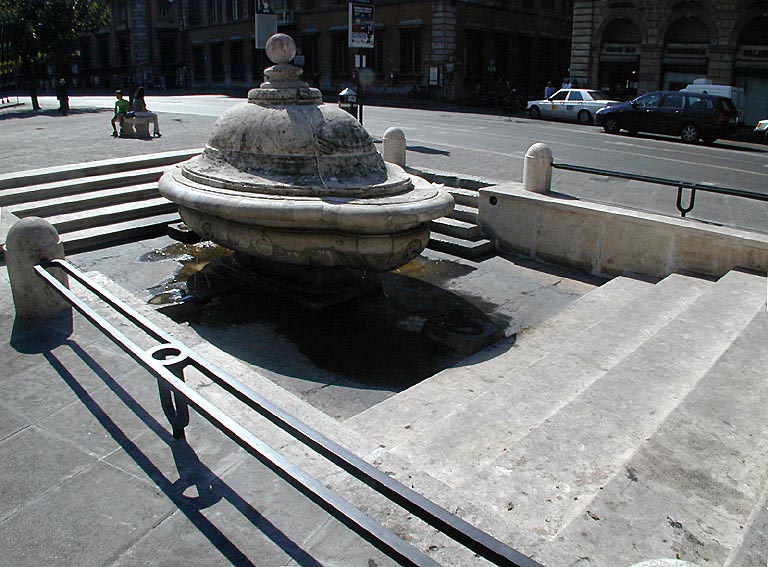
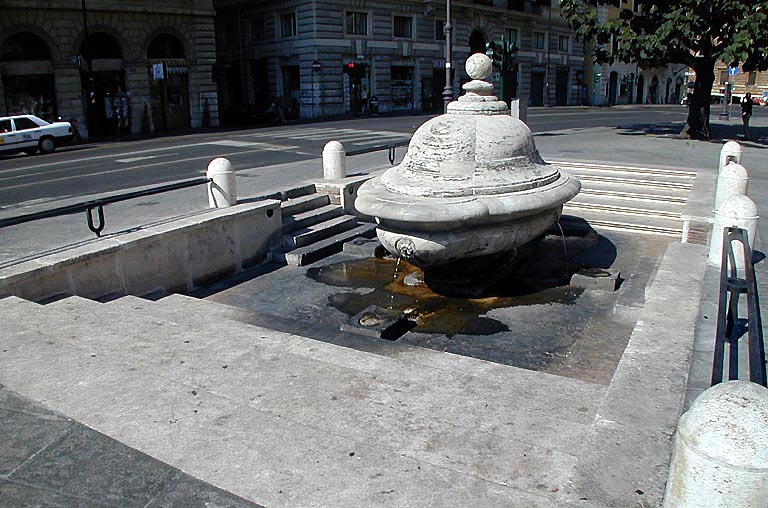
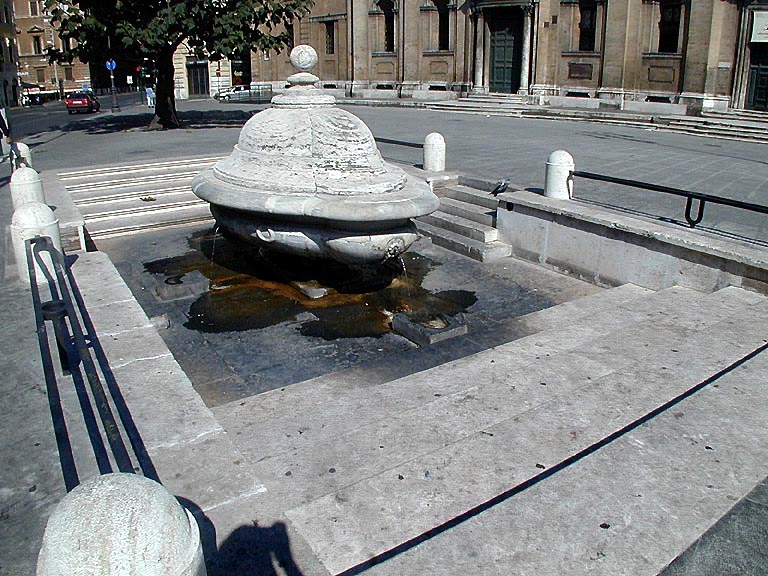
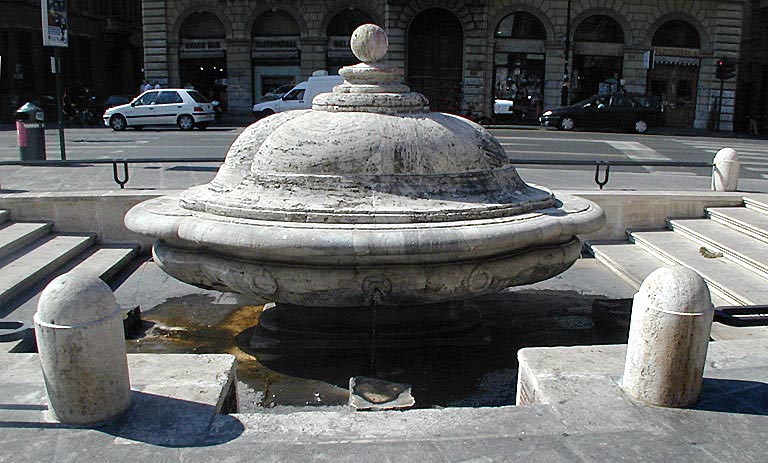
Piazza della Chiesa Nuova Fountain known as the “Terrina” At the wish of Pope Gregory XIII Boncompagni (1572-1585), around 1581 the architect Giacomo della Porta designed a fountain for Campo de' Fiori which, located in the centre of that popular square (below street level, because of the low pressure of the Acqua Vergine), was removed at the end of the 19th century when the monument to Giordano Bruno was erected. The large oval basin of white marble, adorned with four bronze dolphins (later removed and lost) and set within a large tank reached by going down two flights of four steps, was closed in 1622 by Pope Gregory XV Ludovisi (1621-1623) with a travertine lid. After this covering, ordered for reasons of hygiene (rubbish constantly fouled the water, since the square has always been the site of a market), the Romans called this fountain “la Terrina”, that is, the soup tureen. In 1924, after spending more than thirty years in storage in the municipal warehouses, the fountain was rebuilt in Piazza della Chiesa Nuova.
Fountain in Piazza delle Cinque Scole
Piazza delle Cinque Scole Fountain of the Square This fountain, also known as the fountain of Piazza Giudia (or Giudea) because it came from the square of the old ghetto, demolished in 1888, is considered one of the happiest creations of the architect Giacomo della Porta. The stonecutter was Pietro Gucci. On a base formed by two steps stands an elongated white marble basin with a mixtilinear plan, in the centre of which a baluster supports a circular bowl with a central jet; from the bowl the water is poured into the basin below through four masks inspired by the Gorgons, hence with snakes in their hair, which spout water from their gaping mouths.
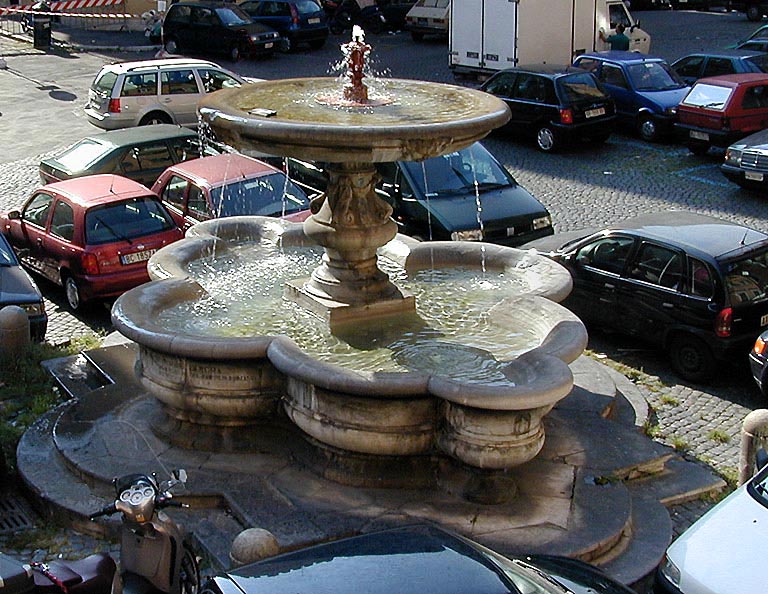
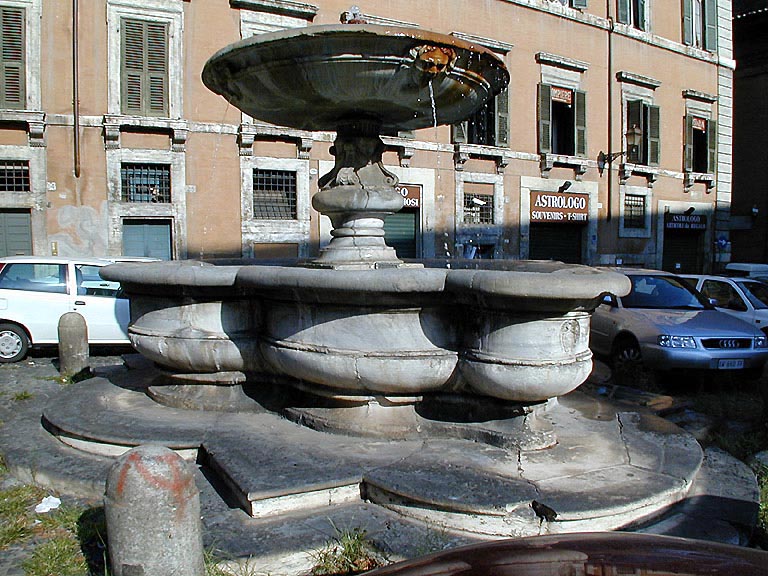
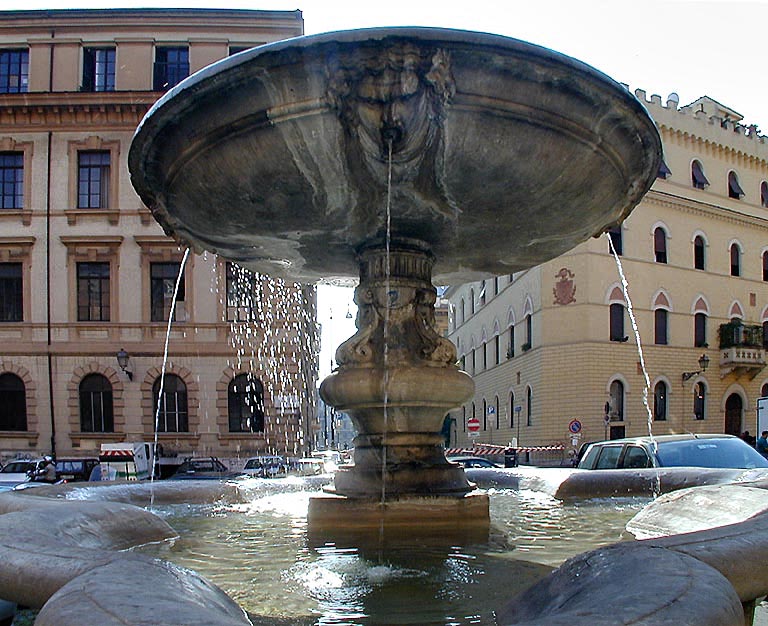
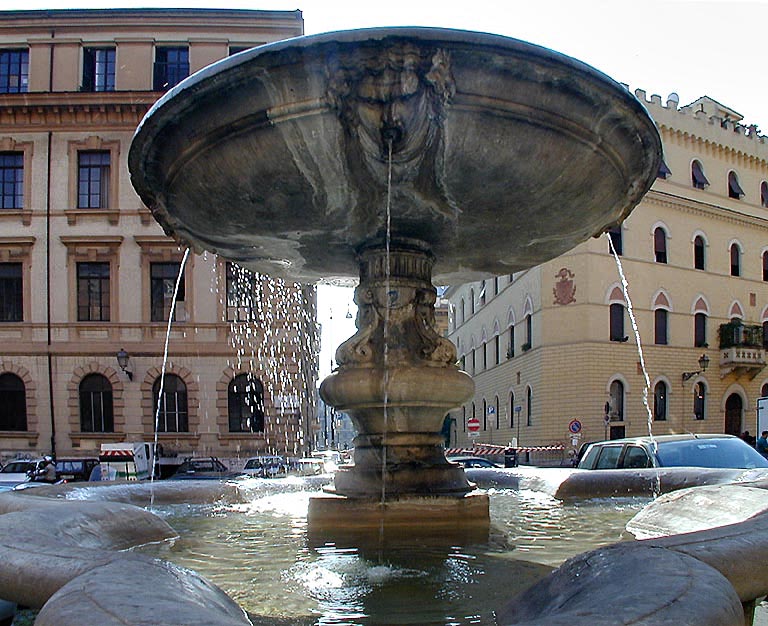
Fountain of the Amphorae
Piazza dell'Emporio Fountain of the Amphorae In the 1920s the architect Pietro Lombardi won a competition held by the City of Rome for the design of a number of district fountains. His most majestic work is the Fountain of the Amphorae, conceived for the Testaccio district where, over the centuries, a small hill was formed from the broken amphorae coming from the nearby river port of Ripa Grande. Lombardi's fountain, made of travertine, is circular in plan and divided into four sectors by as many flights of steps; in each sector, hollowed out as a basin, water pours from an amphora, while volutes and small pillars link the steps to the massive central group of amphorae above.
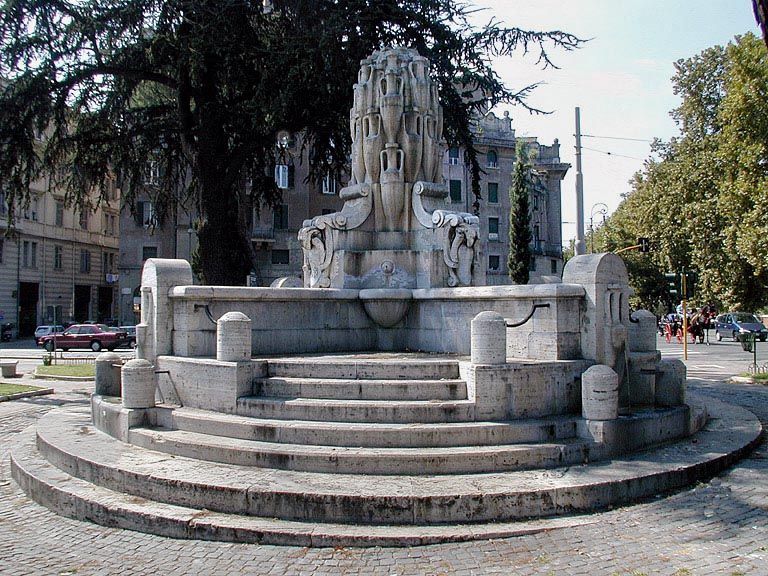
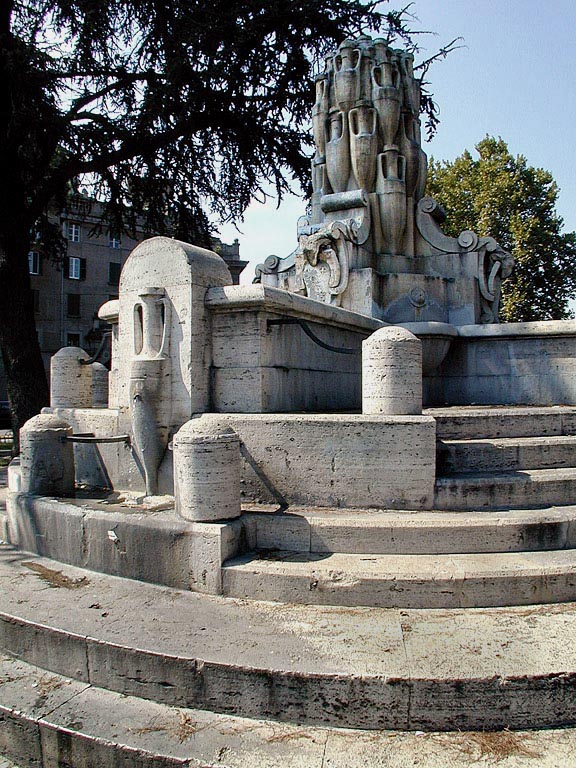
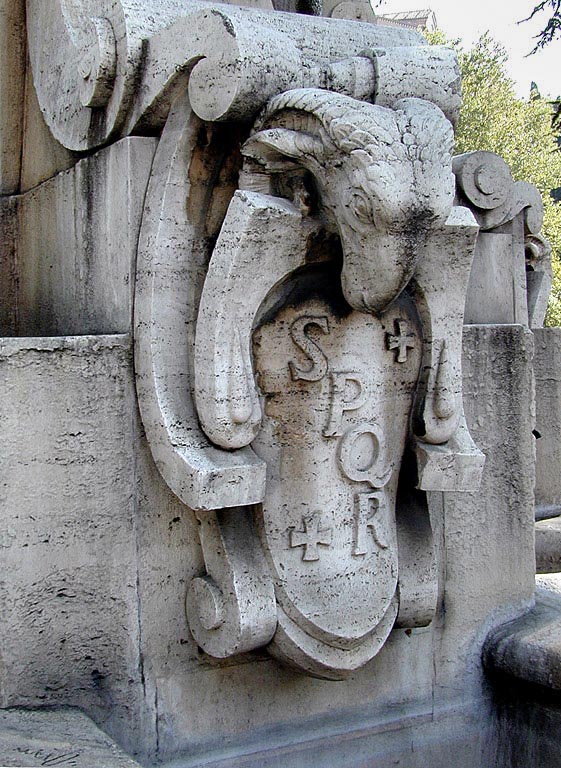
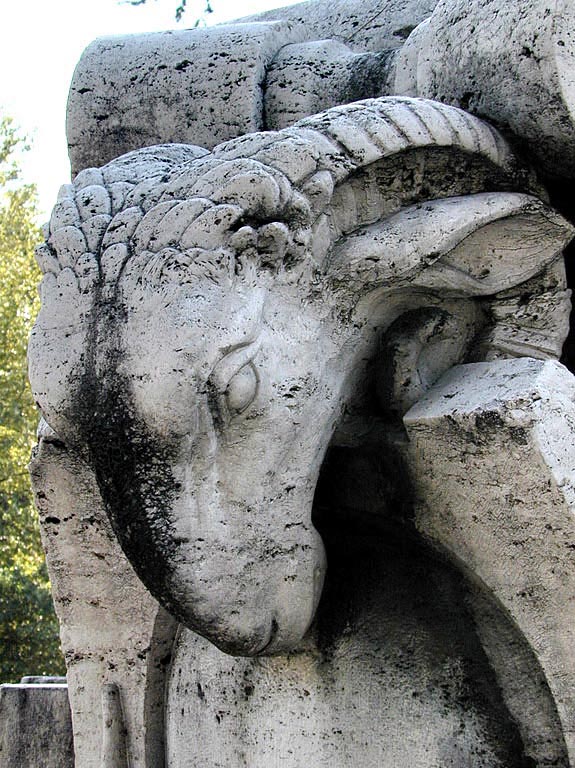
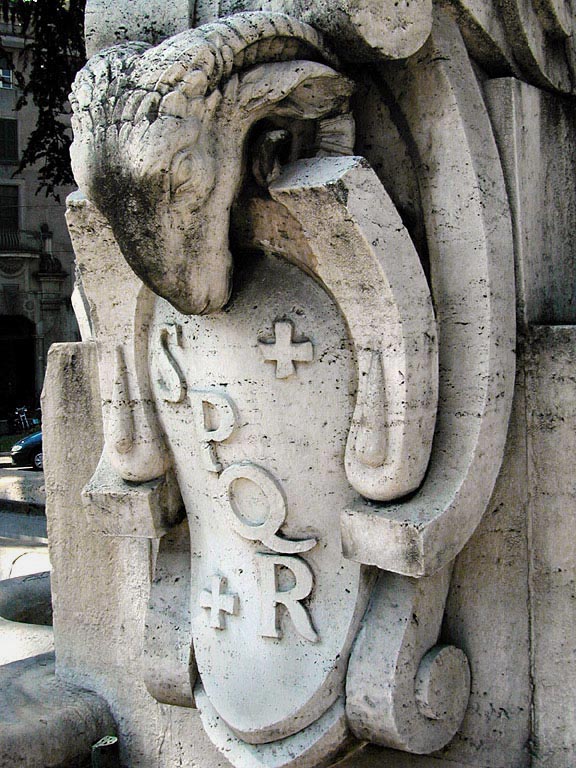
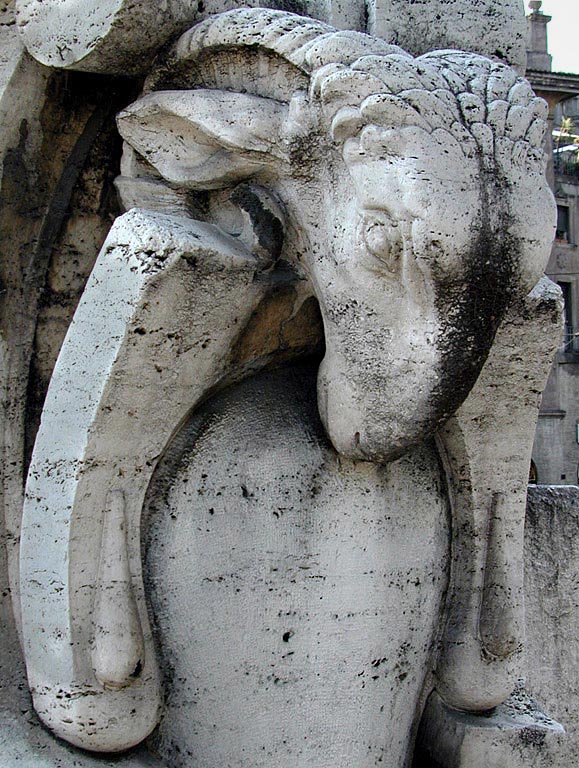
Acqua Paola Fountain
The majestic display fountain of the Acqua Paola, also known as the “fontanone del Gianicolo”, was commissioned by Pope Paul V Borghese (1605-1621), designed by Giovanni Fontana and Flaminio Ponzio and completed by Carlo Fontana with the enormous white marble basin. The monumental fountain has three wide niches (flanked by two smaller niches), from each of which pours an abundance of water coming from Lake Bracciano. The large inscription above the niches contains an inaccuracy: it states that the conduits of the Alsietina spring were restored, instead of those of the Traiana. The papal coat of arms, like the figures flanking it, is the careful work of Ippolito Buzio. It was only in 1690 that Pope Alexander VIII Ottoboni (1689-91), to a design by Carlo Fontana, had the five basins at the foot of the water outlets replaced by the great, magnificent basin, the space of the central arch opened towards the botanical garden behind, and the open square built from which one can admire a wonderful view over the capital.
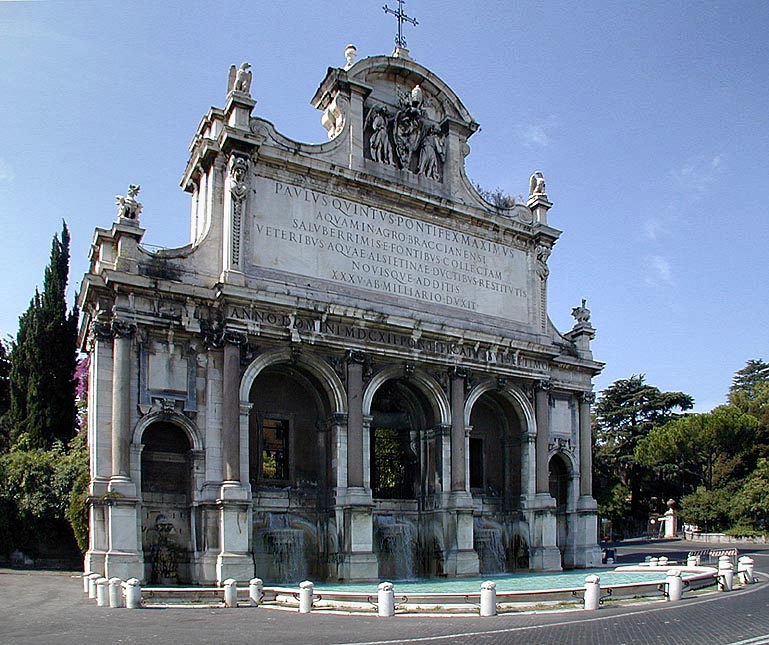
Fountain of the Frogs
Piazza Mincio Fountain of the Frogs
Among the more recent fountains, but no less interesting for that, the fountain of the frogs deserves to be known; it was built in Piazza Mincio in 1924 to a design by the architect Gino Coppedè. On a low circular basin, only slightly higher than street level, four pairs of figures each support a shell holding a frog that pours water into the shell itself. In the centre of the basin, between the four shells, rises a bowl, also circular, on the rim of which another eight frogs are neatly arranged in the act of leaping towards the central jet.
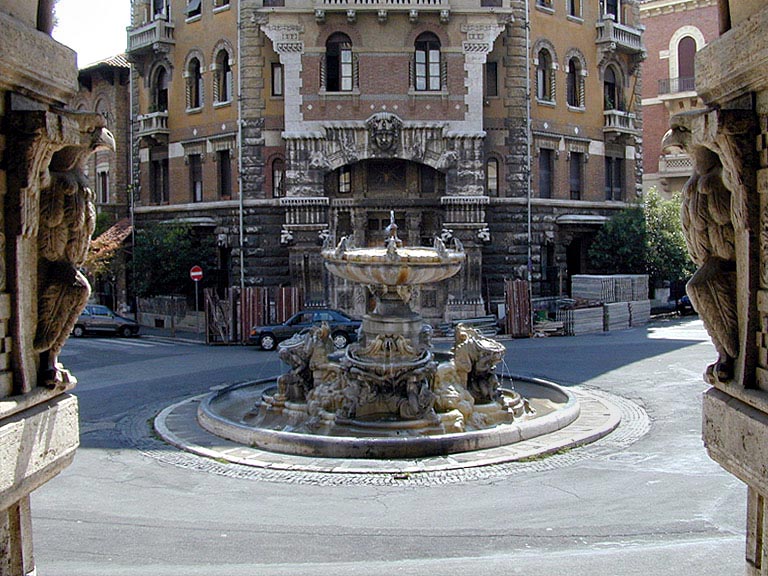
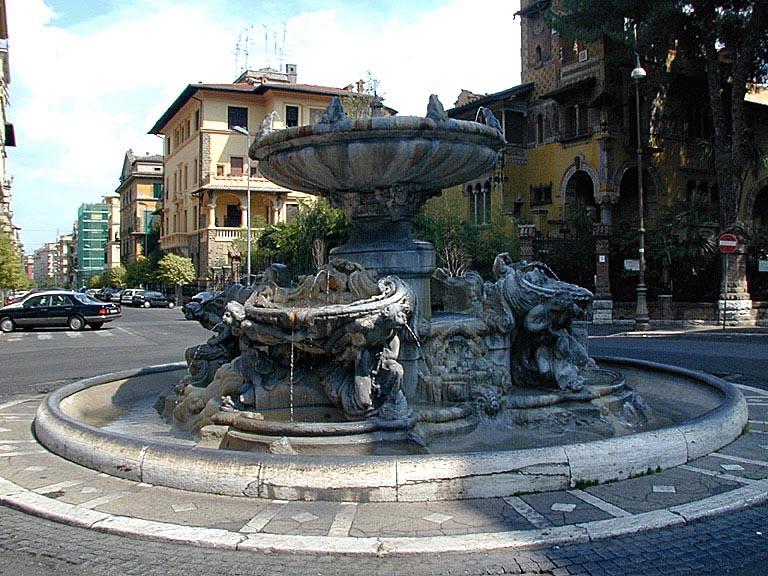
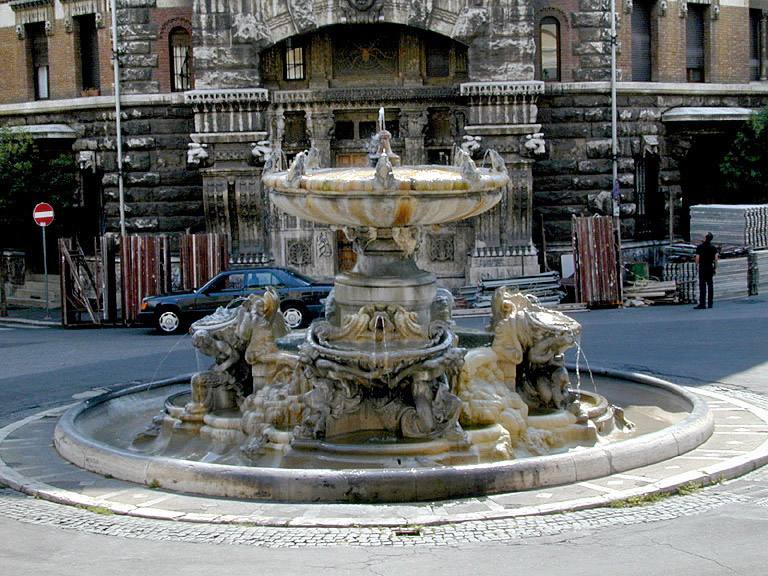
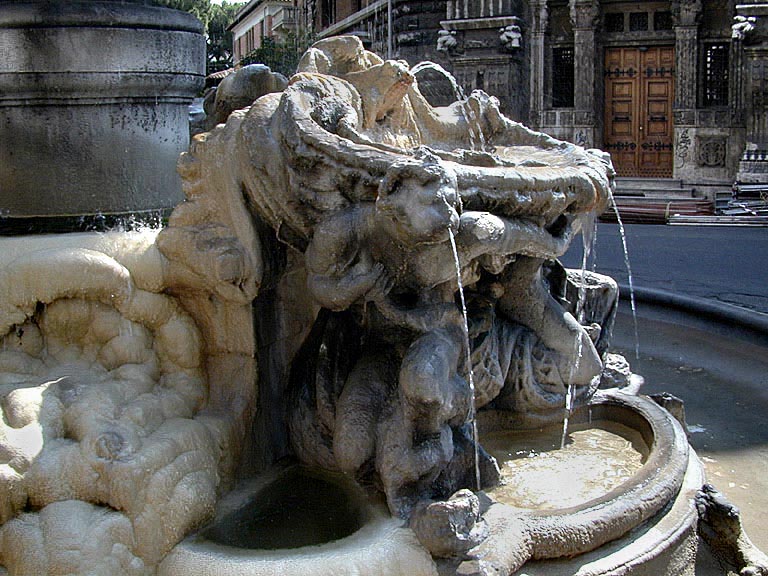
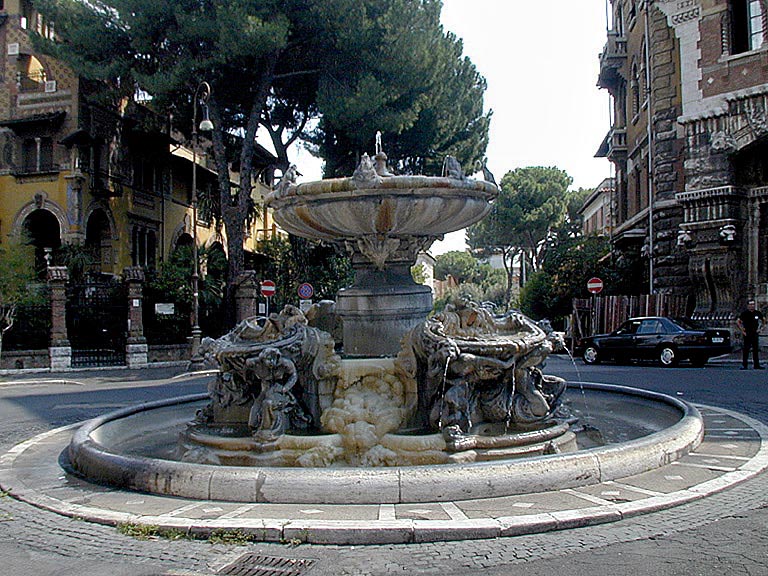
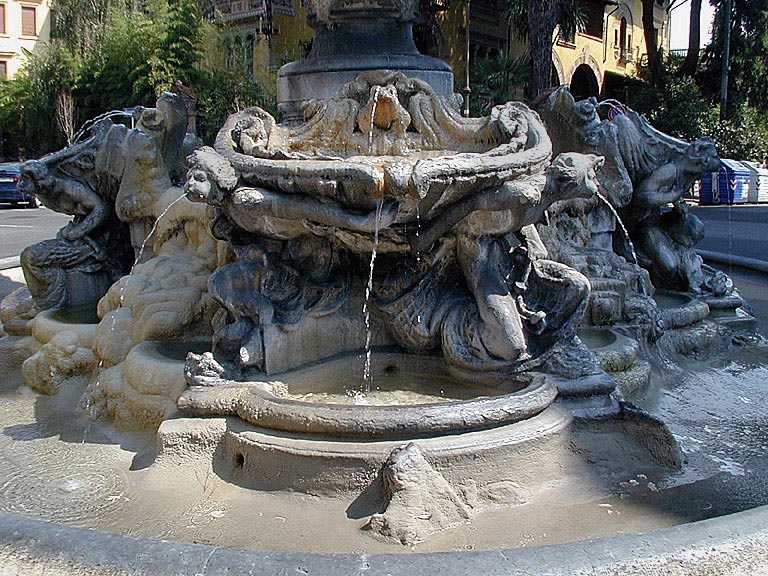
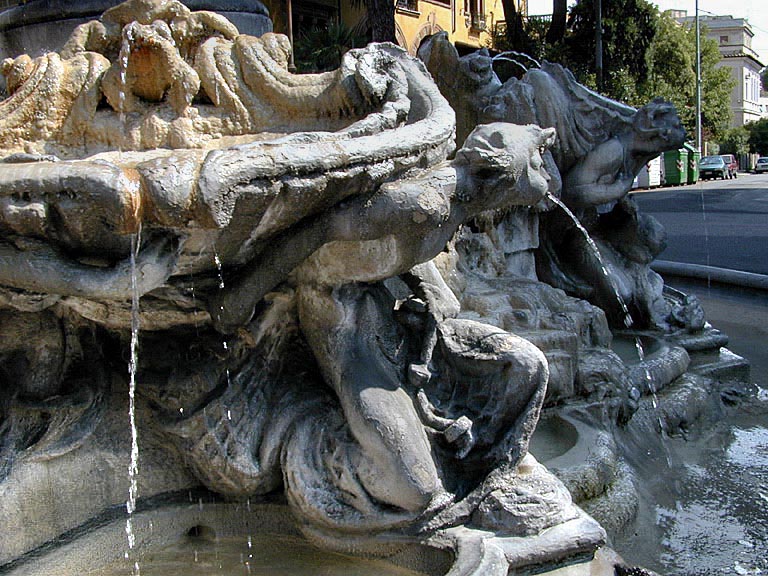
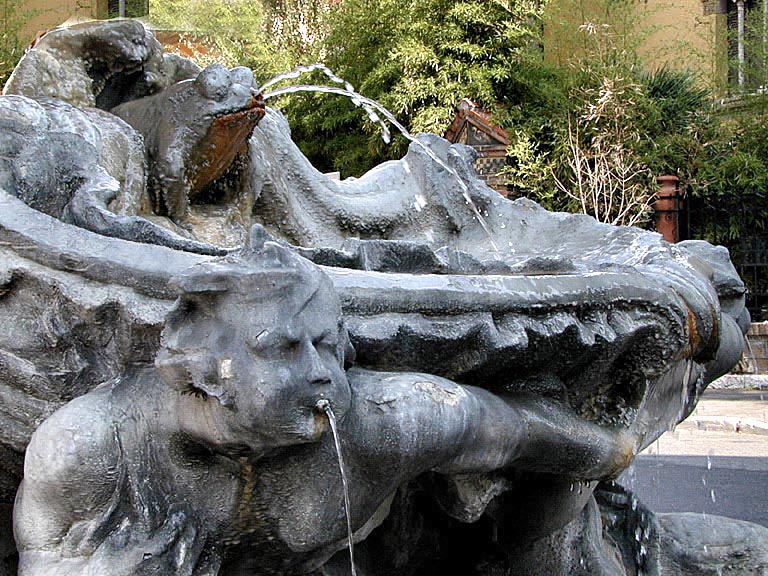
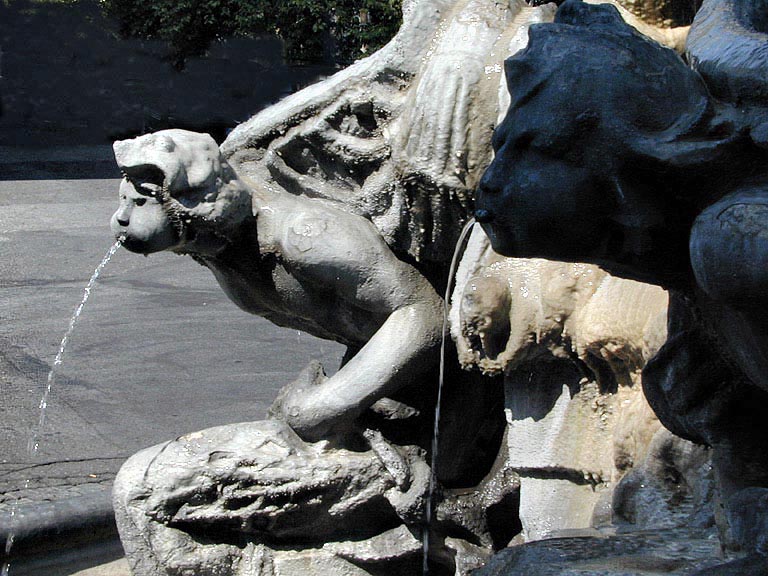
Fountain in Piazza Nicosia
Piazza Nicosia Fountain of the Square The first public fountain of modern Rome was built (before the eighteen commissioned after the reactivation of the Acqua Vergine aqueduct) in 1572 in Piazza del Popolo to a design by the architect Giacomo della Porta, but it did not have an easy life: moved several times and removed in 1823, when Valadier, redesigning the square, placed four fountains at the foot of the obelisk, it also spent time in the municipal warehouses. In the mid-20th century the fountain was rebuilt in Piazza Nicosia, but of the original it retains only the large octagonal marble bowl, while the baluster and the upper bowl are recent. The four crouching tritons that adorn the Fountain of the Moor in Piazza Navona were originally carved for this fountain, but since they proved out of proportion to the size of the basin and bowl, they were happily moved to their present position.
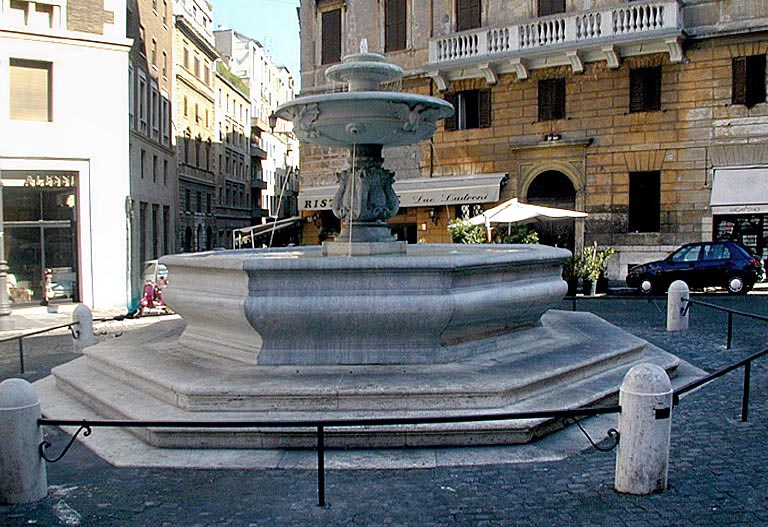
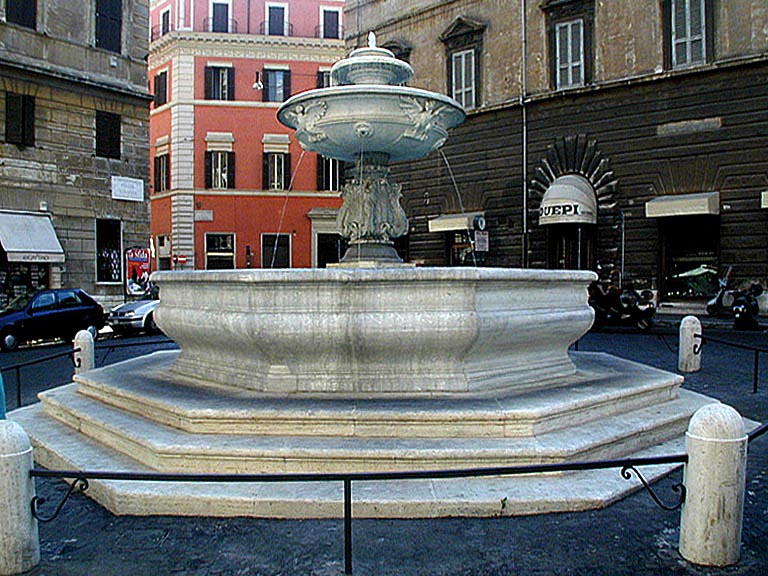
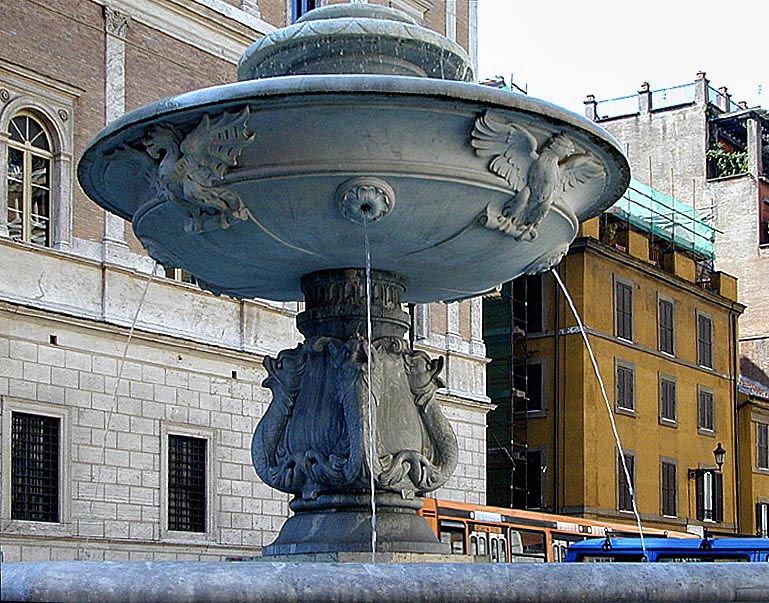
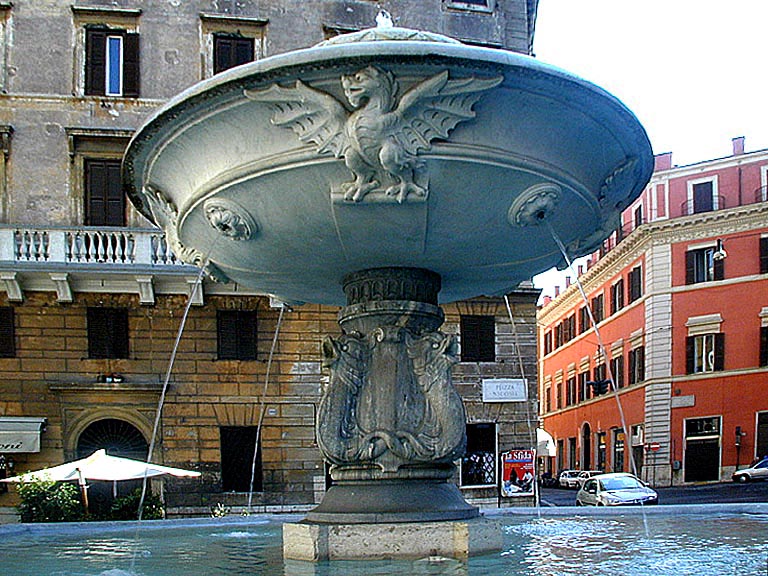
Turtle Fountain
Piazza Mattei Turtle Fountain The splendid fountain known as the fountain “of the Turtles” is a magical creation by Giacomo della Porta that admirably blends water, architecture and sculpture; it is moreover happily set in a corner of Rome that has remained rather similar to how it was when the fountain was built. In 1570 a fountain was to have been placed in the nearby ghetto, in Piazza Giudia, but the intervention of the powerful Mattei family ensured that it was built here instead (1581), while the ghetto got its fountain only in 1591 (see the fountain in Piazza delle Cinque Scole). In the centre of a wide quadrangular basin, on a high square base with concave sides, are four large marble shells, above which four bronze ephebes hold down as many bronze dolphins by placing a foot on their heads. The ephebes, all in the same pose, raise one arm towards the marble bowl above. In the original design another four bronze dolphins (perhaps the same ones that first decorated the fountain in Campo de' Fiori) were to stand where the tortoises are today; the tortoises were added in the mid-17th century, following a first restoration.
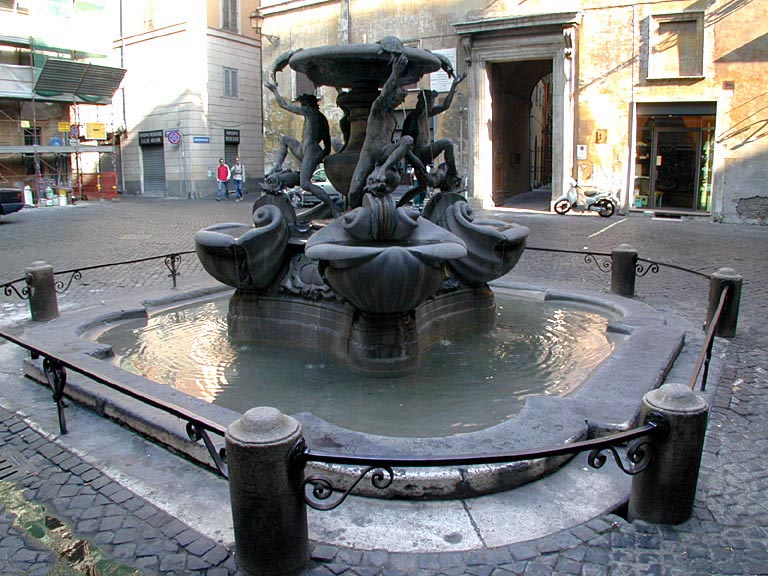
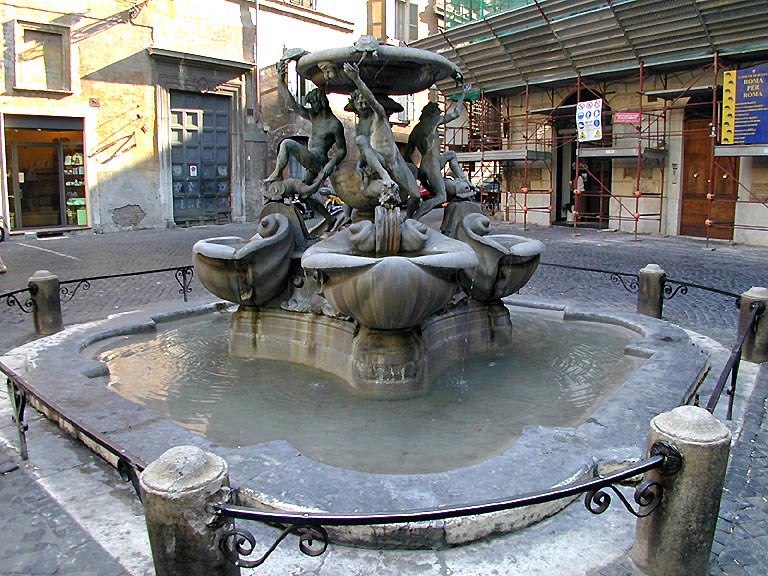
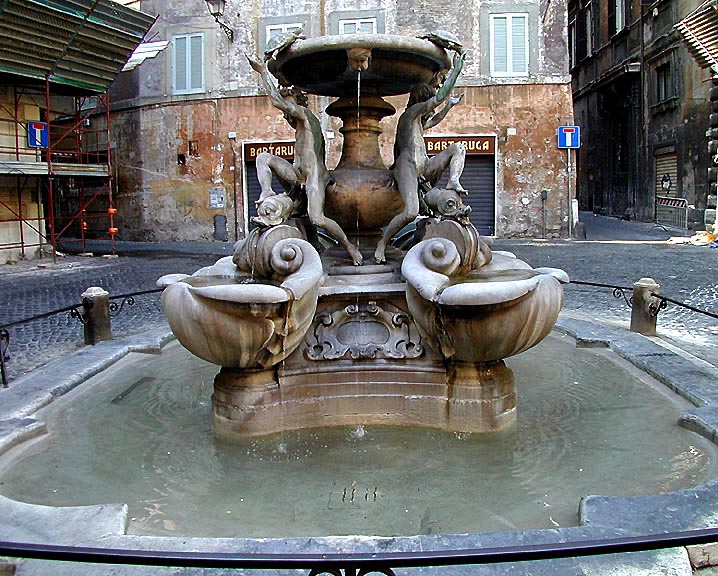
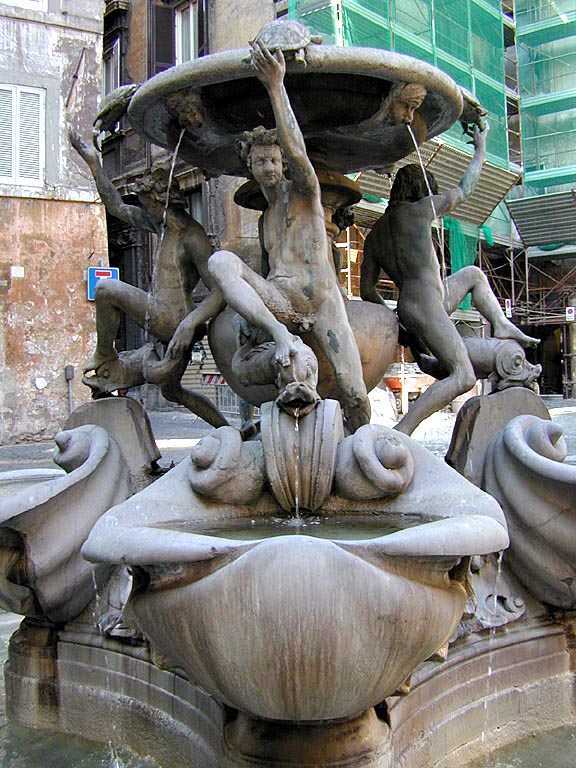
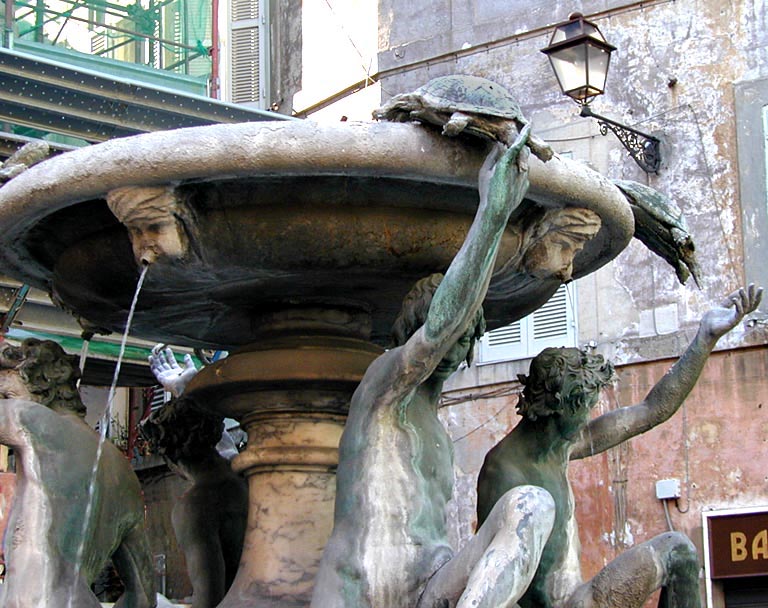
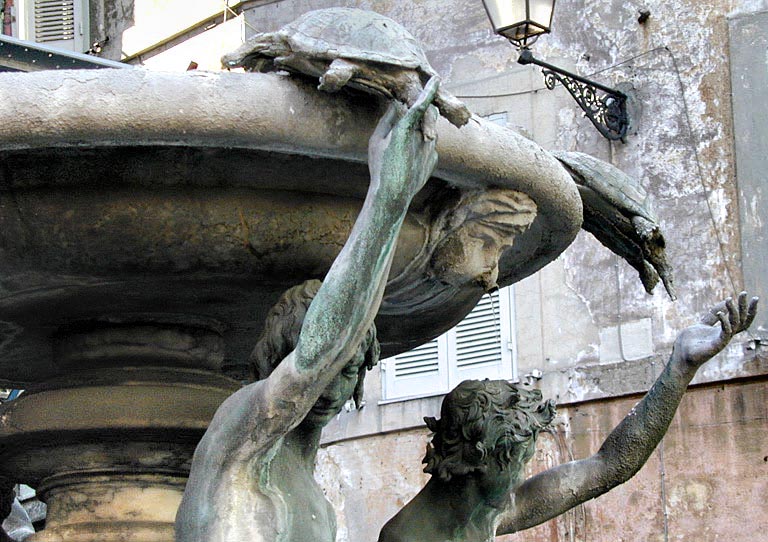
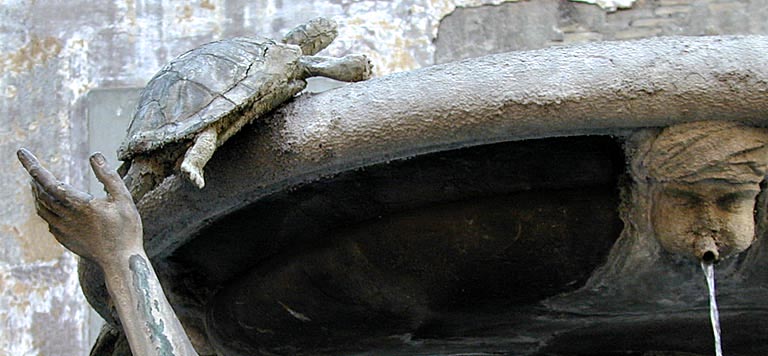
Pigna Fountain in Piazza San Marco
Piazza San Marco Pigna Fountain Designed in 1927 by the architect Pietro Lombardi for the Pigna district, which in ancient times took its name from a colossal pine cone now kept in the Vatican, this small fountain is characterised by a pine cone supported by a stylised base; the water collects at ground level in small basins protected by four small columns.
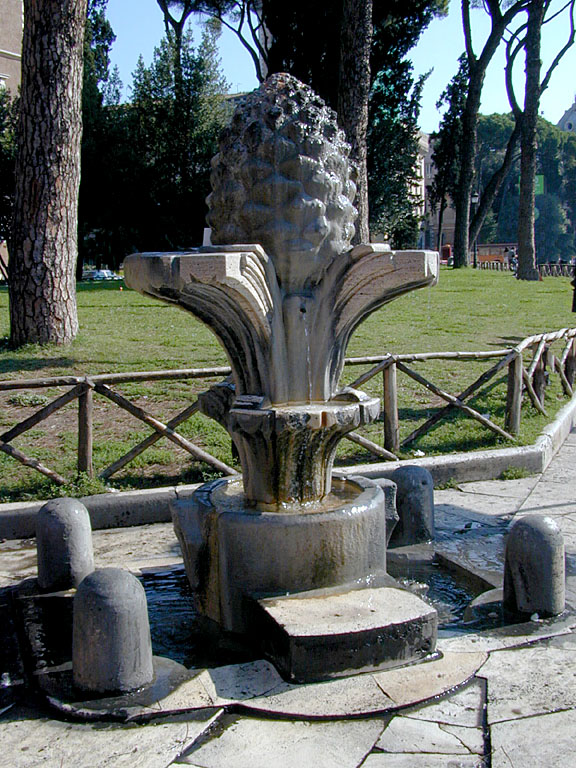
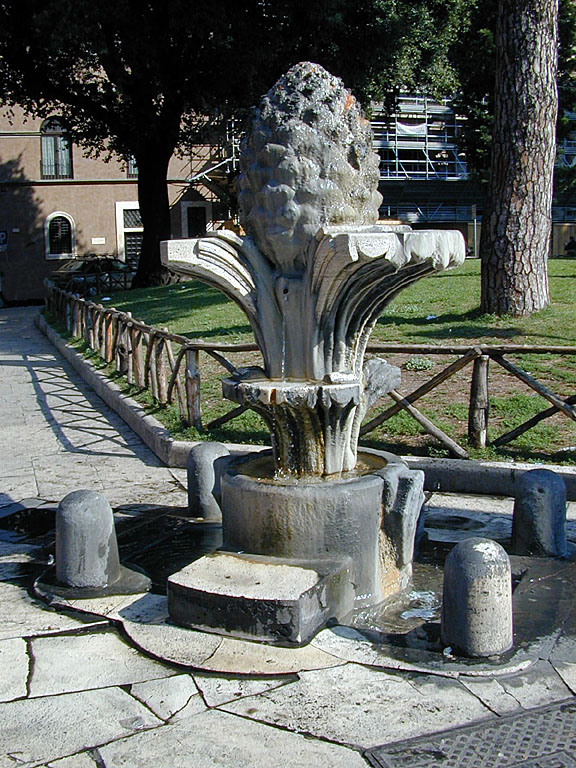
Fountain of the Navigators
Piazza del Porto di Ripetta Fountain of the Navigators In 1704 Pope Clement XI Albani had a fountain built on the bank of the Tiber, near the small port of Ripetta, where the porters who unloaded firewood and wine could quench their thirst. The designer, Alessandro Specchi, conceived an oval basin, at one end of which he set a rock formation supporting a shell flanked by two dolphins. The water that gushes from the top of the rocks (crowned by the Albani coat of arms) and from the dolphins' mouths collects in the basin below. In the mid-18th century a lantern was placed at the top of the rocks to make it easier for boats to land at night.
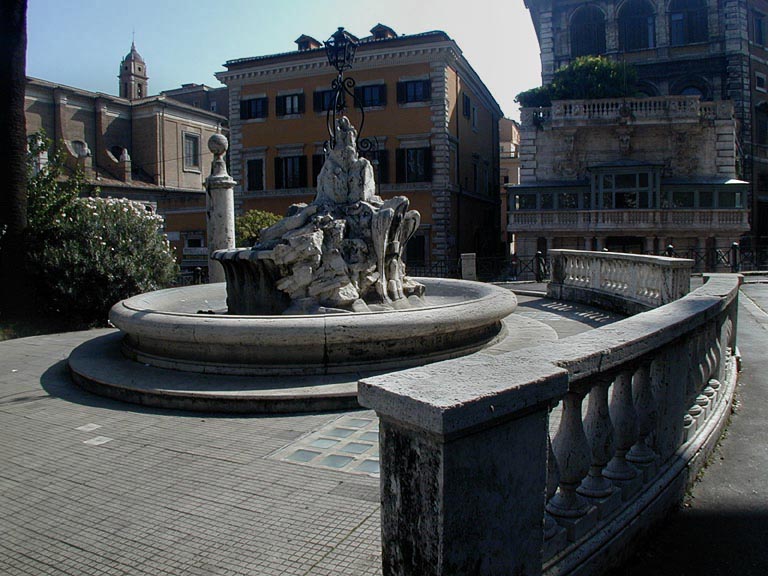
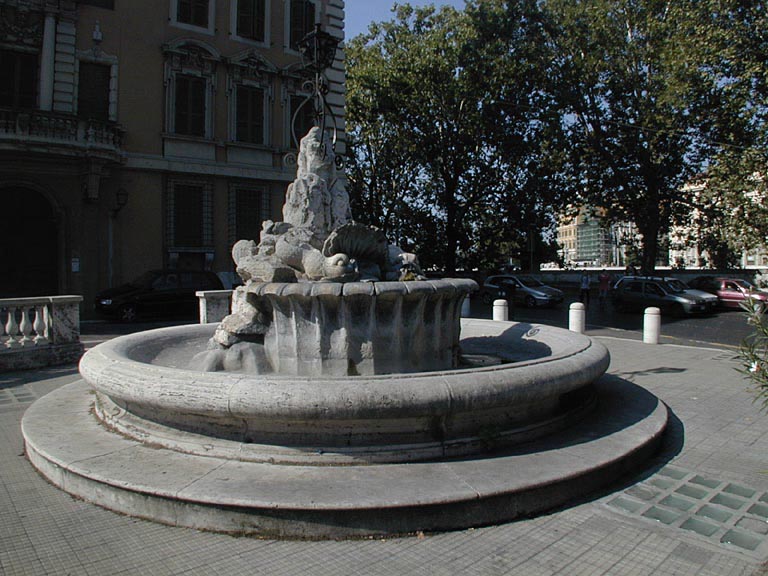
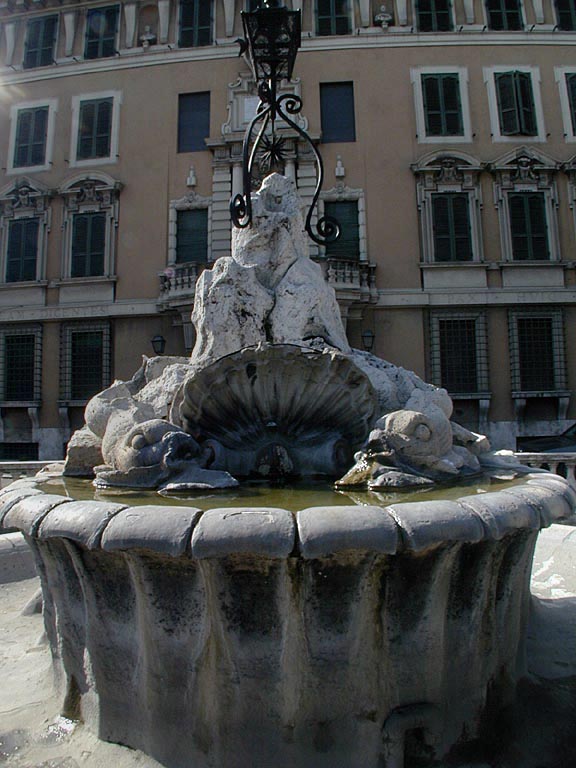
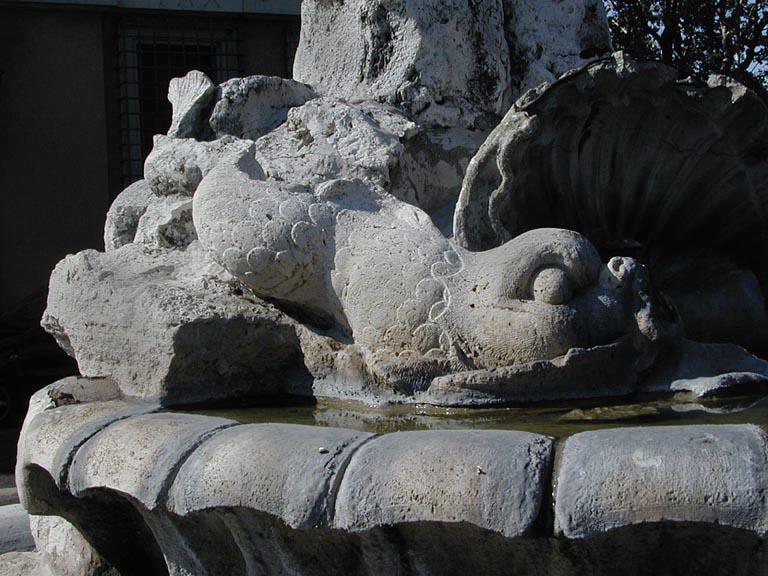
Piazza San Bernardo
Piazza San Bernardo Fountain of Moses This display fountain of the Acqua Felice (a water so named in honour of Pope Sixtus V, born Felice Peretti, who restored the aqueduct of the Acqua Alessandrina) is the work of the brothers Giovanni and Domenico Fontana, dating from 1587. Built in travertine, it has three large niches marked off by four Ionic columns, symmetrically arranged with four Egyptian lions, two in white marble and two in dark marble.
At the time of its inauguration, in June 1587, the massive statue of Moses, over four metres tall, had not yet been placed in the central niche of the fountain. The side niches hold the statues depicting Aaron and Gideon.
The pediment bears the papal coat of arms, while protecting the basins is an imposing balustrade that came, as the inscription on it shows, from a building erected by Pius IV.
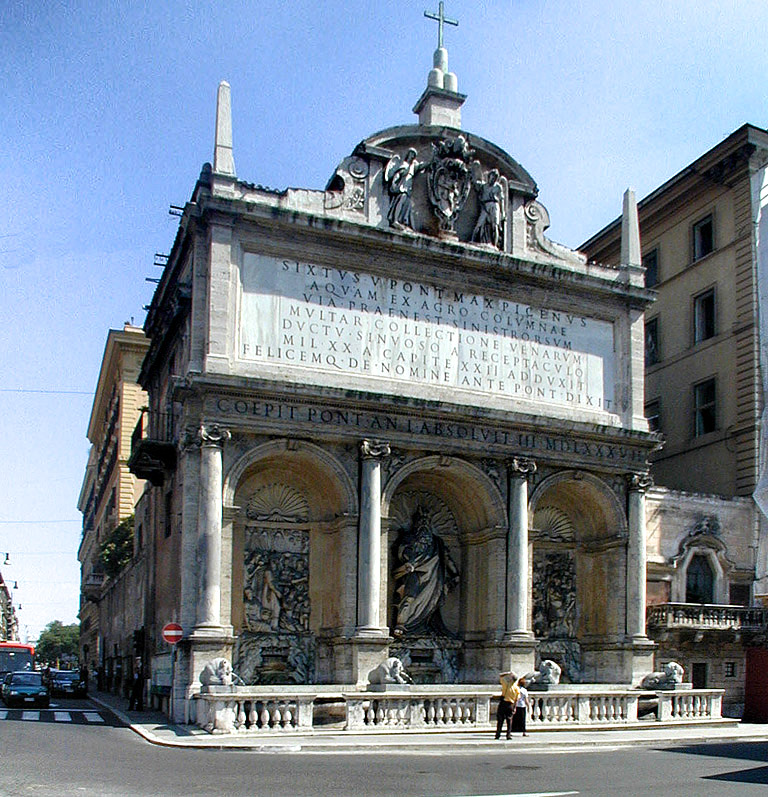
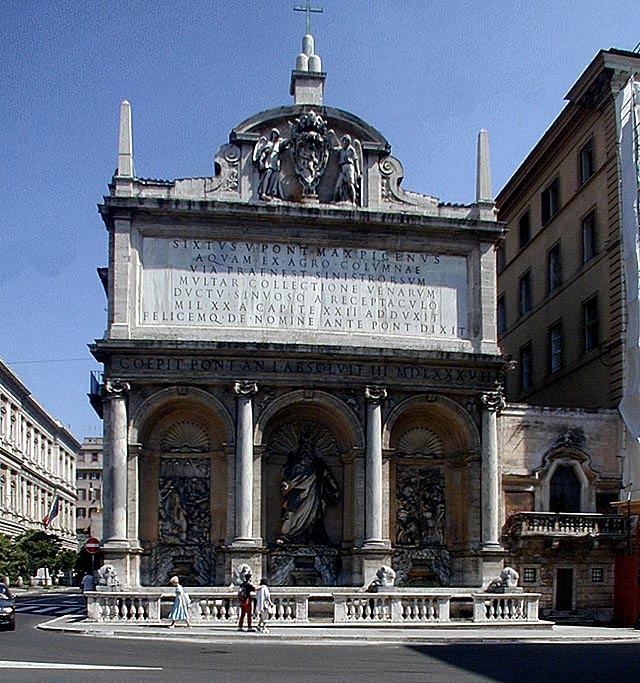
Piazza Santa Maria in Trastevere
Piazza Santa Maria in Trastevere Fountain of the Square According to tradition this is the oldest of Rome's monumental fountains; it appears, in fact, on a plan of the city of 1471 by Pietro del Massaio. The church of Santa Maria in Trastevere was known in ancient times as Sancta Maria in fontibus, so it may be supposed that the fountain of 1471, in which two superimposed bowls rise on balusters from the centre of a polygonal basin set on a base, was the remaking of a much older one. To a restoration carried out at the end of the 15th century by Cardinal Lopez (lupus) we owe the epigram in distichs carved on the stone tablet set at one corner of the fountain.
The life of this fountain, the only one located in a poor district, was marked by the lack of a continuous and plentiful supply of water. It was Alexander VII Chigi (1655-1667) who at last provided it with 36 ounces of water (instead of 5) and had it moved to the centre of the square; the work was entrusted to Bernini (1659): the upper part of the monument was not altered, while the lower part, that is the octagonal basin, was raised on a few steps, and the four double shells (then facing outwards), the Chigi coats of arms and inscriptions commemorating the restoration were added. But only some thirty years later (1692) Pope Innocent XII had to carry out extraordinary cleaning works, during which the capacity of the basin was probably increased and the double shells were turned to face the basin, almost as if to protect it. Finally, in 1873, the City of Rome completely rebuilt the fountain in bardiglio marble instead of travertine, but on the exact model of 1692.
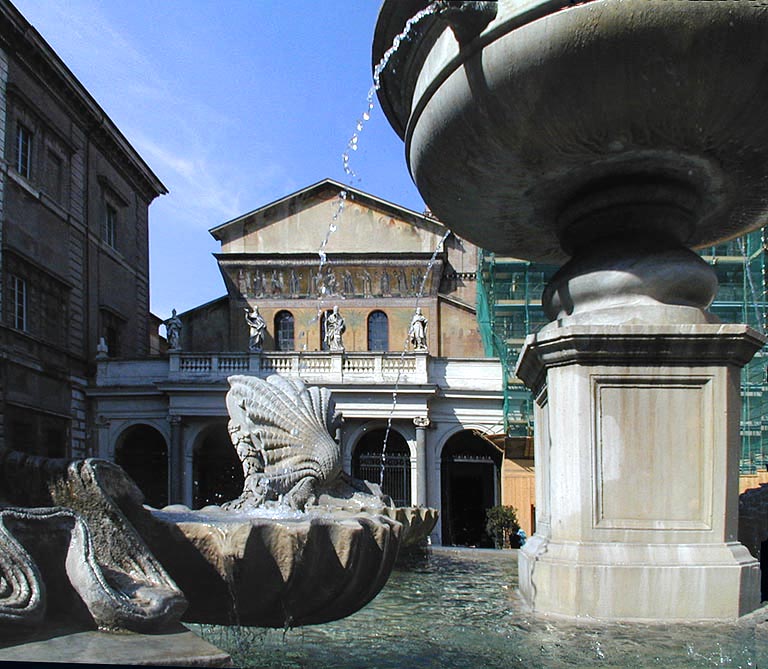
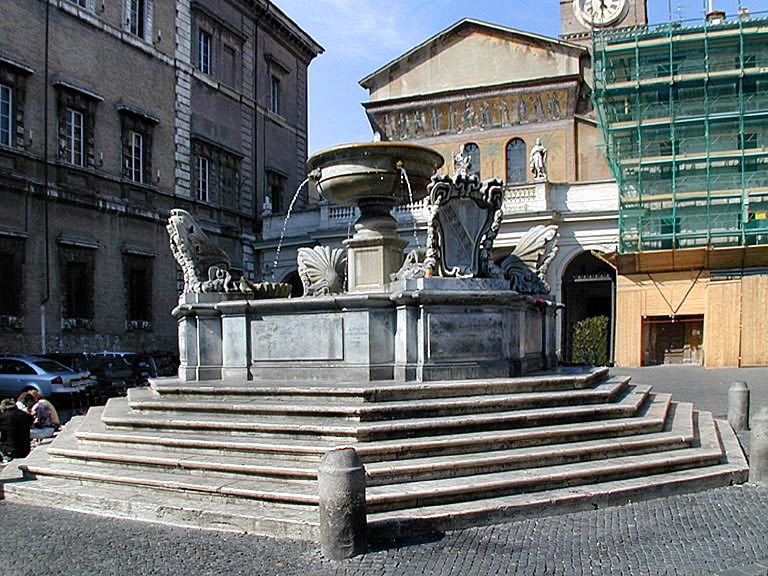
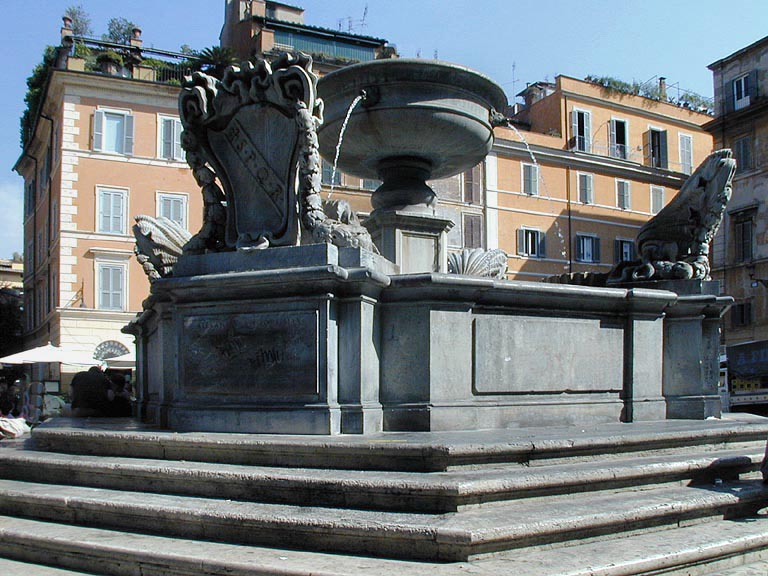
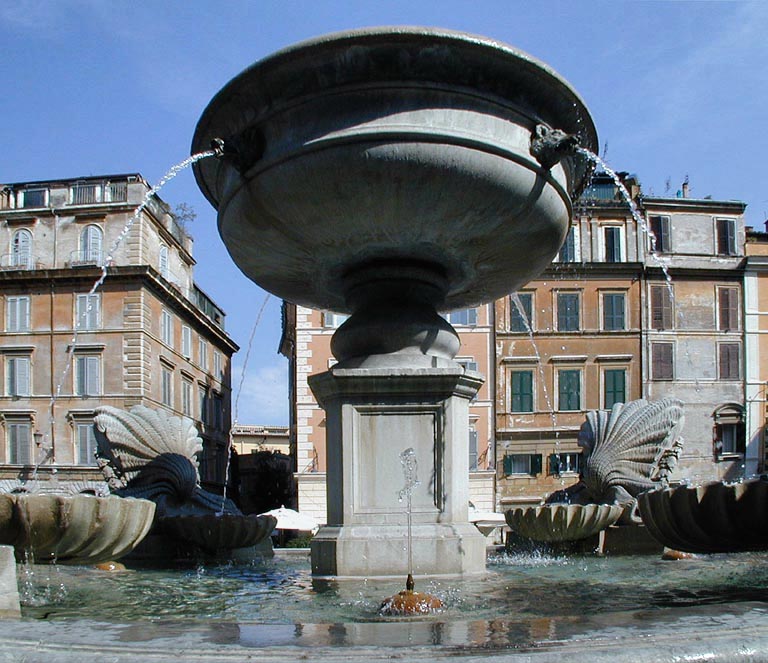
Piazza Trilussa
Piazza Trilussa Fountain of the Square The great fountain of Ponte Sisto (display fountain of the Acqua Paola), built in travertine by Giovanni Vasanzio (the Fleming Van Zanten) in 1613 at the wish of Paul V Borghese (1605-1621) and originally located at the end of the elegant Via Giulia, against the Ospizio dei Mendicanti, now stands in Piazza Trilussa as a free-standing structure aligned with Ponte Sisto.
Two Ionic columns on either side of a wide barrel-vaulted niche support an architrave above which is a commemorative inscription. The Borghese coat of arms surmounts the whole. From an opening cut in the upper part of the niche abundant water gushes out, falling into a first basin from which it plunges noisily into the basin at street level. Two dragons carved on the bases of the columns also spout water into the basin, as do two lions' heads. Six small red granite columns linked by an iron structure protect the fountain, which was moved in 1879, when it was decided to widen the bed of the Tiber and build the left-bank embankment, and was rebuilt at the end of the 19th century. It was then raised some fifteen steps above street level to make it more visible from Ponte Sisto.
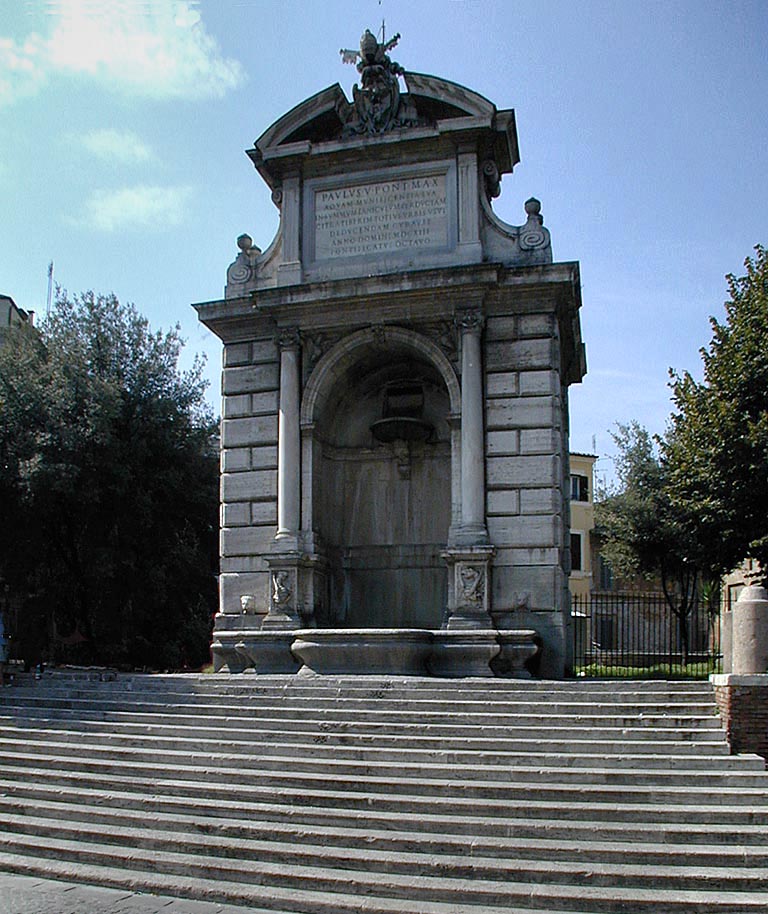
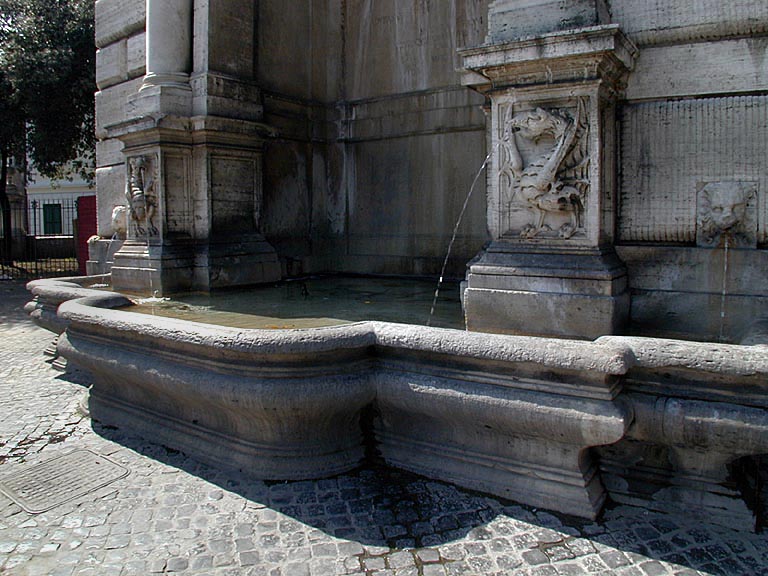
Fountain in Piazza Quiriti
Quiriti Fountain of the Square In 1927 a fountain was built in the Prati district to a design by the sculptor Attilio Selva, inspired in form by those of the 17th century; its female nudes caused a stir at the time. In the centre of a large circular basin rises a bowl from whose rim a veil of water flows down; four female figures, back to back, stand in the centre of the bowl and support with their heads and arms a smaller quatrefoil bowl, in the centre of which a jet rises from a large pine cone.
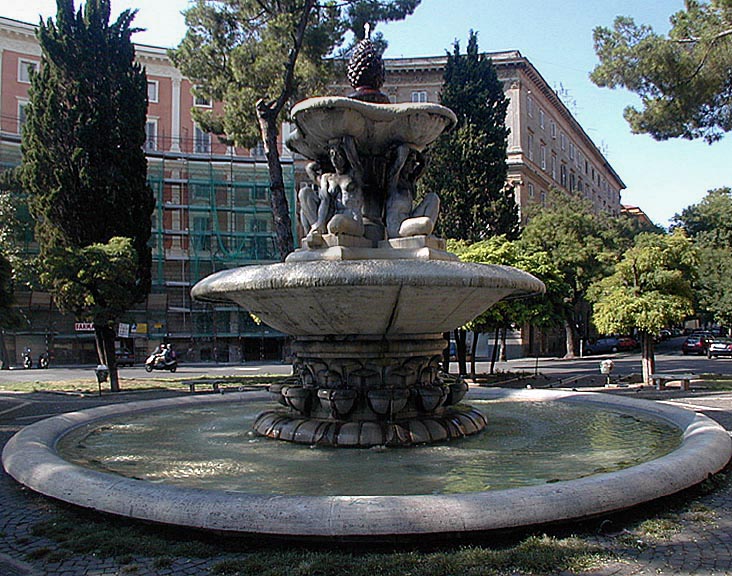
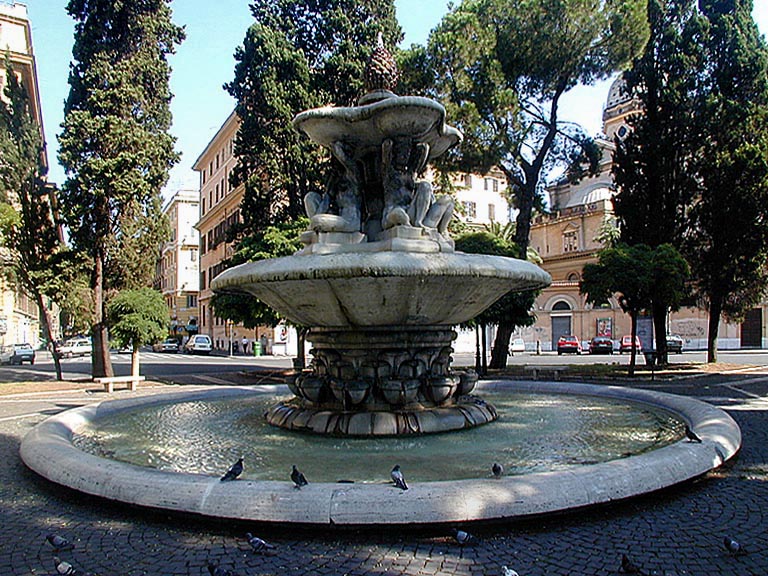
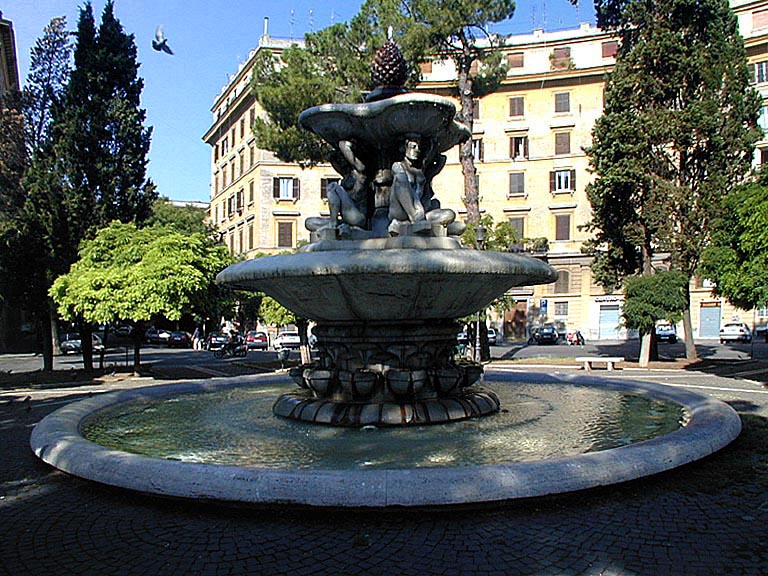
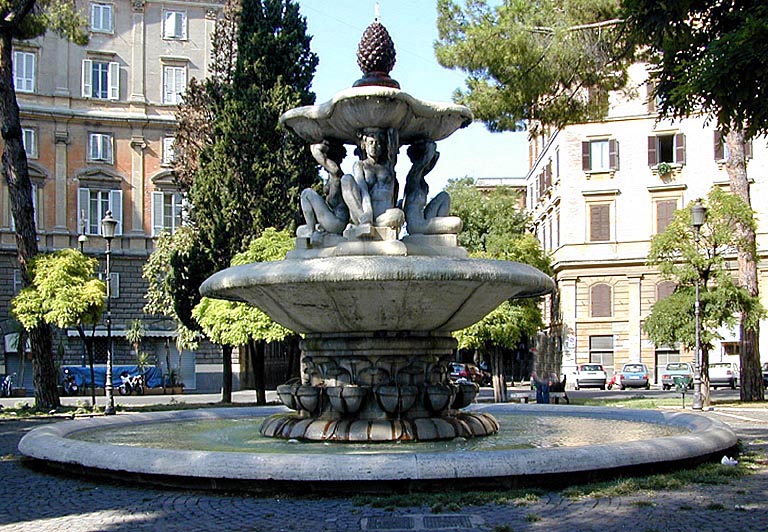
Fountain of the Dioscuri in Piazza del Quirinale
Piazza del Quirinale Fountain of the Dioscuri The fountain in Piazza del Quirinale is called the fountain of the Dioscuri because two gigantic statues of the Dioscuri with their horses have stood here since 1588, when Domenico Fontana, at the wish of Pope Sixtus V Peretti (1585-1590), designed his only public fountain, placing in front of the statues an octagonal basin in the centre of which a baluster supported a bowl.
It was Pope Pius VI Braschi (1775-1799) who had the obelisk found in the Campo Marzio moved to Piazza del Quirinale: the transport was a complex operation, completed in 1786. The present fountain in Piazza del Quirinale, however, dates from 1818, when Pius VII Chiaramonti (1800-1823) replaced the previous fountain, all trace of which has been lost, with the splendid granite basin supported by a baluster and rising from a large circular pool.
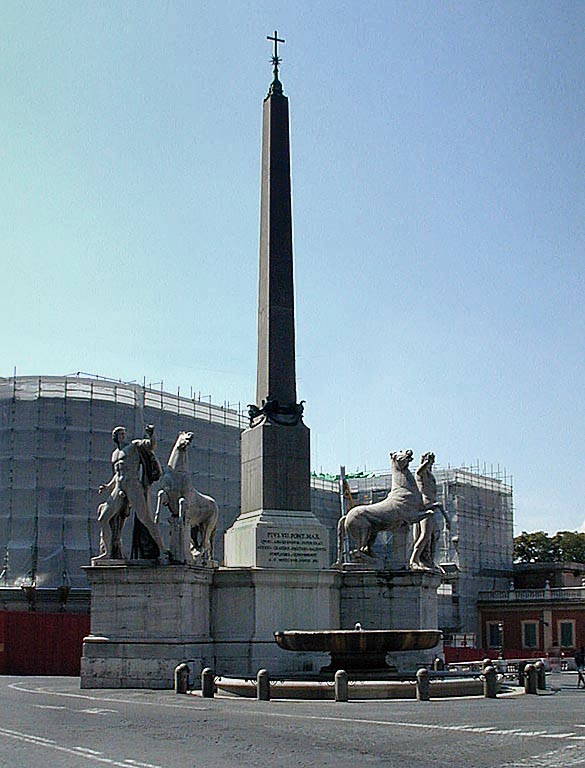
Triton Fountain in Piazza Barberini
Considered one of the most beautiful fountains in Rome, it was made in travertine by Gian Lorenzo Bernini in 1643. Among the tails of the dolphins supporting the shell on which the Triton crouches, Bernini placed two Barberini coats of arms. The Triton, blowing forcefully into a conch, sends out the jet of water which, falling back into the valves of the shell and then from their flutings into the basin below, creates a choreography of great effect. Restored in 1932 and in 1990.
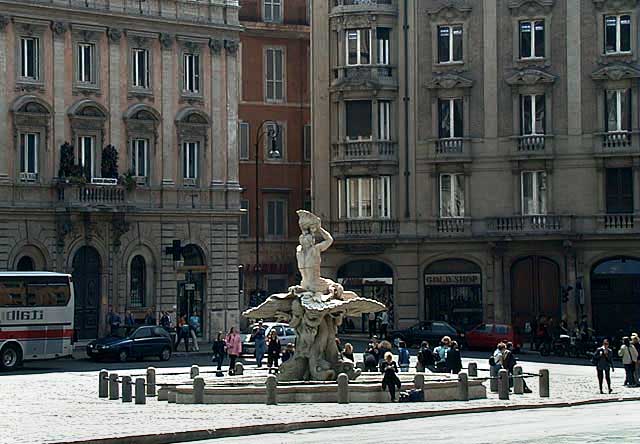
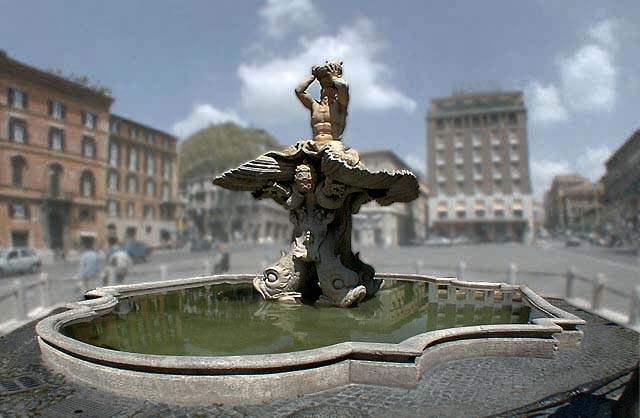
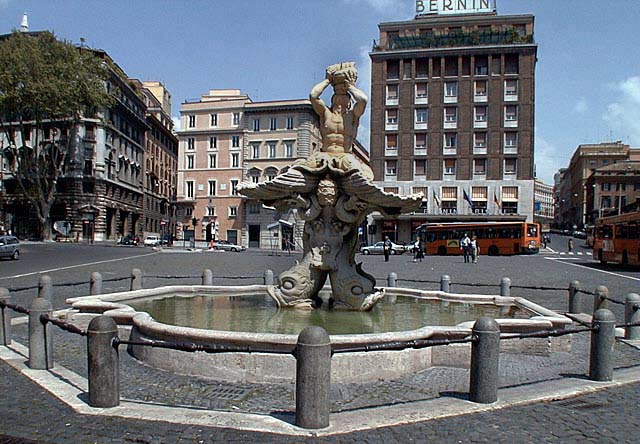
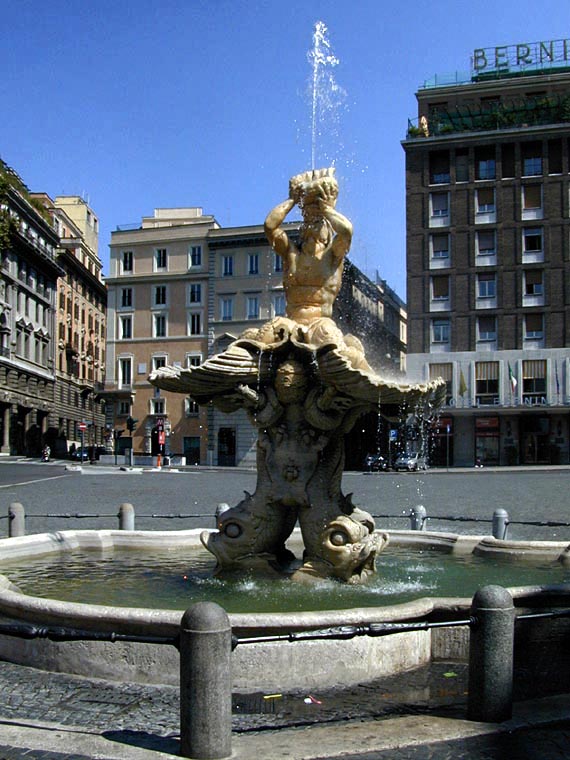
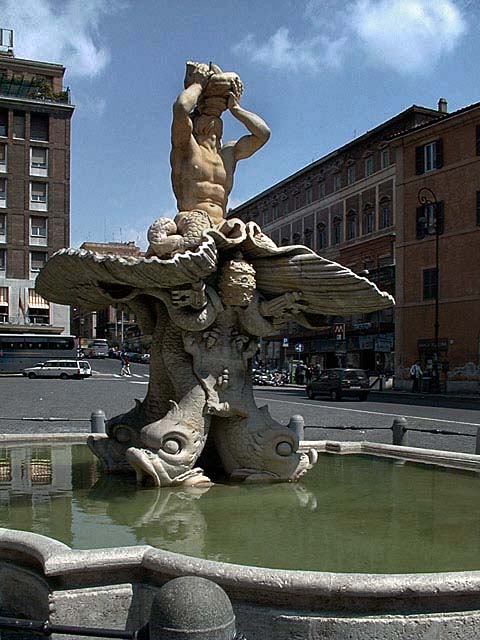
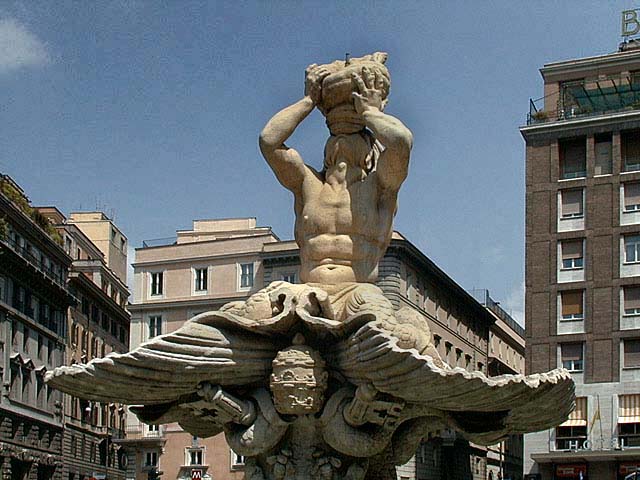
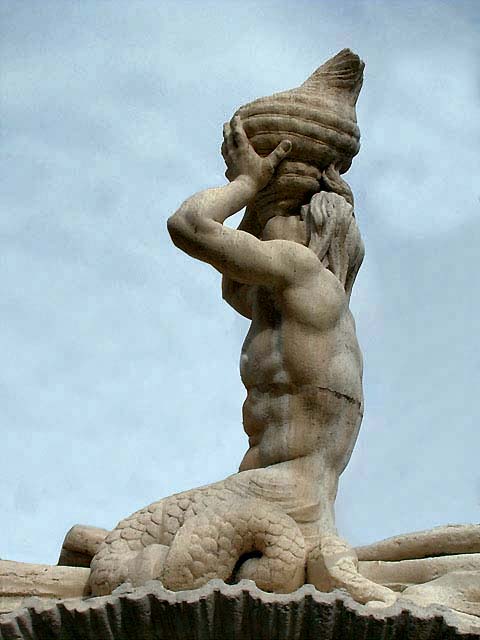
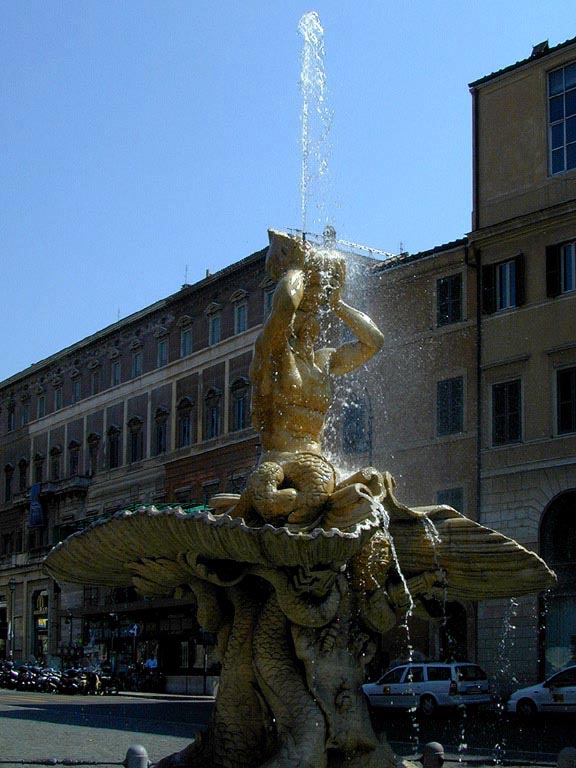
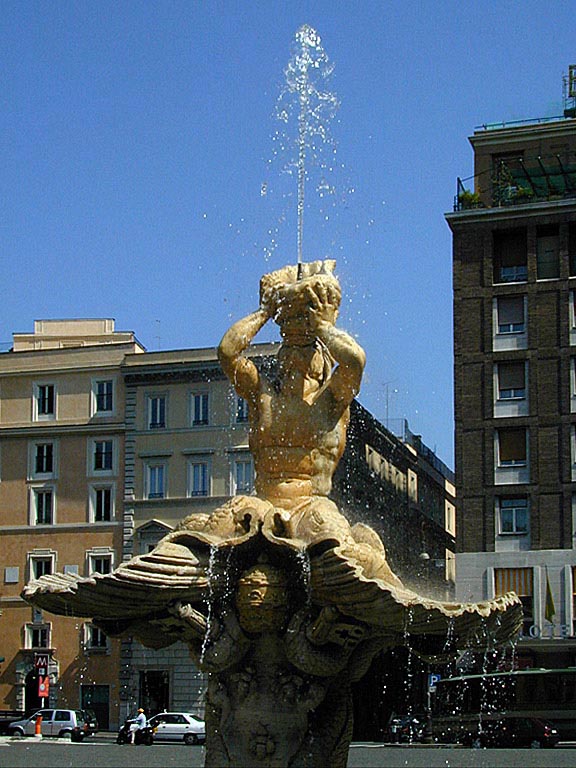
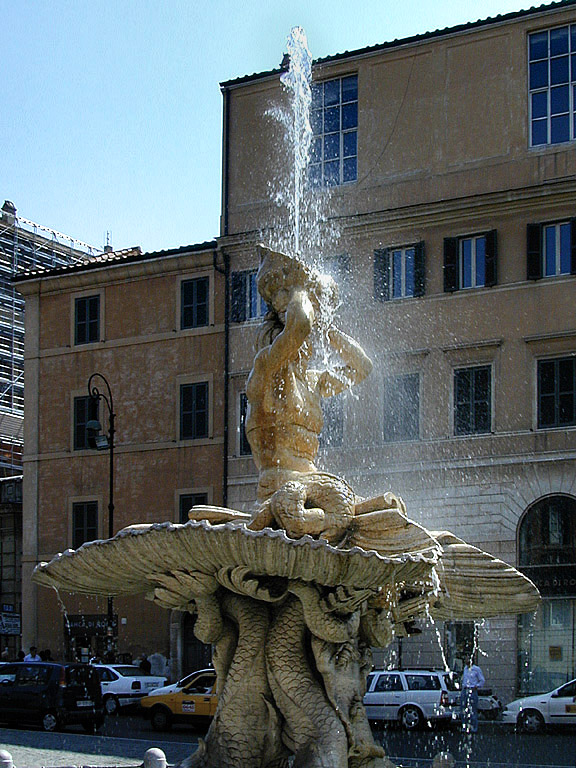
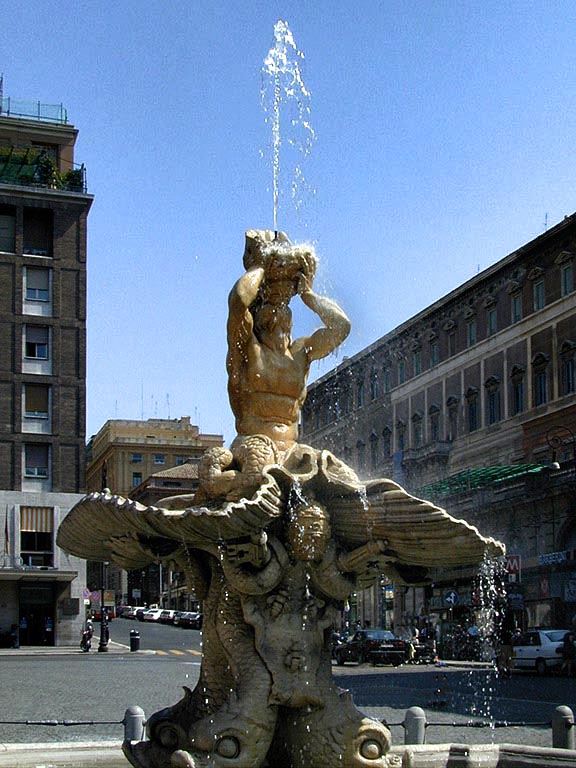
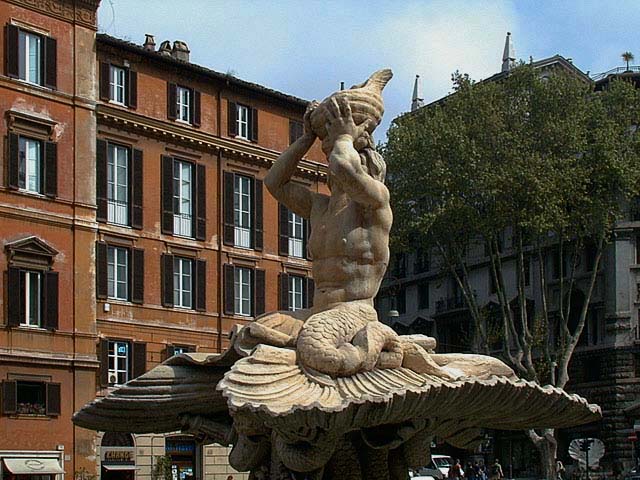
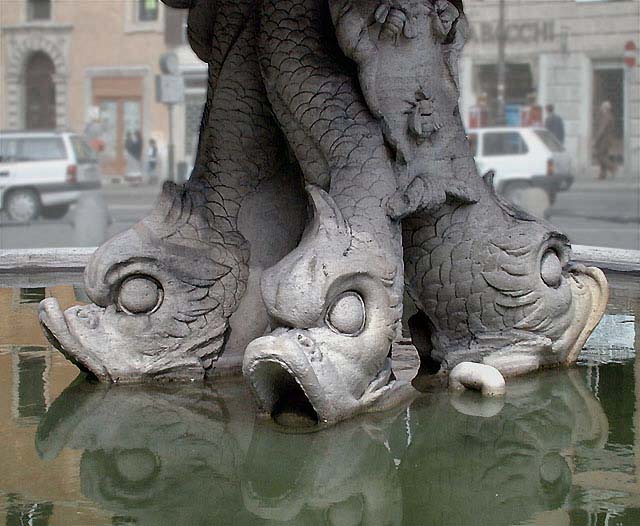
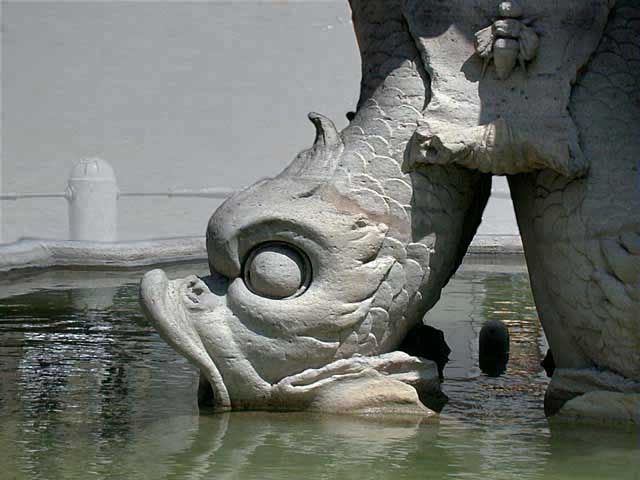
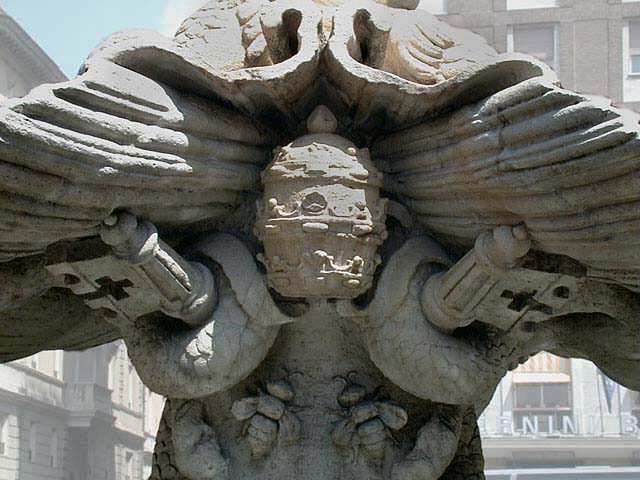
Fountain in Piazza Campitelli
The elegant little fountain in Piazza Campitelli was conceived by the skilled architect Giacomo della Porta in 1589 (and executed by the stonecutter Pompilio de Benedetti). The fountain originally stood in the centre of the square, but in 1679, following the enlargement of the church of Santa Maria in Campitelli, it was moved to its present position. The travertine monument consists of an octagonal base whose straight (longer) sides alternate with concave ones, on which rises a basin, also octagonal, decorated with the coats of arms of the four leading families of the area (Albertoni, Capizucchi, Muti and Ricci, who bore the cost of the work) and with two large masks pouring water. Above the basin, supported by a goblet-shaped marble baluster, is a circular bowl from the centre of which a jet of water rises.
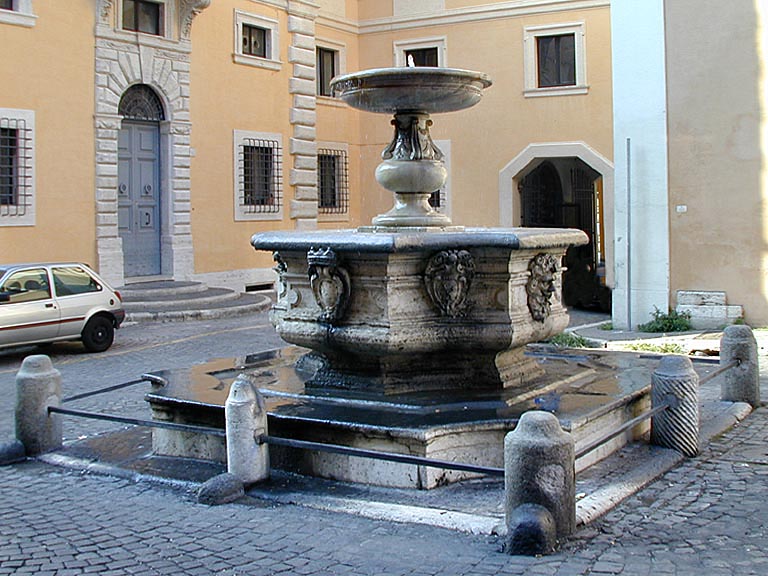
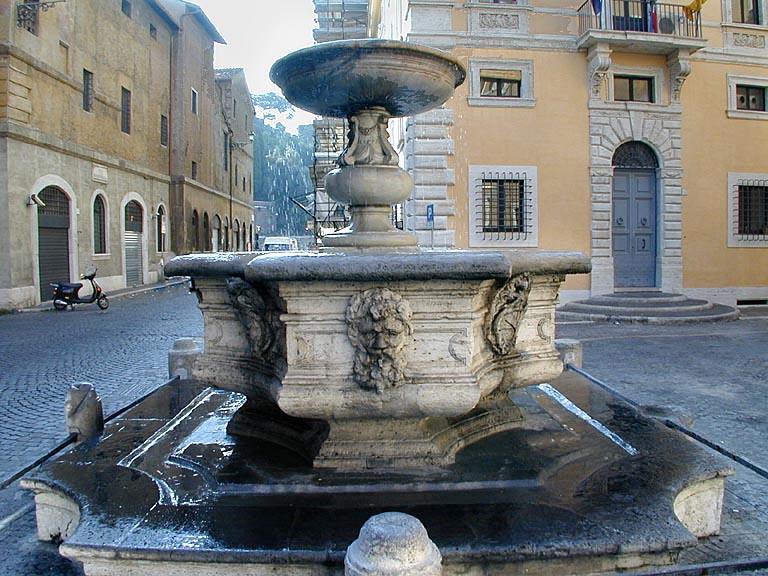
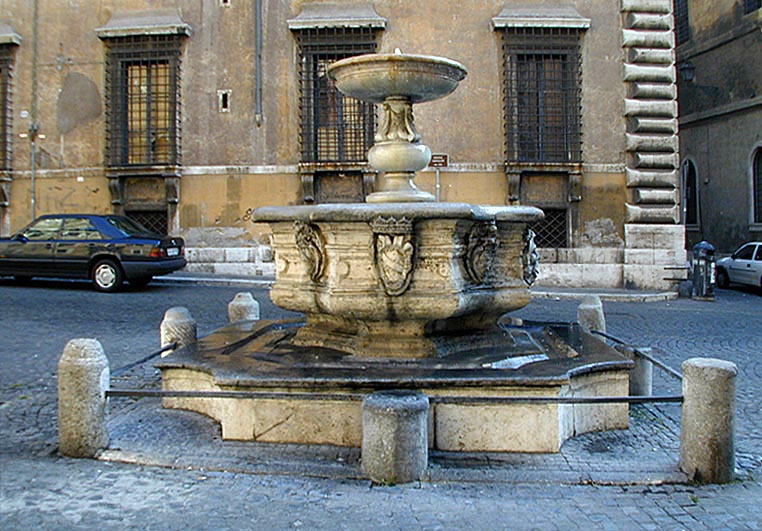
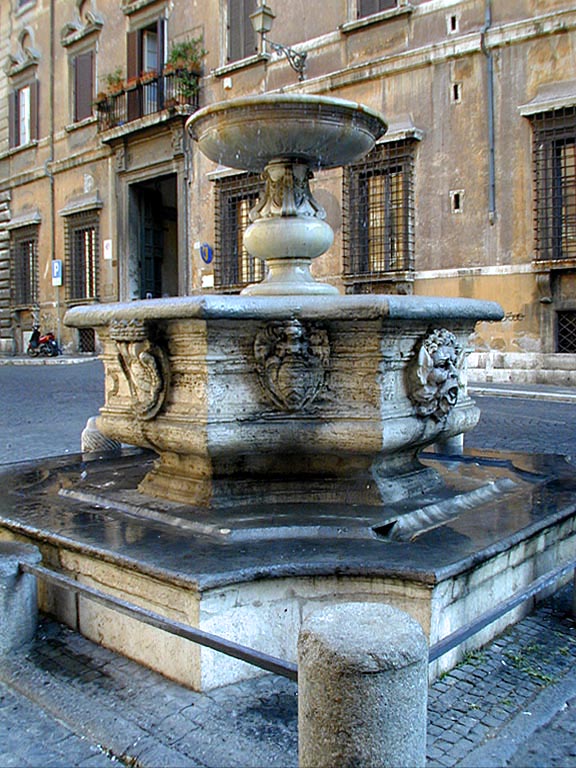
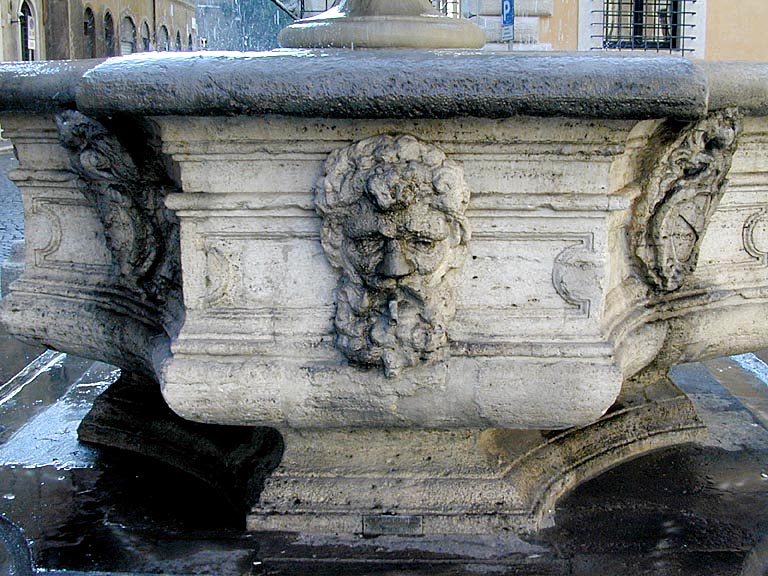
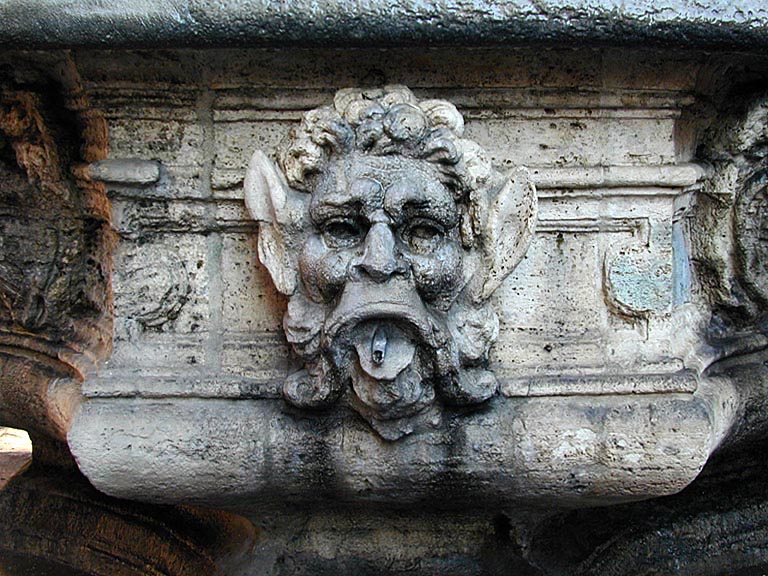
Fountain in Piazza Colonna
Pope Gregory XIII Boncompagni (1572-1585) commissioned Giacomo Della Porta to design the elegant fountain, which was executed by the Fiesole sculptor Rocco De Rossi and in 1577 was set where it still stands today. During the restoration of 1830 the two groups of dolphins with intertwined tails, the work of the sculptor Alessandro Stocchi, were added. On that occasion the worn upper basin was replaced with a smaller and more modest one which, through a central jet, sends an elegant veil of water down into the basin below.
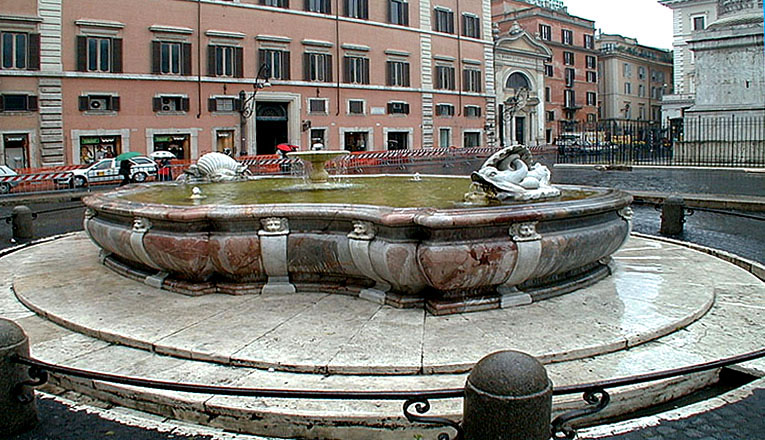
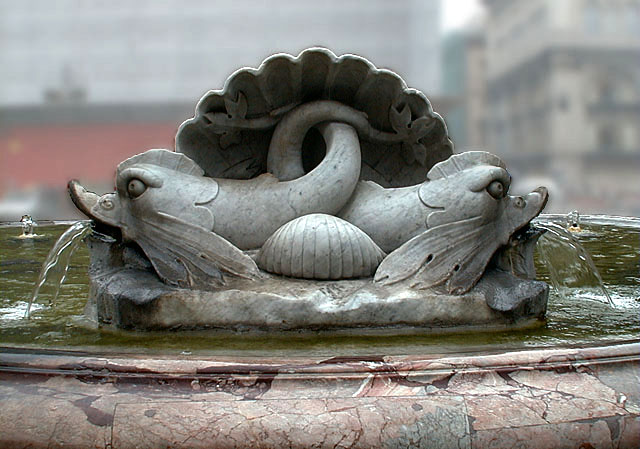
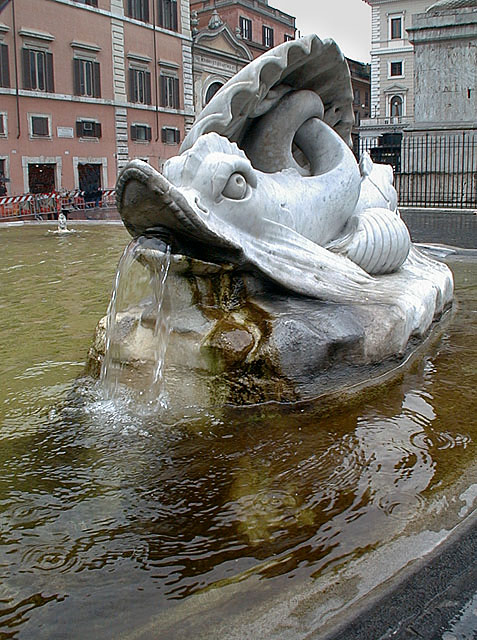
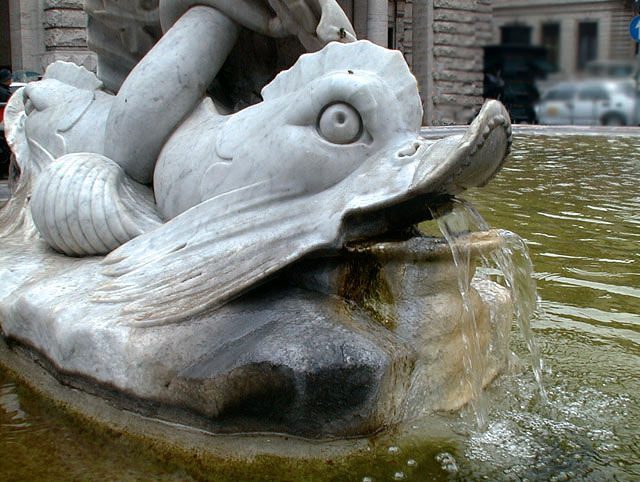
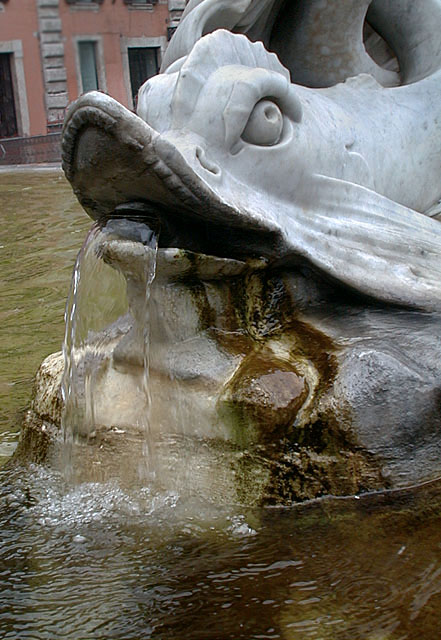
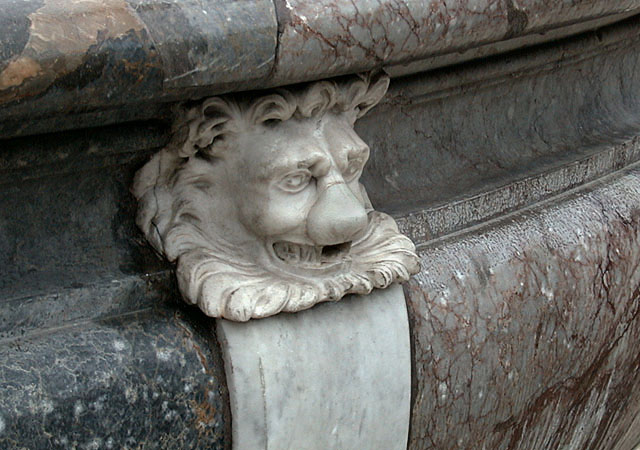
Piazza Navona — Fountain of the Four Rivers
To give a worthy setting in Piazza Navona to the obelisk from the Circus of Maxentius and to Bernini's design, Pope Innocent X Pamphilj authorised the works, and the magnificent monument was inaugurated on 12 June 1651. Around the monolith were placed four white marble statues, five metres tall, representing the rivers. The first, by Claude Poussin, is dedicated to the Ganges and symbolises Asia; the Nile, for Africa, is by Giacomo Antonio Fancelli and has its head veiled because at the time its sources were unknown; Antonio Raggi carved the Danube for Europe, and finally the Rio de la Plata, symbol of America, is by Francesco Baratta.
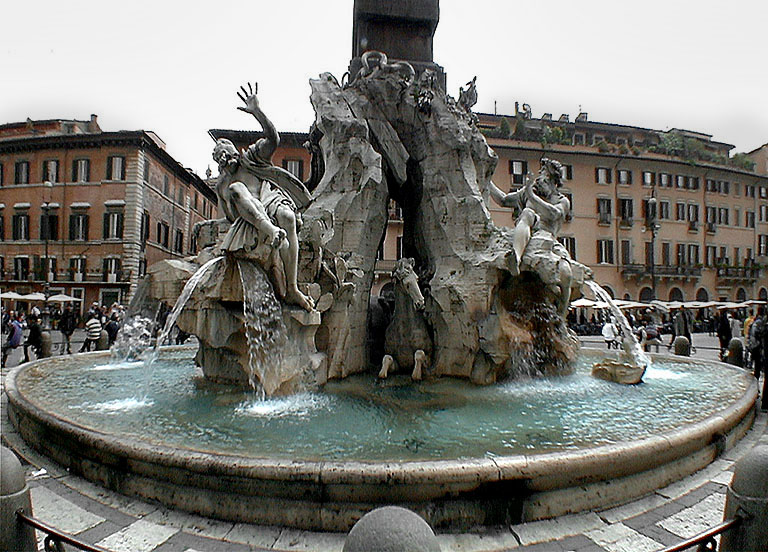
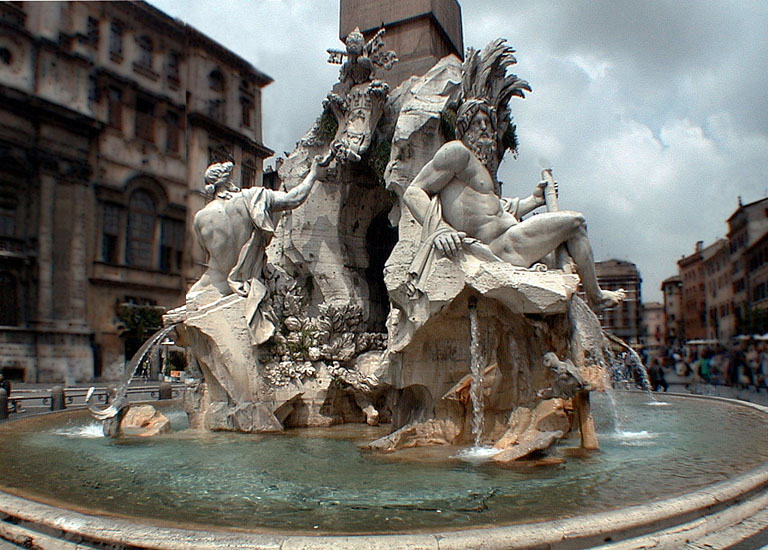
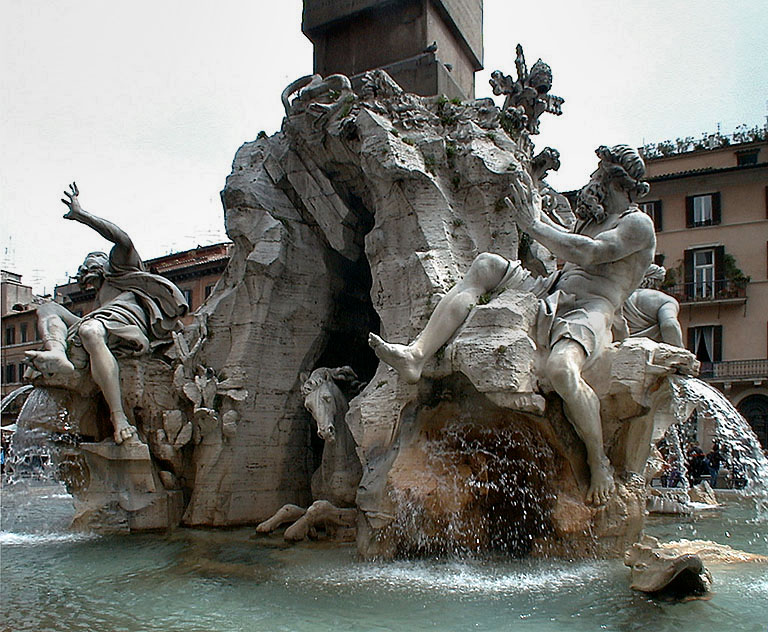
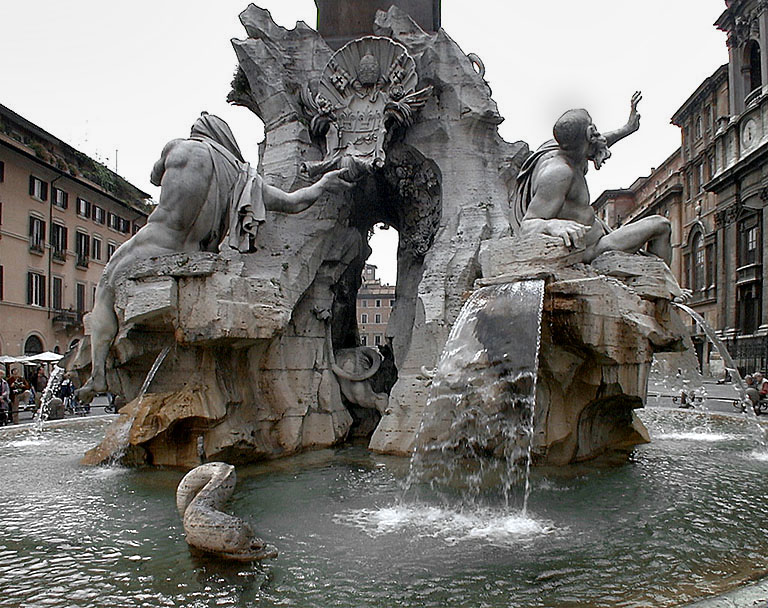
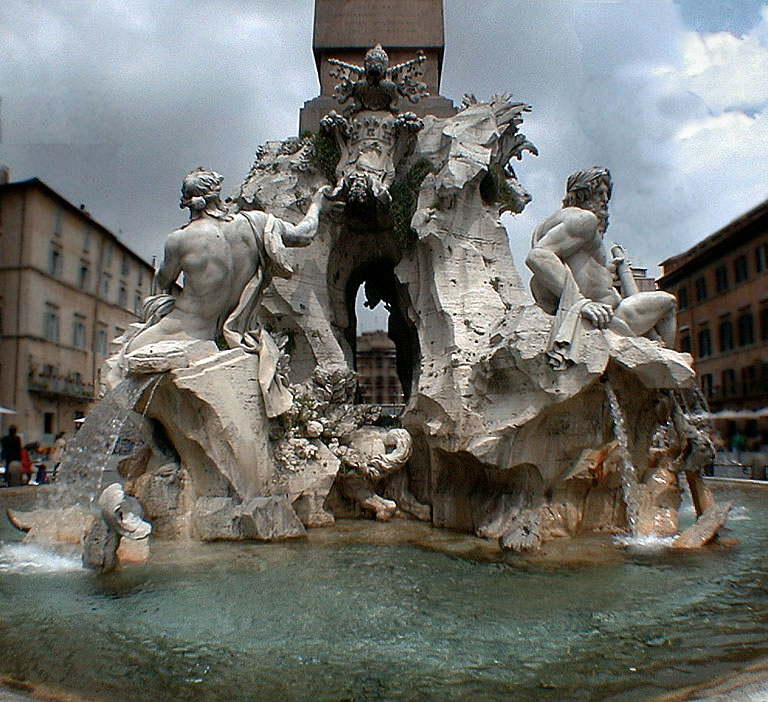
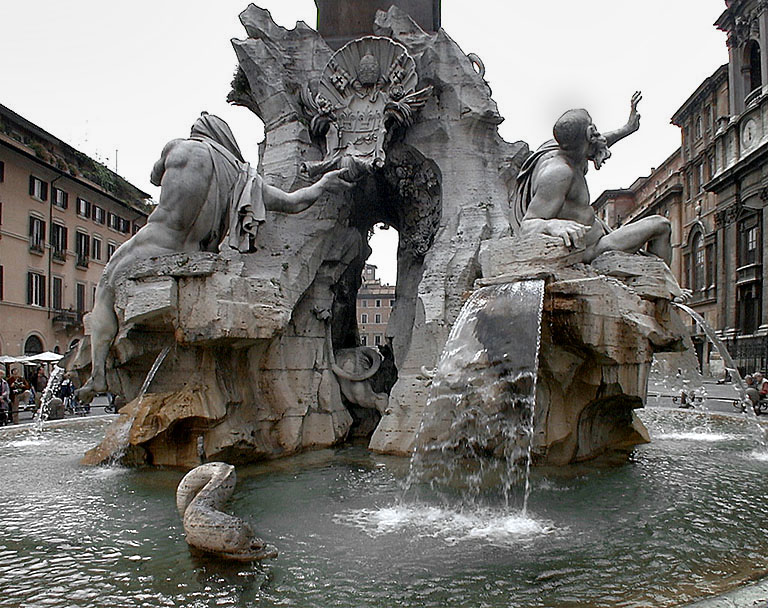
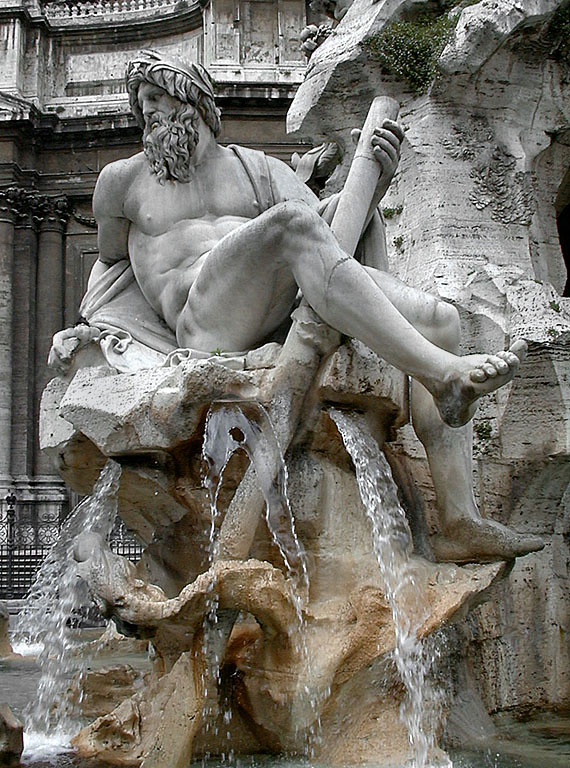
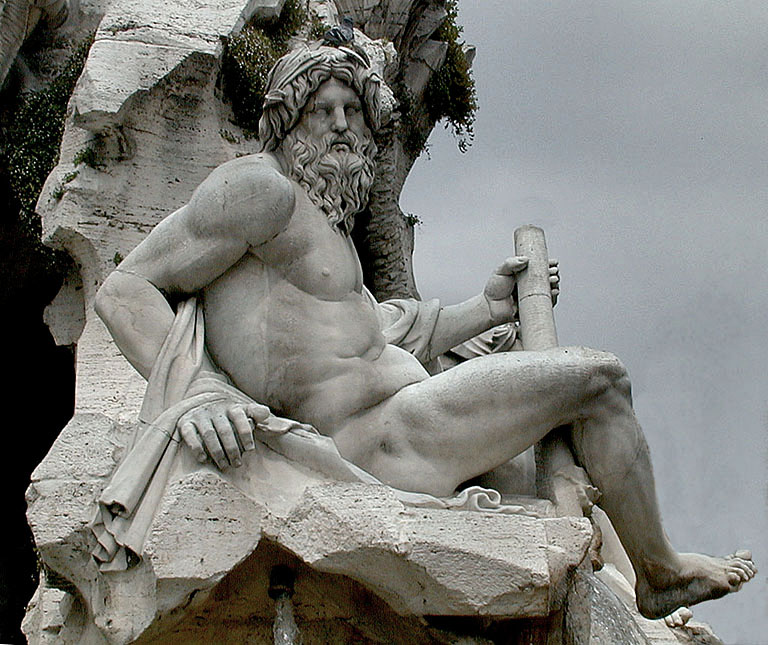
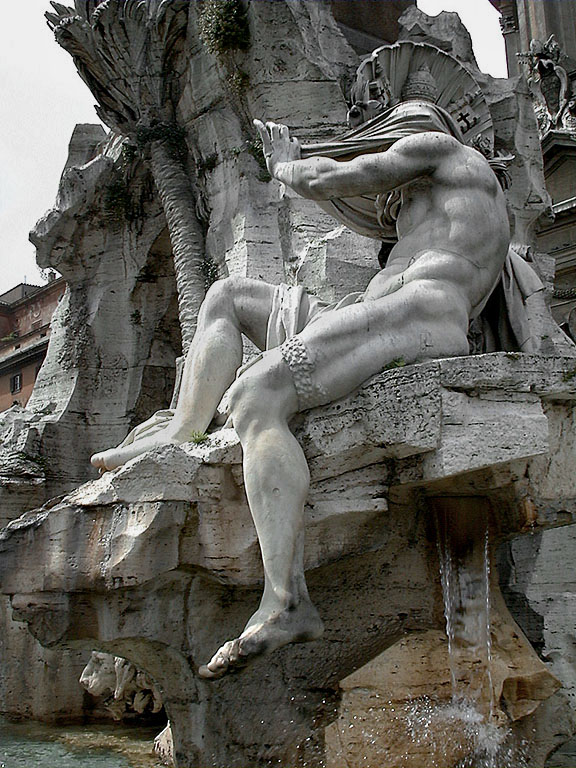
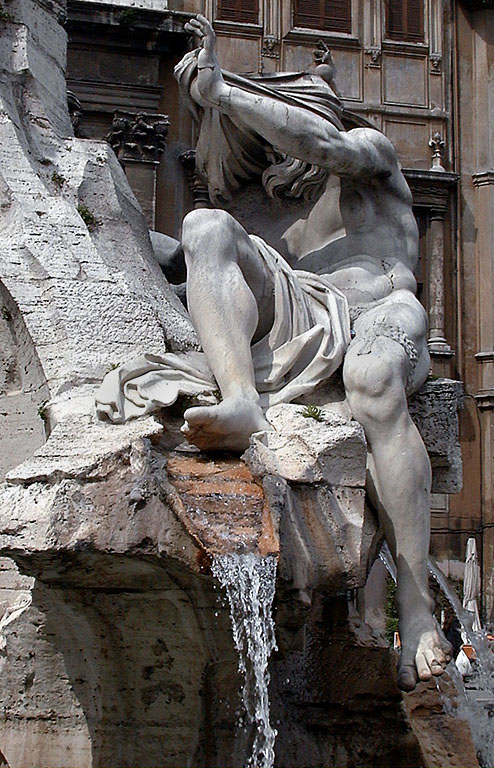
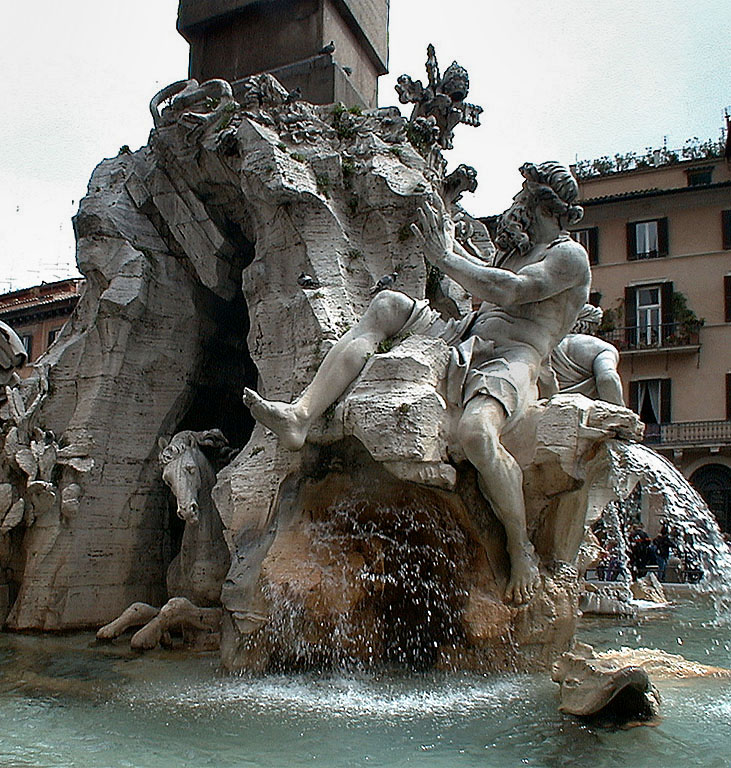
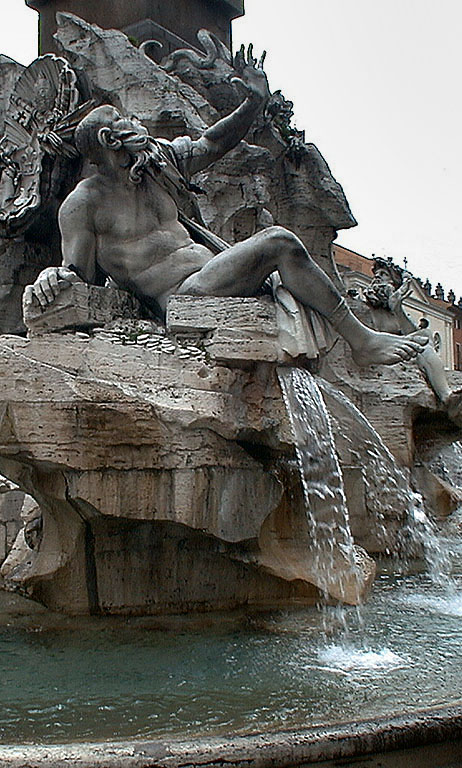
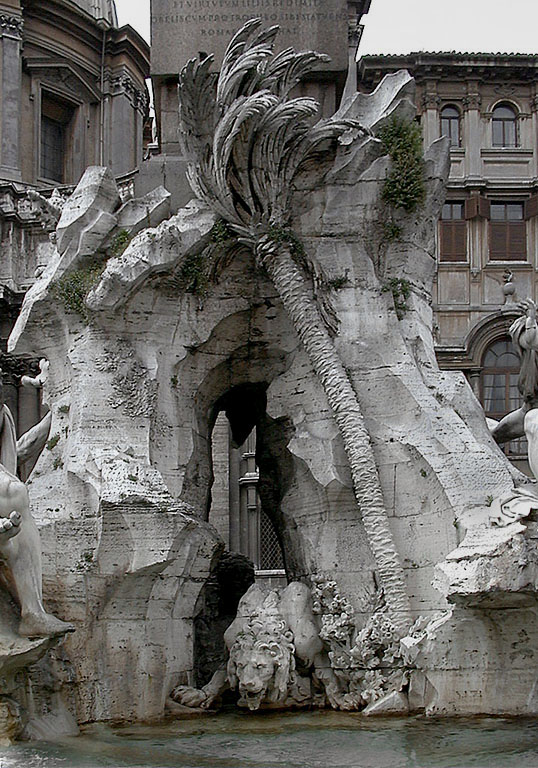
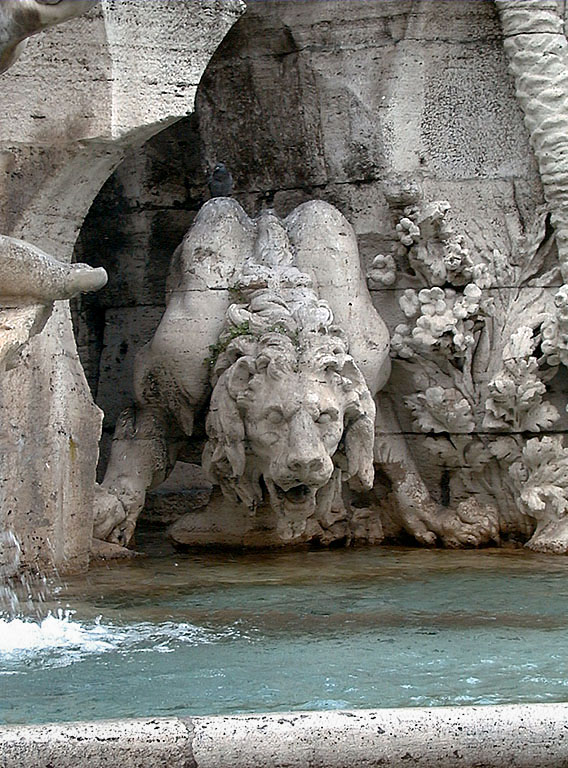
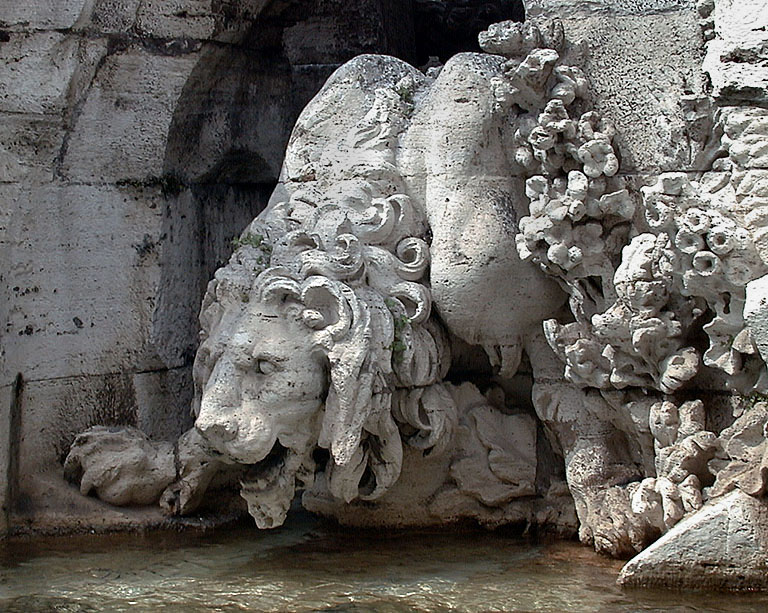
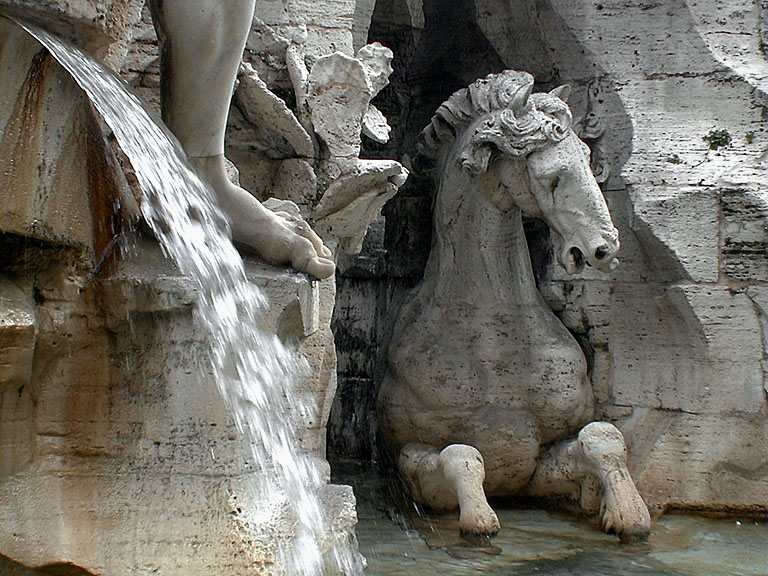
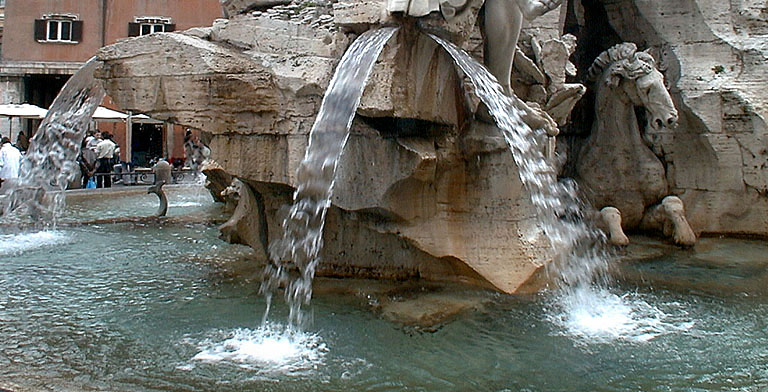
Piazza Navona — Fountain of the Moor
Built in 1574 to a design by Giacomo Della Porta during the pontificate of Gregory XIII Boncompagni, it was completely renewed in 1653, when Pope Innocent X Pamphilj entrusted the task to Bernini. In the restoration of 1874 the four tritons and the four masks were replaced by copies made by Luigi Amici (the originals are perhaps in some municipal storehouse). The central sculpture, designed by Bernini and executed by Giannantonio Mari in 1655, is wrongly called the Moor because of its facial features, but it is in fact a muscular triton subduing a dolphin.
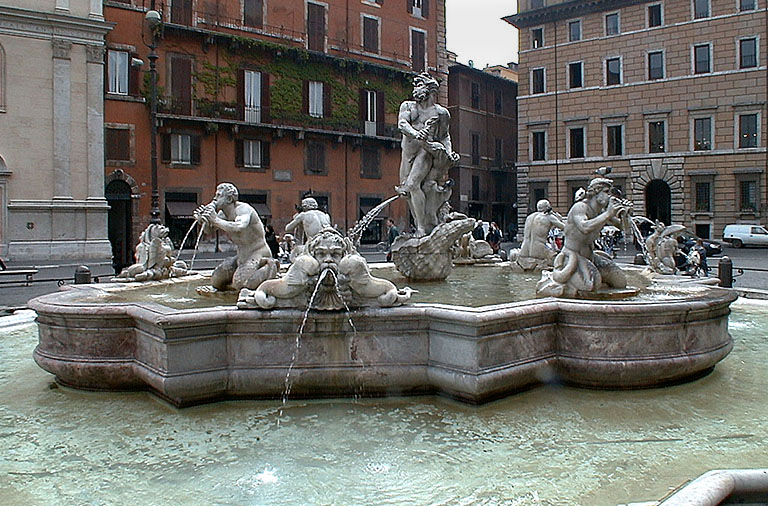
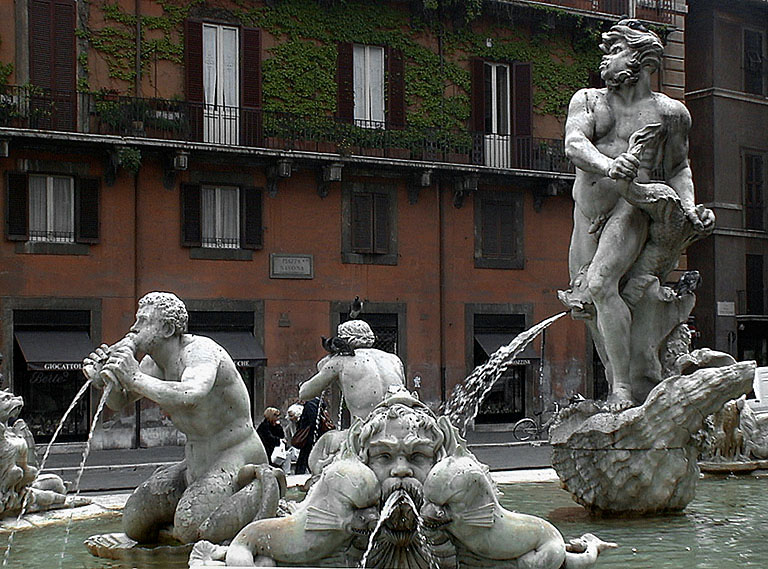
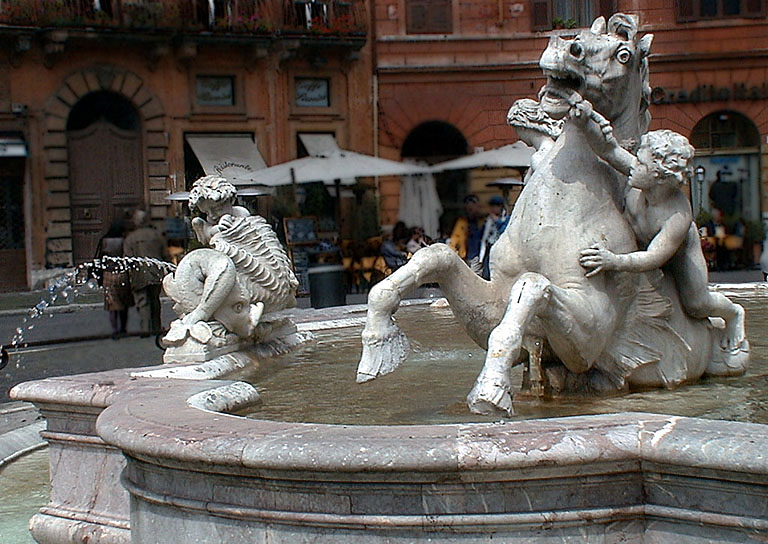
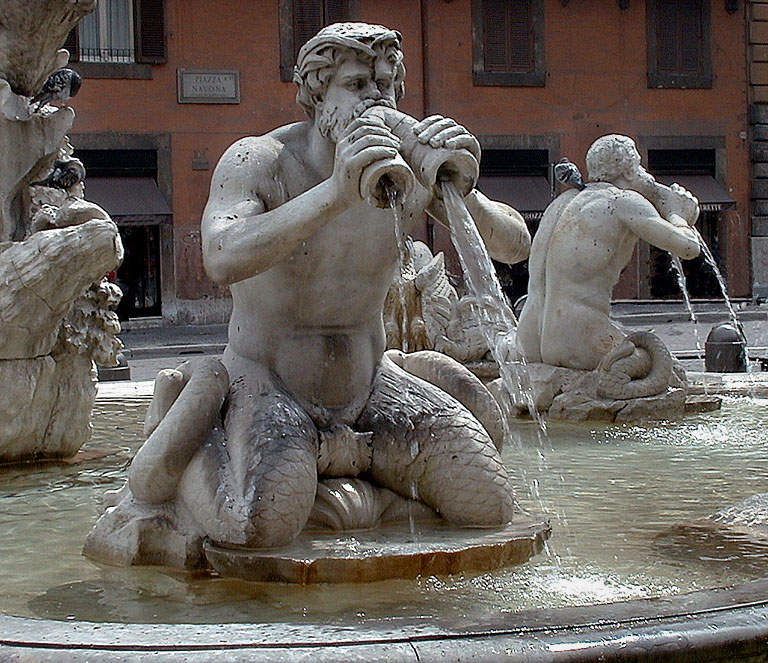
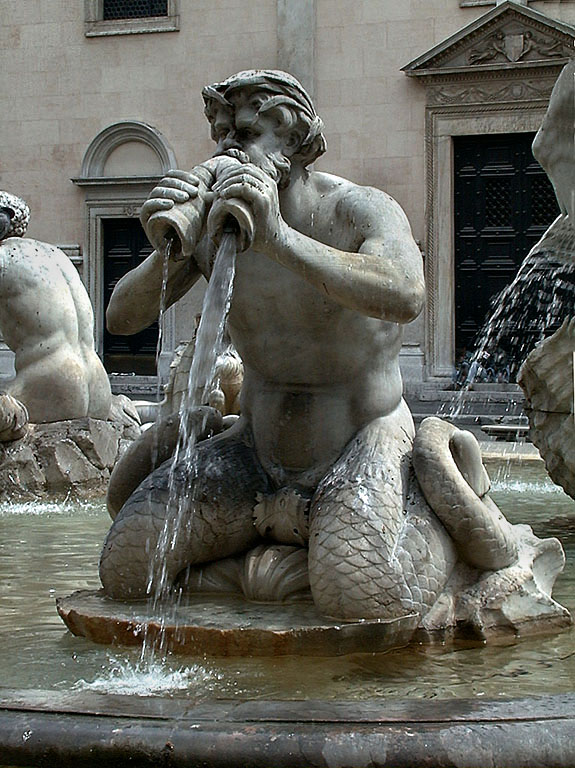
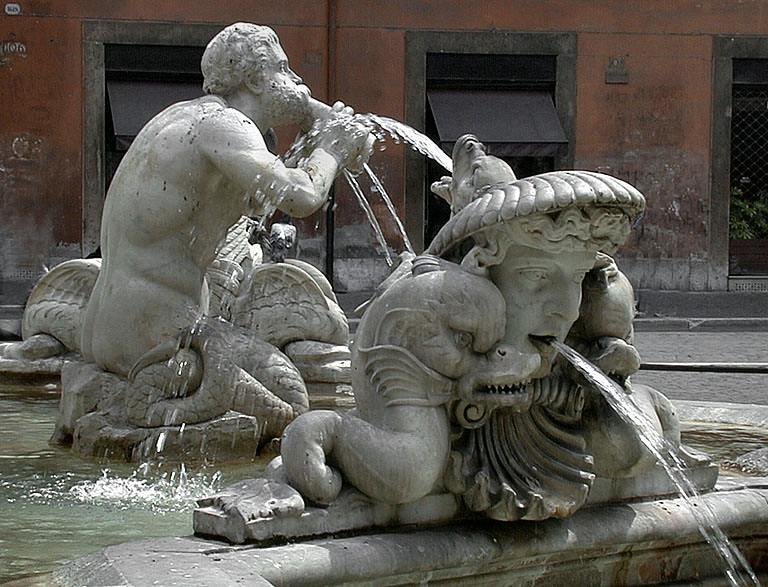
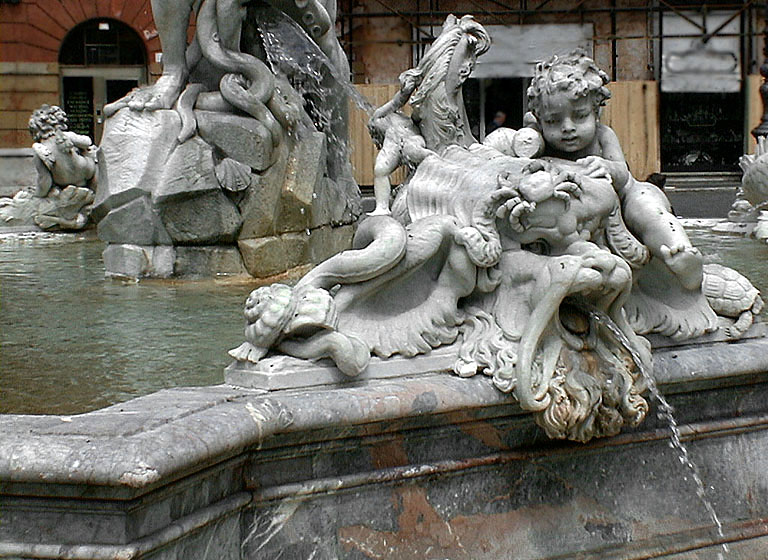
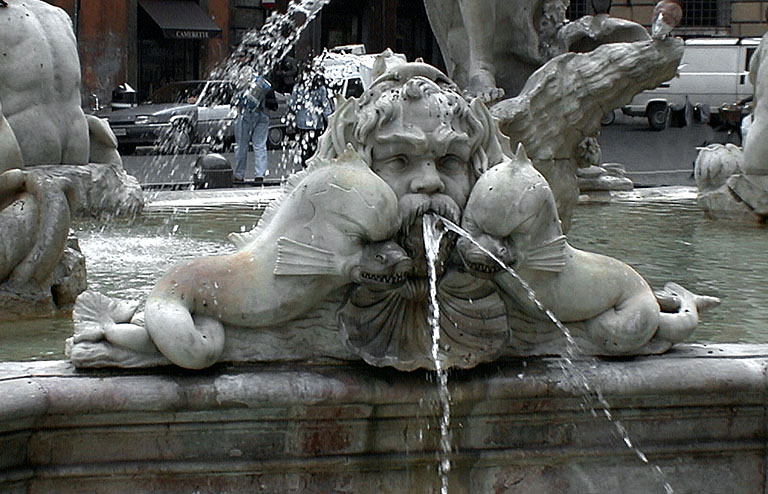
Piazza Navona — Neptune Fountain
This fountain, placed in the northern part of the square, was also restored by Bernini but remained for three hundred years without statues and decoration. In 1873 Antonio Della Bitta won the competition to carve the statue of Neptune, whilst Gregorio Zappalà carved the group around the basin: sea-horses, mermaids and putti playing with the dolphins. Work was completed in 1878.
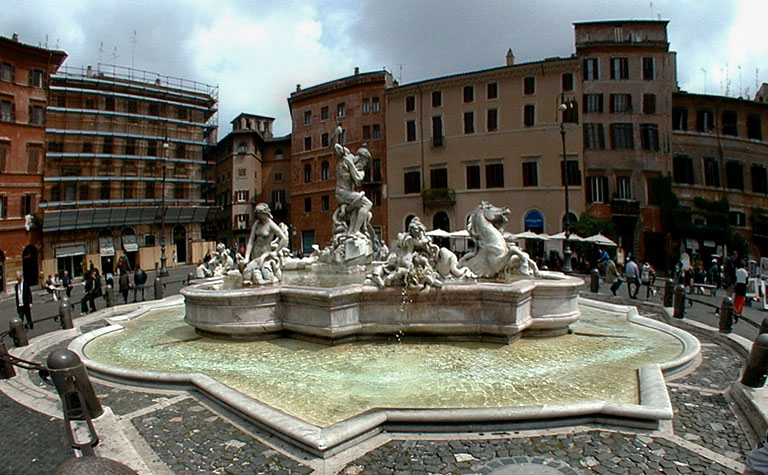
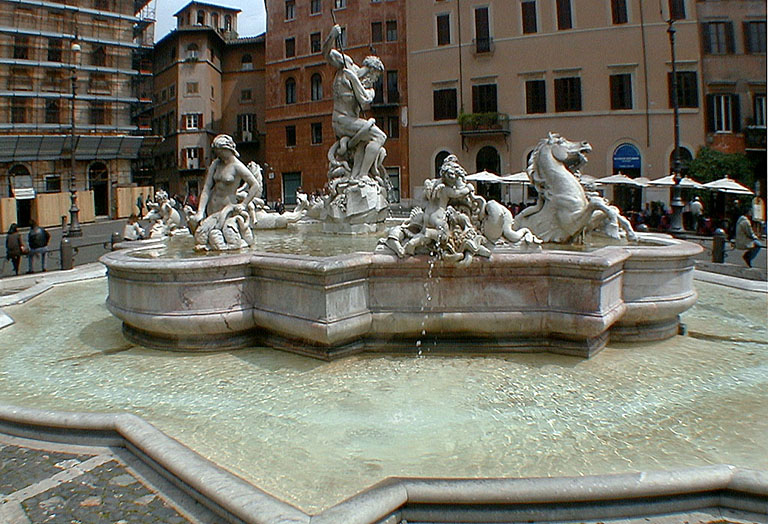
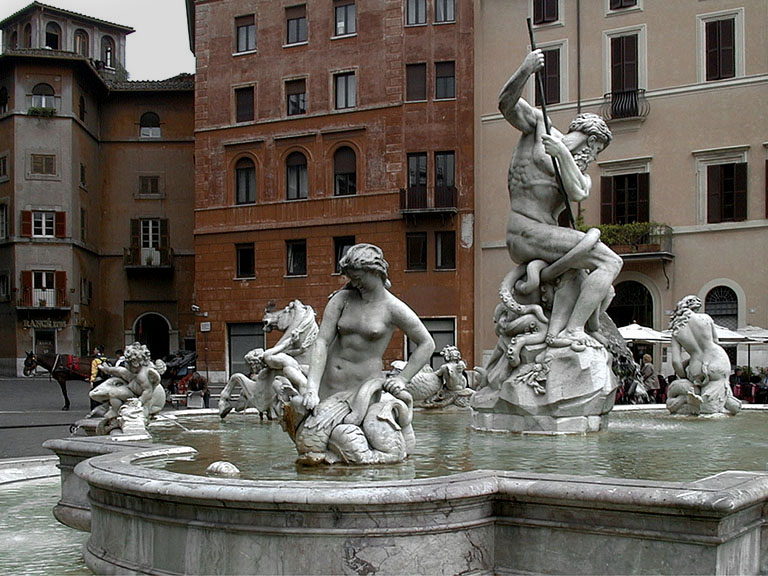
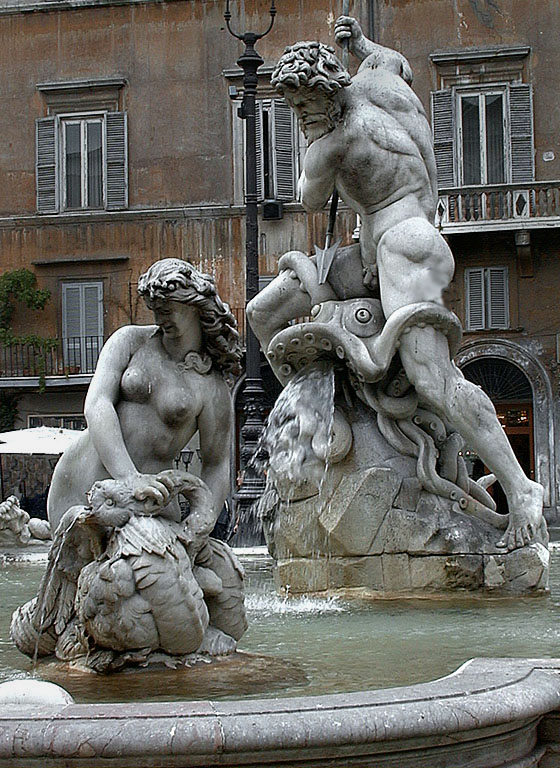
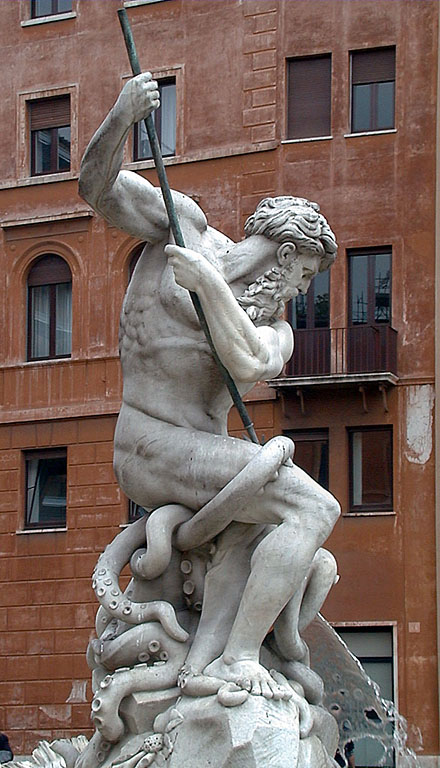
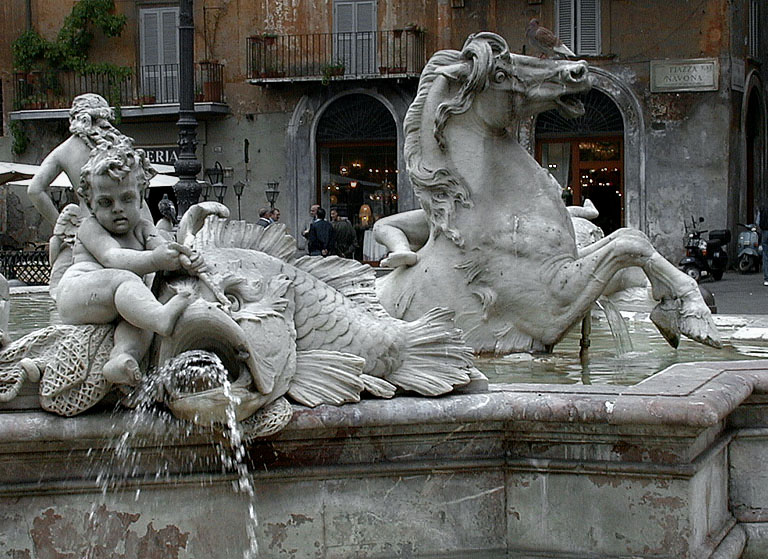
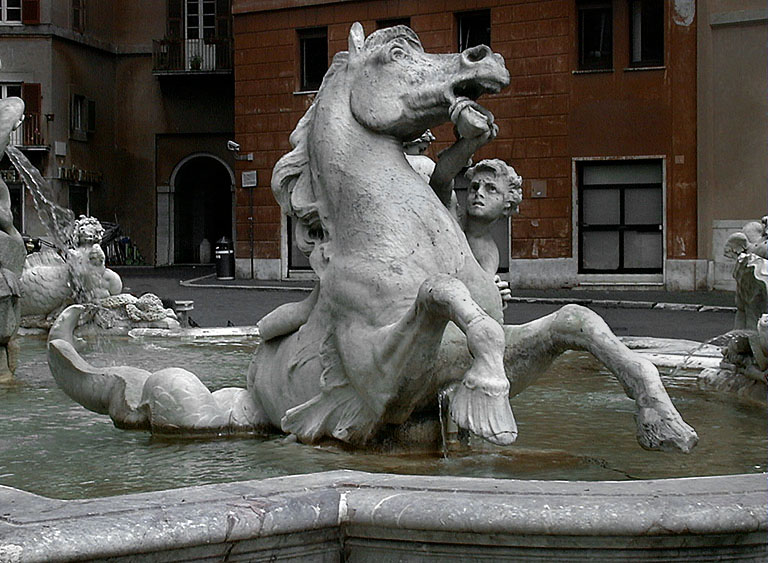
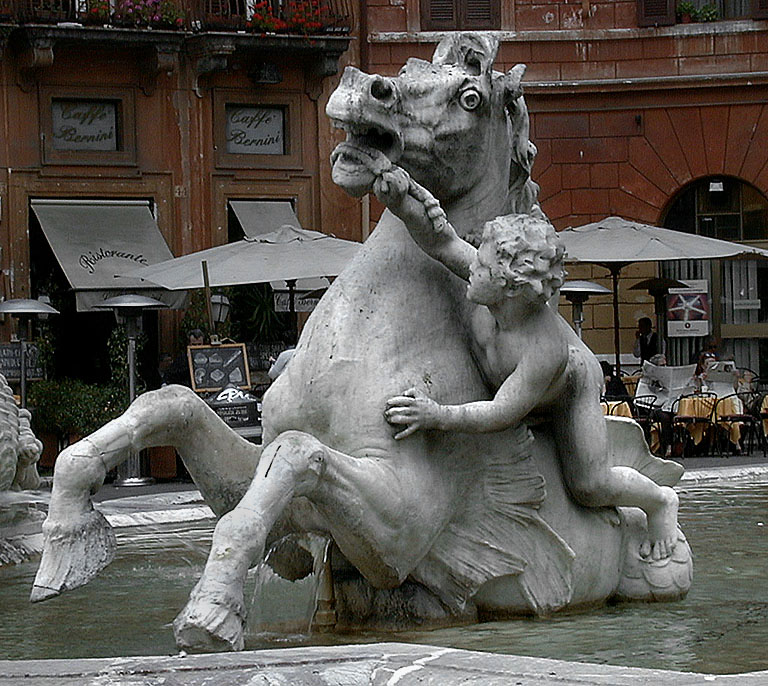
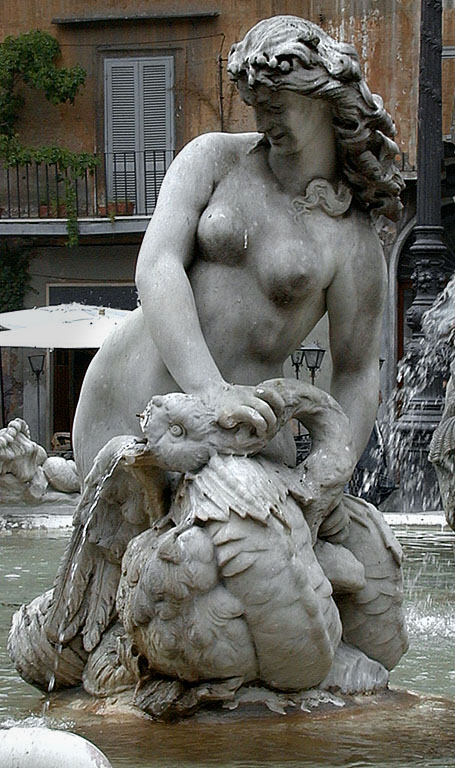
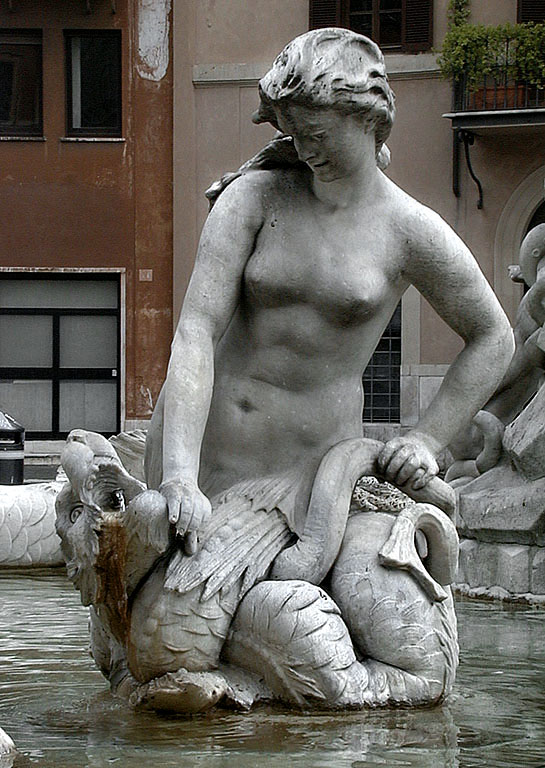
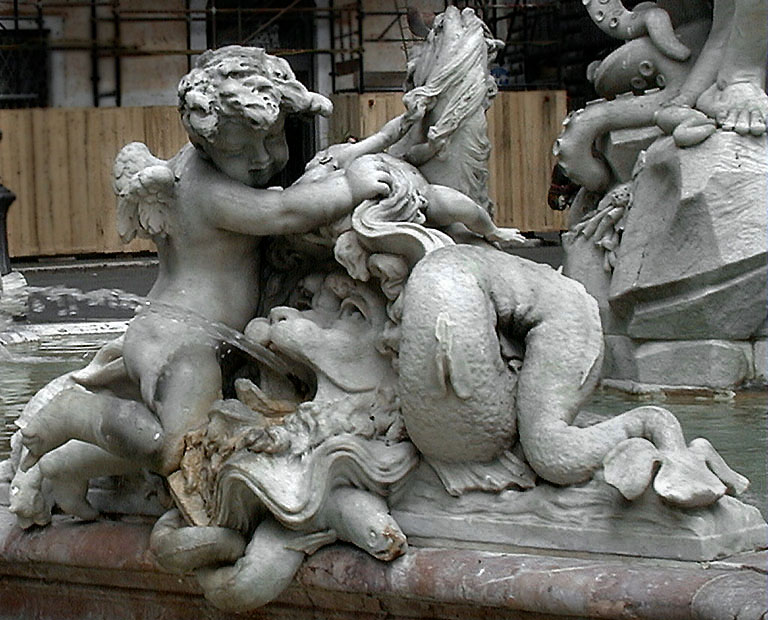
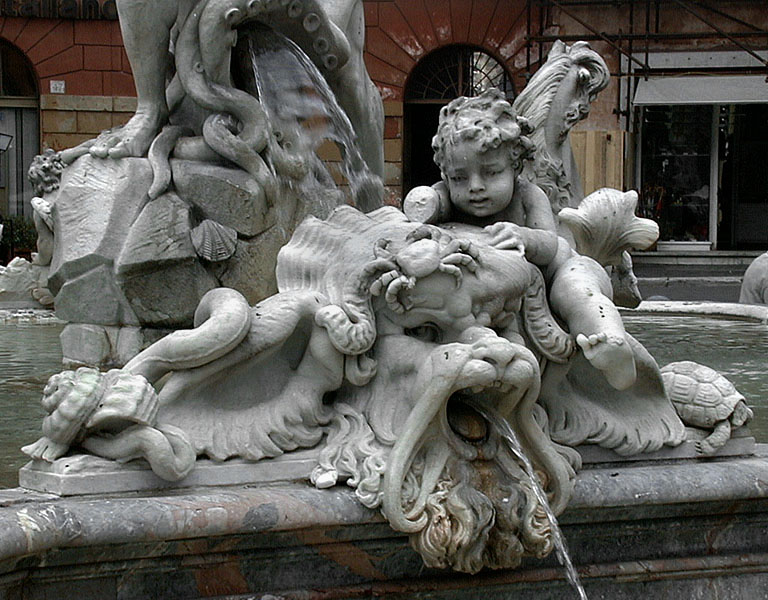
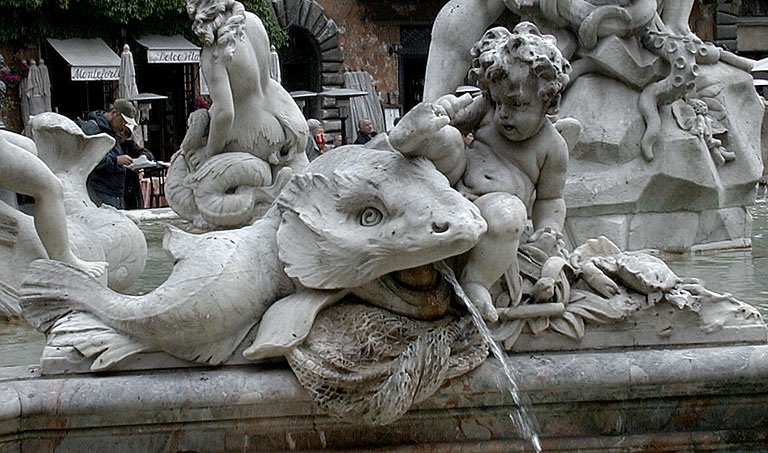
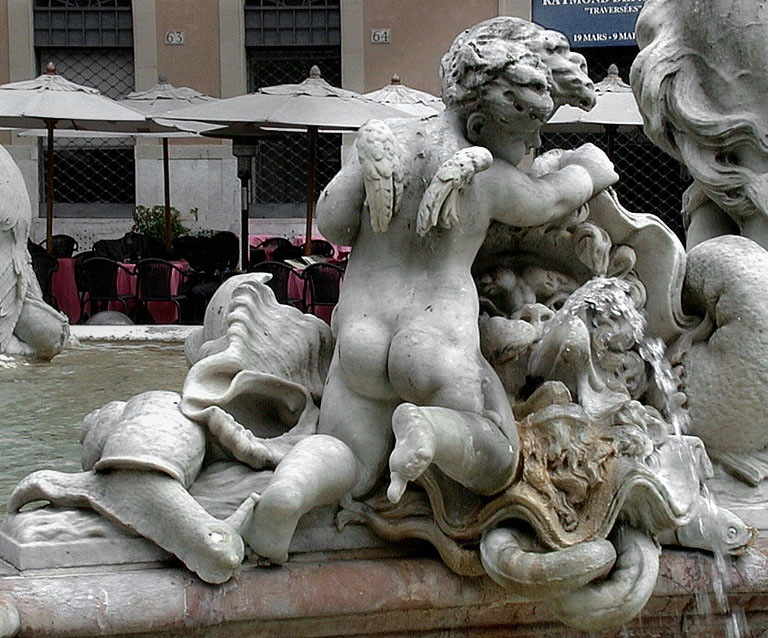
Piazza del Popolo — Obelisk Fountain
The first fountain, built by Giacomo Della Porta on commission from Pope Gregory XIII Boncompagni, was judged by Leo XII Della Genga to be, though beautiful, inadequate for the size of the square, and he entrusted its rebuilding to Giuseppe Valadier, the leading figure of Roman classicism. Valadier placed around the obelisk four Egyptian-style white marble lions, which pour water in fans into as many round travertine basins resting on a square base of five steps. Valadier also designed two other fountains to complete the side hemicycles.
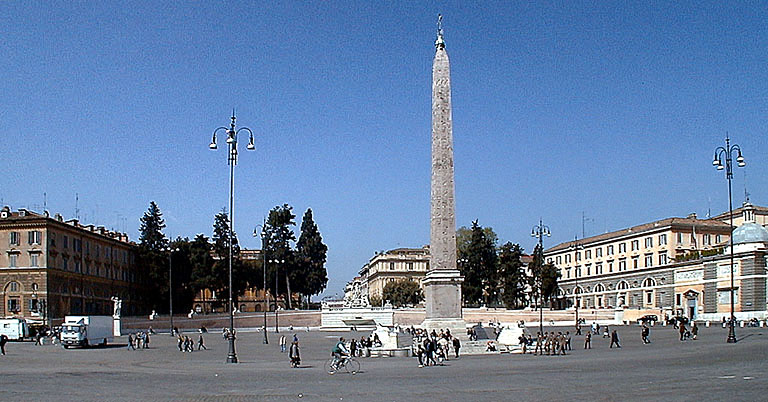
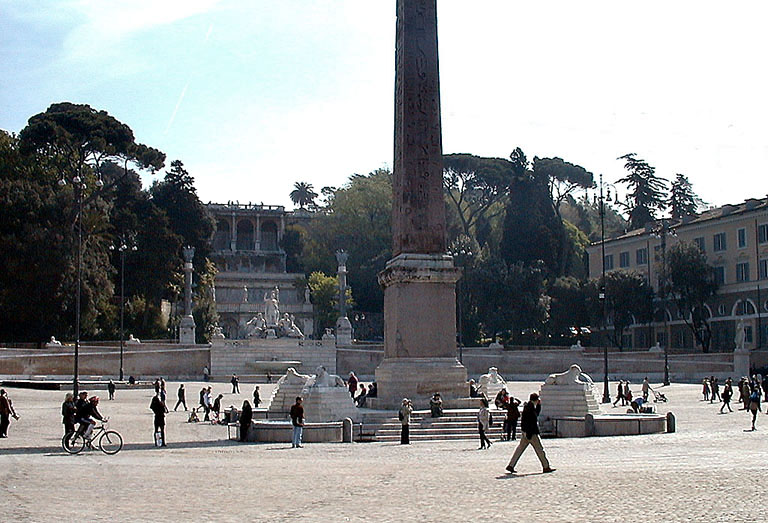
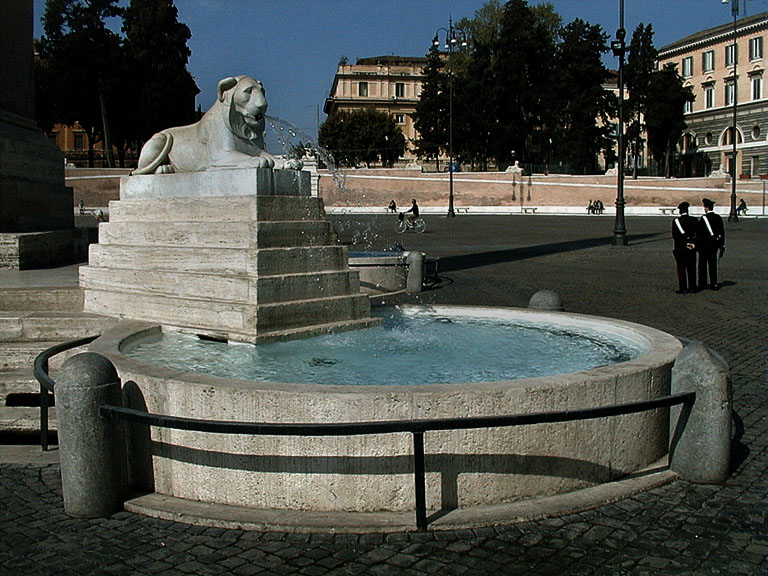
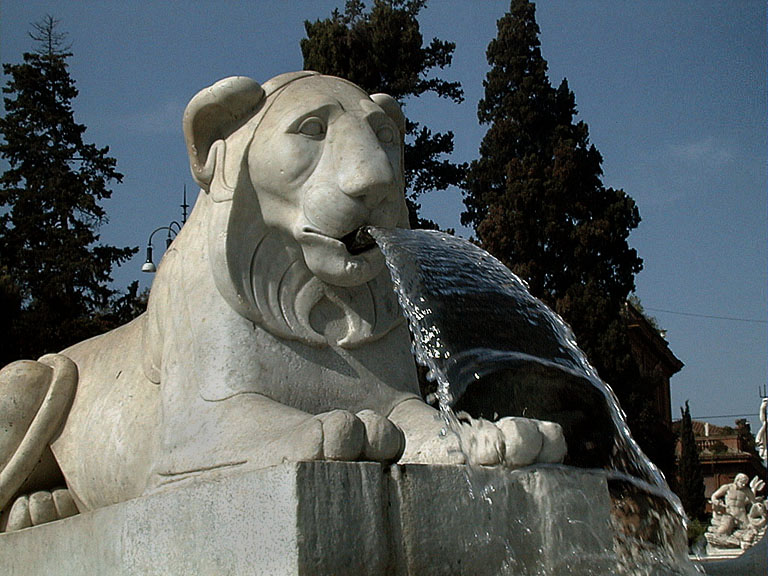
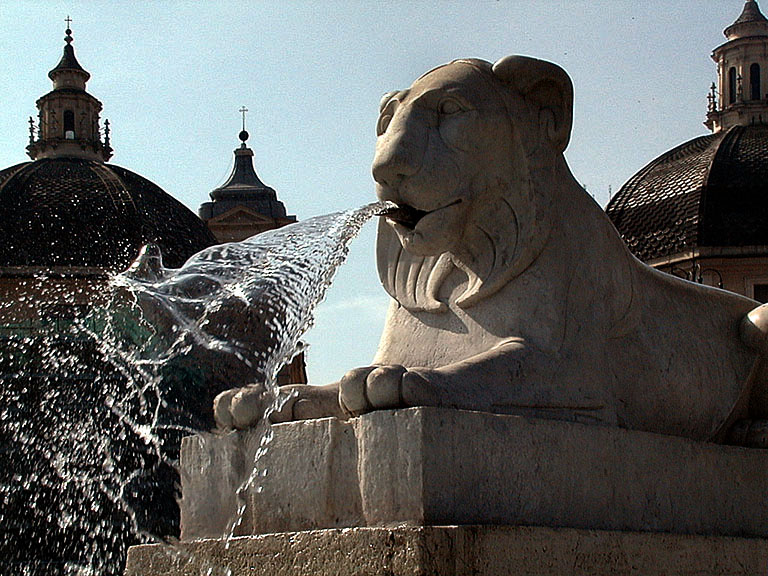
Piazza del Popolo — Fountain of the Goddess Roma
This is the fountain set in the right-hand hemicycle, towards the Pincio, designed by Valadier in 1823; the marble sculptural group, executed by Giovanni Ceccarini, represents the goddess Roma armed with a spear and wearing a helmet, flanked by the reclining statues of the Tiber and the Aniente and by the she-wolf suckling the twins. The travertine basin, shaped like a broad shell, collects the water that comes from a small bowl placed at the base of the monument.
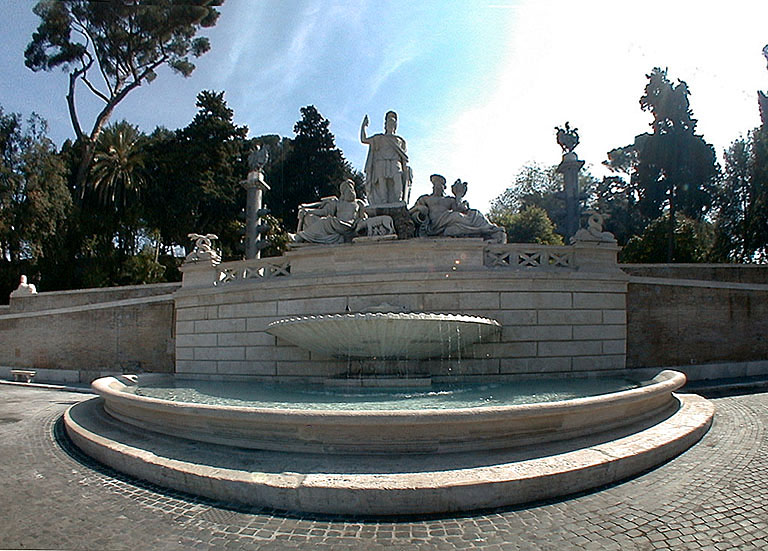
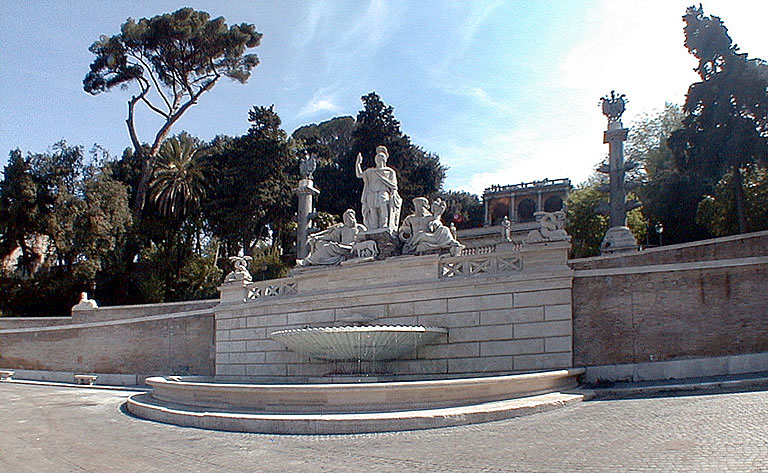
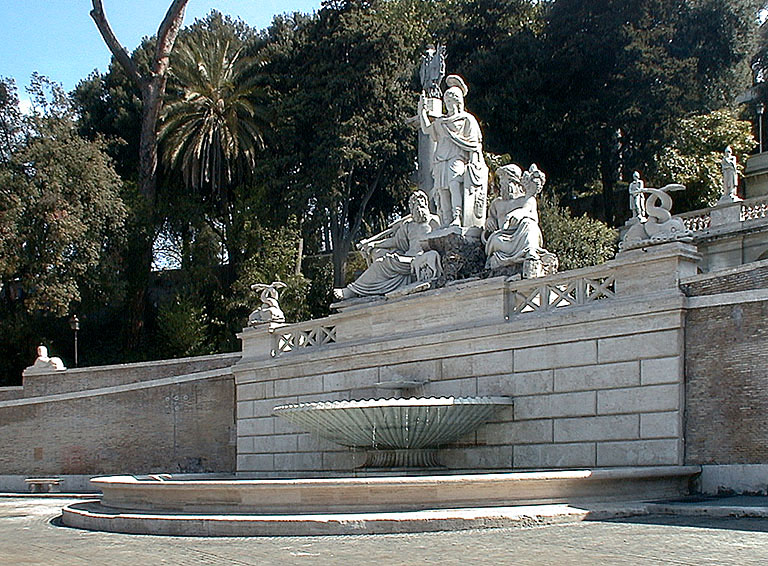
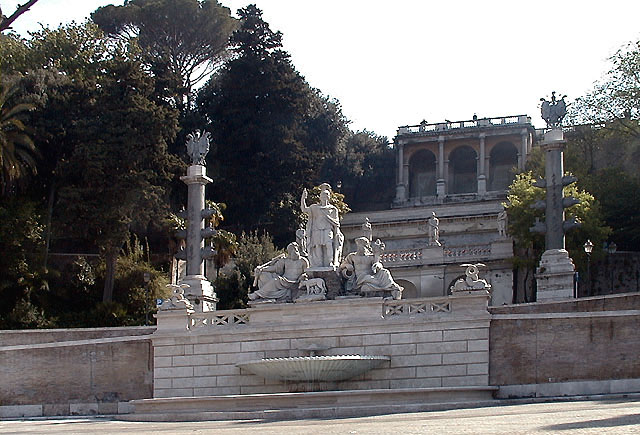
Piazza del Popolo — Neptune Fountain
In the left-hand hemicycle Valadier set, as its counterpart, a fountain with a monumental group, again carved by Ceccarini, depicting Neptune with his trident above two dolphins guided by two tritons. The water flows and is collected in the same way as the other fountain.
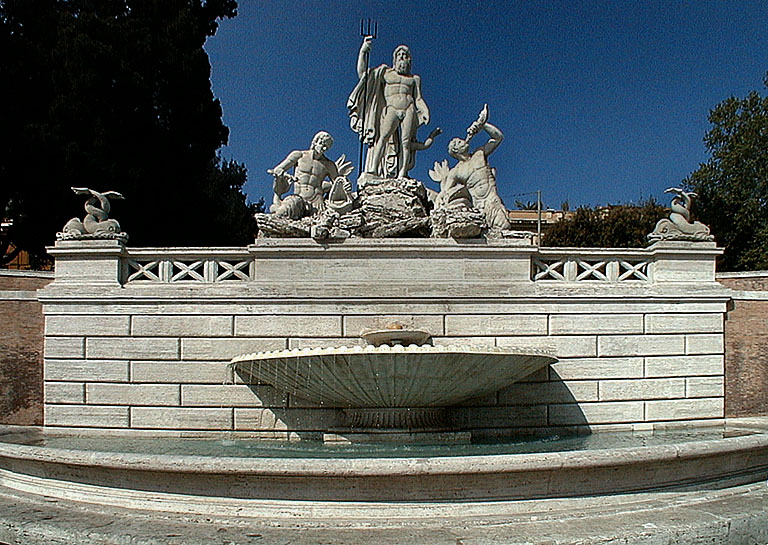
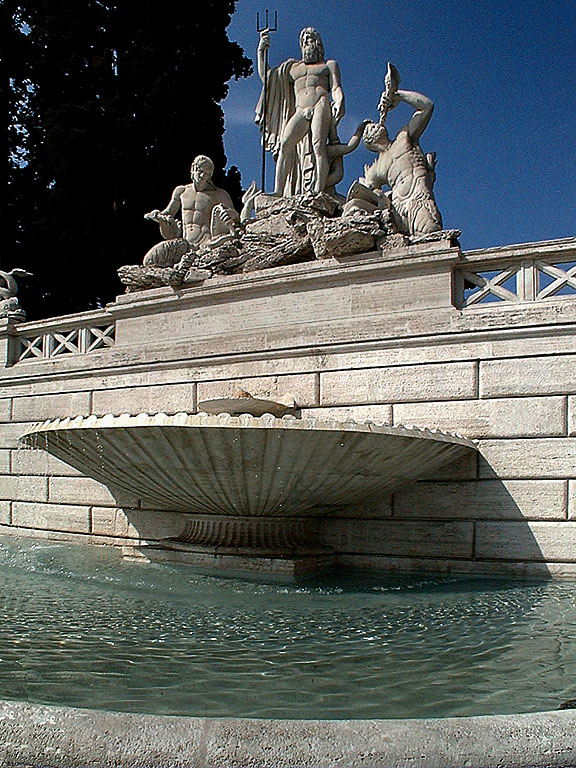
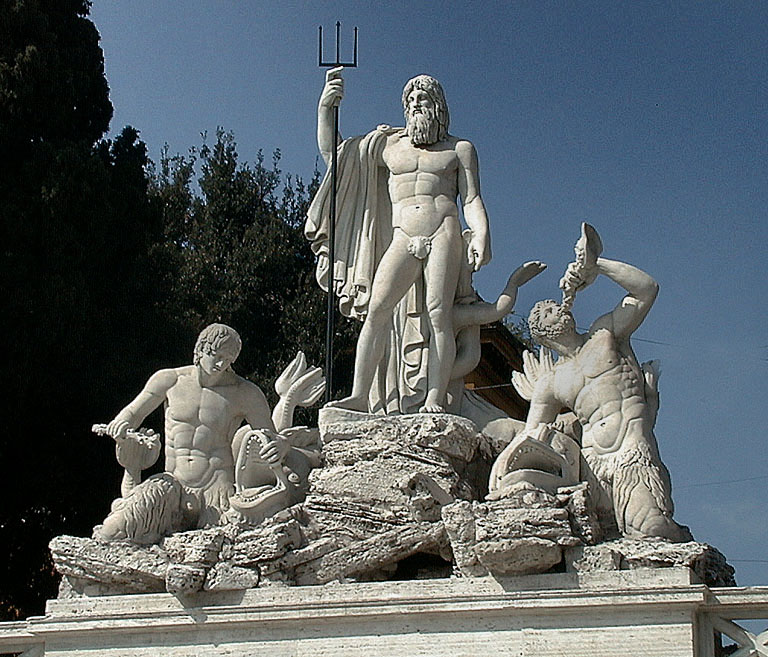
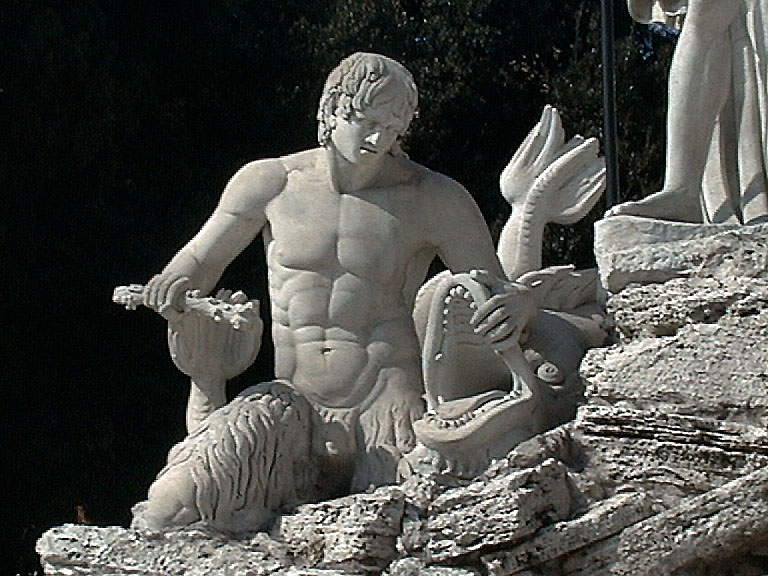
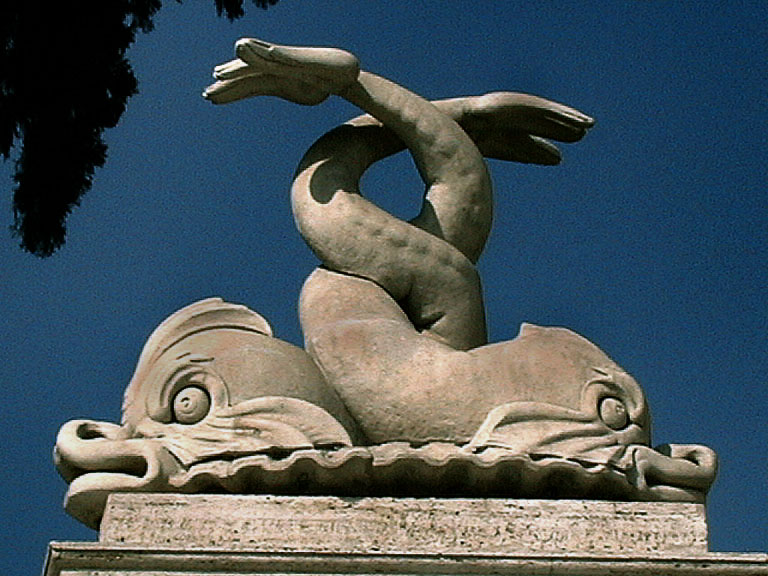
Fountain of the Naiads in Piazza della Repubblica
It is the most beautiful of Rome's modern fountains. It was built in 1888 to a design by Alessandro Guerrieri, who placed four plaster lions around the large circular basin. These were replaced in 1901 by the four bronze groups by the sculptor Mario Rutelli, representing the Nymph of the Lakes with the swan, the Nymph of the Rivers on a river monster, the Nymph of the Oceans, known as the “Oceanina”, on a wild horse symbolising the breakers, and the Nymph of Underground Waters, lying on the back of the dragon. In the centre, the “Glauco” group, also carved by Rutelli and added in 1912, replaced an earlier one, which represented man's dominion over the forces of nature and was taken to the gardens of Piazza Vittorio Emanuele because the patrons did not like it.
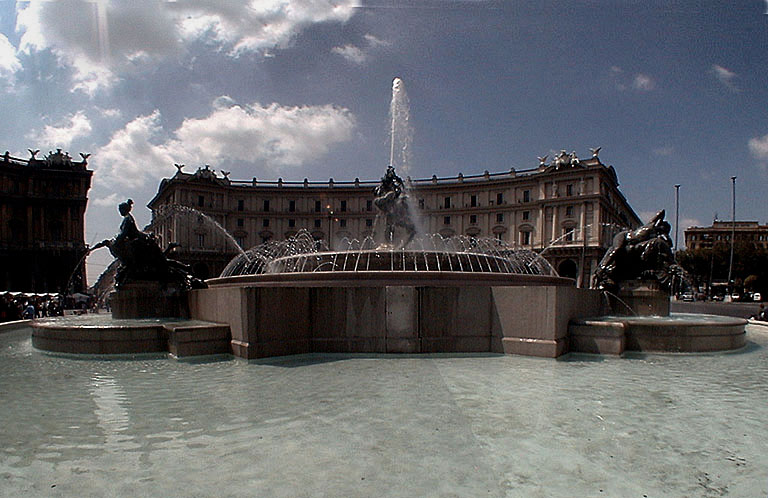
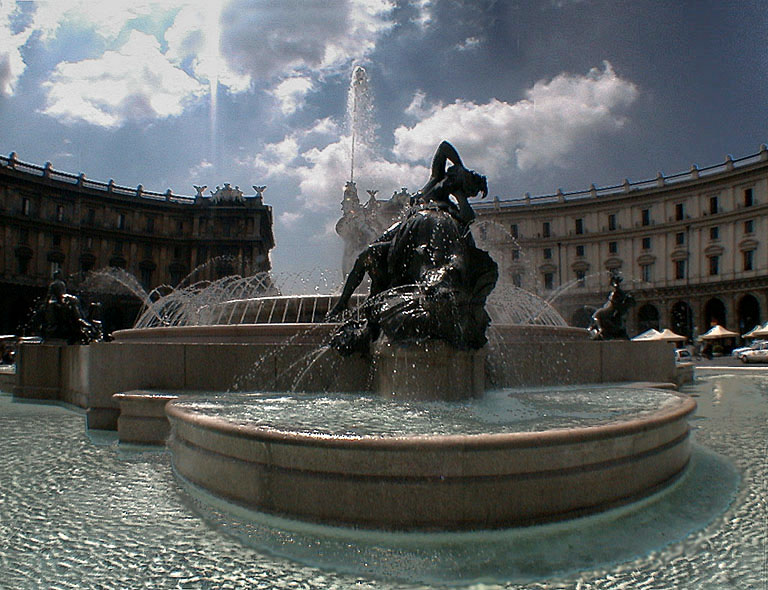
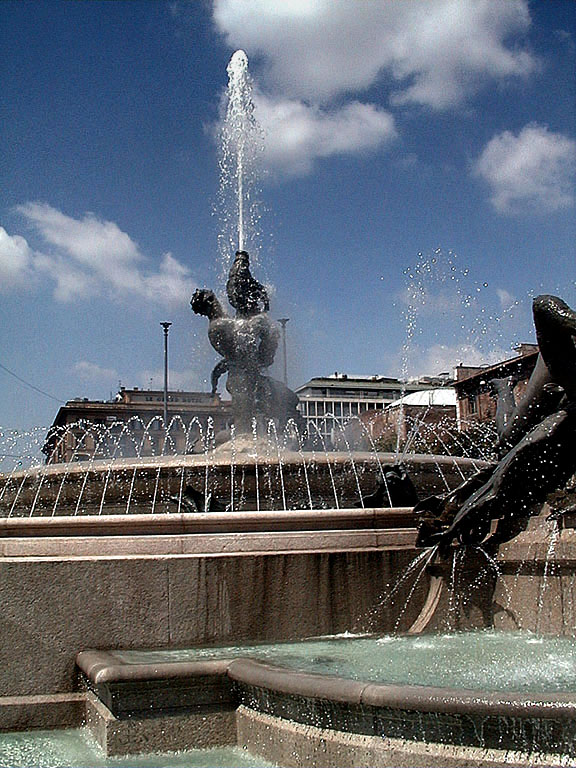
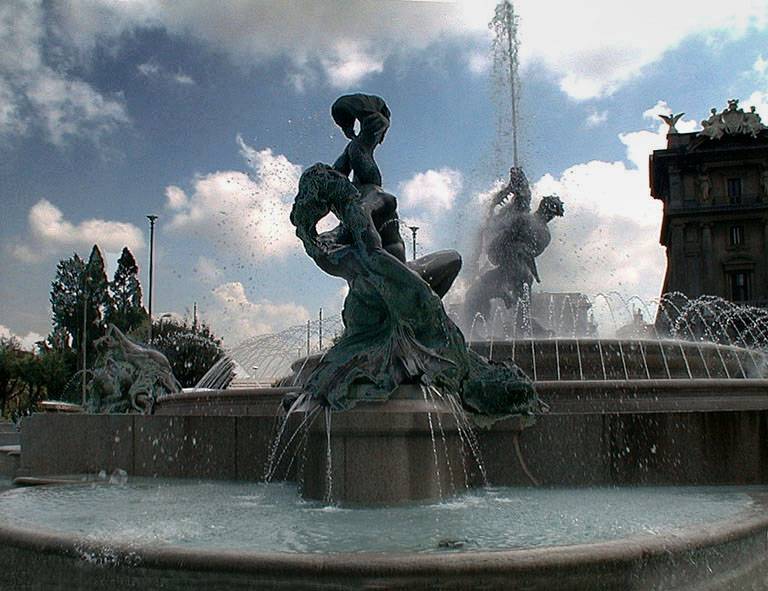
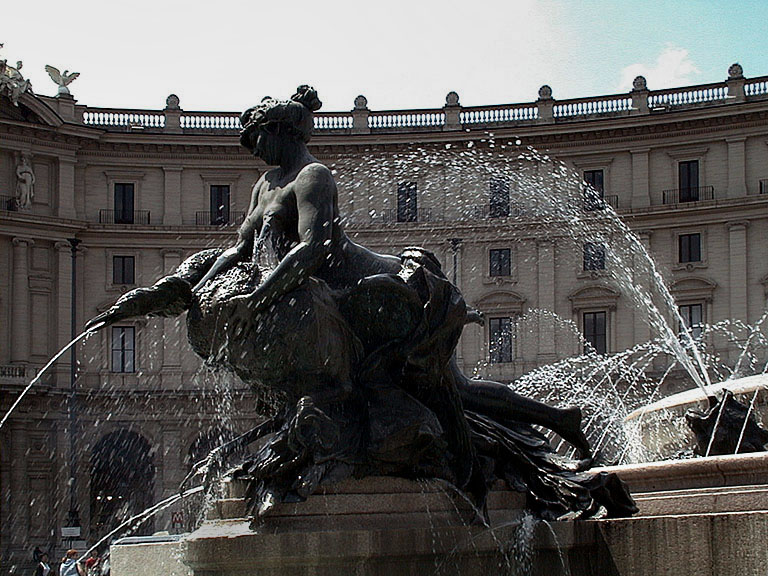
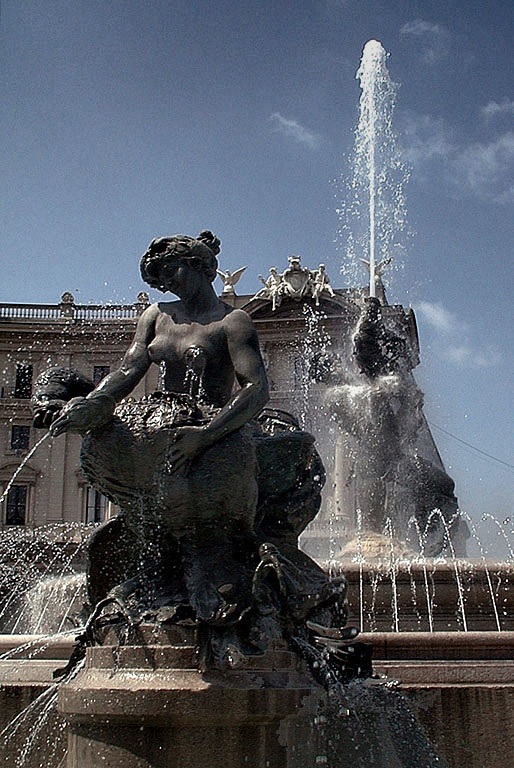
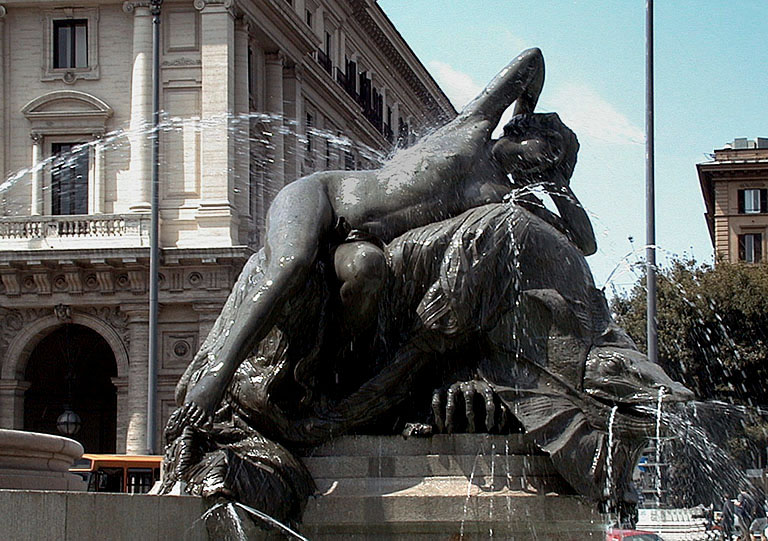
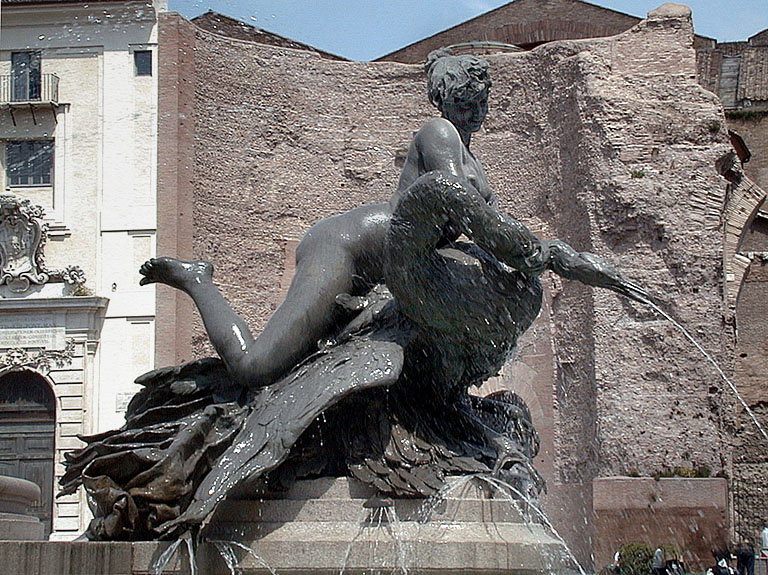
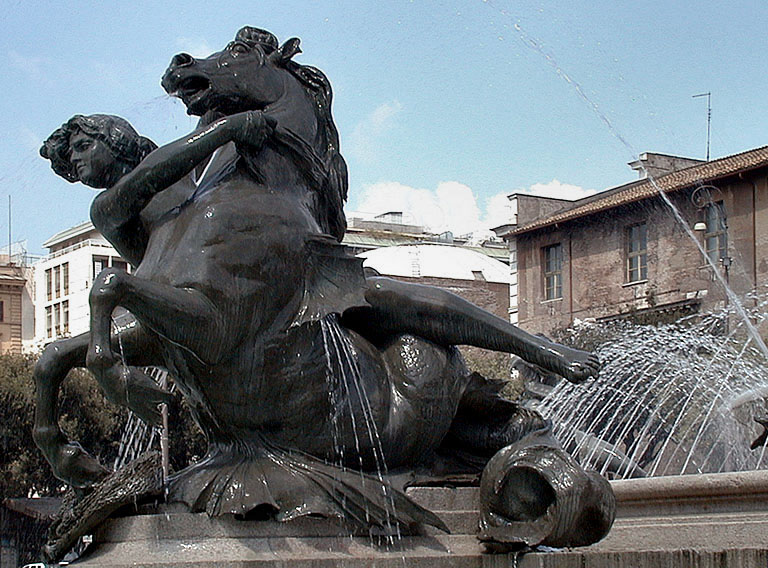
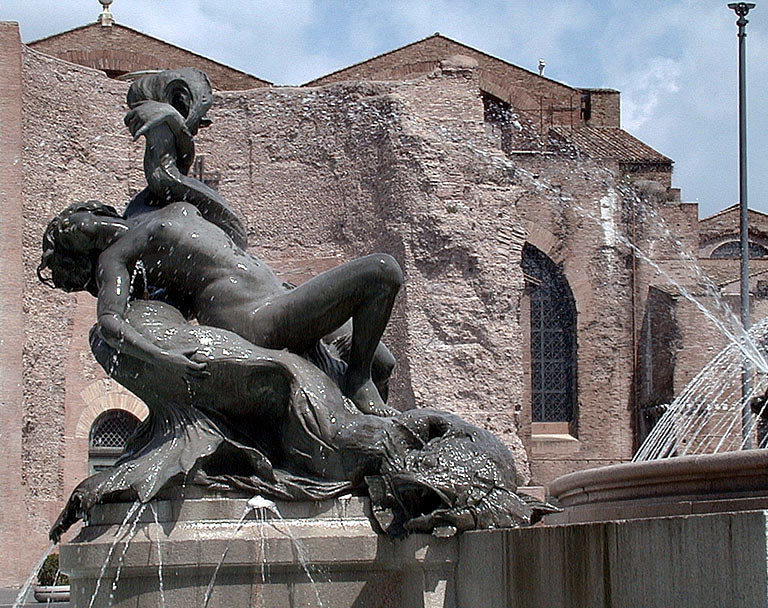
Pantheon Fountain in Piazza della Rotonda
In 1575 Giacomo Della Porta, commissioned by Pope Gregory XIII Boncompagni, drew up an elegant design for a fountain to be placed in the centre of the square. Leonardo Sormani executed the work, consisting of a mixtilinear basin raised on three travertine steps and enriched with four groups of dolphins and masks, with a bowl with a spouting jet of water in the centre. In 1711, by order of Pope Clement XI Albani, the architect Filippo Barigoni replaced the bowl with a rocky outcrop, on which was set the six-metre-high obelisk of Ramesses II, adorned at its base with four dolphins carved by the sculptor Vincenzo Felici. In the restoration of 1804 the four sixteenth-century masks were replaced by copies made by Luigi Amici.
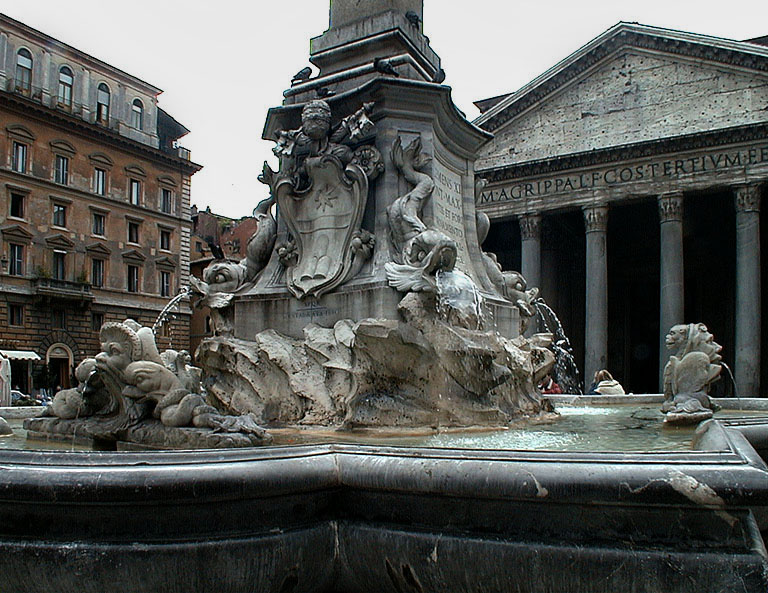
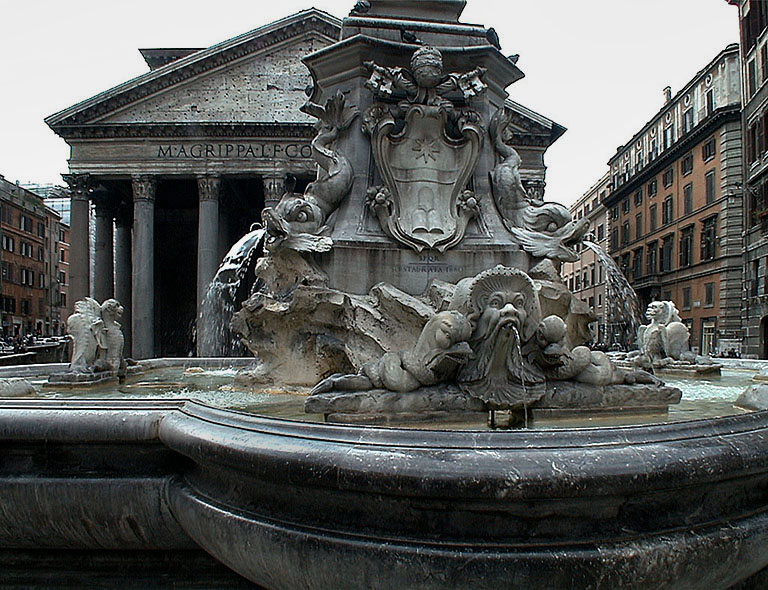
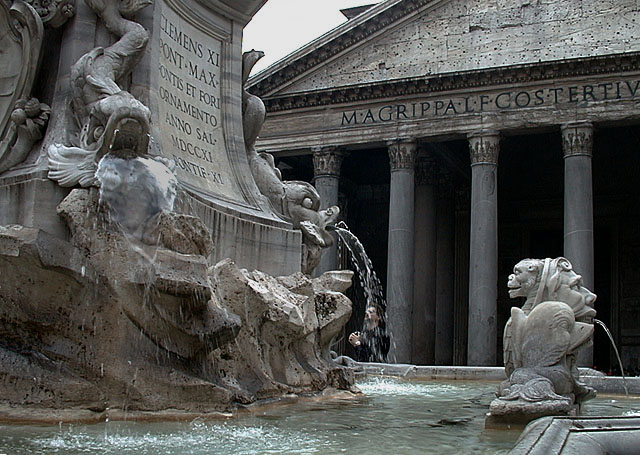
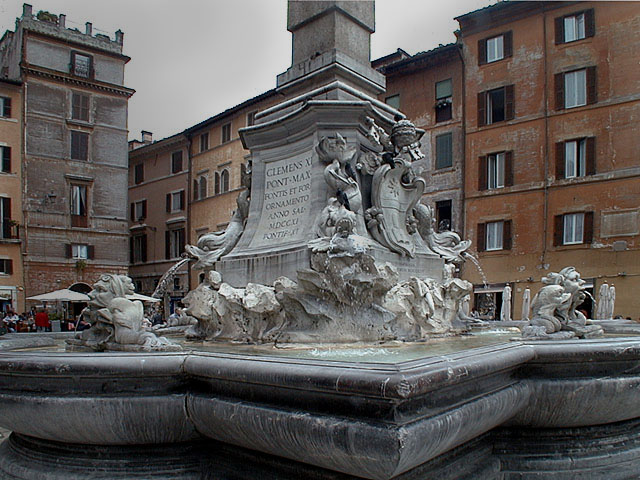
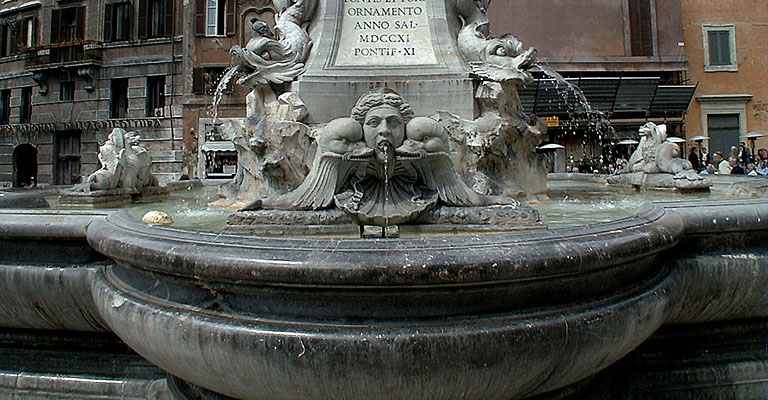
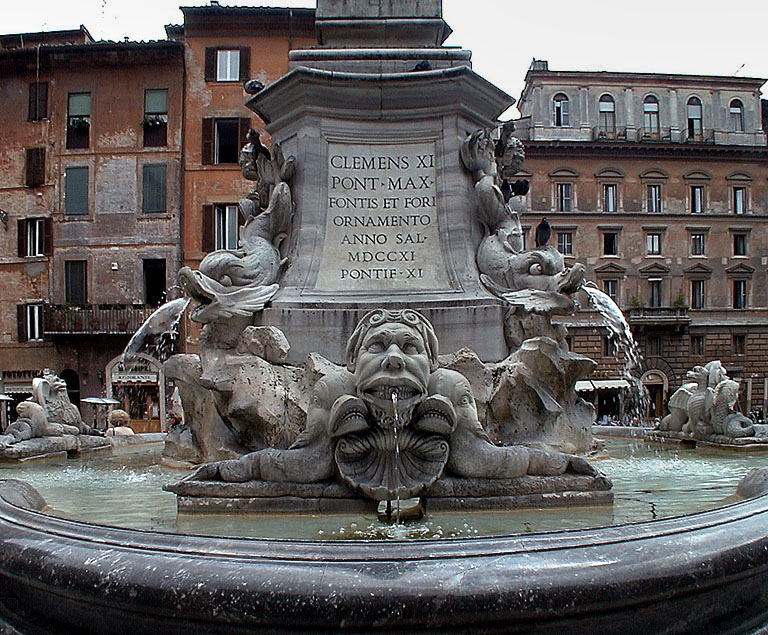
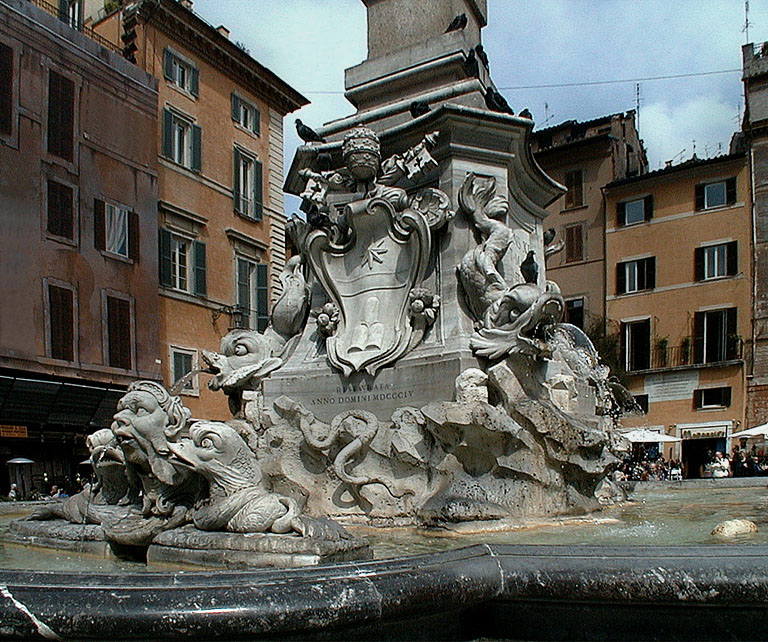
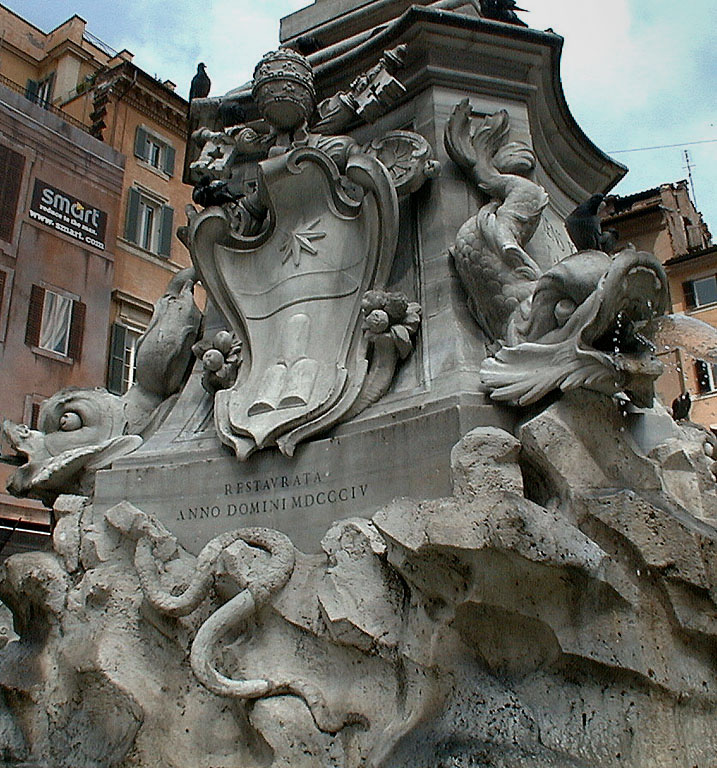
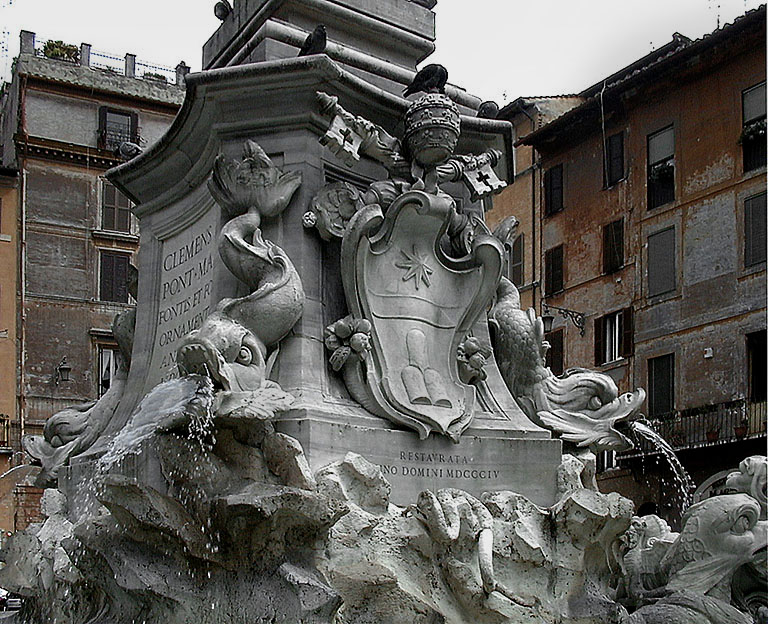
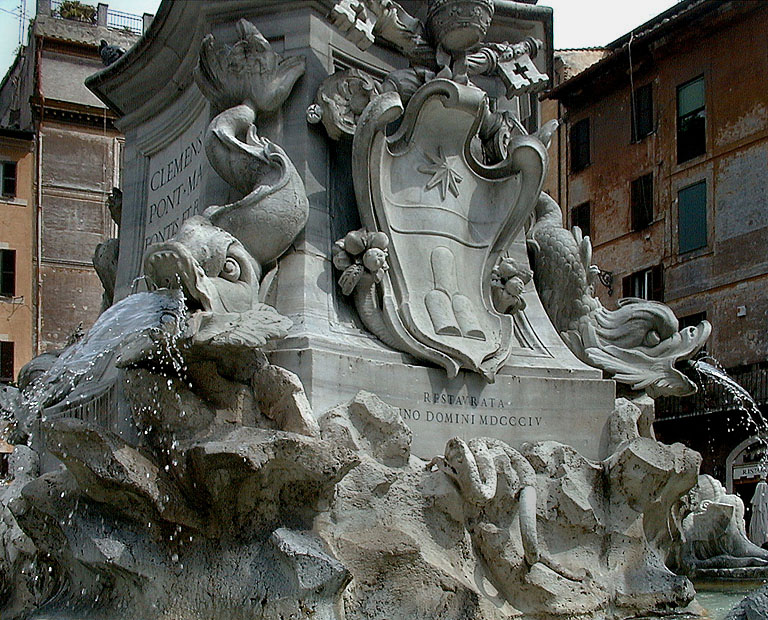
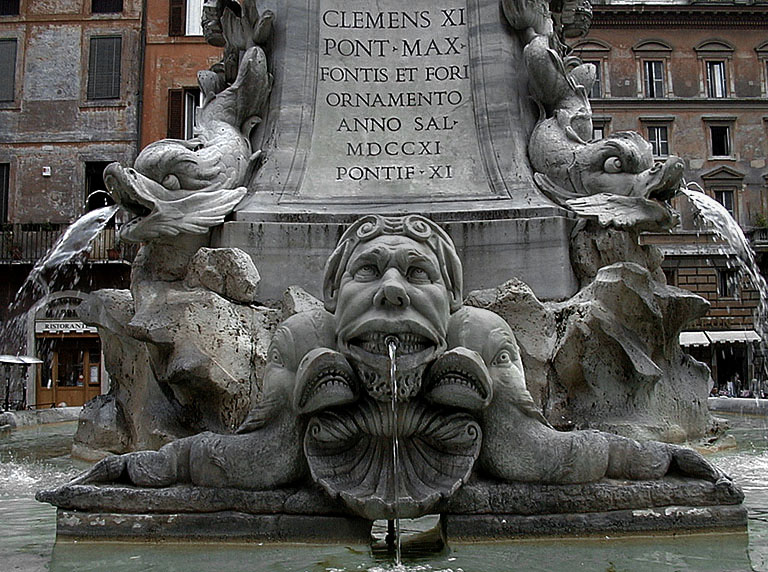
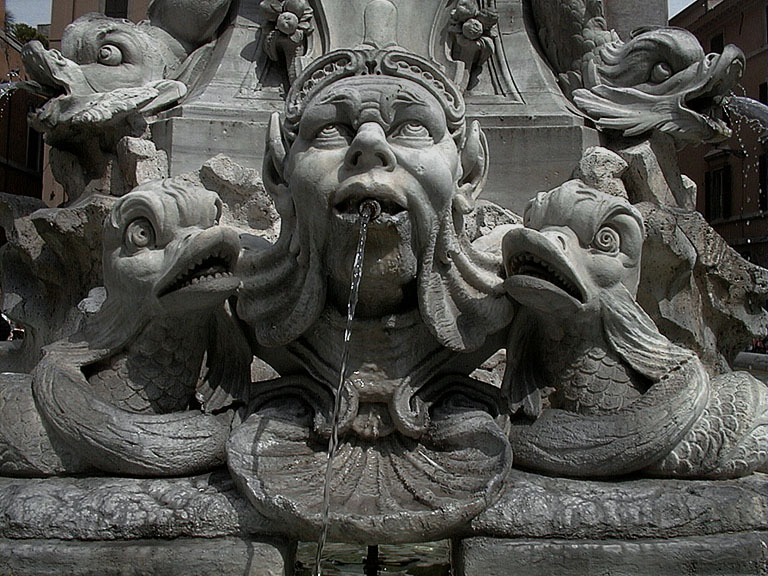
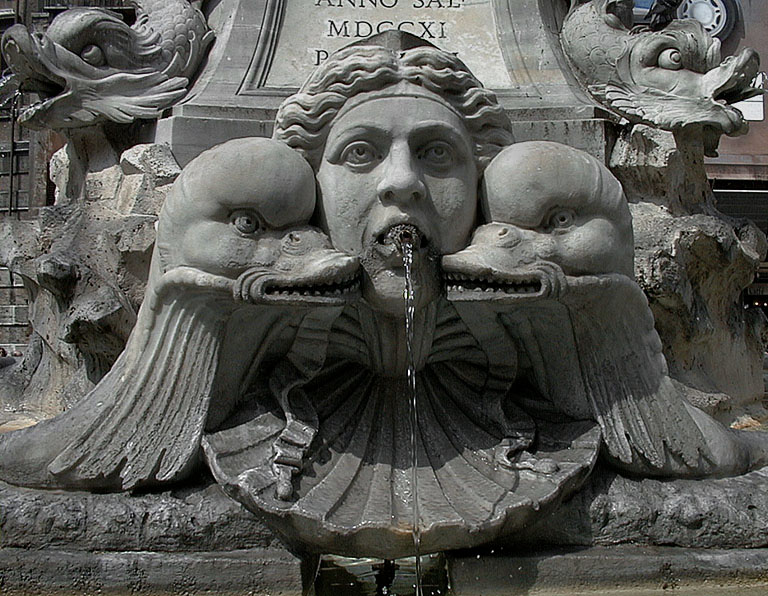
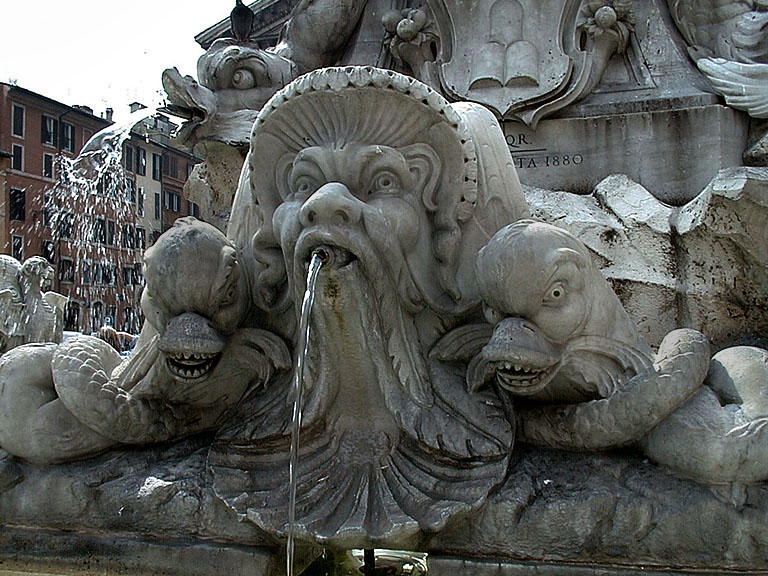
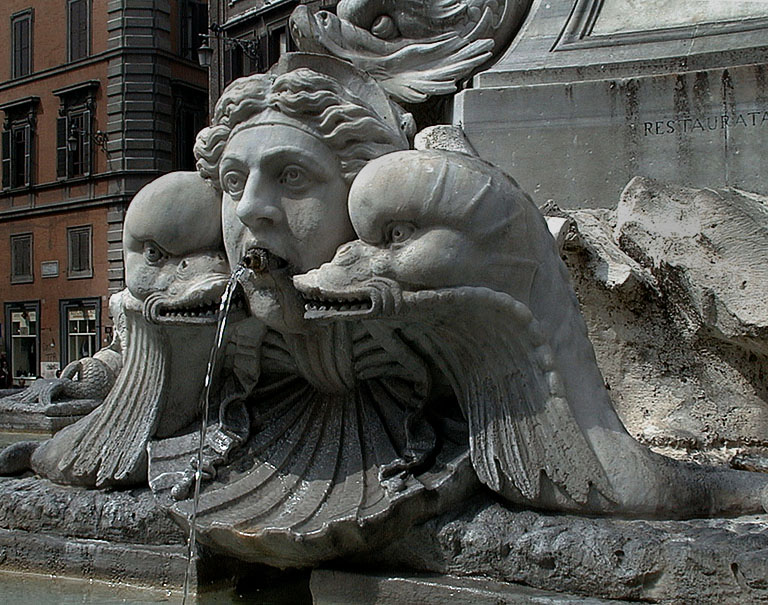
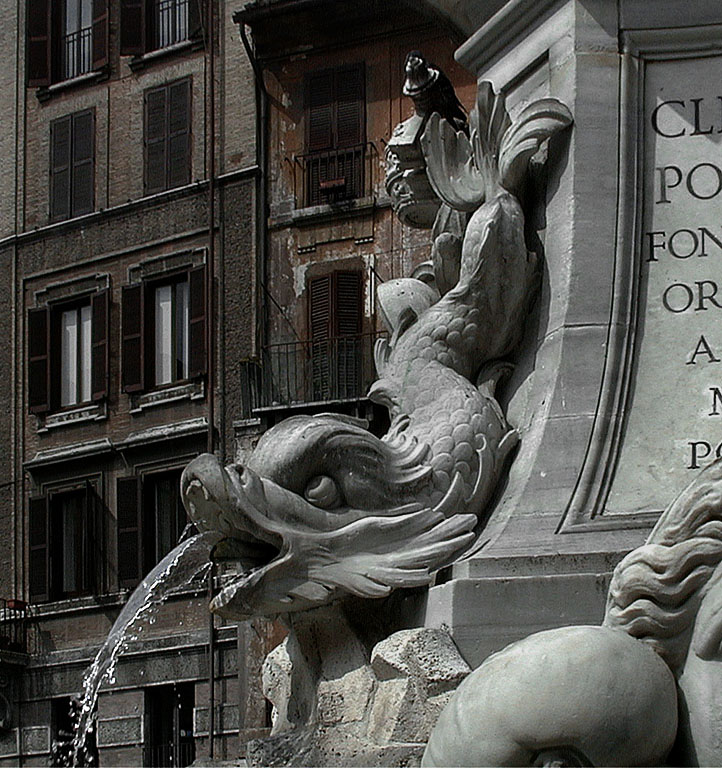
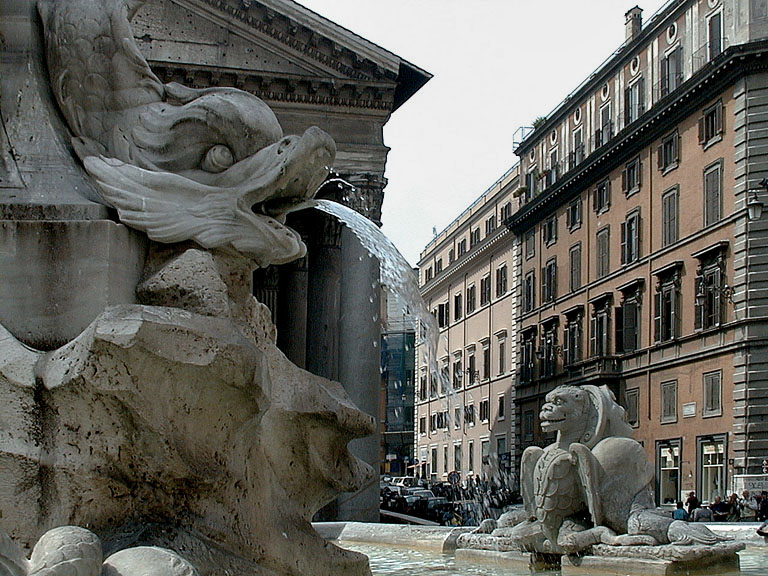
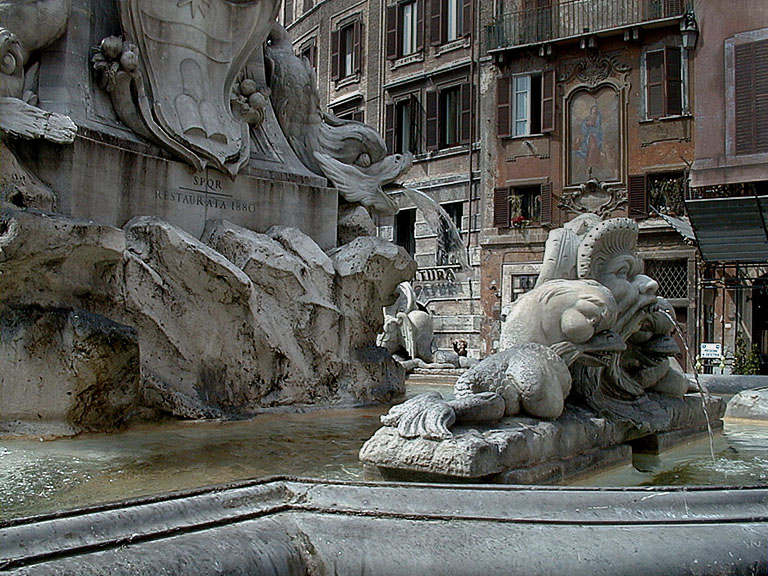
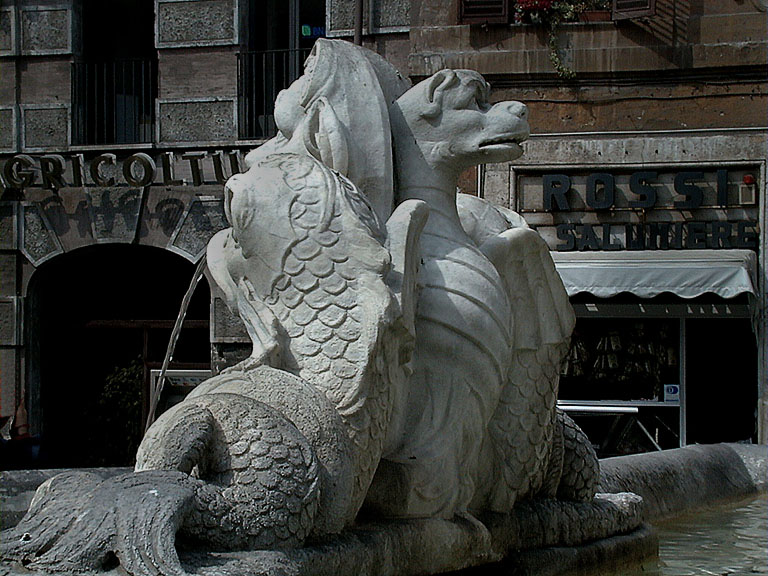
La Barcaccia in Piazza di Spagna
Pietro Bernini, father of Gian Lorenzo, designed this distinctive fountain on commission from Pope Urban VIII Barberini. Tradition has it that for his design Bernini was inspired by an old boat left stranded by the Tiber flood of 1598. The work was built at ground level to make up for the low pressure of the Acqua Vergine aqueduct, which at that point was very low. Inside, it is adorned with two Barberini “sun mouths” that release water in a fan. On the outside are two coats of arms of Urban VIII. A touch of irony may be noted, knowing that this type of boat was used above all for transporting wine.
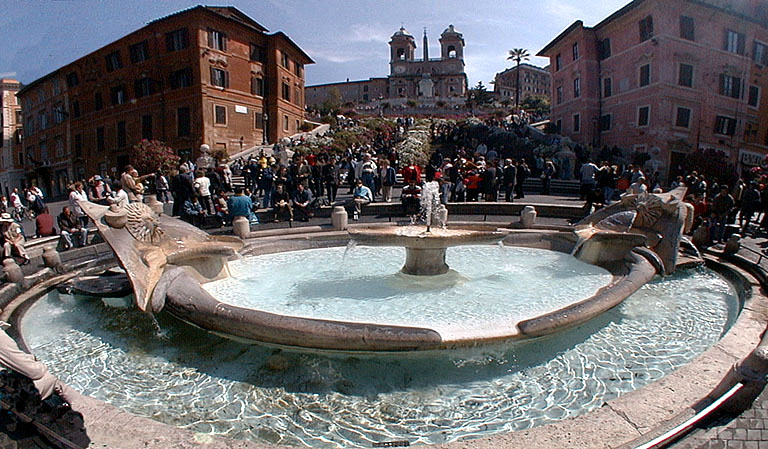
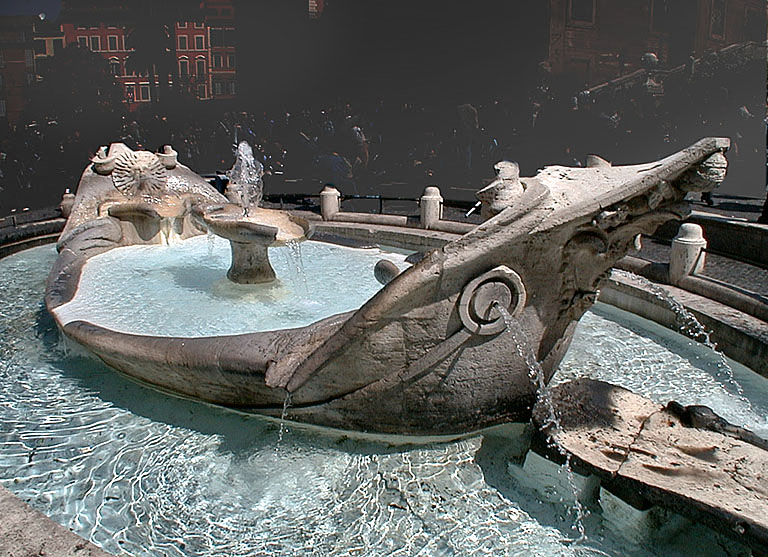
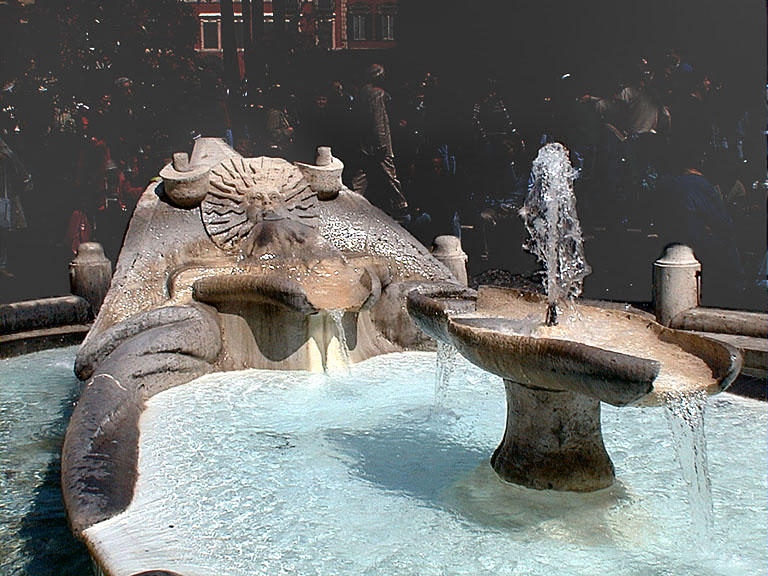
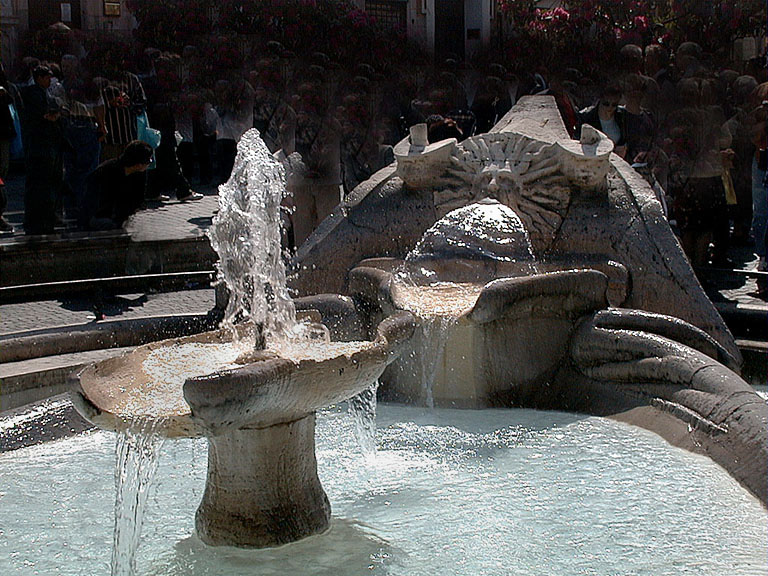
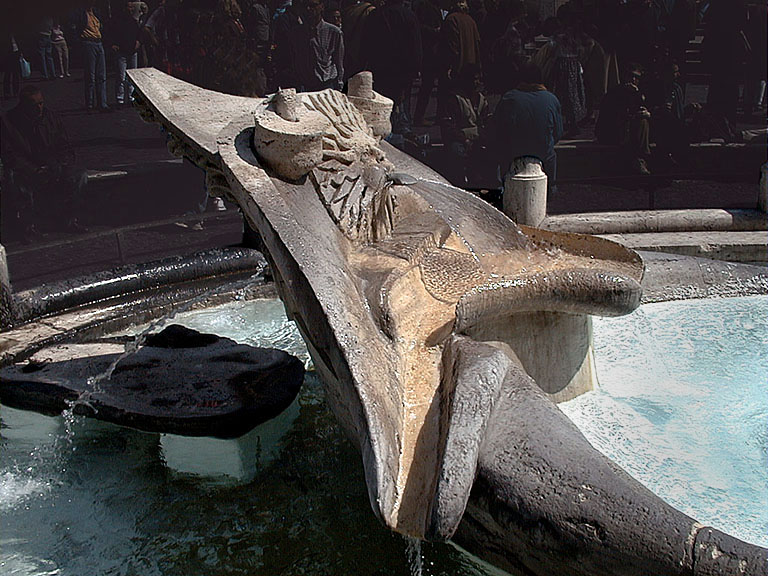
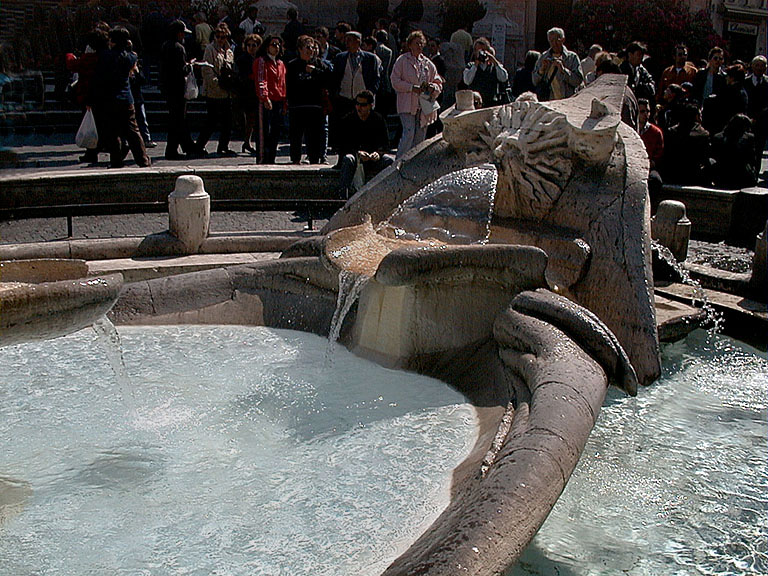
Trevi Fountain
Imposing and artistically remarkable, it is the most spectacular fountain, and not only in Rome. When, in the early 1730s, Pope Clement XII decided to replace the beautiful fountain designed by Leon Battista Alberti in 1453 with one of imposing majesty, he invited the best artists of the day to submit their designs. That of Nicola Salvi was chosen; work began in 1735 and was completed under the pontificate of Clement VIII Rezzonico, and the fountain was inaugurated on 22 May 1761. It covers an entire side of Palazzo Poli and is twenty metres wide and twenty-six metres high. At the top is the coat of arms of Clement XII carved by Paolo Benaglia; on the balustrade, the four statues symbolise the four seasons and are the work of the sculptors Corsini, Ludovisi, Pincellotti and Queirolo. In the centre, on a shell-shaped chariot drawn by two sea-horses led by two tritons, rises the majestic statue representing Ocean. The whole group was carved in marble by Pietro Bracci; in the side niches are “Salubrity” on the right and “Abundance” on the left, the work of Filippo Valle. Above these two sculptures, the bas-reliefs by Giovan Battista Grossi and Andrea Bergondi recall the legend of Agrippa approving the plan for the aqueduct and that of the maiden showing the springs to the thirsty soldiers. The great basin, built at street level, symbolises the sea, and it is here that tourists throw a coin to wish themselves a happy return to the Eternal City. Legend has it that, to block the view of the works from an overly critical barber, the architect Salvi had a large and very heavy travertine vase, an ironic imitation of a soap pot, placed right in front of the barber's shop. On the outer left side can be seen the “Fontanina degli Innamorati” (the Lovers' Fountain), a simple rectangular basin fed by a small spout. It is said that lovers who drink here will never be unfaithful.
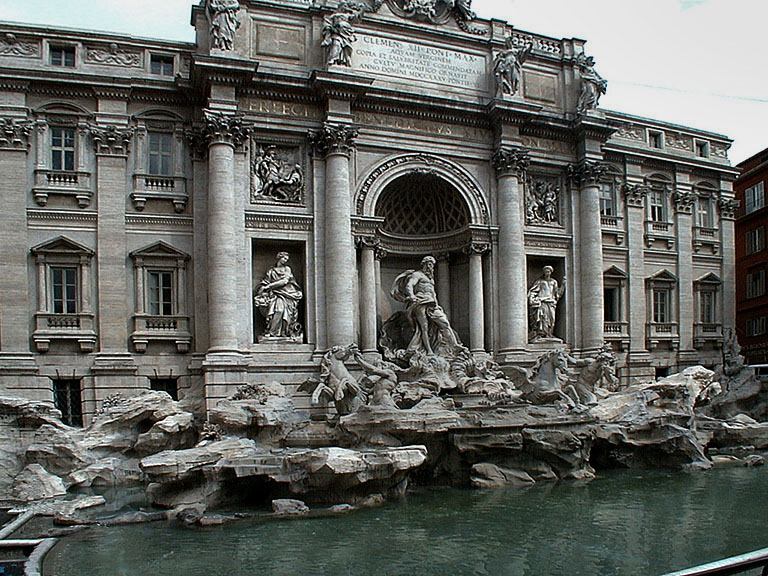
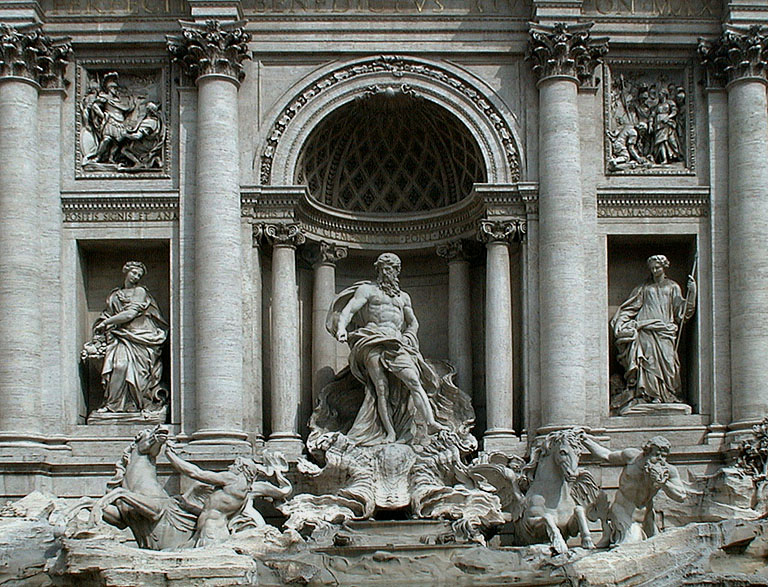
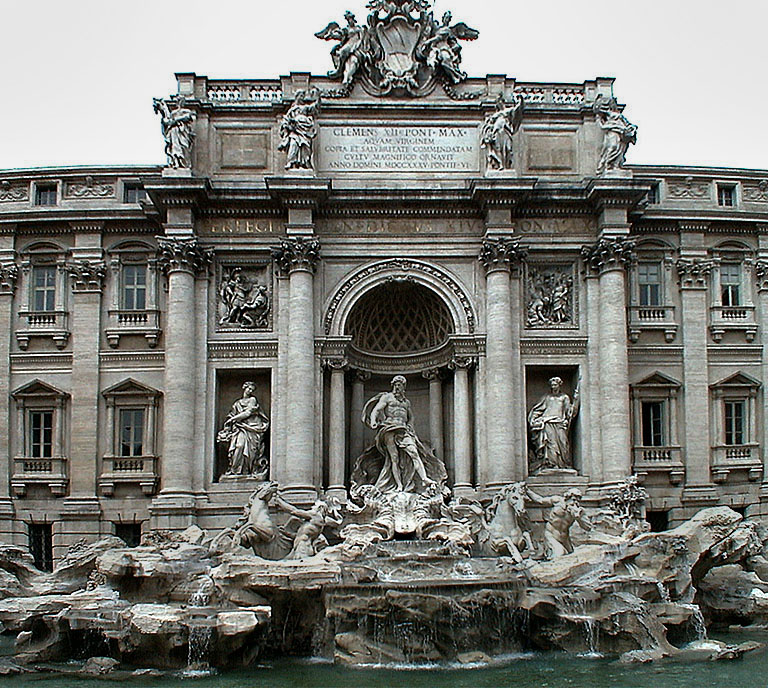
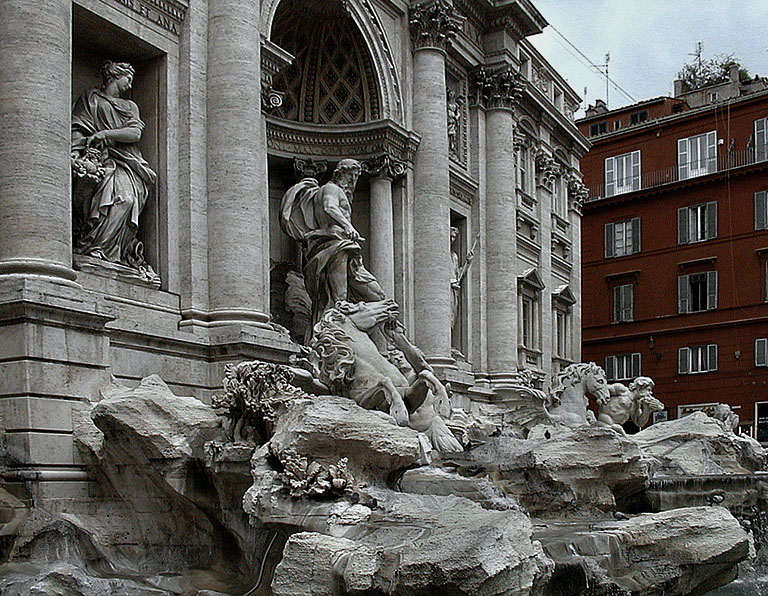
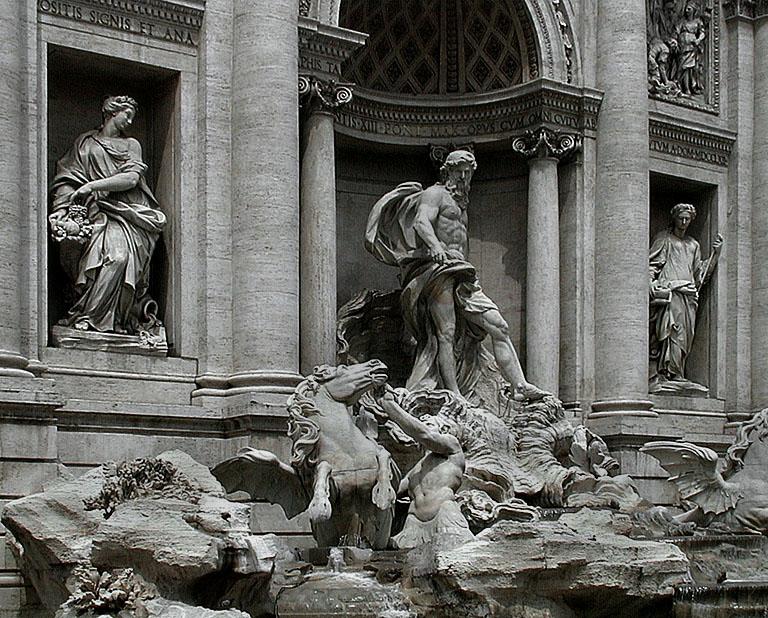
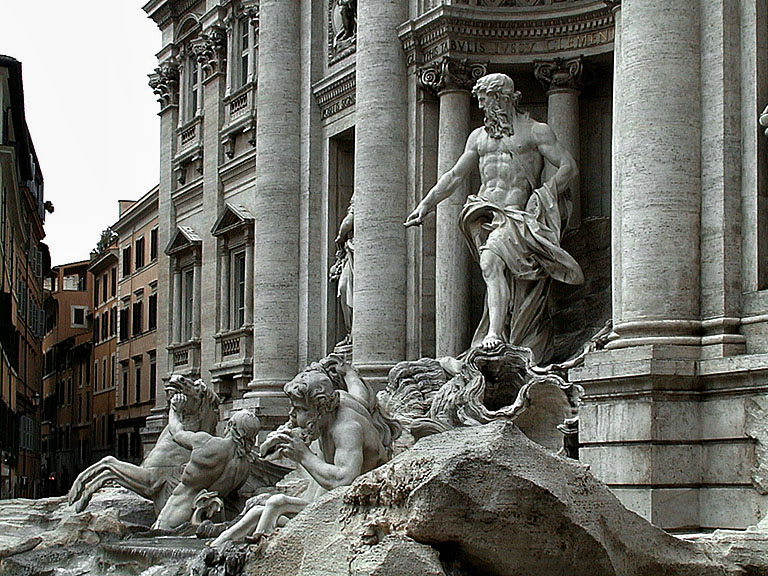
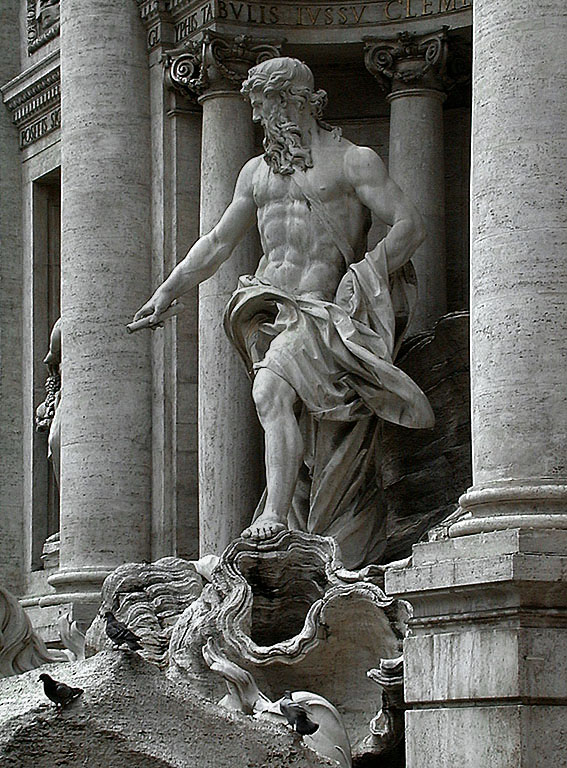
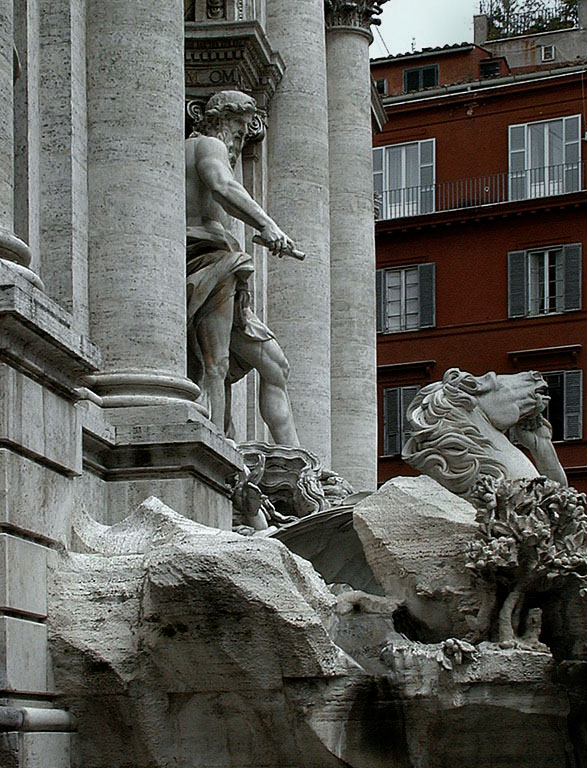
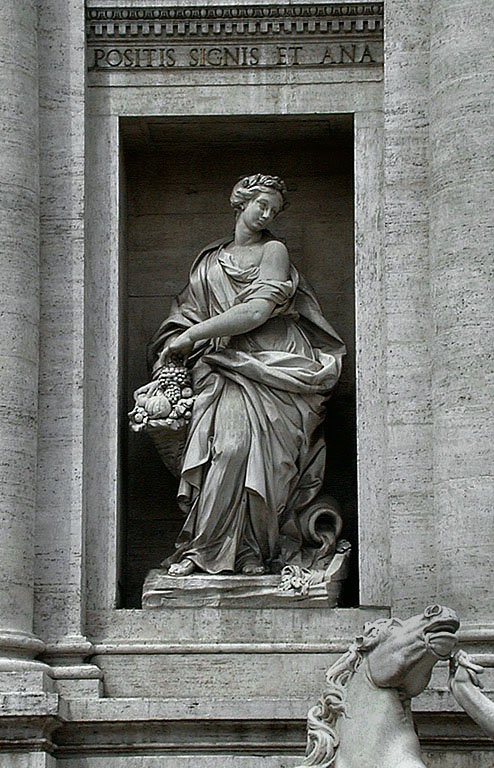
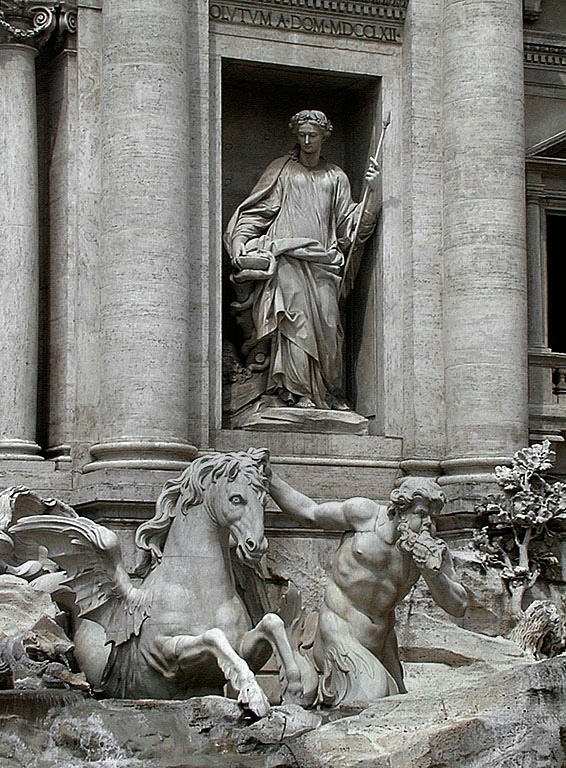
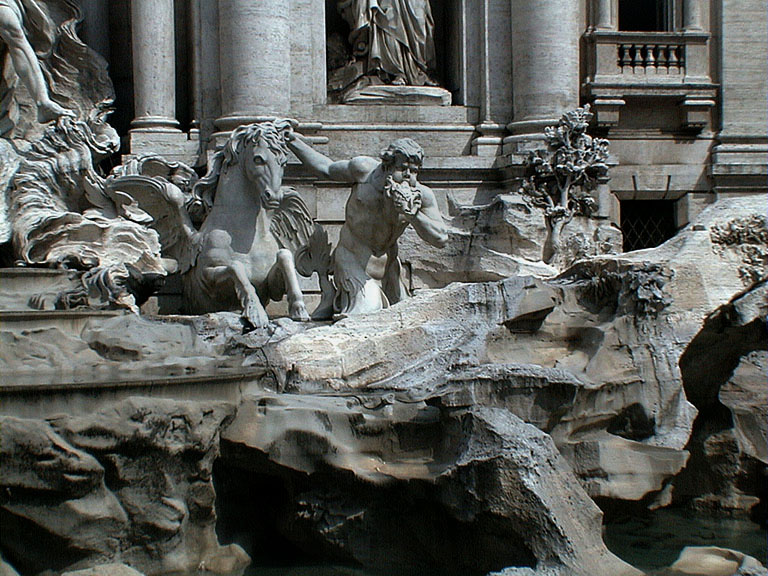
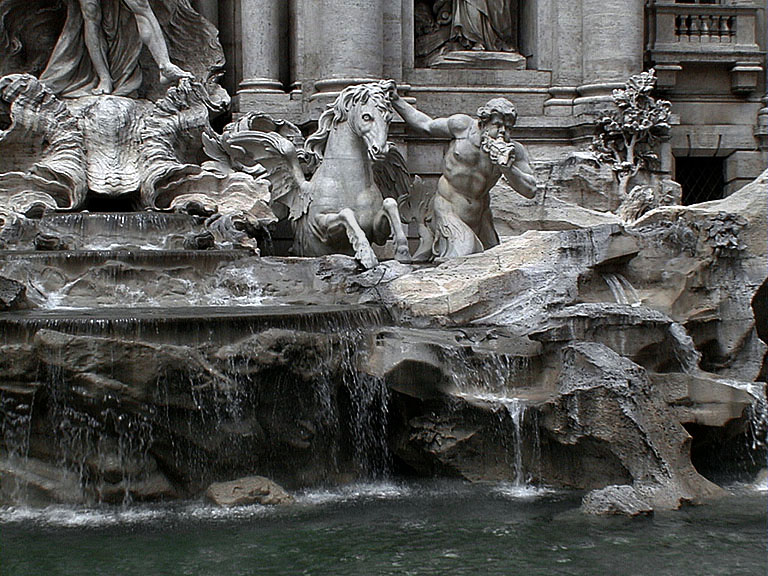
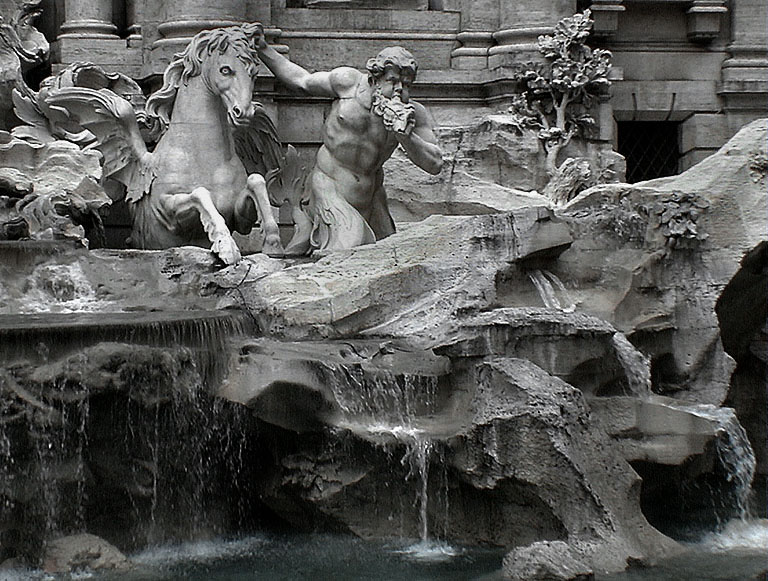
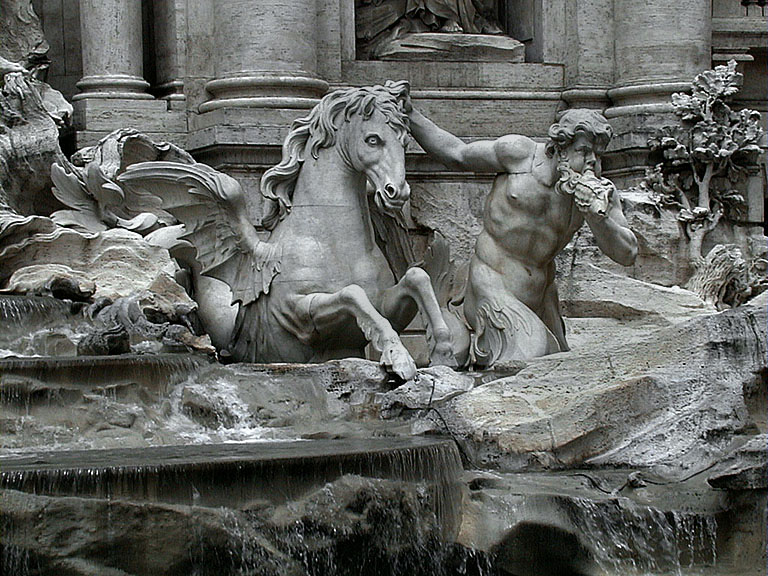
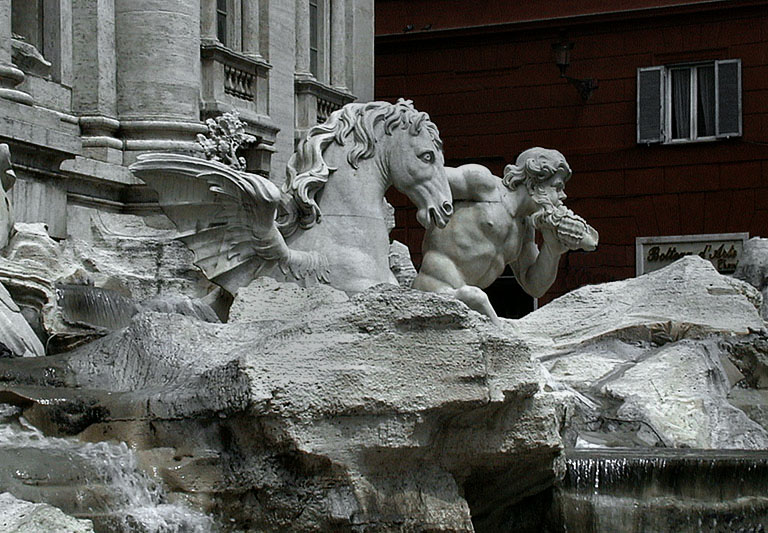
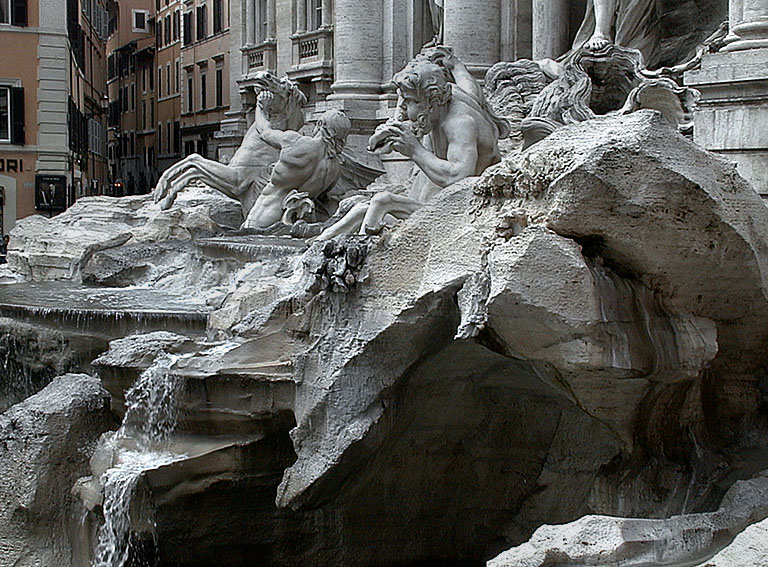
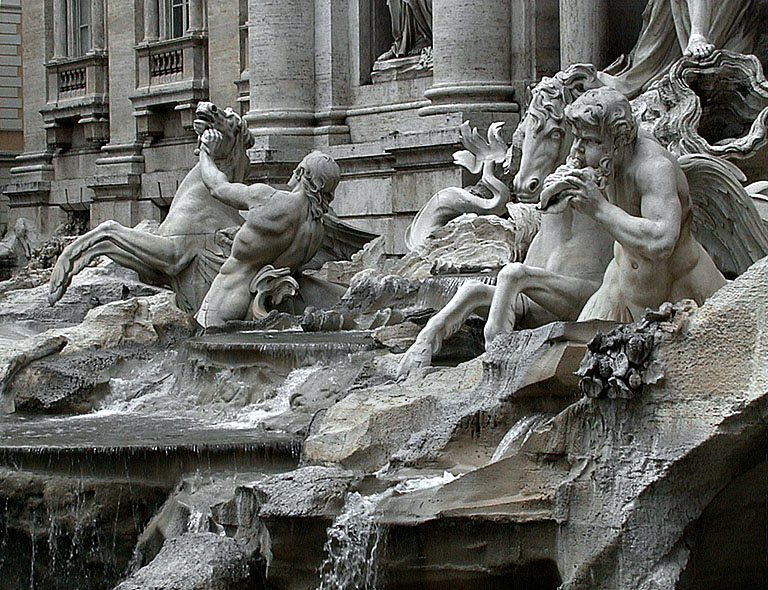
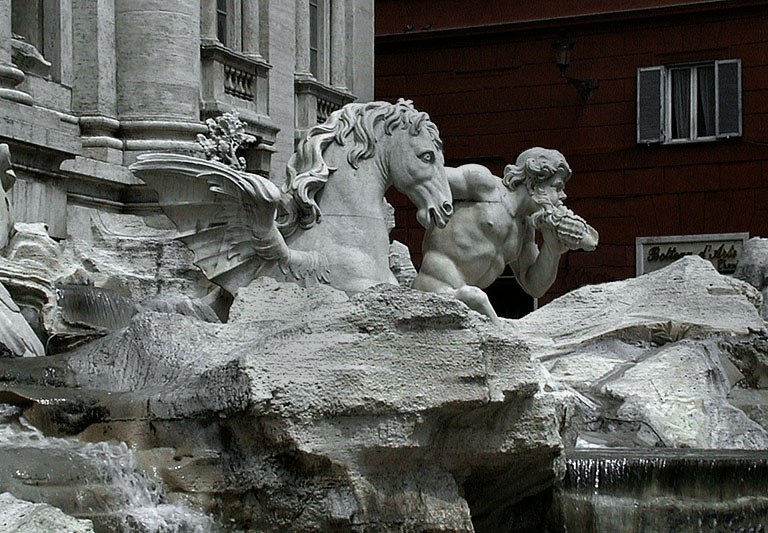
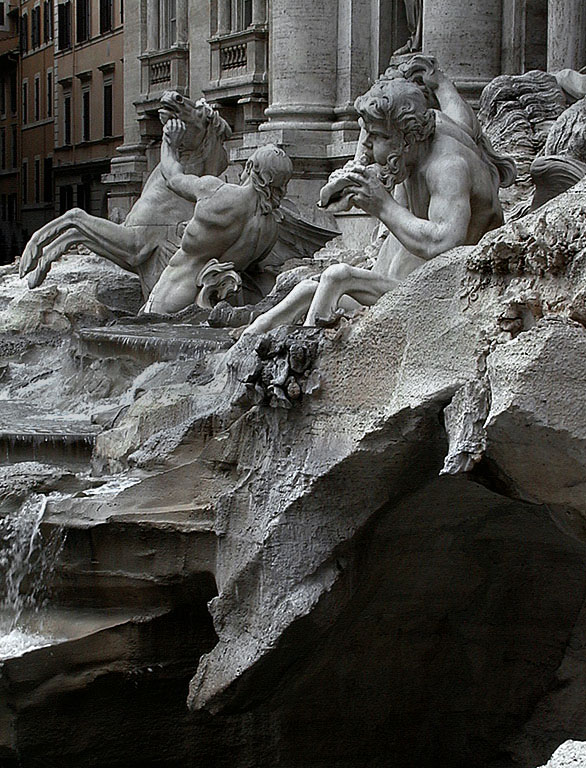
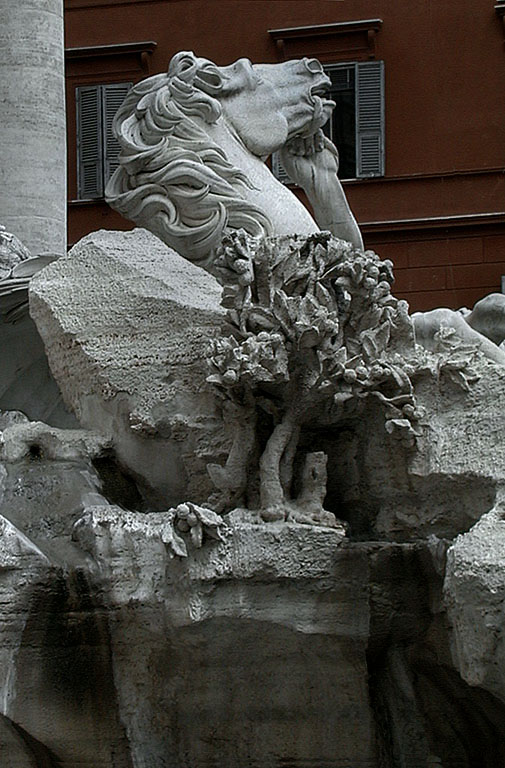
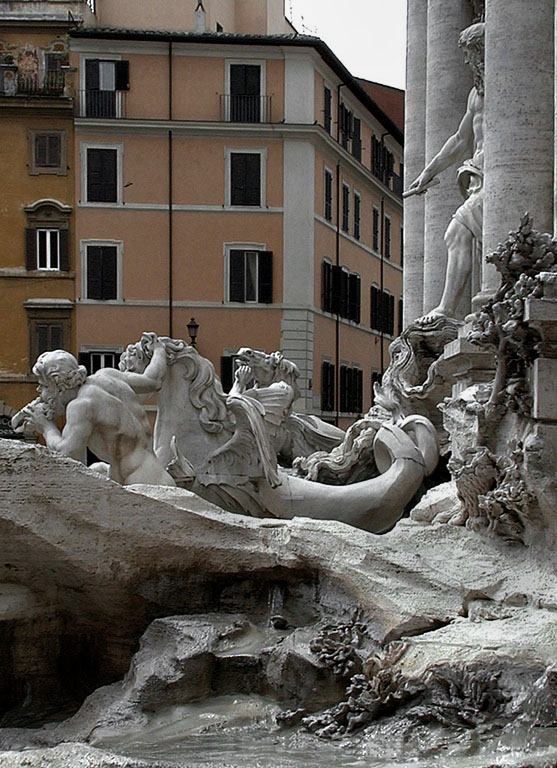
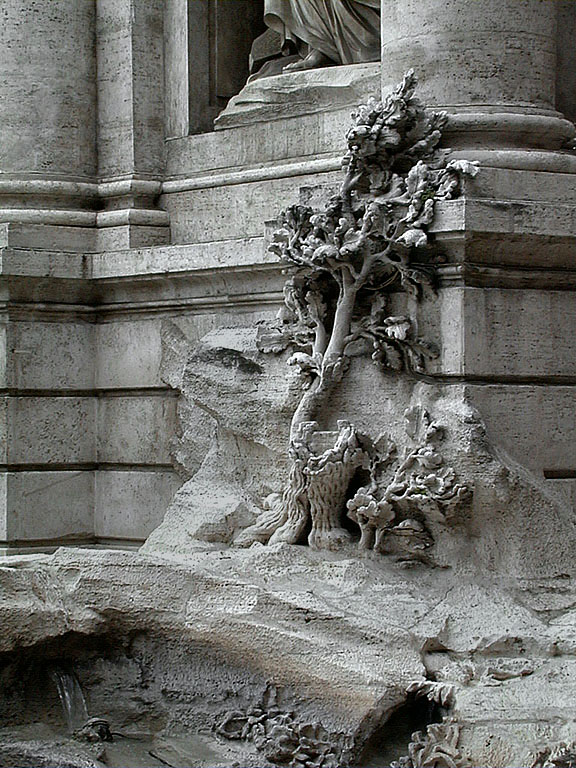
Fountains of St. Peter's Square
Gian Lorenzo Bernini, commissioned by Alexander VII Chigi, built the famous colonnade of the square, moved Maderno's existing fountain, which stood asymmetrically in relation both to the façade of the basilica and to the obelisk, and, to form a matching pair, built a second one, which was inaugurated in June 1677. The older one bears on its longer sides the coat of arms of Paul V Borghese, who had the fountain restored; the other bears the six-star coat of arms of Clement X, under whose pontificate the work was completed. From the upper basin rise seven jets which are meant to reach a height of eight metres. At the time the two fountains consumed about six million litres a day; they are now fitted with a device that allows the water to be recycled.
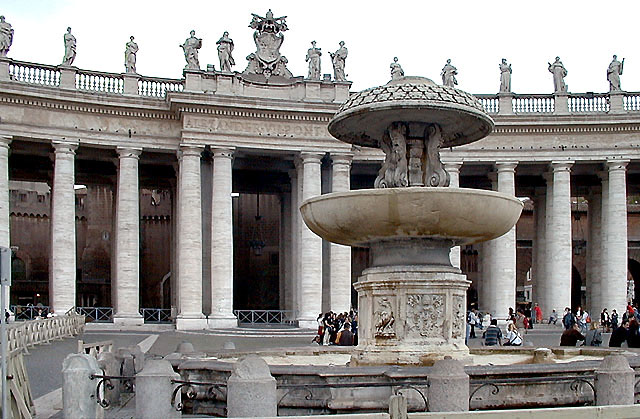
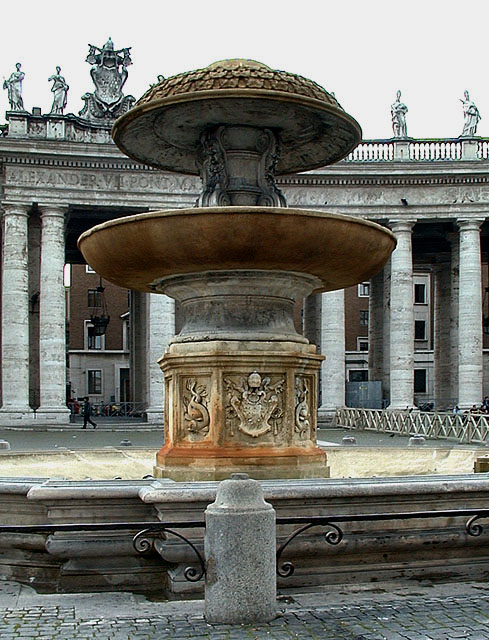
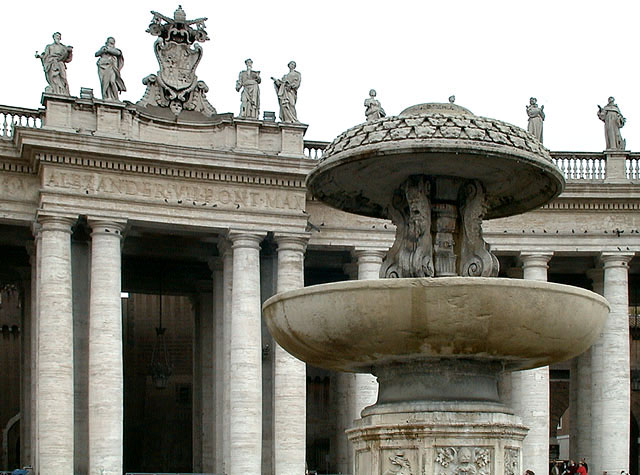
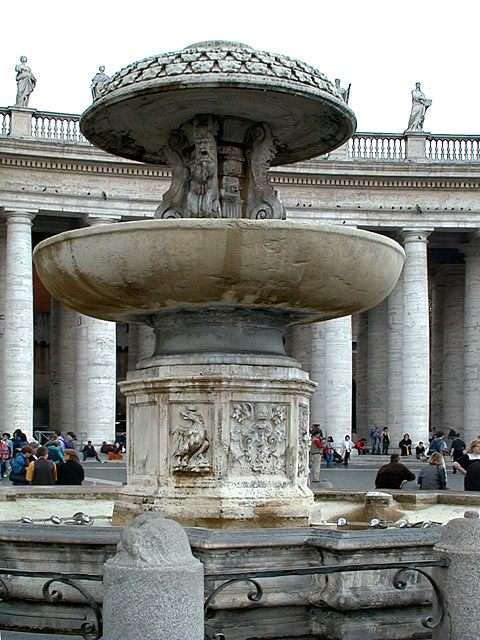
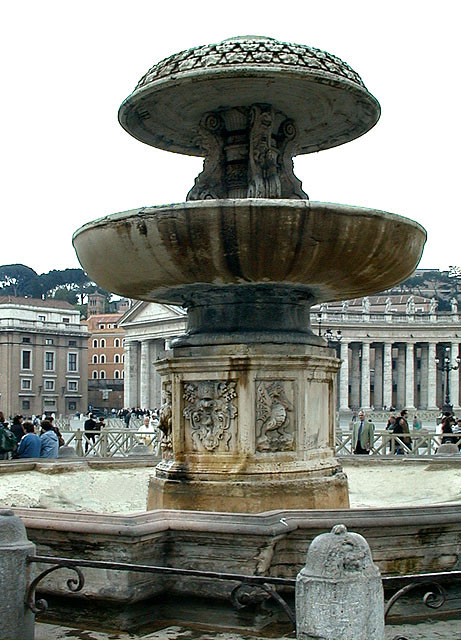
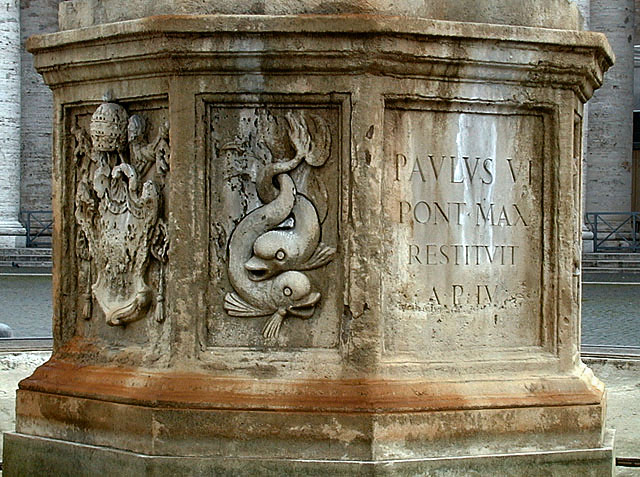
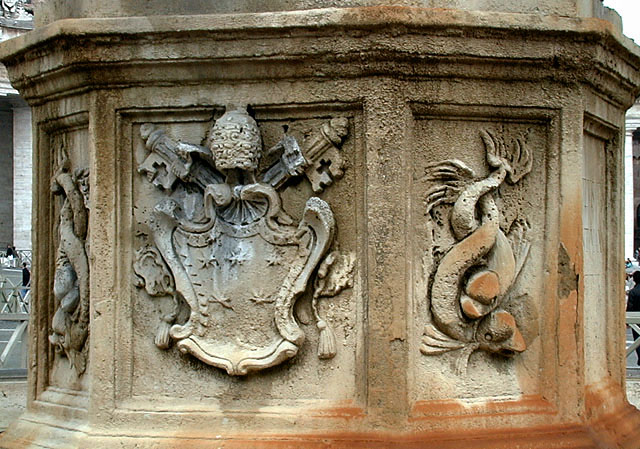
Vatican
The Sistine Chapel: Interno.
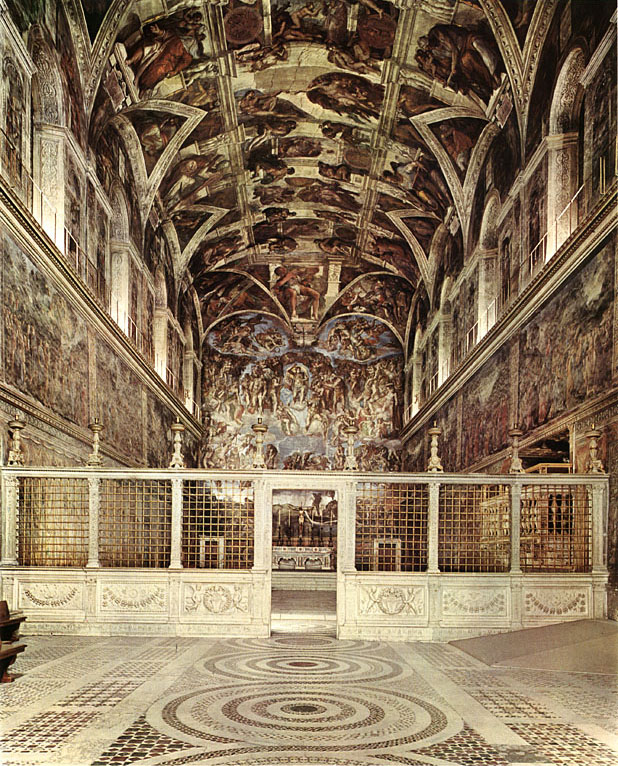
Vault of the Chapel: Ignudo.
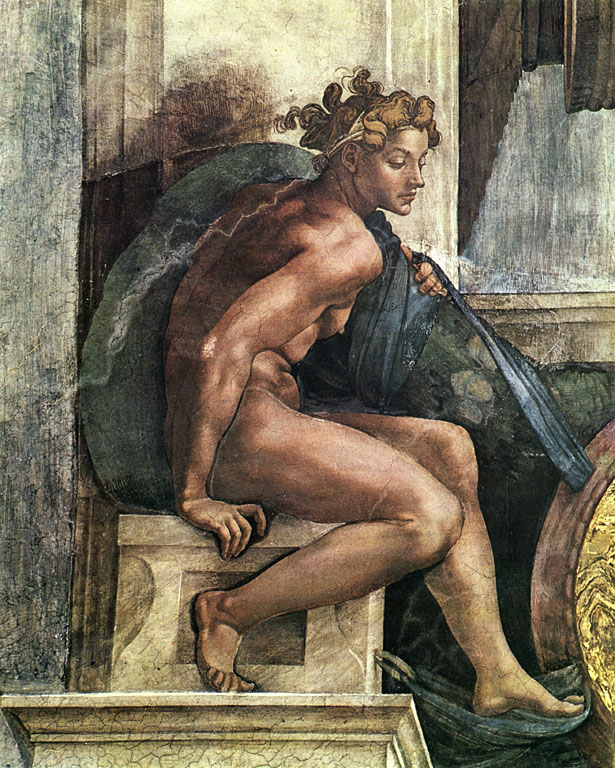
Vault of the Chapel: The Prophet Daniel.
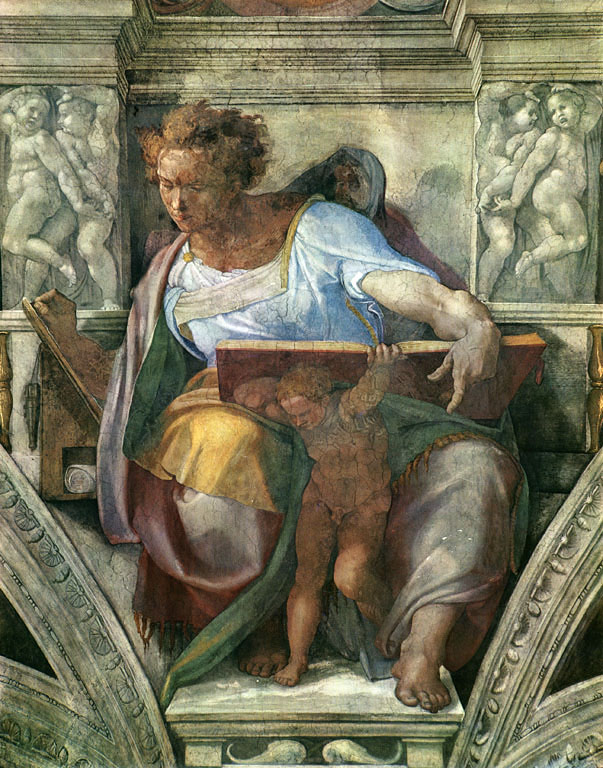
Vault of the Chapel: The Delphic Sibyl.
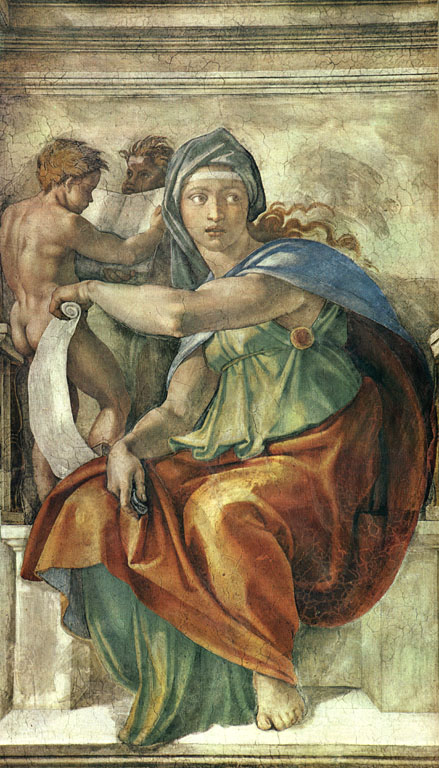
The Last Judgement: A Damned Soul.
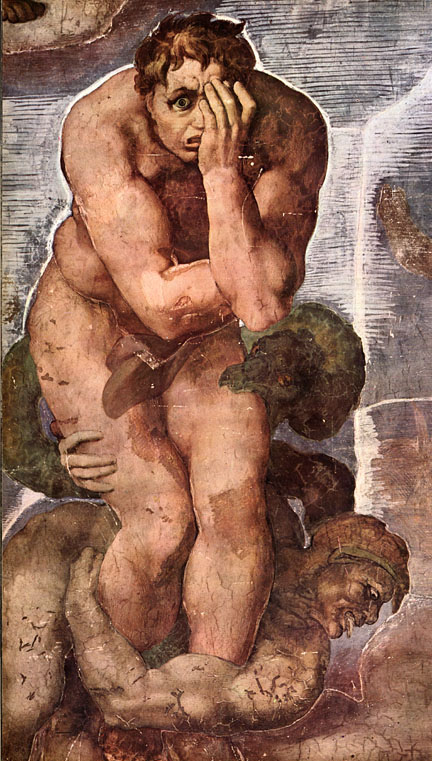
The Last Judgement: the Expulsion from Paradise.

The Last Judgement: Christ the Judge and the Virgin.
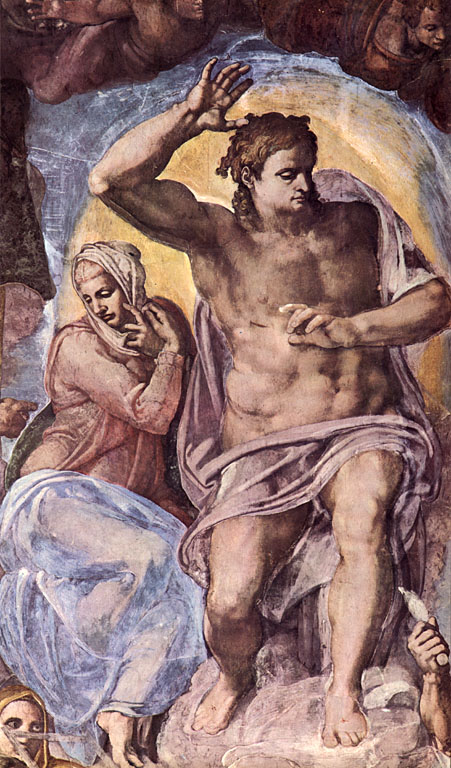
Sandro Botticelli: The Daughters of Jethro, detail of the events of the life of Moses. Sistine Chapel.
The Offering of Abbot Desiderius to St. Benedict. Vatican Apostolic Library.
Fra Angelico: Saint Lawrence Receiving the Treasures of the Church. Vatican, Niccoline Chapel.
Raphael and pupils: The Fire in the Borgo. Vatican, Raphael Rooms.
Cross of Justinian (staurotheke). Treasury of St. Peter's in the Vatican.