Pompeii — the Villa dei Misteri
Around the middle of the 18th century, thanks to the excavations at Pompeii, a decisive turning point was reached in the knowledge of the Romano-Italic world. The Vesuvian excavations, in fact, brought to light an entire ancient city, with its treasures and its objects of everyday life.
Until then, knowledge of classical antiquity had been, almost entirely, owed to Rome, but the picture that Pompeii could provide, having remained completely buried since 24 August AD 79, was certainly more complete and decisive than that of Rome, which over all these years had developed and, of those years, had preserved only the most significant things.
The city of Pompeii stood on a plateau formed by a lava flow. To the north rose Vesuvius, then characterised by a gentle slope, to which the land owed its fertility, ideal for viticulture. To the south, instead, flowed the river Sarno, which gave the people of the area the opportunity to undertake a profitable trade with the other cities of Campania.
The actual settlement of Pompeii began in the 6th century BC. and the city was immediately surrounded by walls, built of pappamonte (soft lava), which, precisely because of the characteristics of the building material, were not intended as a defensive system, but rather to mark out the territory of the city.
It is important to remember that two very important sanctuaries date from this period, one to the west and the other to the south-west, the Sanctuary of Apollo and the Sanctuary of Hercules and Minerva.
There are many doubts as to who inhabited Pompeii at that time, but, among the most widely accepted hypotheses we may mention the Greeks, the Etruscans and the Ausones.
The pappamonte walls were replaced with true city walls between 525 and 474 BC. because of the war between the Greeks and the Etruscans, who were fighting for supremacy in Campania.
The new walls consisted of a double facing of squared blocks of Sarno stone and enclosed the same area as the earlier ones.
The walls were replaced and reinforced again, according to the degree of protection the city required. In that period, in fact, a series of conflicts followed one another in Campania, such as the clash between the Samnites and the Romans and the Second Punic War, which saw Hannibal’s descent into southern Italy.
At this point the walls took on their final form: with a double curtain, with ager inside and vallum outside. The city remained, however, allied with Rome and, in this period, thanks to trade with the other cities, Pompeii grew rich and began to use its income to embellish the city. To these years belong the Civil Forum, the Triangular Forum, the Great Theatre and the Quadriporticus.
This favourable situation came to an end around 89 – 80 BC, when Pompeii decided to ally itself with the Italic Allies against Rome, for the right to the “status” of “Roman citizens” and, to face the war, reinforced its walls with thirteen towers.
The city was taken by Sulla, but, fortunately, the colonists decided to continue the programme of Hellenisation, under way in Pompeii, and had the Temple of Venus built, the Odeion, the Forum Baths and the Amphitheatre.
We then come to AD 62, the year in which Pompeii, together with other towns around Vesuvius, was struck by an extremely violent earthquake, followed by numerous further tremors, which destroyed a great many buildings.
The Pompeians immediately set about restoration, despite the social unrest that characterised this period, but the work was abruptly interrupted on 24 August AD 79, when Pompeii was overwhelmed and completely buried by a devastating eruption of Vesuvius.
The worst-hit towns were Pompeii and Herculaneum, and the whole territory of the Sarno valley was covered by an enormous white blanket.
Pompeii was covered by a layer about six metres thick and, although everyone had been forbidden to pass through the city, a measure necessary to protect the property of the survivors, over the years it was plundered through tunnels dug by looters.
Excavations at Pompeii began in 1748 and are still not finished today.
Since then the work has been directed, obviously, by many different people and, at the beginning, was conducted in a disgraceful manner. Often, in fact, the buildings brought to light, were stripped of their best paintings, which were then handed over to the king, if they were considered worthy of his private collection.
The devastation by King Charles III ceased thanks to the denunciations of many scholars and, above all, of J. Winckelmann. In 1765, in fact, under the direction of F. La Vega, it was established that every building brought to light, should keep its architecture in situ, and its movable works should be displayed in the royal museum.
Later, with the arrival of the French in Naples, Pompeii aroused great interest in Caroline Bonaparte, wife of the King of Naples, who planned the excavation of the entire circuit of walls,
so as to locate the city gates and, therefore, the most important roads, with the aim of achieving a certain continuity in the work.
The programme proved too ambitious and, in 1815, when the Bourbons returned, the project had been carried out only in part.
From 1815 to 1863, that is, in the Bourbon period, the work slowed down sharply.
In 1863 the direction of the works passed into the hands of G. Fiorelli, who carried out the task admirably. He decided to apply a new methodology to the excavations. Until then, in fact, the streets had been cleared first and the houses were then entered from them; Fiorelli established instead that excavation should proceed from above, so that recording all the elements making up the dwellings would be simpler, and also more precise. It was again thanks to him that a topographical system was established, dividing the districts into Regiones, Insulae and houses, and that the shapes of the victims’ bodies and of all the organic elements living at the time of the eruption were recovered through the use of plaster casts. The organisms, in fact, after decomposing, left a void in the volcanic ash.
Fiorelli’s successors continued to follow his methods of excavation and, in addition, ensured that the paintings and mosaics, too, were not separated from their original location.
Then came the direction of Maiuri, one of the most influential scholars in the history of the Pompeii excavations, which, in the years between 1924 and 1961, uncovered the entire circuit of the city walls. He also launched the programme of stratigraphic investigations to shed light on the earliest history of the settlement.
The directors who succeeded Maiuri have mostly devoted themselves to the restoration of Pompeii and, to this day, of the sixty-six hectares that made up the city, only forty-four have been brought to light.
Turning to the building techniques used in Pompeii, it should be noted that the most common building materials were: Sarno stone, Vesuvian lava stone, lava foam, grey tuff, yellow tuff, brick and travertine.
While, as for the techniques, we may mention: opus quadratum, opus africanum, opus incertum, opus reticulatum, opus latericium, opus vittatum and opus vittatum mixtum.
Four decorative systems were used in Pompeii, and they are called “styles”. This classification was made possible thanks to A. Mau, who in 1882 wrote the “History of Wall Decoration in Pompeii”
The oldest is the First Style, also called “incrustation” or “structural”. It was used between 200 and 80 BC. and its characteristic is the imitation of architectural elements such as cornices, pilaster strips, ashlar blocks, using stucco and obtaining, through the decoration, an effect similar to marble. These features were never abandoned, not even with the arrival of the later styles.
The Sullan age, 80 – 25 a.C., was characterised by the Second Style, also called “architectural”, which saw the use of the decorative elements of the First Style, with the sole difference that stucco was replaced by painting.
The decoration generally consisted of a high podium, on which stood four columns, and, often, there were paintings with naturalistic scenes and various figures (a striking example of this type of decoration can be found in the Villa dei Misteri).
The Third Style, “ornamental”, in vogue from 25 to 35 BC, shows only some revisions with respect to the previous one: the columns become thinner, taking on the appearance of carved ivory columns, the decorations consist of miniatures, the colours become bright and the backgrounds are, generally, white or black.
The Fourth Style, “fantastic”, was mainly used after the earthquake of AD 62. and in it are found various elements of the Second Style, with a marked architectural fantasy, and some of the Third Style, with an accentuated decorative tone. This last style, precisely because of the characteristics described, gives the architecture an unreal appearance.
In this same period, the Fourth Style is accompanied by a type of decoration that includes both painting and stucco relief.
Also noteworthy is the so-called “popular” painting, whose main characteristic is the depiction of scenes from the everyday life of the humbler population of Pompeii.
As for mosaics, it should be noted that not many have been found at Pompeii, and the few that exist mostly concern floor decoration. These were made of small tesserae of stone, glass paste and, above all, marble. The types of mosaic were: opus tesselatum, with geometric motifs; opus vermiculatum, with pictorial scenes called “emblems”; and opus sectile, made of polychrome marbles enclosed in a square or a circle, in which emblems were also depicted.
Outside the Porta Ercolanese, on the Street of Tombs, stand some beautiful patrician villas, among them the Villa dei Misteri, brought to light by Maiuri around 1929-1930.
It was built, almost certainly, around the middle of the 3rd century. a.C., but underwent various alterations over the years.
The Villa dei Misteri, thanks to its good state of preservation, the care with which it was excavated and the works carried out to protect it, offers, certainly, the finest wall decoration in Pompeii.
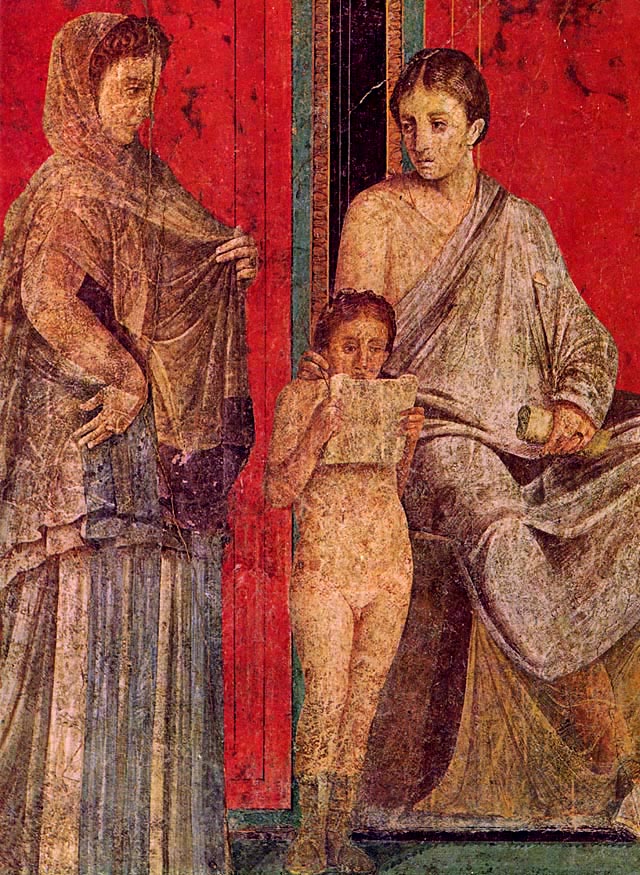
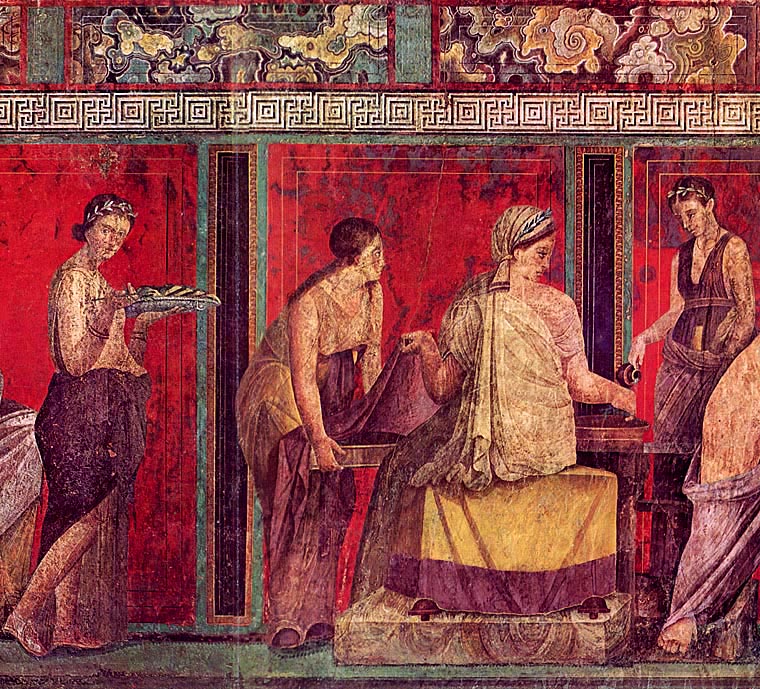
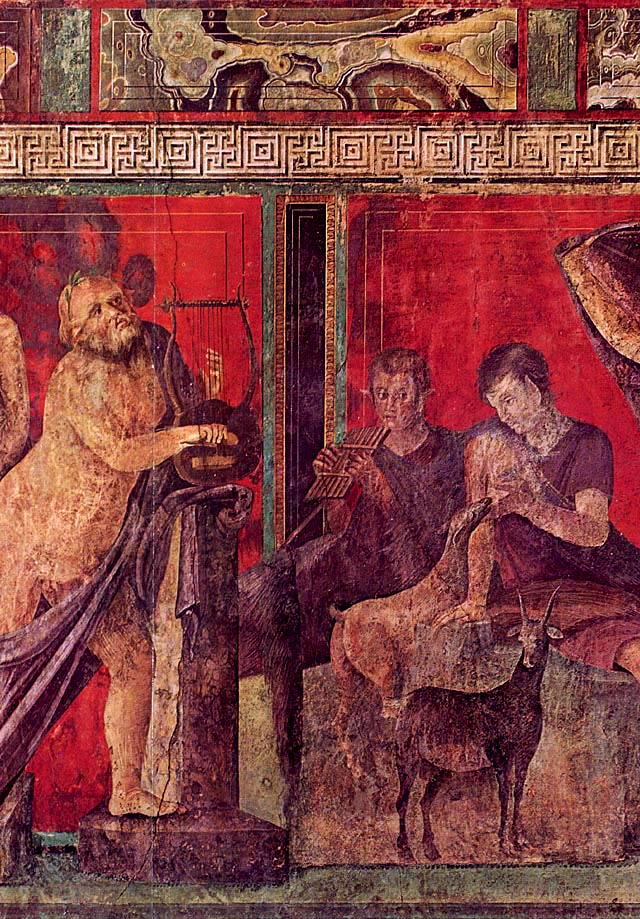
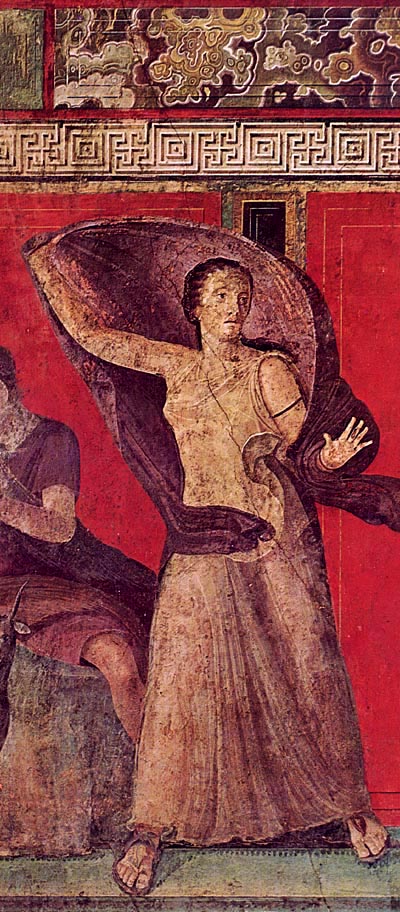
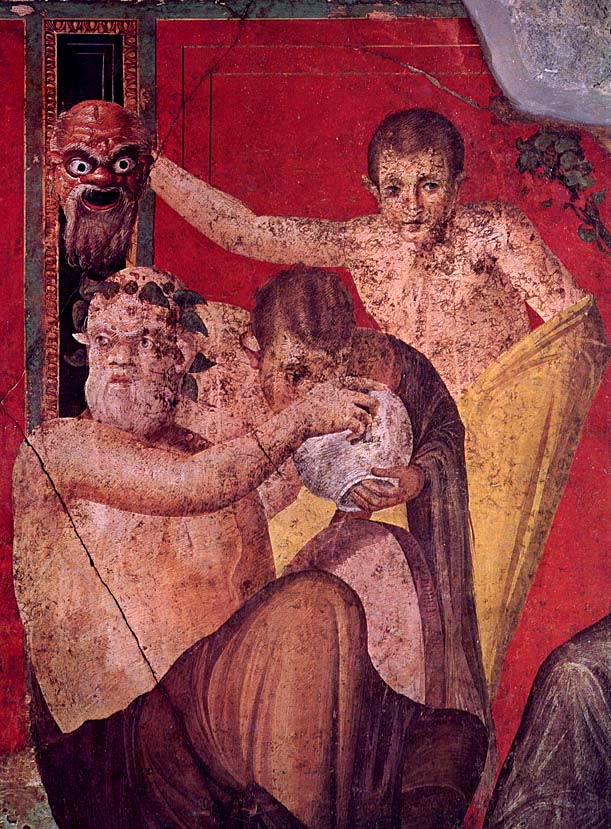
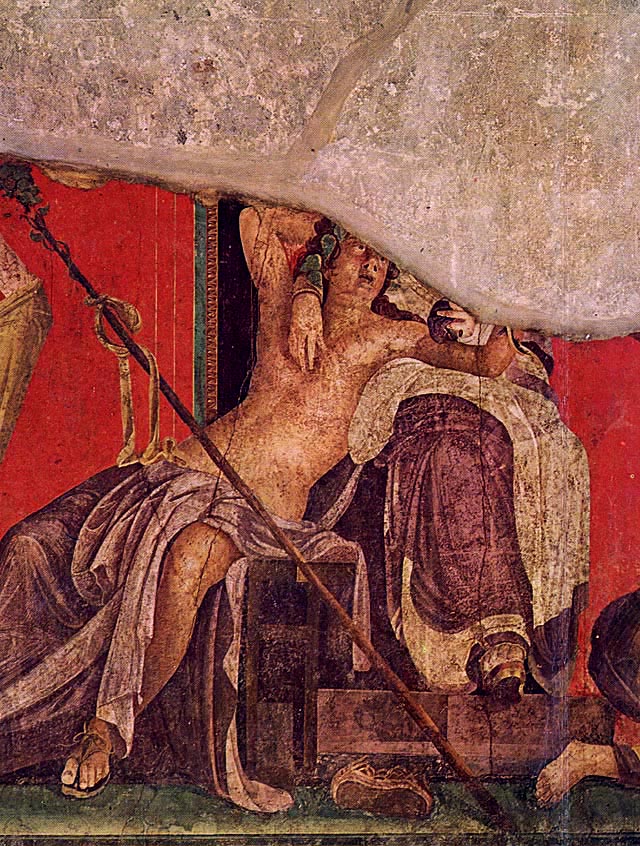
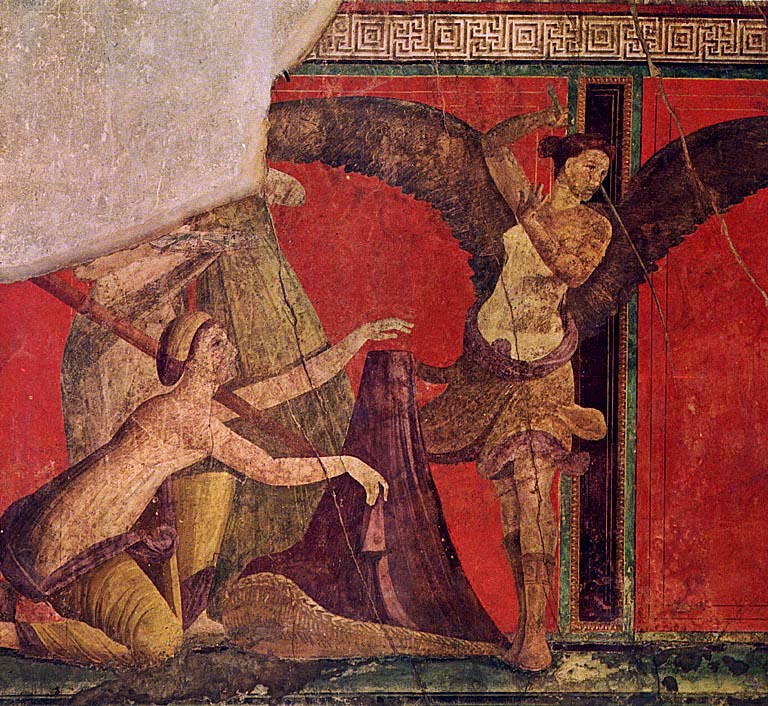
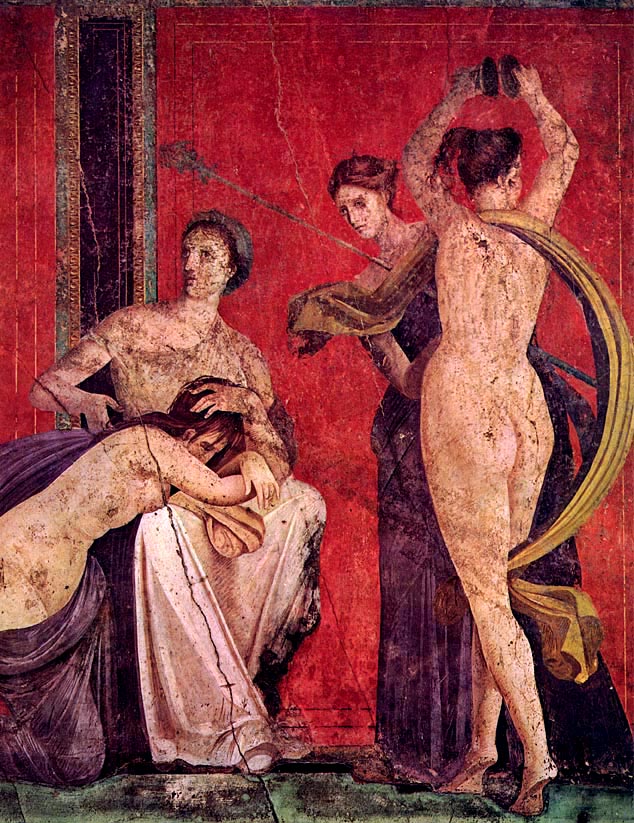
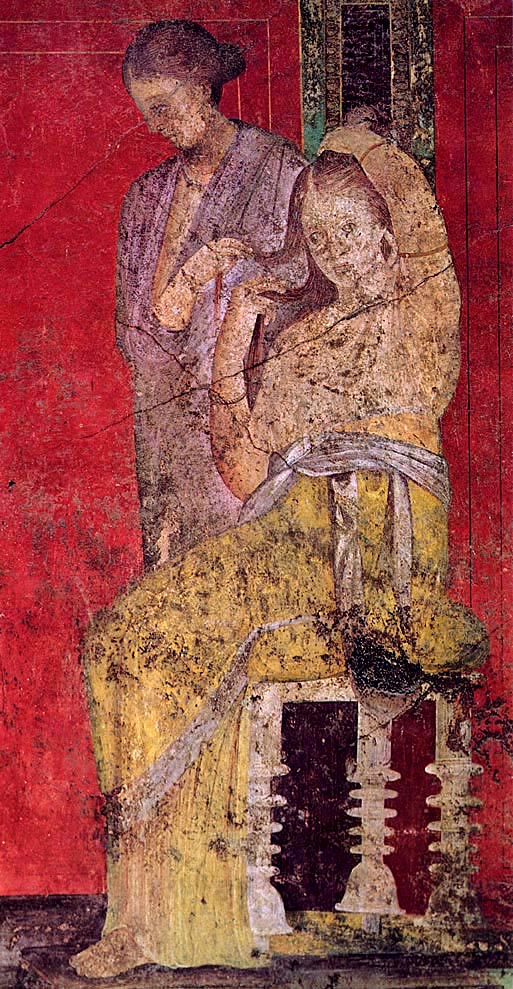
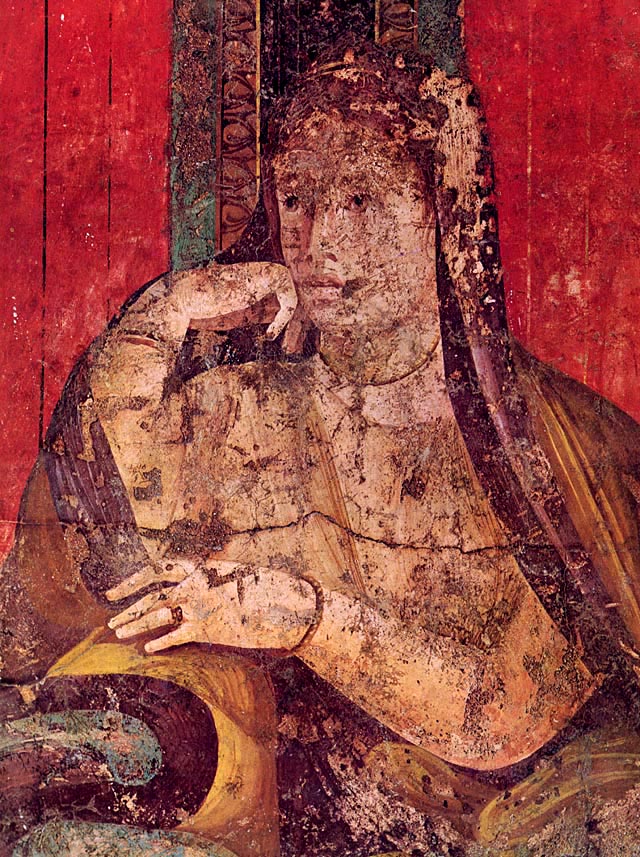
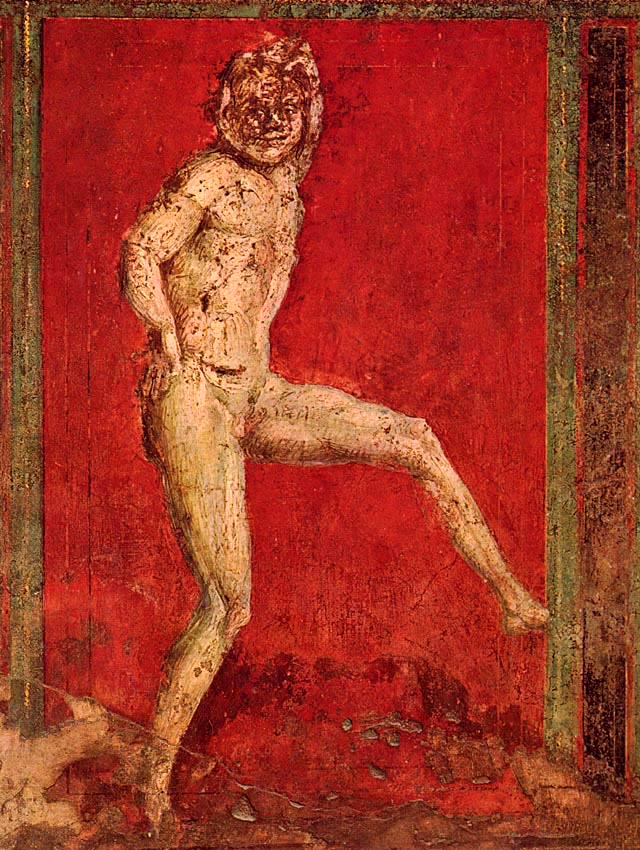
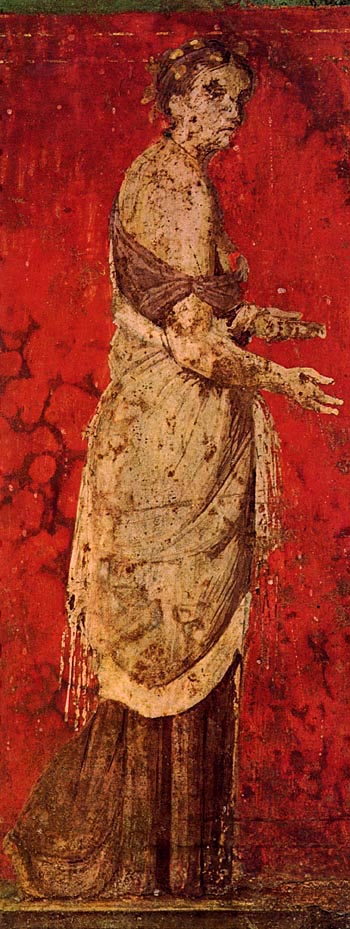
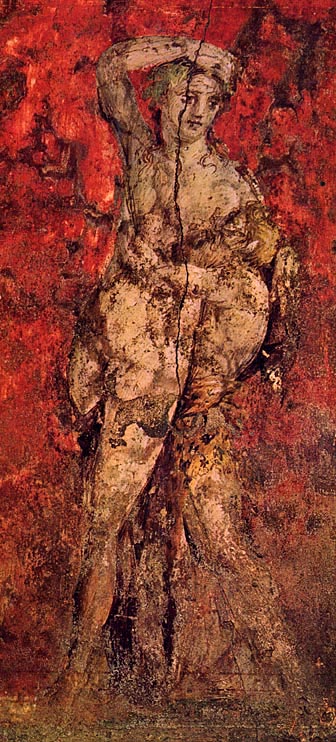
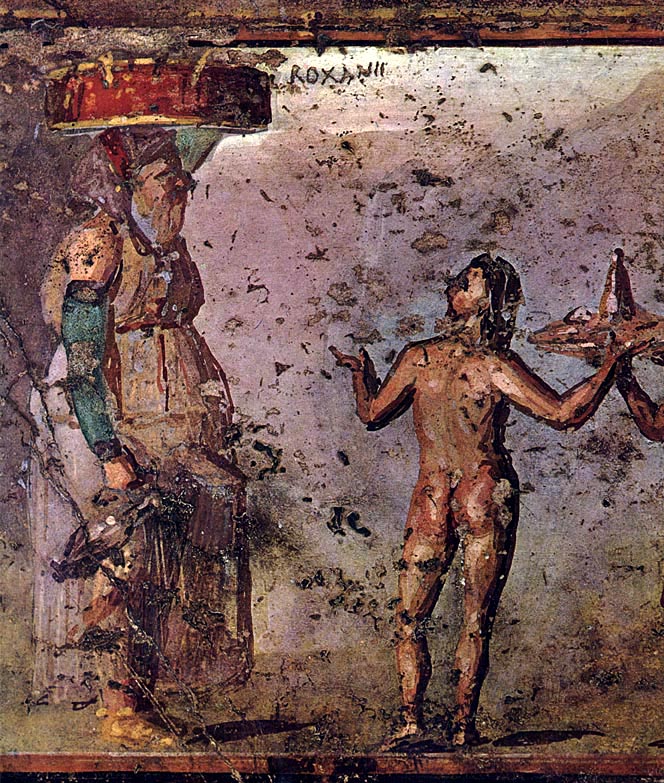
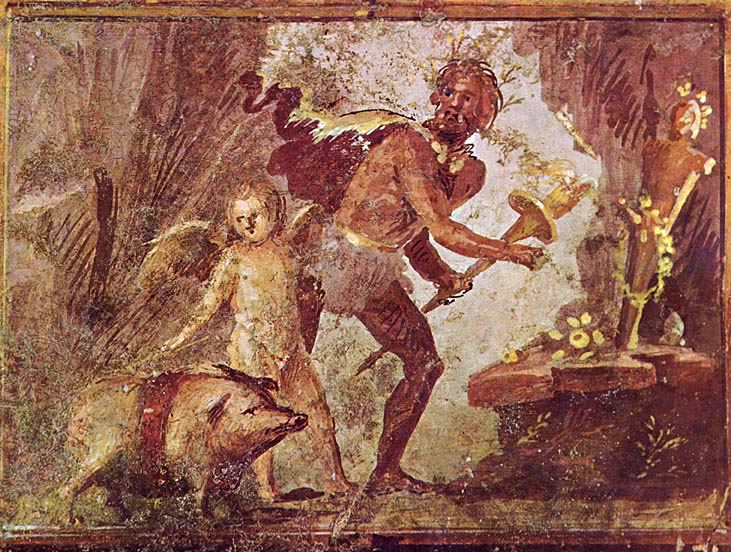
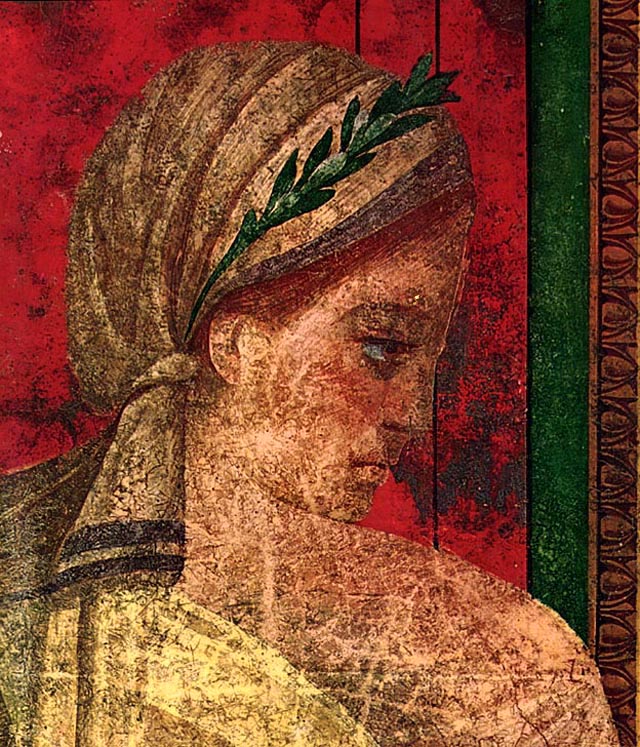
Inside the triclinium of the Villa dei Misteri one can admire a large frieze that covers, entirely, the walls of the room.
The fresco, which shows almost life-size figures, belongs to the period of the Second Style.
It has given rise to many interpretations, but the most widely accepted, to which we shall adhere, is certainly that of Maiuri. He maintained that the fresco represented an initiation rite into a mystery cult, probably Dionysian, and it is from this that the villa takes its name.
The wall is divided into rectangular spaces with a cinnabar-red background. Inside them are further panels, formed by fine lines, and outside them, bands of green marble. Moreover, all the spaces are separated by violet pilaster strips.
The architectural partition of the wall does not in fact exist; indeed the figures are arranged on the plane as if they were depicted on a perfectly neutral background.
The fresco symbolises the initiation rite of brides into the Dionysian mysteries and is permeated by an abstract atmosphere, in which the light gives the setting a uniformity that appears totally unreal.
It almost seems that the artist treated the figures as if they stood on their own, and avoided any kind of relationship between them and the space in which they are depicted, and it is precisely from this that the absence of light and shade derives.
There is no particular spatial criterion, the figures, in fact, are all painted in the same way, with the same intensity, whether they are placed in the foreground or in the background.
The composition shows a certain alternation between seated figures and others standing, moving or still, and, moreover, there are no spatial breaks between one scene and the next.
All the figures, with the exception of the winged Fury, are depicted with an unreal and surprising stillness, even though, before the whole, one feels an incredible sense of anxiety and of expectation of something unknown and indecipherable.
It must be stressed that, despite the richness of its content and the perfect balance of the composition, there are some less than excellent profiles and a certain dryness in the execution. In any case, the artist shows great skill. The decoration, based on very bright colours, is achieved through hatched overlays of colour, which create the volumes, and then, through watercolour-like glazes, the details are defined.
Despite the evident work of assistants, this frieze shows a far higher level than the other Pompeian paintings.
The photographs