Pintoricchio — Libreria Piccolomini, Duomo di Siena
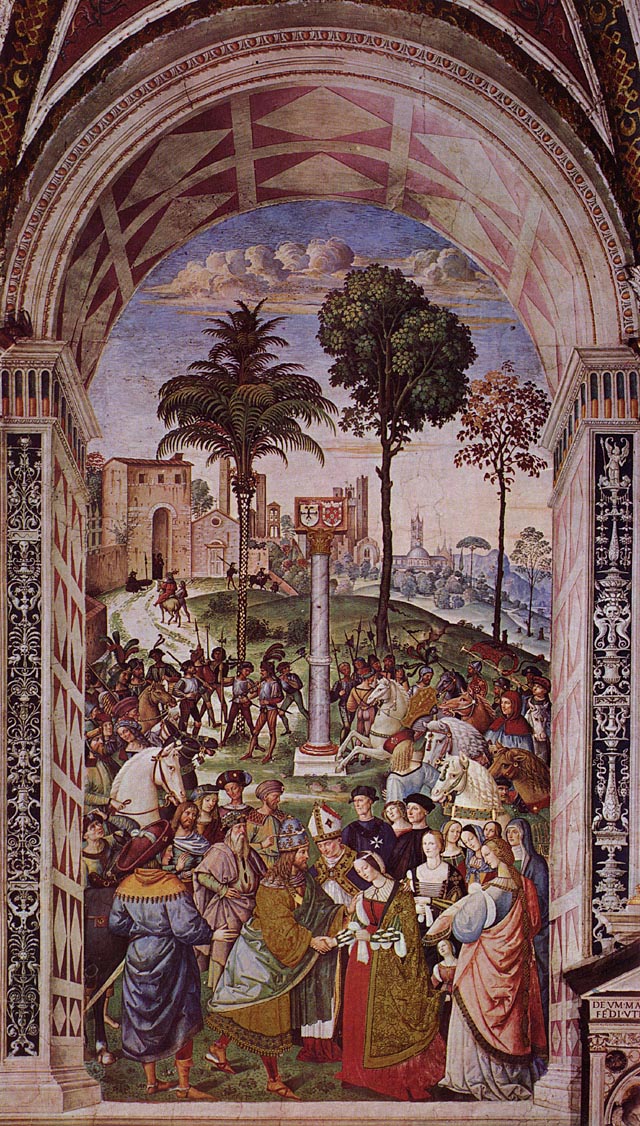
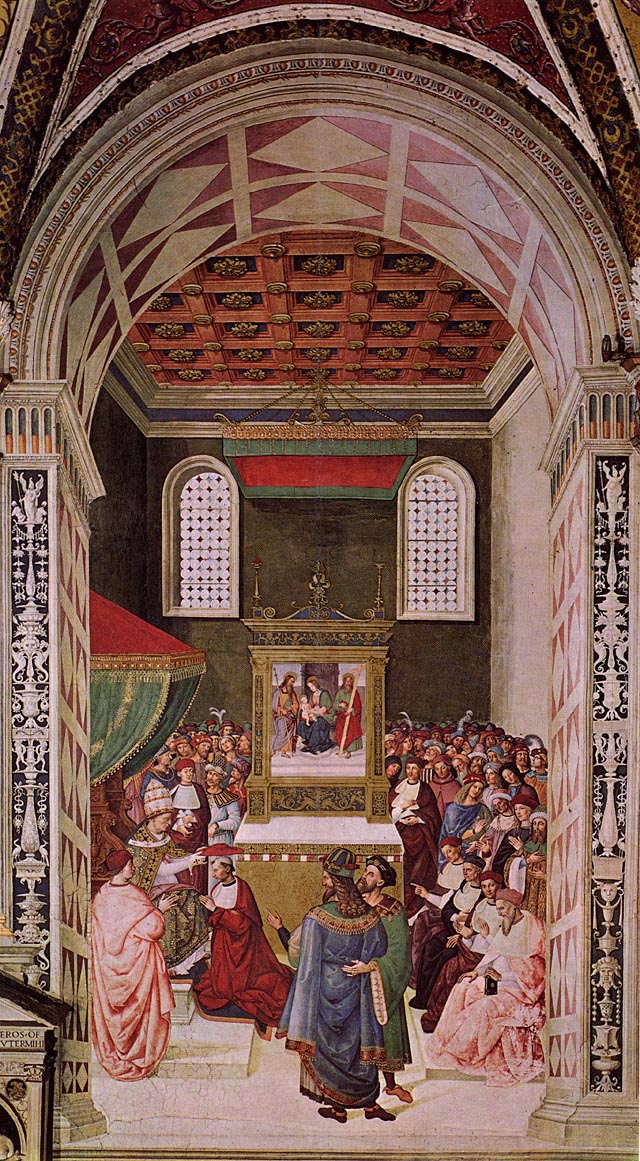
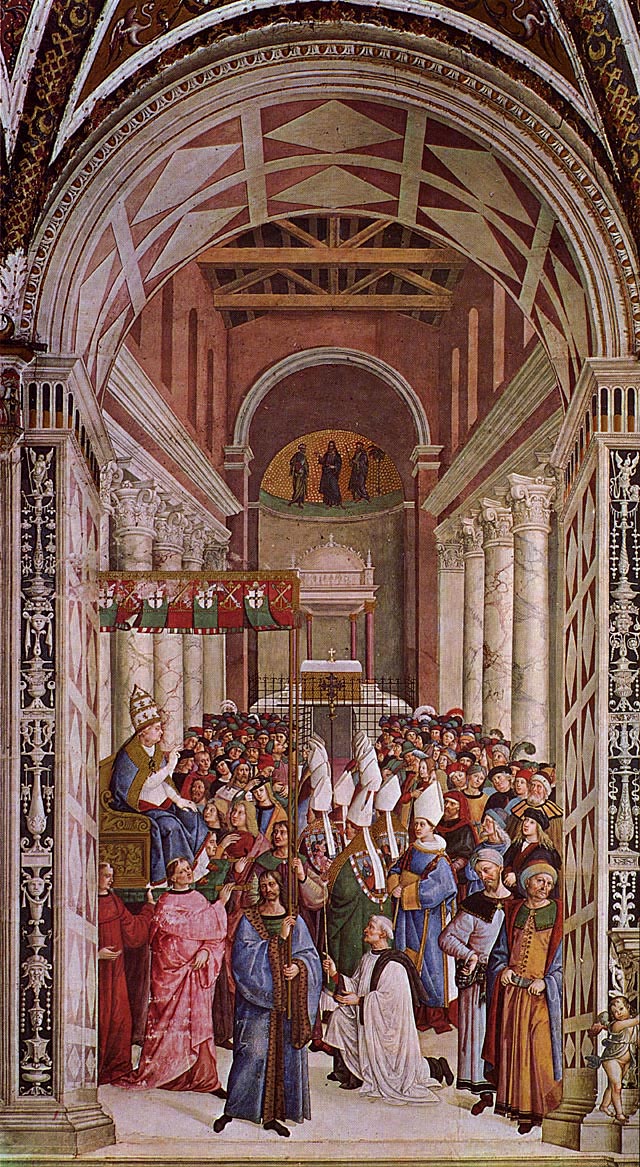
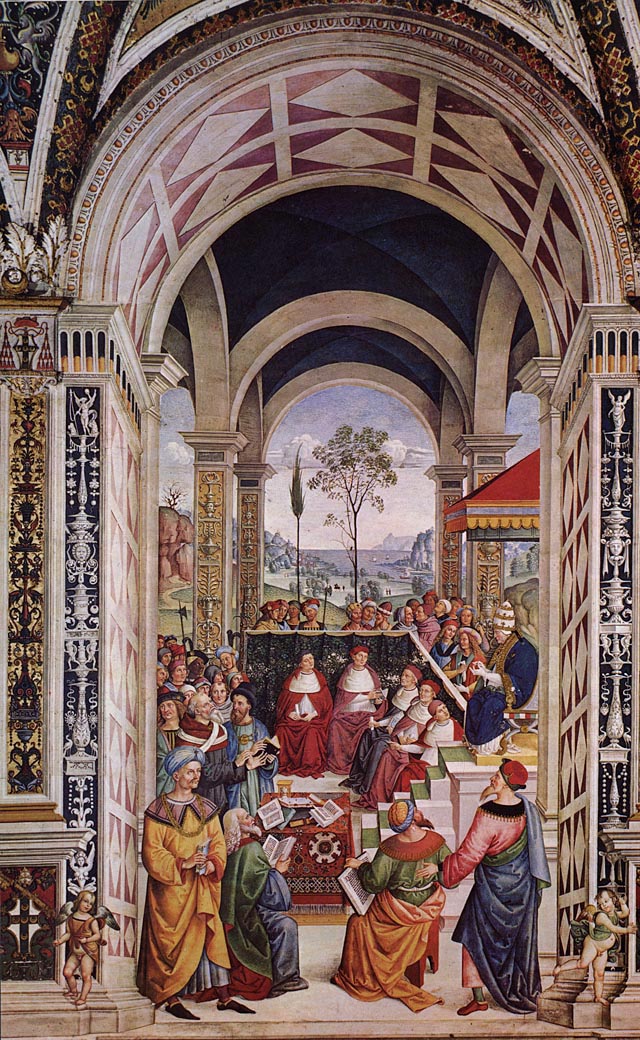
On the threshold of the 16th century, to Bernardino di Betto, known as “Pintoricchio”, was given the task of frescoing the Library in the Duomo di Siena.
The patron was Cardinal Francesco Piccolomini Todeschini, the future Pius III, who wished, with that work, to pay homage to the memory of his uncle, Enea Silvio Piccolomini, later Pope Pius II.
At the centre of the Library the cardinal had placed the marble Three Graces, a Roman copy of a Hellenistic original. He wanted to turn that hall into a glorification of Enea Silvio, a most refined humanist, a supreme poet, a great diplomat and, finally, a great Pope.
The contract between the cardinal and Pintoricchio was signed on 29 June 1502, full of clauses in which the painter undertook not to accept other commissions until the work in question was finished.
It was later established that in the first months of 1503 Pintoricchio was still in Perugia, perhaps busy sketching the first drawings for the Sienese Library, where he seems to have been strongly influenced by the then young Raphael.
Meanwhile his pupils, Matteo Balducci da Fontignano, Eusebio da San Giorgio and Giovanni di Francesco Ciambella, known as “il Fantasia”, had begun to decorate the vault, following the Master’s drawings and the patron’s wishes, with mythological scenes and figures in often far from chaste poses. This, however, could not and should not have been a cause for scandal, since the Library was not intended for any kind of religious worship, a situation made clear also, and above all, by the presence of the statue of the Three Graces and by the function of the Library, intended to house the masterpieces of classical literature, of which Enea Silvio was a great admirer.
On 21 September 1503, Francesco became Pope, on 8 October he was crowned and on the 18th, of that same month, moriva.
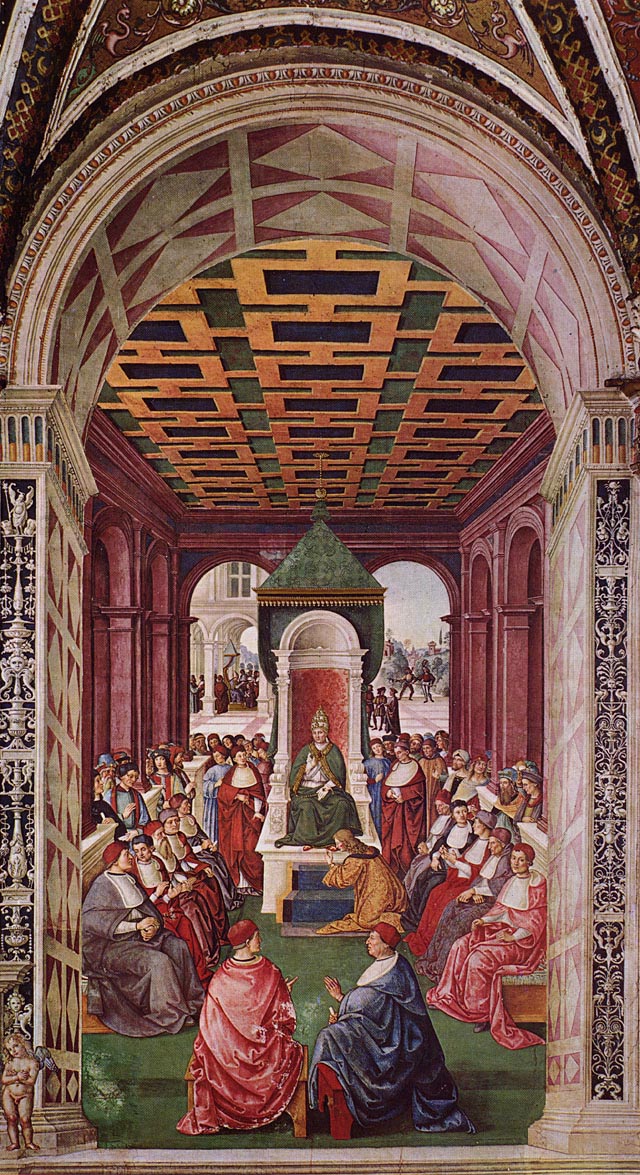
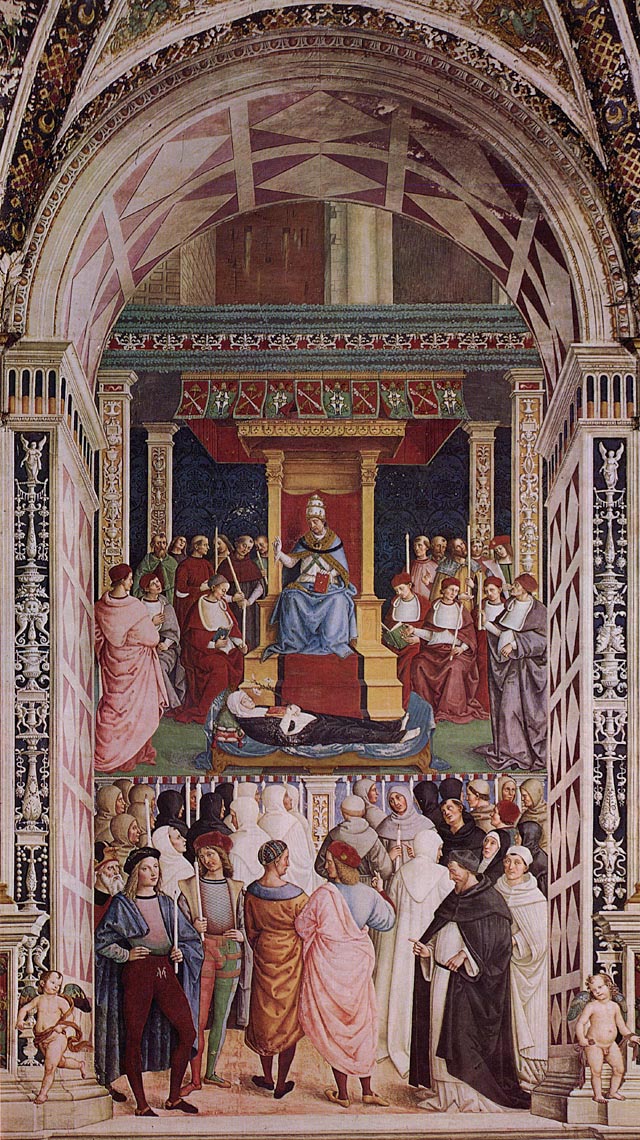
After the Pope’s death, Pintoricchio considered himself automatically released from all the clauses and, indeed, did not touch the work for the whole of 1504. Work resumed in 1505 thanks to a new contract, this time signed with the Pontiff’s brother, Andrea Piccolomini. He commissioned a further scene, not foreseen in the original project, the Papal Coronation of Pius III, which surmounts the marble front of the Library. This fresco, the first to be painted, already shows the main ideas of the work, but did not meet with much success. The upper scene, in which the Pontiff is depicted between the two cardinals, is rather monotonous and lacking in creative flair, while some motifs and figures worthy of greater interest are found only in the lower part.
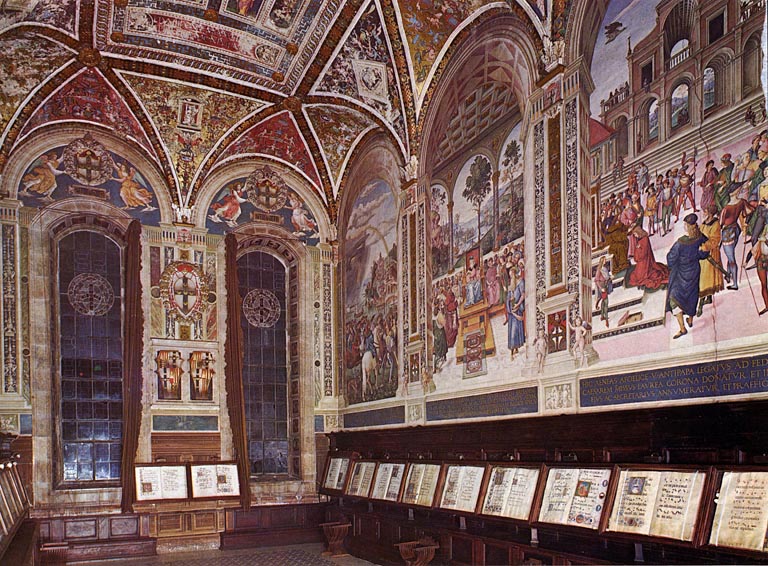
The interior of the Library offers the viewer an unforgettable spectacle. Many are those who, on entering the Library, have tried to describe that room, suffused with such luminosity and such richness of colour, as to be unrivalled.
Pintoricchio, in fact, manages to describe the life and deeds of Enea Silvio Piccolomini, depicting them in the colours of a beautiful, magical fairy tale.
But this gift of his has certainly not protected him from the criticism that has followed over the years.
Opinion ranges, in fact, from the great enthusiasm of early visitors, who, it is now certain, were strongly swayed by the belief that the young Raphael had taken part in the paintings, to the excessive and unjust condemnations of recent critics.
Despite everything, even the severest critics have found a particular charm emanating from the room in which Pintoricchio carried out his last great undertaking.
In this regard it is right to recall Berenson who, although he classified this work as late and as one of the worst examples of Umbrian painting of the early 16th century, had to admit that the frescoes possess an “undeniable enchantment”. According to Berenson, this is probably due to the perfect architectural and decorative division of the space, which makes the room so airy and so clearly articulated as to leave the viewer astonished.
In the stories of Pius II, too, analysis reveals a considerable contribution from the above-mentioned assistants, but, compared with the ceiling, perhaps thanks to greater coordination, a great overall unity can be seen.
It is also essential to reflect on how Pintoricchio, brilliantly, resolves this work, which deals with a decidedly arid theme, monotonous, devoid of imaginative possibilities, of picturesque and romantic cues. The work, in fact, consists of a series of depictions of official ceremonies among wealthy personages, devoid of any appeal.
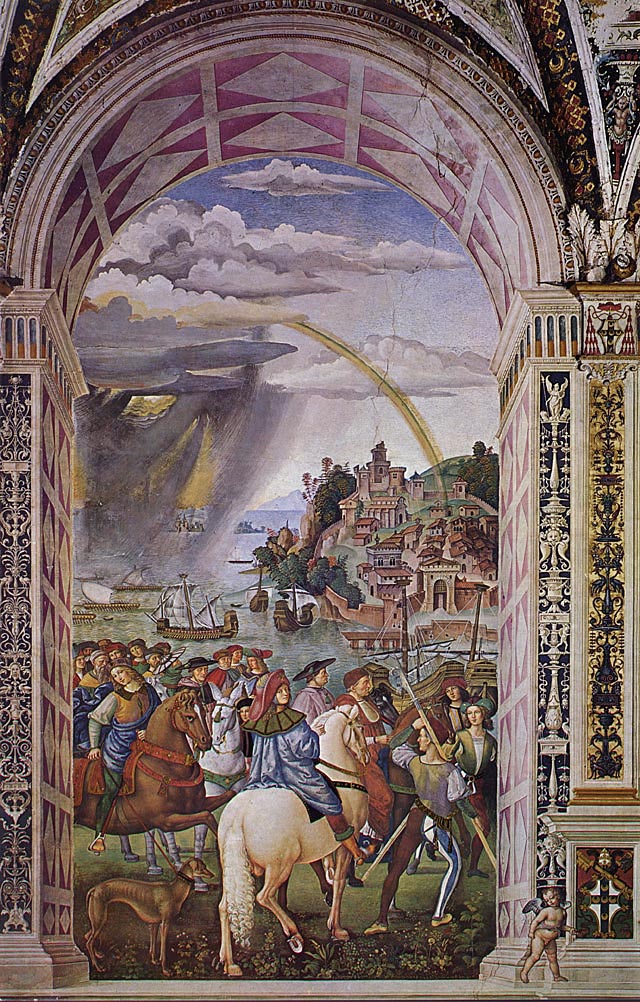
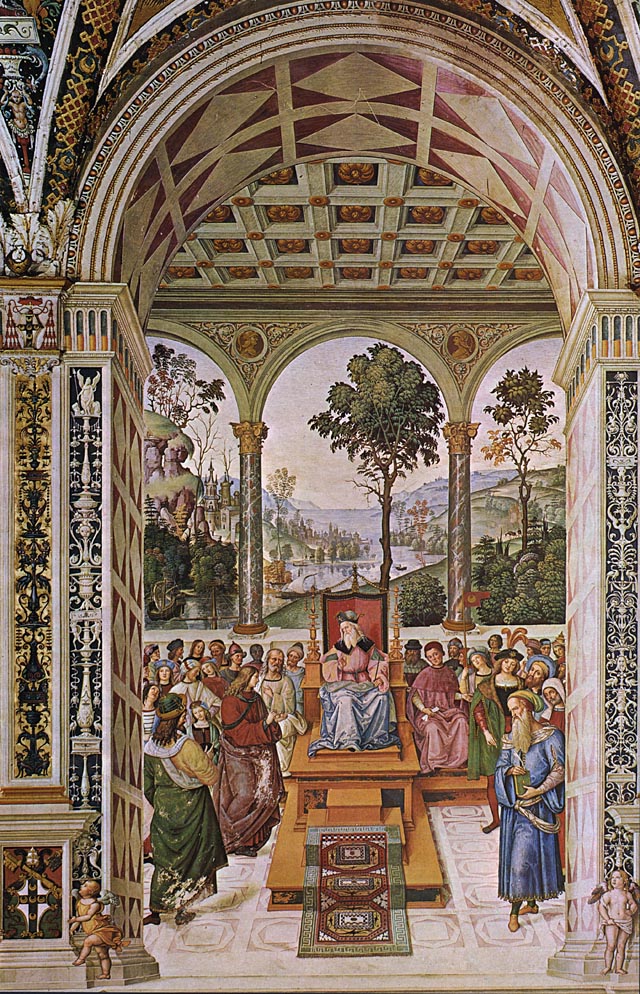
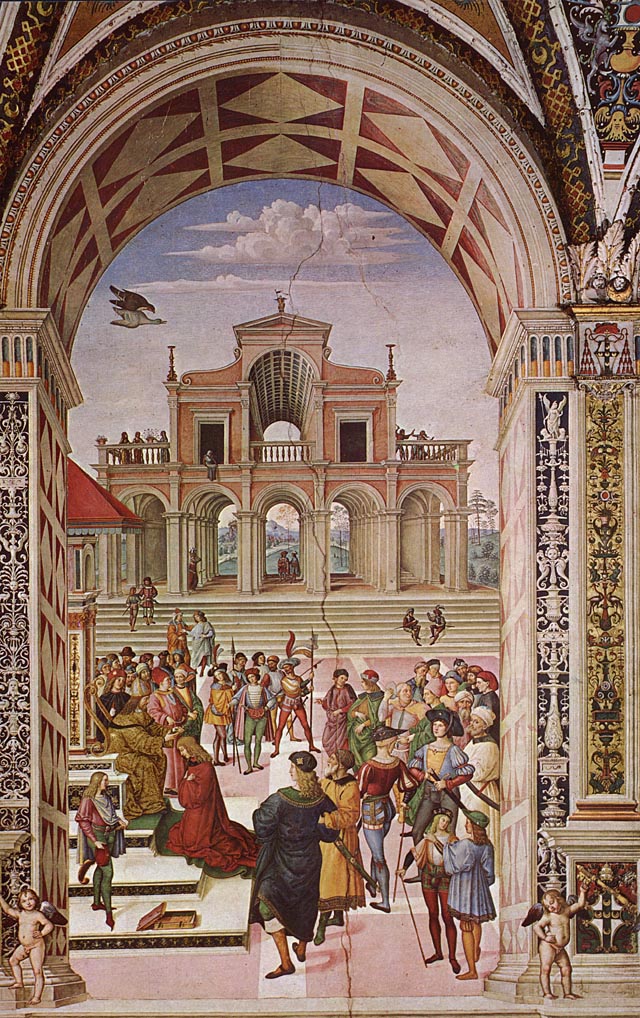
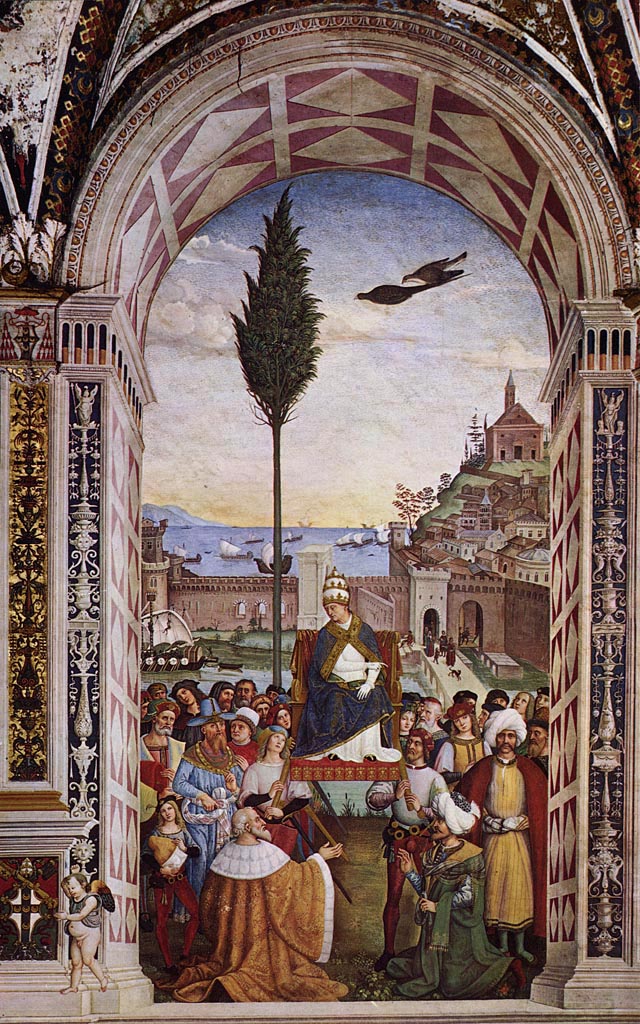
Nevertheless Pintoricchio, forced to work with his patrons always at his back, ready to defend the honour of their great ancestor at every turn, and unable to allow himself any particular extravagance, felt at ease in carrying out that tedious work, making the best use of his imagination and always introducing into the paintings stimulating motifs worthy of interest: elegant pages and splendid youths, as if placed to compensate for the absence of feminine grace and frivolity, motifs not permitted in that context, and, above all, the splendid landscapes in which he set the tedious ceremonies. The landscapes created by his imagination consist of blue-green gulfs into which ships burst, great squares enriched by airy porticoes, clear blue skies adorned with ducks and falcons, towering poplars and cypresses and even oriental palms.
In this regard, it should be pointed out that almost all these splendid landscape backgrounds in the Piccolomini stories were painted by Pintoricchio himself, without help from his collaborators; moreover, in most of the frescoes the accessories of the figures depicted stand out: footwear, damasks, silks, brocades, which under the Master’s brush take on a surprisingly natural appearance, thanks above all to the use of intense, vivid colours that, set side by side, seem to give life to floral compositions.
This brief introduction to the work in the Libreria Piccolomini may therefore be concluded by stating that, despite all the defects the critics have highlighted over the years, it is almost impossible to find another work of that period, or even by Pintoricchio himself, that displays such imaginative quality, such intense richness of colour and such great inventiveness in developing a secular story.
It must be made clear, however, that to understand and appreciate it fully, it is necessary to detach it from the works of Perugino, of Raphael and from the great cycles of the Renaissance, and consider it, rather, the last great work produced in the wake of late Gothic taste.
The photographs