Bruno BalestriniPhotographer
Bruno Balestrini/ Applied Arts/ Textiles/ The griccia, the cammino, the velvets (15th century)
Back to Textiles
The griccia, the cammino, the velvets (15th century)
Italy

The griccia, the cammino, the velvets (15th century)

The griccia The cammino The velvets

The research and competition brought about by the rise of numerous textile centres led the textile art of this century, which may be considered the golden age of fabric, to a great richness and perfection of means. Stylistically, production attains a spontaneous originality of its own, thanks also to the interest of the greatest artists in the minor arts, and the composition of the decoration shows greater balance and a notable symmetry.

THE GRICCIA

Period
From the first quarter of the 15th century to the middle of the 16th century.
Description
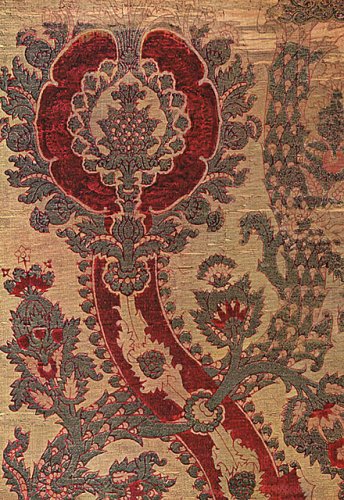
Succession of plant motifs such as the pine cone, trunk, pomegranate, thistle or lotus flower, in a vertically developing composition with a sinuous, writhing movement.
Technique
Pile-on-pile velvet brocaded in spun or bouclé (allucciolato) gold or silver, with grounds in gros, satin or gold teletta
Origin
In the alternation of proposals and in the evolution of textile techniques, the naturalism of fourteenth-century fabrics, characterised by thematic fancy and a plurality of colours, gives way to a rigorously unified elaboration in terms of chromatic values, technical and compositional ones. The fabric no longer looks like an illuminated page but like a bas-relief.

THE CAMMINO

Period
From the first quarter of the 15th century to the middle of the 16th century.
Description
Succession of plant motifs such as the pine cone, trunk, pomegranate, thistle or lotus flower, in a horizontally developing, rectilinear composition.
Technique
Pile-on-pile velvet brocaded in spun or bouclé (allucciolato) gold or silver, with grounds in gros, satin or gold teletta.
Origin
In the alternation of proposals and in the evolution of textile techniques, the naturalism of fourteenth-century fabrics, characterised by thematic fancy and a plurality of colours, gives way to a rigorously unified elaboration in terms of chromatic values, technical and compositional ones.

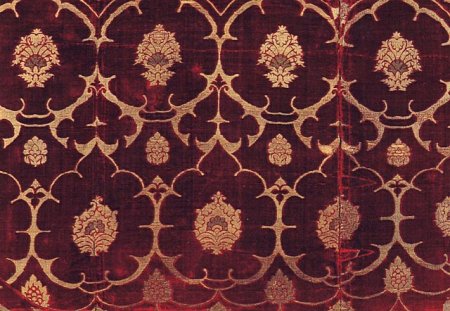
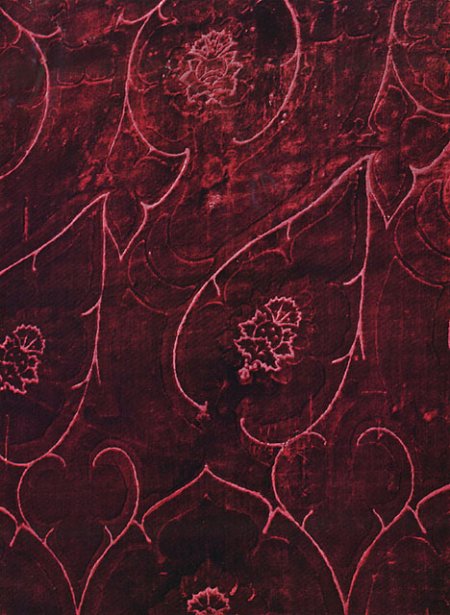
GRILLE VELVETS

Period
From the middle of the 15th century to the middle of the 16th century.
Description
Large multi-lobed leaves, tangent to one another, enclose pomegranate or thistle flowers, in turn surrounded by small flowers equal in number to the lobes.
Technique
Cut velvet, mainly on a satin ground, in which the outlines of the design are defined by the appearance of the ground, free of velvet pile.
Origin
It is found in the search for greater simplicity and clarity of decoration, achieved in a finer design such as the Gothic arch in architecture and wrought ironwork might suggest; hence the name of grille velvets.
Source
Bruno Balestrini Photographic Archive
This English text was translated with the help of artificial intelligence (Claude) from the Italian original, except where an English version already existed in the original archive. Read the Italian version.