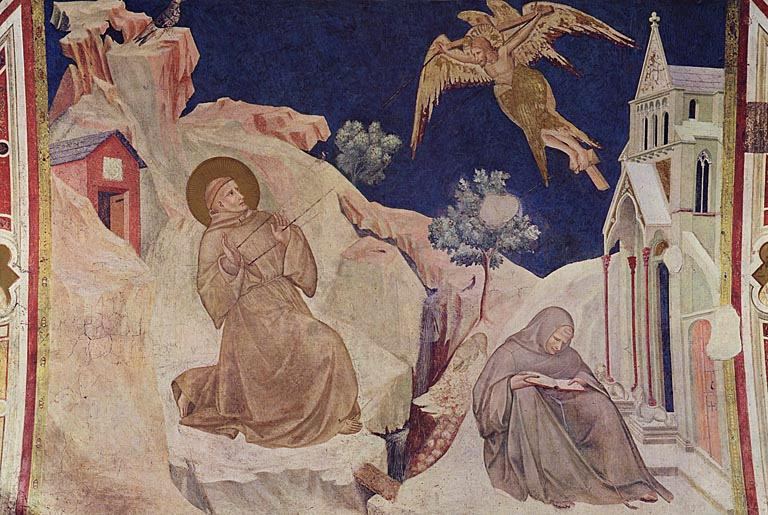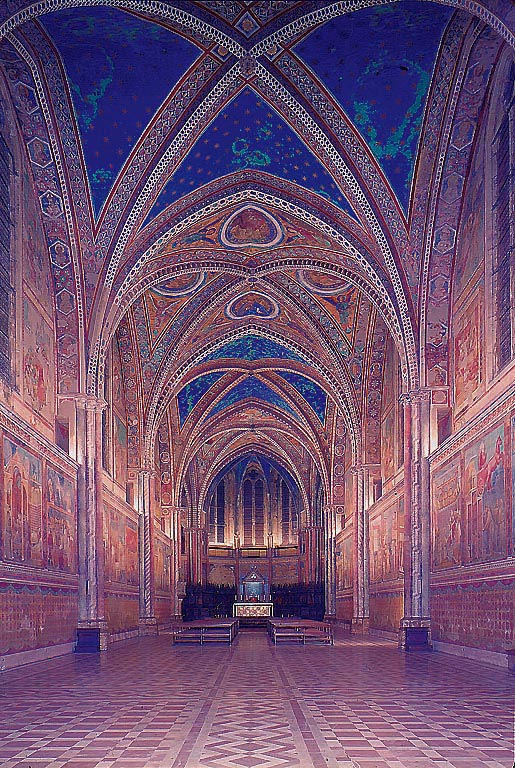
Assisi — Basilica di San Francesco
Giotto
Giotto’s activity for the Franciscan church of Assisi and his participation in the frescoes depicting episodes from the Old and New Testaments constitute a complex problem, long debated by scholars, many of whom, however, recognise in this very pictorial cycle the beginnings of the painter’s activity.
Many scholars agree, now, in recognising Giotto’s first intervention in the frescoes of the second bay of the upper church, depicting the last two Stories of Isaac.
The excellent quality of these two frescoes shows that Giotto himself painted each detail, something that is rather obvious if one considers that, on the basis of these two works, the patrons would then decide whether to dismiss the masters already working in the basilica and entrust the continuation of the work to the Florentine painter.
At this point, given the vastness of the decorative scheme, it is natural to think that the painter decided to take on some assistants from among those who had worked in the basilica up to that moment. The intervention of these assistants, undoubtedly of a more archaic culture than Giotto, can be detected in all the frescoes of the first bay, namely the Vault of the Doctors and its intrados, and the Stories of the Old and New Testament. This would suffice to explain the drop in quality, not at the level of invention but only of execution, compared with the Stories of Isaac and up to the cycle of the Stories of St. Francis.
To establish a chronological order for the frescoes, the logical movement of the scaffolding has often been followed, from top to bottom, whereby Giotto’s first frescoes, after the Stories of Isaac, would be those of the first bay, where the Vault of the Doctors is depicted.
Also in favour of this temporal sequence is the spatial arrangement of these latter frescoes, which, though not following the rules of perspective, nonetheless reveal a law of convergence towards the centre of the vault cells. All this shows that behind the Vault of the Doctors there was an innovative mind, one that experimented and constantly set itself new problems, trying, of course, to solve them.
The only assistant who can be named today, almost certainly, is the Sienese Mimmo di Filippuccio, to whom is attributed, beyond any shadow of doubt, a substantial participation in the execution of the Vault of the Doctors, in the corresponding intrados and in the Pentecost.
All this leads us, logically, to the threshold of Giotto’s other great work inside the basilica: the Stories of St. Francis, which illustrate the Franciscan legend.
In this case too, the attribution of the work to Giotto has provoked opposition from some critics, which, moreover, has not yet ceased.
There are, however, numerous imitations of the Assisi cycle in early 14th-century painting, and this makes the attribution of the cycle to Giotto easier, since it is hard to imagine that at that time another great master, at least as brilliant and innovative as Giotto himself, could have been working alongside the Florentine.
In the light of these facts there seem to be no valid reasons to reject the tradition, handed down to us by Vasari, according to which the patron of the Stories of St. Francis was Giovanni da Murro, General of the Franciscans from 1296 to 1305.
As for the duration of the work, we can refer to a recent survey which established that 272 “giornate” of work were needed, corresponding to 272 patches of plaster laid “a fresco” over the whole cycle. The same survey made it possible to identify the sequence in which the frescoes were executed, confirming the narrative order of the legend, with the exception of the first, which on stylistic grounds was very probably the last to be executed.
Simone Martini
In the lower church of the Basilica di San Francesco are the stupendous frescoes of the chapel of San Martino, perhaps one of Simone Martini’s greatest masterpieces and, certainly, of 14th-century painting.
This work too has given rise to the usual critical debate, in this case, aimed not so much at establishing its authorship as, rather, the exact dating of the work.
Among the various scholars who have laboured over the study of the work, the first to name Simone Martini as its author was the restorer Sebastiano Renghiasci, towards the end of the 18th century. His theses were later confirmed by Cavalcaselle in 1885, the year in which he published the “Storia della pittura in Italia”.
As regards the date, critics then continued to express conflicting opinions, until reaching the almost unanimous conclusion that the work could not predate 1317. This opinion rested on the fact that St. Louis of Toulouse is depicted in the cycle, canonised, precisely, in that very year.
On the other hand, it must be pointed out that the image of St. Louis appears in the cycle only on the soffit of the chapel’s entrance arch, an area that logically should have been the last to be frescoed, and therefore at a time when the work on the whole chapel was by then finished. Moreover, beside the figure of St. Louis, in the same intrados, there is a type of iconography wholly unrelated to that of the chapel’s interior.
From this last analysis it could easily be deduced that the whole fresco decoration of that intrados was not part of the original plans but was redesigned at the last moment, precisely because of the saint’s canonisation. In this way the argument used to date the entire work to 1317 would instead lead to establishing that this was the year the work was completed, thus overturning, once again, the old convictions.
Moving on to more certain arguments about the work in question, it can be stated that the decoration of the chapel was commissioned by the Franciscan cardinal Gentile di Partino da Montefiore, who in 1312 set out on a journey that took him from Assisi to Siena and then to Lucca, where he died suddenly. From this it is easy to deduce that the “foundation” of the chapel of San Martino can in no way be later than 1312.
The fact that the chapel had been founded in that year certainly does not mean that Simone’s work began immediately, but nor did it begin much later, especially since a stylistic comparison is available with another work: the Maestà, completed by Simone Martini in Siena in 1315, in which artistic elements very similar to those of the Assisi cycle are found, a cycle which almost certainly belongs to the master’s early formative period.
The fresco cycle appears permeated by the experience of perspective derived from Giotto, but it should be pointed out that Simone’s approach to Giotto was not a casual occurrence, but rather the sign of a great maturity in the Sienese master.
The first works to be executed for the chapel were, almost certainly, the large dedicatory scene, on the entrance wall, and the half-figures of saints adorning the three large windows, the latter of such high quality as to astonish everyone, since in mural paintings these less important parts were, generally, entrusted by the great masters to assistants.
This masterly perspective presentation is also found in the scene of the dedication of the chapel.
Passing then to the Stories of the Life of St. Martin, one finds oneself in a setting enclosed by an unequalled Gothic architecture. Here the architectural capsules do not act as enclosures of space, but rather underline the existence of a much larger room that contains them, allowing a glimpse of, wherever the opportunity arises, the blue of the sky.
These architectures, which appear rich and precious, to the point that they could be mistaken for reliquaries or monstrances, nevertheless give a sense of their own material substance that almost brings to mind the image of inhabited castles.
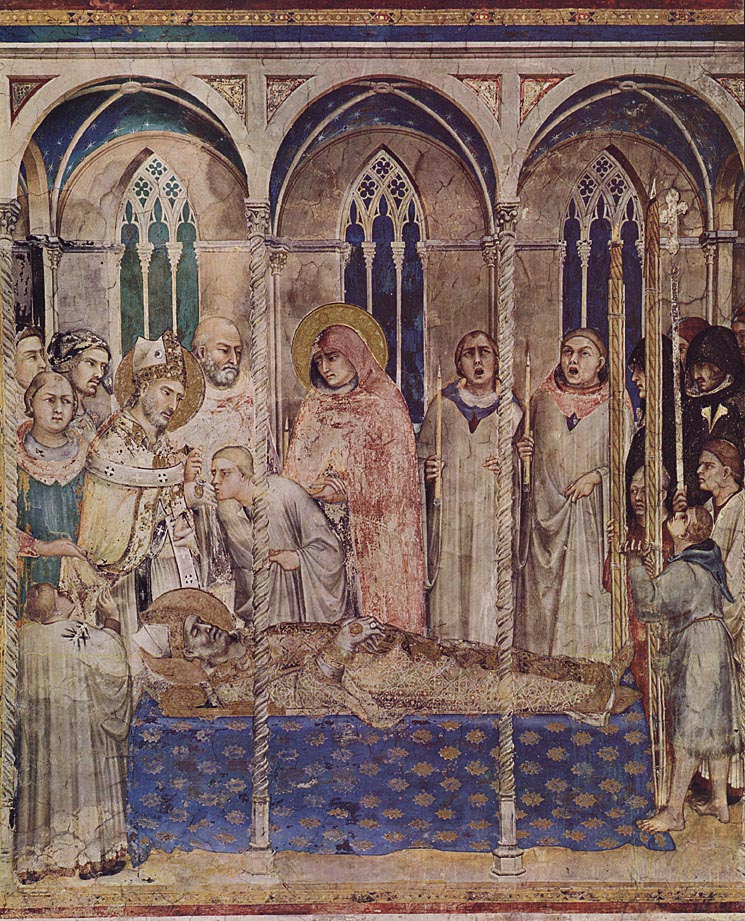
Nor is there any lack of evident iconographic references to Giotto’s Assisi cycle: in the scene of the Funeral of St. Martin, for example, the portico painted in perspective is very similar to the one in St. Francis Preaching before Honorius III, while the two singing monks are taken exactly from the Crib at Greccio.
Within these tabernacles, typically Giottesque, Simone, however, drew a melancholy world, typical, in this case, of the secular civilisation of the Middle Ages, but he did so using a colour so luminous that, despite its purely Duccesque derivations and those from the culture of Parisian miniatures, it presented absolute novelties in its evocative power.
In the half-figures of saints placed between the large windows, in the dedicatory scene and in all the Stories of St. Martin, colour becomes a means of illumination and succeeds in giving form and depth to the various surfaces. In some cases – the Death, the Funeral and the Investiture of St. Martin – colour is fundamental in creating particular atmospheres, in re-creating shadows or in conveying the density of the air that is breathed.
In the figure of the saint bending over the dead body of St. Martin and in the bedspread depicted in the Dream, Simone achieves an absolute and unrivalled realistic effect. In the scene of the Dream of St. Martin the painter succeeds, through the combination of colour and light, in re-creating a gentle, calm setting, to the point of making the observer perceive an almost familiar room, all within an architectural context of which colour itself becomes the absolute author.
All these elements, characteristic of the master’s art, are also present in the eight figures of the entrance arch, placed in pairs within the openings of four Gothic two-light windows, beyond which can be glimpsed, as always, the blue of the night sky.
This work, for its brilliant conception, is mentioned as one of the highest architectural conceptions of the time.
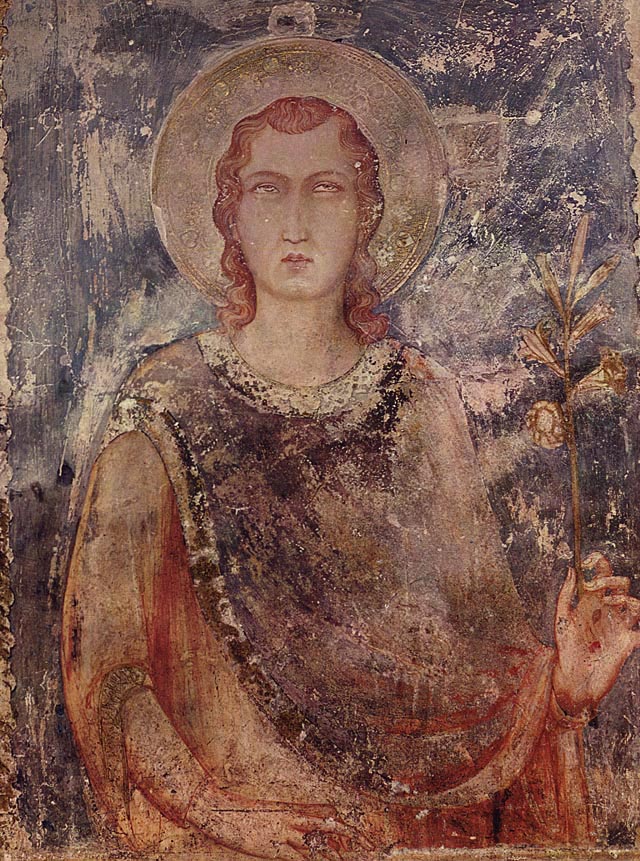
Among these figures of saints, the St. Francis stands out, from which emanates a fantastically surreal sweetness, thanks to the perfect balance of plasticity, space and colour.
One cannot, finally, fail to recall that Simone Martini’s innovative solutions in painting were also due to his openness towards a profane and secular evolution, typical of the contemporary European world and above all of the monarchies of France, England and Bohemia.
Pietro Lorenzetti
In the left arm of the transept of the Lower Church of San Francesco in Assisi, is the fresco cycle by Pietro Lorenzetti.
Here too we are faced with a rather tormented question, because of the various controversies, that have followed one another over the years, on the part of critics concerning the attribution of the works to the great Sienese master.
It was then Cavalcaselle who, on the basis of purely stylistic investigations, and thanks above all to a careful analysis of the Pieve d’Arezzo, commissioned from Lorenzetti in 1320, quite effectively refuted the tradition handed down by Vasari, according to which these works were attributed to Cavallini, Giotto and Puccio Campana.
In any case, of the whole fresco cycle, critics today are fairly unanimous in assigning to Pietro Lorenzetti the great Crucifixion, the Sacra Conversazione, the frescoes with the post mortem episodes of the Passion and, apart from a few dissenting opinions, the fresco triptych of the Orsini Chapel, the Hanged Judas and the Stigmata of St. Francis.
While, as regards the six frescoes of the vault, depicting the ante mortem stories of the Passion, the most common tendency among critics is to deny that they are by Pietro and to attribute them, instead, to clumsy, makeshift collaborators or, even, to a follower more modest than the master and, perhaps, his own brother Ambrogio.
A turning point in the problem came only with Dewald, who, through more thorough analyses, went so far as to state that behind the fresco depicting the Madonna between the Baptist and St. Francis and the six frescoes of the vault there was not a collaborator but Pietro himself. Dewald seeks to give a rational explanation for this finding by pointing out that these works show the typical characteristics of the master’s early culture, in which archaic and new elements coexist. At that time, in fact, Lorenzetti was working in a situation of transition between the archaic traditions handed down to him by Duccio and the Gothicising openings typical of the great masters of the second decade of the 1300s.
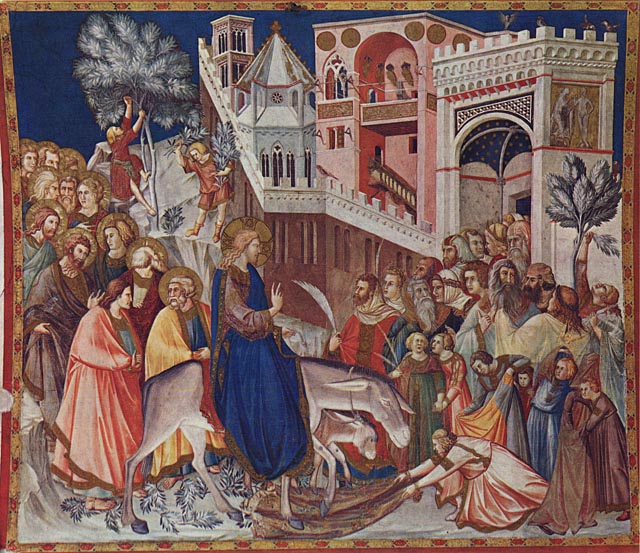
It is easy to find in Lorenzetti’s works an overlapping of elements that recall at times Cimabue, at others Giovanni Pisano and at others still Giotto. All this can be seen, for example, in the six frescoes of the vault and above all in the first: the Entry into Jerusalem. Here, in fact, one notes a clear and concrete construction of volumes, following Giotto’s teaching, but all built according to the precarious and unstable old schemes, since Pietro was at that time still unaware of Giotto’s compositional synthesis.
On the other hand, it must be admitted that Pietro’s openness of mind towards every lesson offered to him by the various art forms of the time, and above all contemporary sculpture, meant that his works were imbued with an admirable chromatic and luminous timbre.
This masterly use of colour, so intense, is certainly due to the legacy of 13th-century painting, Sienese and above all Duccesque, with its rich palette, with which only the French Gothic world could worthily compare.
The most extraordinary achievement of the poetry of colour would come with Simone Martini, while in Lorenzetti it is found above all in his early period, when the influence of Duccio, his most natural and direct master, is still very strong, only to give way later, in the more mature Lorenzetti, to a truth of material far poorer and much closer to that of Giotto.
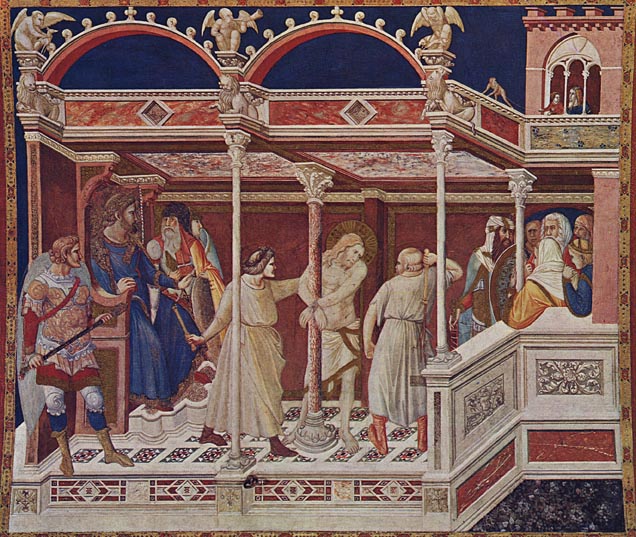
The works in which Lorenzetti, with great mastery, gave greatest prominence to this aspect are: the Flagellation and the Washing of the Feet. Here the interiors are richly ornate and at the same time tremulous, the gold seems to shine, refracting the light and giving life to fantastic settings.
It seems obvious, at this point, point out that what makes the colour and light so natural, in these works, is Pietro’s increased mastery of space, thanks above all to the secrets gleaned from the art of Giotto. The Gothic hall in which the episode of the Washing of the Feet takes place presents, in fact, a spatial composition worthy of the most mature Giotto.
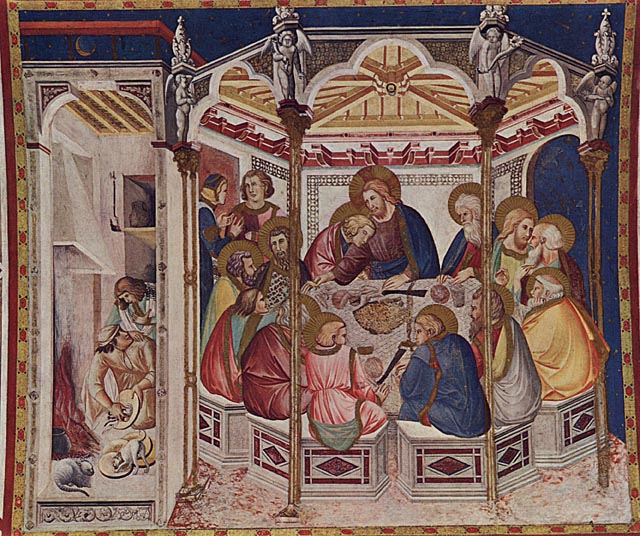
Still exceptional is the emblematic and restless spirit, subtly inclined towards drama, of Lorenzetti’s figures, to be read skilfully beneath the more striking garb that colour gives the work, as in the Last Supper, in which the artist succeeds in making the viewer perceive the most varied stirrings of the protagonists’ souls. Another notable element in this work is the setting in which the event takes place: the hexagonal cenacle. Here, once again, archaic elements stand alongside new ones in an extraordinarily harmonious way; indeed, the hexagonal element, certainly close to Duccio’s art, is then studied in plan according to the canons of the new advances of 14th-century painting.
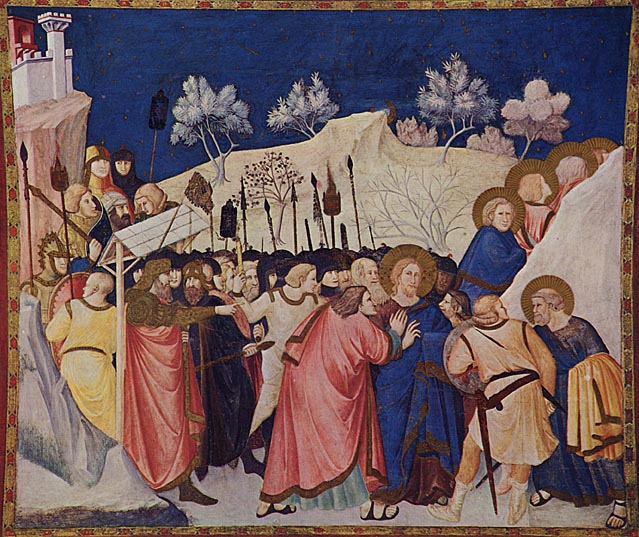
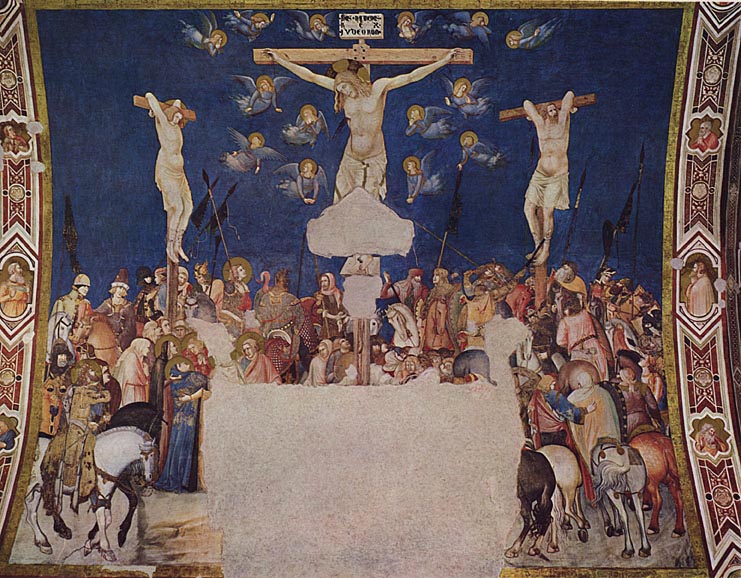
It is very likely that the works in the transept were separated by intervals of time owing to the execution of other works commissioned from Lorenzetti outside Assisi. This is why a different spatial composition can be seen in the Capture of Christ compared with that of the Crucifixion, in which an increased plasticity of forms is evident.
The master is in fact probably at the height of his greatness when he paints this work, succeeding in surpassing all iconographic precedents for this event, thanks both to an enlargement of the scene so as to include the three crosses and to his ability to bring out the distress of those witnessing the martyrdom and to give a certain continuity to the movement, something entirely absent from the art of Giotto, who instead was rather inclined to use pauses in his way of narrating events.
Giotto — Stories of St. Francis and the Vault of the Doctors
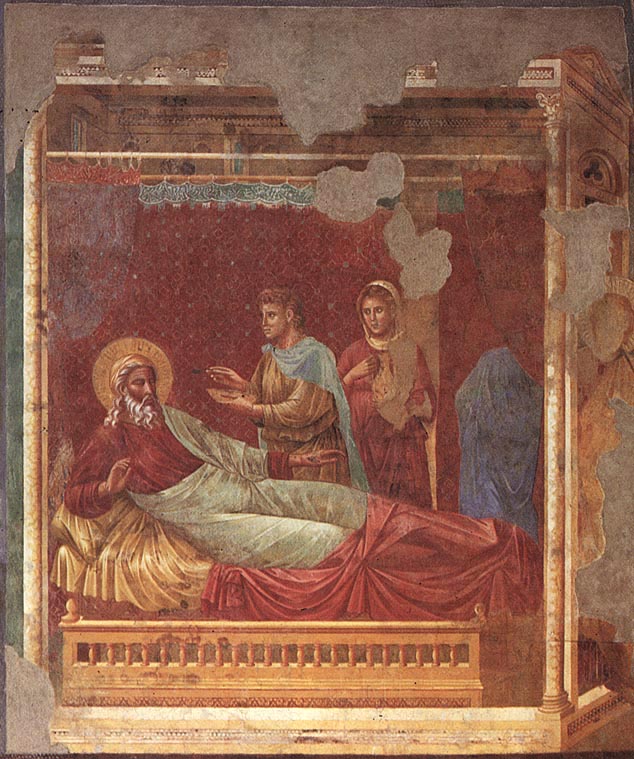
ISAAC BLESSES JACOB (detail)
In this first fresco Isaac, now blind and dying, raises himself from his bed, supported by a handmaid, and, touching Jacob’s hand, who had cunningly covered it with lambskin to imitate the natural hairiness of his brother Esau, believes he recognises his favourite son.
The space appears narrow but well defined in depth. Isaac’s halo has a thickness of its own, something new in the history of art, thus defining, without any doubt, what is “in front” and what is “behind”.
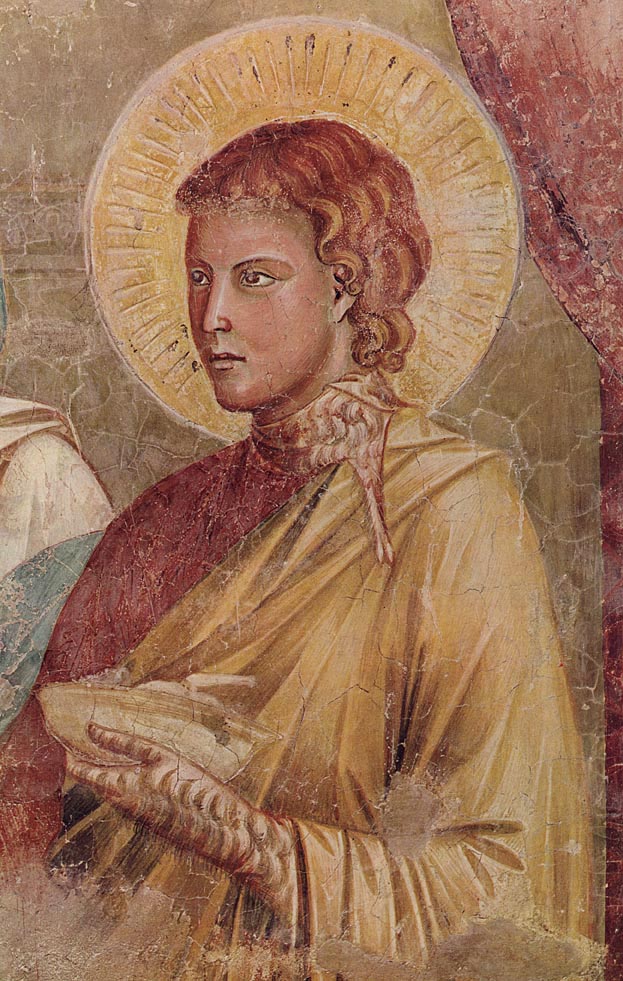
ISAAC REJECTS ESAU
In this second scene, while Jacob and his mother Rebecca flee on the right, although only the outlines of these two figures remain, Esau, naturally hairy and accompanied by a young woman, offers Isaac the food prepared from the animals he has hunted himself. But Isaac rejects him, having already received and blessed Jacob.
The spatial arrangement is practically identical to that of the previous fresco, but the better condition of this one, especially in the left part of the scene, immediately brings out its feats of perspective, something quite evident in Esau’s hand holding a spoon and in Isaac’s fingers, staggered in depth.
The iconographic comparison with Cavallini’s mosaics in Santa Maria in Trastevere immediately suggests that the young Giotto derived from Cavallini, or vice versa. This fact also leads one to believe that Giotto’s activity in Assisi did not begin much later than 1290.
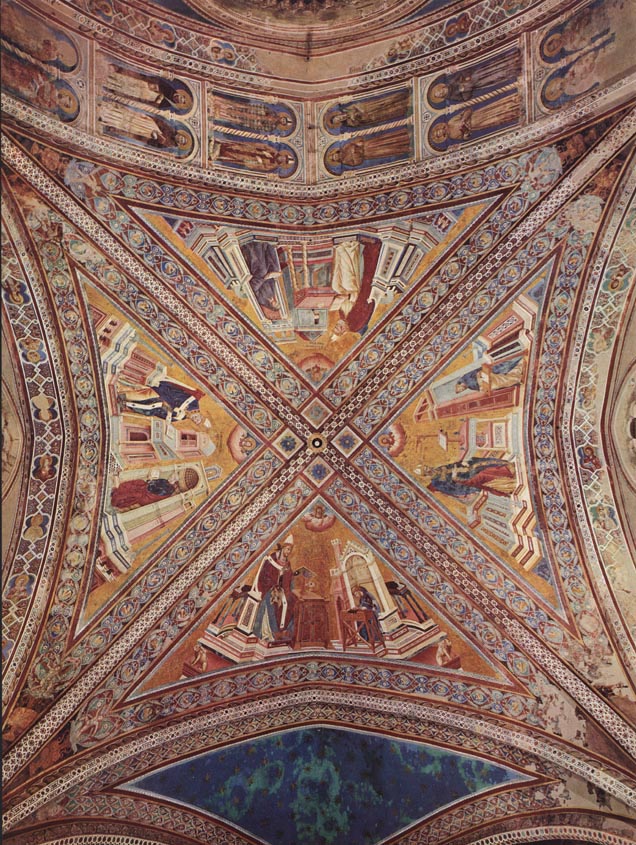
THE VAULT OF THE DOCTORS
The vault of the fourth bay takes the name of Vault of the Doctors from the depiction, in each of its four webs, of a Doctor of the Church.
The names of the four Doctors have been identified thanks to the inscriptions in each web, and they are: St. Ambrose, Saint Jerome, St. Augustine and St. Gregory the Great. The four depictions all show a Doctor, seated before a lectern or a bookcase, dictating to a cleric, who is also seated inside an aedicule.
At the top, above the highly ornate architecture of the aedicules and the thrones, the head of the Redeemer can always be glimpsed, surrounded by a semicircle of clouds.
Despite the various attributions, put forward by critics over the years, it is now commonly held that the Vault is the work of Giotto, albeit helped by some collaborators. Given the loftiness of the conception, of the formal and iconographic features and the masterly pictorial rendering, one could not fail to conclude that the work was to be attributed to the great Florentine master.
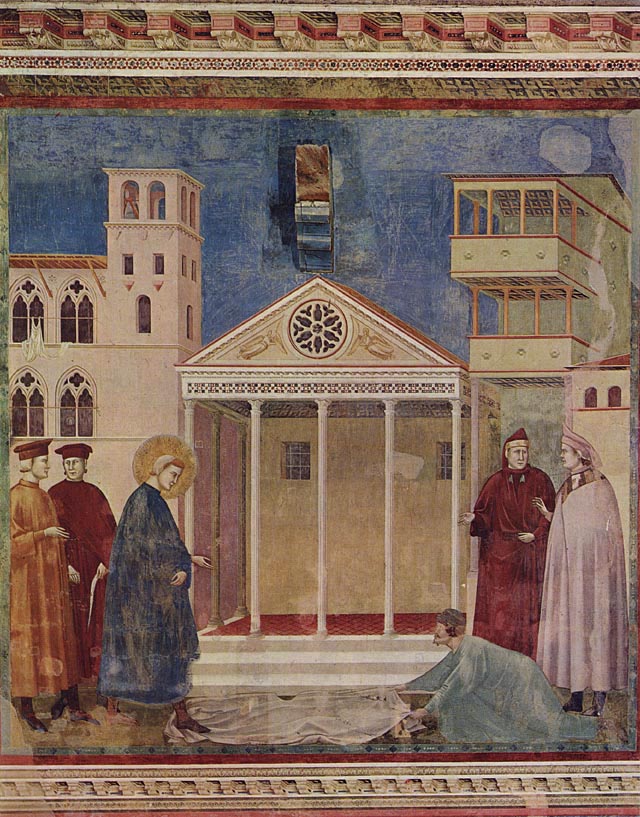
ST. FRANCIS HONOURED BY AN ORDINARY MAN
The scene shows a simple man of Assisi spreading his garments before St. Francesco, thus paying him homage as he passed.
This first episode in the order of the narrative is usually placed among the last in order of execution, an opinion widely accepted by critics.
The painting is not entirely autograph; indeed, the collaboration of an assistant has often been recognised, usually identified as the “Master of St. Cecilia” or the “Master of the Montefalco Crucifix”, on the basis of stylistic affinities between this fresco and the last ones on the opposite wall, which have in fact generally been attributed, almost entirely, to this unknown painter.
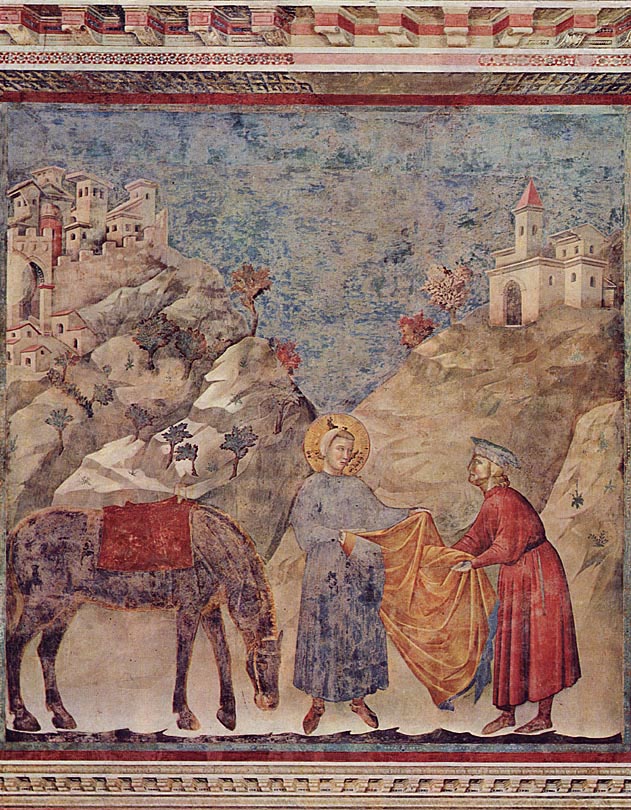
ST. FRANCIS GIVING HIS CLOAK TO A POOR MAN
The scene depicts the meeting between St. Francis and a knight, noble but poor and ragged. The Saint, moved to compassion, honours the knight with his cloak.
This is, almost unanimously, recognised as the first compartment, in order of execution, of the whole cycle, and, thanks to the elements typical of Giotto’s artistic language, the painting is recognised as entirely autograph.
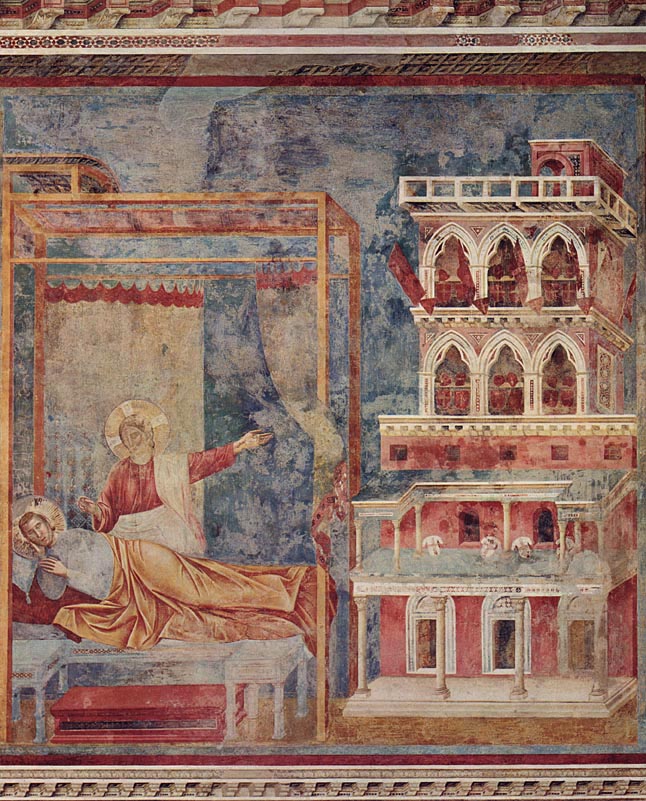
THE VISION OF THE PALACE FULL OF ARMS
S, Francesco, asleep, sees in a dream a beautiful palace with arms emblazoned with the sign of the Cross of Christ and, as he wonders whose they are, a heavenly voice replies that they would be his and his soldiers’.
The scene consists of the room in which the Saint is sleeping, with Christ beside him pointing out the vision of the palace, depicted in a slightly recessed position.
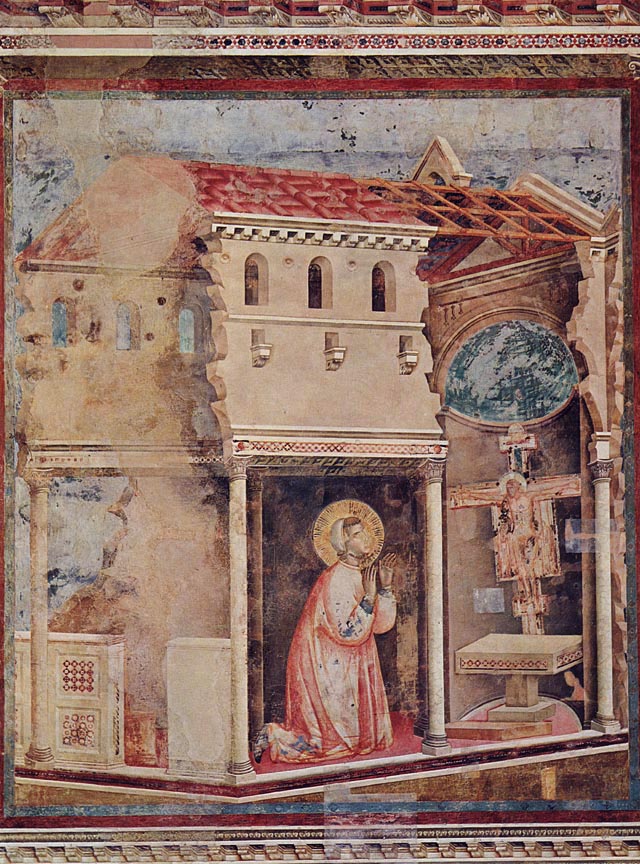
THE PRAYER IN SAN DAMIANO
According to the ancient legend, St. Francesco, praying before the Crucifix, hears a voice urging him several times to repair a certain house that is slowly falling into ruin. The building depicted here represents the ruined church of San Damiano near Assisi, and Franciscan commentators interpreted the event as an exhortation to rebuild the church itself.
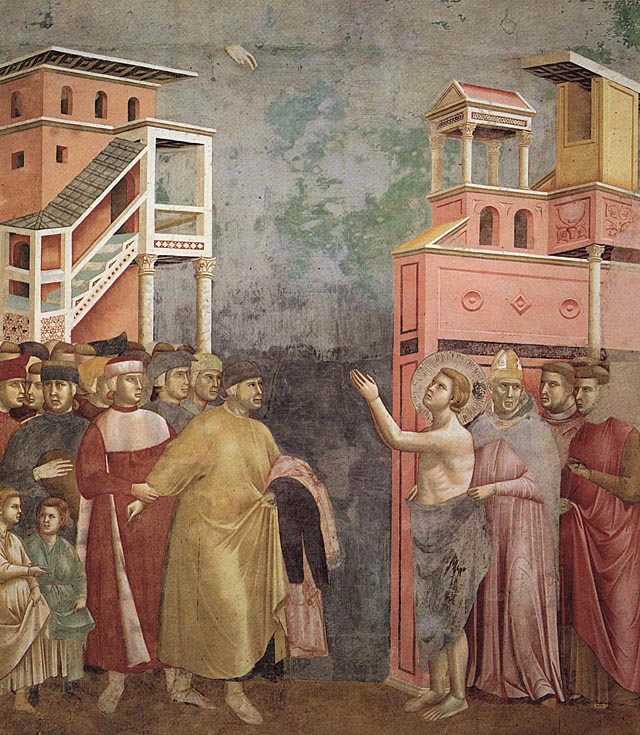
RENUNCIATION OF HIS WORLDLY GOODS
This depicts the moment when St. Francis, having taken off his clothes and partly covered by the bishop, renounces his paternal and temporal possessions and invokes the Eternal, who was probably represented symbolically in the upper central part, where only a hand now appears, while, in front of him, his father, Pietro di Bernardone, is held back by the arm by one of his men.
In this case too, the fresco is thought not to be entirely autograph, which seems fairly evident in some of the heads of Bernardone’s retinue and, perhaps, and also in that of the bishop.
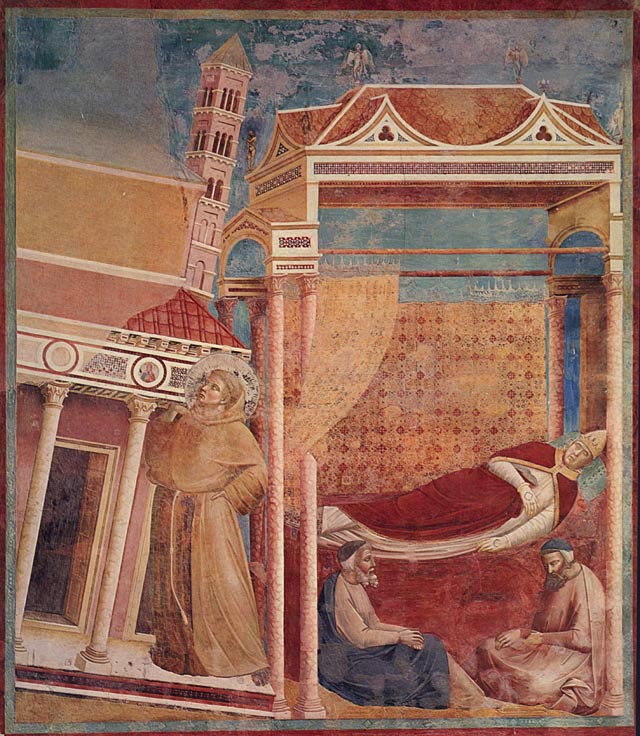
THE DREAM OF INNOCENT III
The fresco depicts Pope Innocent III dreaming of the Lateran basilica on the verge of collapse, but held up by a poor man in the garb of St. Francis.
The execution is considered almost entirely autograph. The figure of the Saint, in this compartment, is better preserved than in the previous scenes, since the monk’s habit is, completely, executed “a fresco”, whereas, to execute the blue garment in which he had been depicted up to that point, the lapis lazuli was applied a secco, so as to economise on the precious powder.
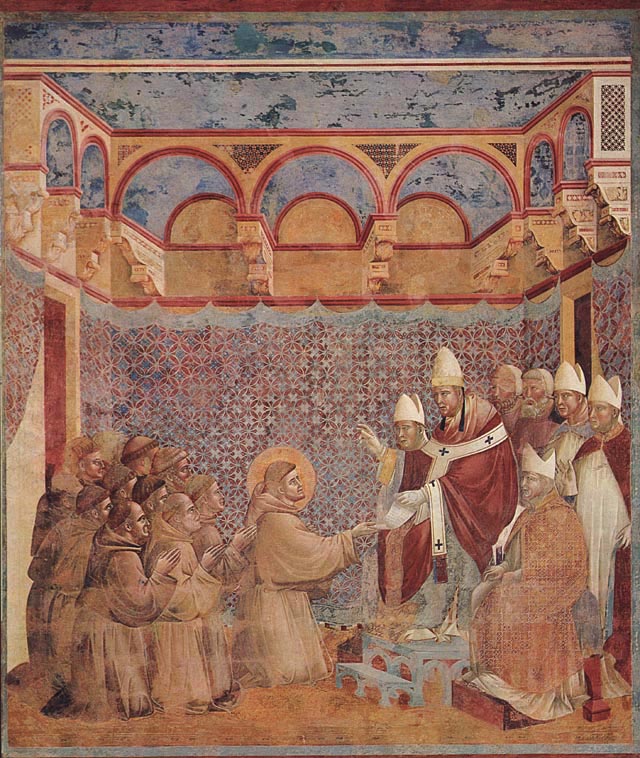
THE CONFIRMATION OF THE RULE
The panel depicts the approval of the Rule by the pope and his mandate to preach penance. The pope, moreover, had the friars who accompanied the saint given the tonsure, so that they might preach the word of God.
The contrast is immediately evident, in the sumptuous hall hung with fabrics, between the pope with his prelates and the group of friars, often identified with the contrast between the earthly image of the Church and its spiritual image.
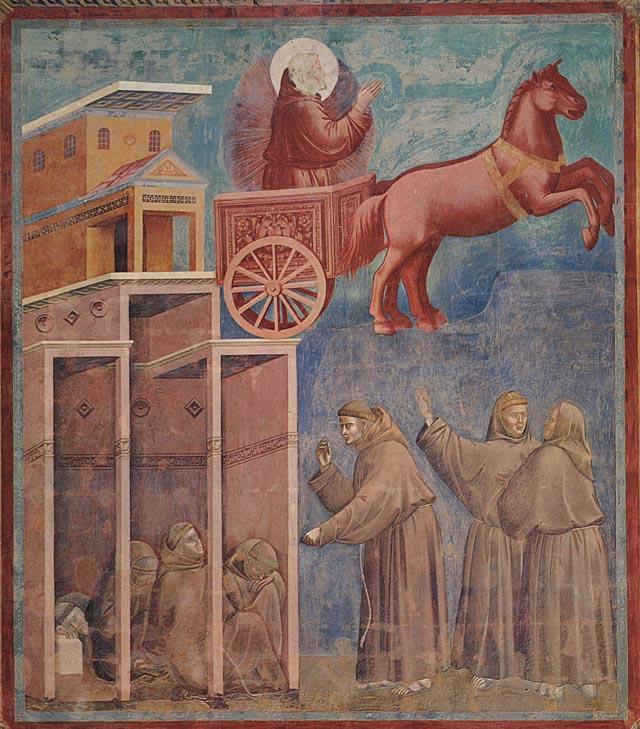
THE VISION OF THE FIERY CHARIOT
The scene is divided into two parts. Below is depicted St. Francis praying in a hovel while above appears a vision, probably of his friars, who are far away from him at that moment, of the Saint on a fiery, shining chariot.
It is said that the gap between the focal points of the two parts emphasises the contrast between the real world and the otherworldly nature of the vision.
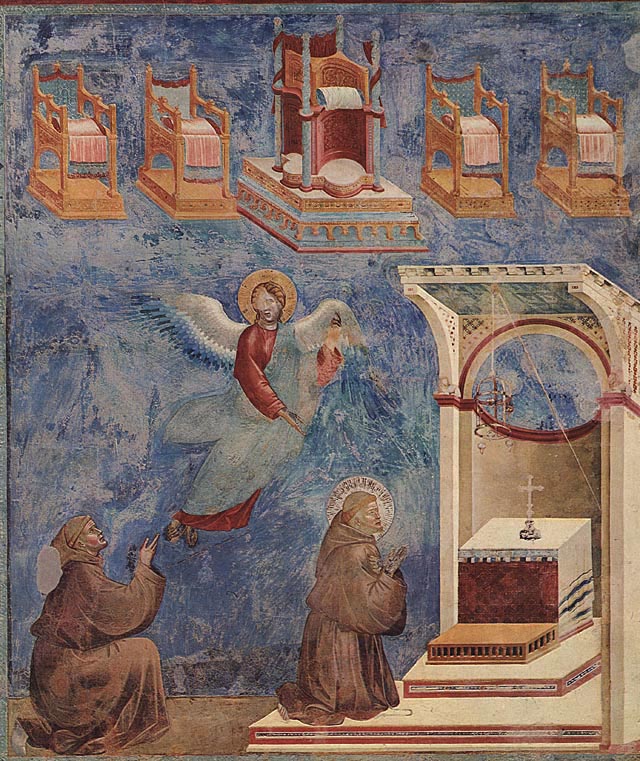
THE VISION OF THE THRONES
This time the vision of a companion of St is depicted. Francesco, who sees several seats appear in the sky, one of which stands out for its dignity and splendour. The friar then hears a voice announcing that this throne is reserved for St. Francis.
Here too, as in the previous fresco, the earthly space, with the friar having the vision and St. Francis praying in the chapel, is represented according to a different focal point from that of the vision.
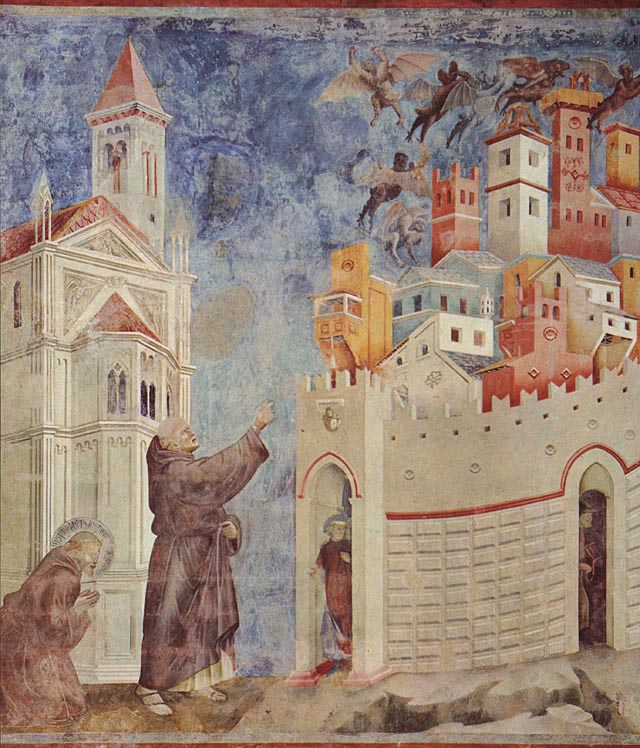
THE EXPULSION OF THE DEVILS FROM AREZZO
The scene depicts St. Francis, who sees the demons above the city of Arezzo and asks his companion to drive them out by shouting, because so the Lord had commanded him. As soon as the friar shouted, the demons fled in terror.
In the foreground, on the left, Saint Francis is shown kneeling and, in front of him, the friar who shouts, on the right the city of Arezzo with the fleeing demons above it. In the middle ground, on the left the apse of a church.
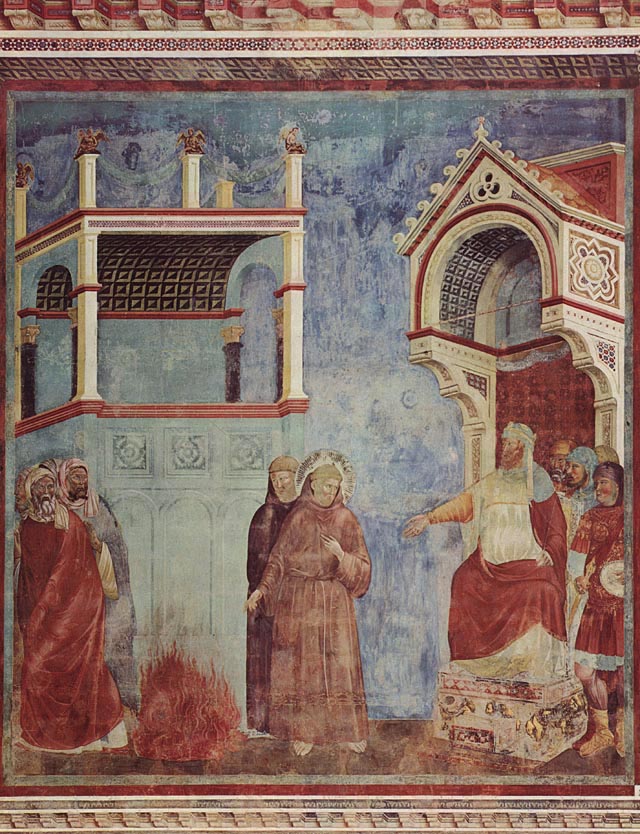
THE TRIAL BY FIRE BEFORE THE SULTAN
Here we see St. Francis who, to express his faith in Christ, wished to enter a fire together with the priests of the Sultan of Babylon. Not only did no one follow him, but they all fled.
The fresco is not autograph, it is believed, in fact, that the hand of an assistant with a personality of his own is present, very probably the same one who worked on the Vault of the Doctors.
THE ECSTASY OF SAINT FRANCIS
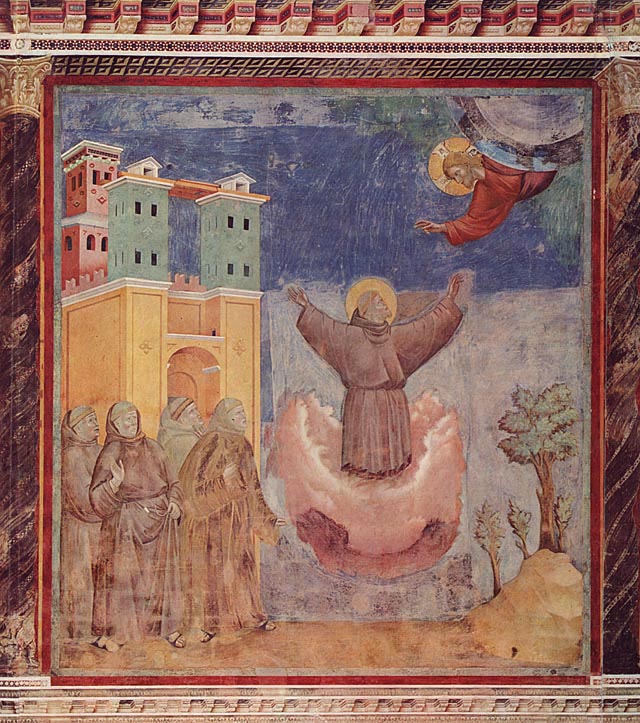
The scene depicts St. Francis, watched by the friars, as he rises from the ground with his whole body and his hands outstretched, surrounded by a small shining cloud.
The conception of the scene is certainly Giotto’s, but the execution seems to belong largely to other hands.
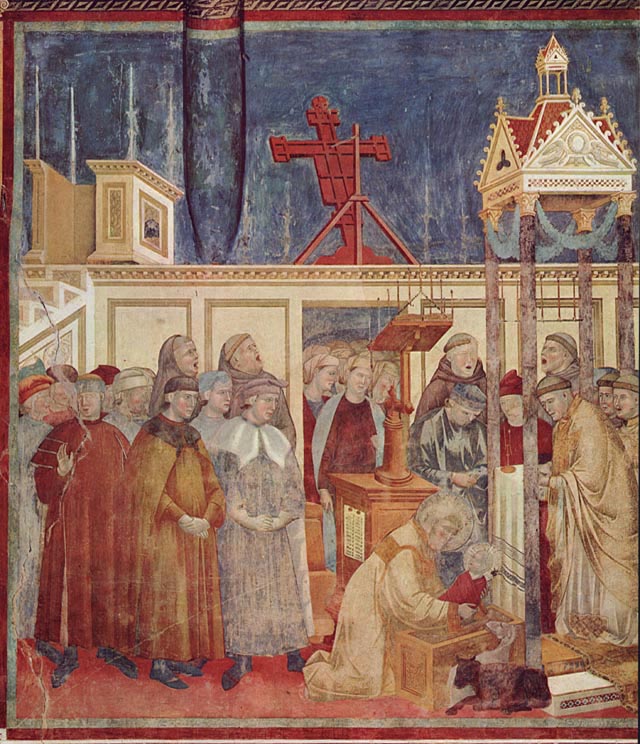
THE CRIB AT GRECCIO
This is the scene in which the blessed Francis ordered that the crib be prepared, that hay be brought and the ox and the ass led in, and preached on the nativity of the poor King. While the holy man was praying, a knight saw the real Christ Child in place of the one brought by the Saint.
In this fresco, superb and certainly autograph parts, such as the cross at the top and the Saint with the child in his arms, alternate with others of rather mediocre workmanship, the heads of the friars on the right and those of the women behind the lectern.
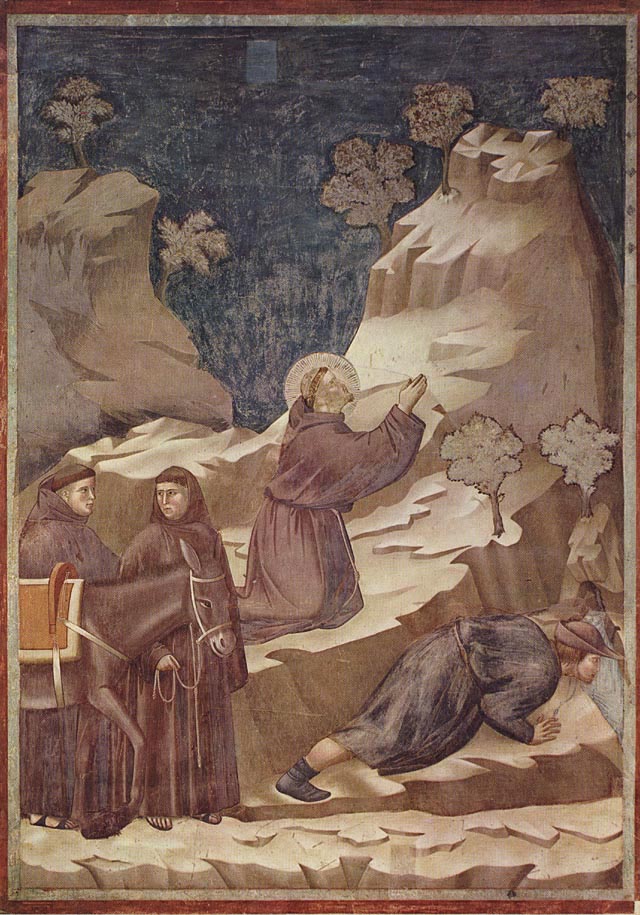
THE MIRACLE OF THE SPRING
Saint Francis climbs a mountain on the back of a poor man’s donkey, which, feeling that he was dying of thirst, calls for a little water and, all of a sudden, sees it gush from a rock: this spring had not existed before and was never seen again afterwards.
This, together with the scene of the following fresco, are often considered entirely autograph and, perhaps for this very reason, owe their fame, ever since Vasari’s time.
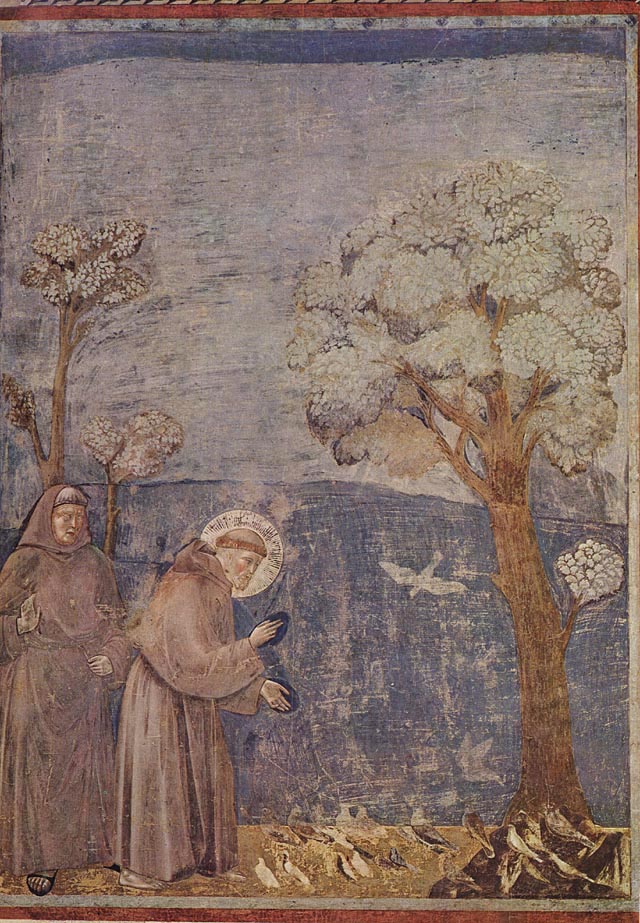
THE SERMON TO THE BIRDS
This panel shows Francis who, on his way to Bevagna, stops to preach to the birds, who are depicted rejoicing. Meanwhile the scene is observed by St. Francis’ companions who are waiting for him in the road.
Thanks to its superlative quality, but also to the theme treated here, this is surely the most famous scene of the entire cycle.
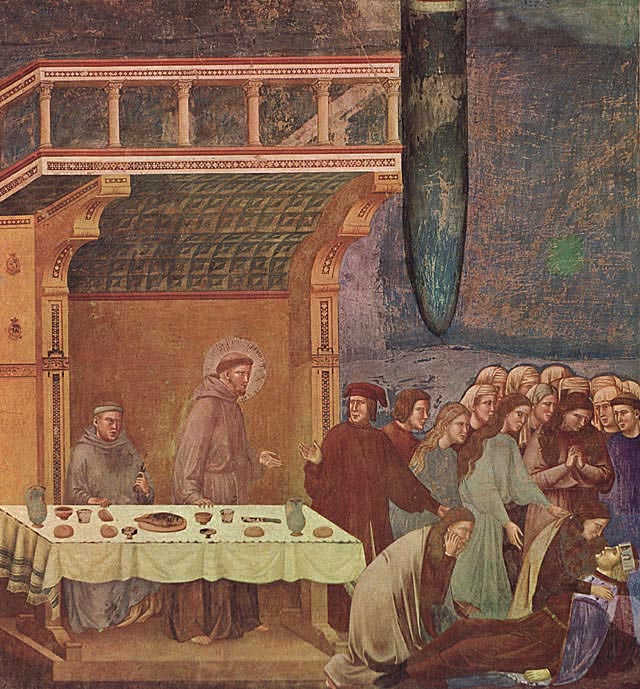
THE DEATH OF THE KNIGHT OF CELANO
After the blessed Francis had prayed for the salvation of the soul of a knight of Celano, which, courteously, had invited him to a meal, the knight is seen, after confession and while everyone was preparing to eat, dying suddenly.
It is in this fresco that the painter we have already mentioned in the analysis of the first scene, which was also the last to be executed, sets his hand to the series for the first time, and it is, probably, at this point that Giotto, having realised the painter’s qualities, also entrusts him with the last three scenes of the left wall and the first of the right wall, executed almost entirely in complete autonomy.
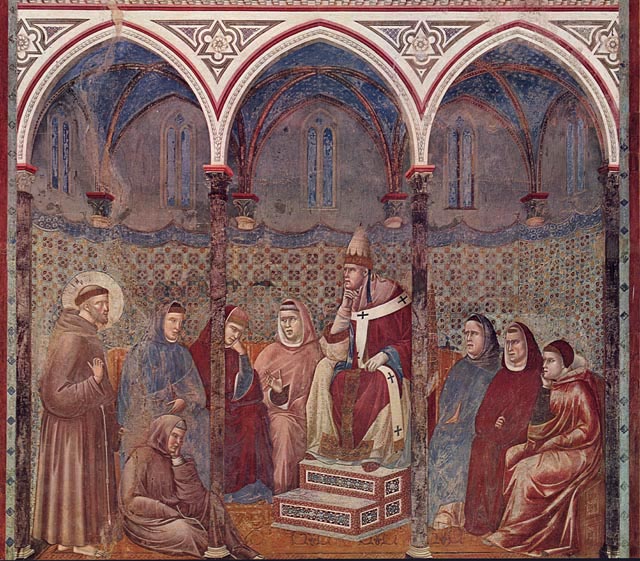
THE SERMON OF SAINT FRANCIS BEFORE HONORIUS III
Here we see St. Francis preaching before the pope and the cardinals with such devotion and effectiveness that it was immediately obvious that he was not expressing himself in learned words, the fruit of careful study, but by divine inspiration.
This is one of the crowded scenes in which the rapid development of Giotto’s mind is evident. The artist, in fact, appears engaged in the study of compositions increasingly articulated in space and in “Architectures of Figures”.
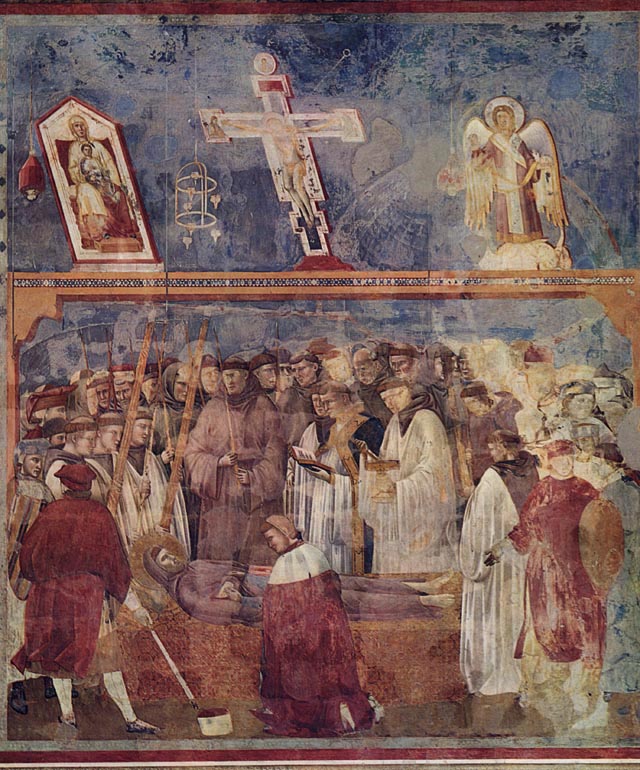
VERIFICATION OF THE STIGMATA
This is perhaps the most amazing example of Giotto’s personal intervention.
The incredulous Jerome of Assisi is shown verifying, personally, the presence of the stigmata on the body of the dead St. Francis, something that intrigued friars and laymen enormously.
The imprint of Giotto’s personality is recognised, above all, in the upper area, where the sacred images are depicted above an iconostasis, and in the figure of the Saint.
The cross placed in the centre is the same one that appears in the Crib at Greccio, but seen from the front.
Examination of the plaster has also revealed that the figures on the iconostasis had been conceived, originally, in an upright position and, and only at the last moment received their present forward inclination, a sign of the Master’s continuous and innovative presence alongside his followers.
Simone Martini — Chapel of St. Martin
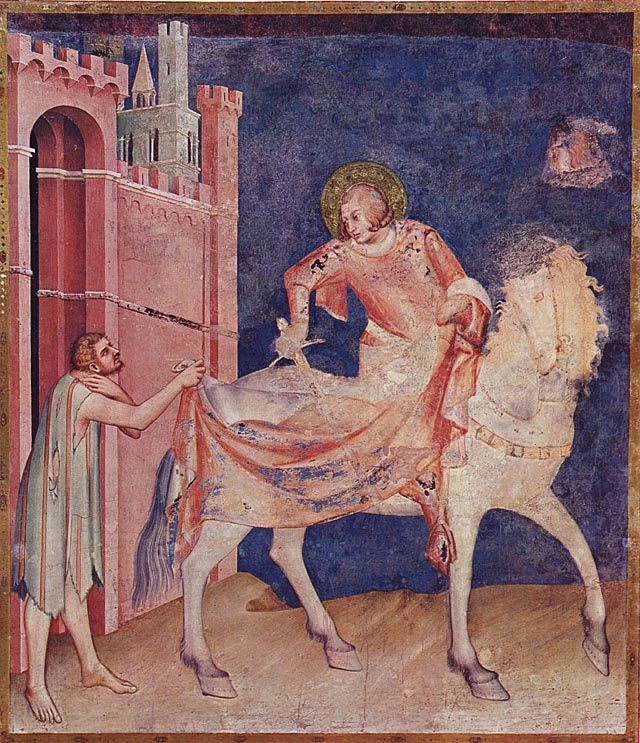
ST. MARTIN DIVIDES HIS CLOAK WITH THE POOR
This scene tells the anecdote in which St. Martin, on a bitter winter’s day, is approached by a ragged beggar numb with cold. St. Martin, having seen Jesus Christ embodied in the poor man, divides his cloak into two equal parts with a stroke of his sword, offering one half to the beggar.
A thorough analysis of the fresco, carried out because it had been detached, made it possible to recover the sinopia, which revealed the differences between the original drawing and the present painting, and showed that the scene originally unfolded in the opposite direction to the present one. It was also noted, above all in the depiction of the horse, that the painting, compared with the sinopia, had acquired a greater stylistic refinement, typical of Martini’s art.
THE DREAM OF ST. MARTIN
During his sleep, there appears to St. Martin a vision of Christ surrounded by a host of angels, wearing half of the cloak that he had given to the poor man.
There almost seems to be a separation, thanks to a careful use of perspective, between the scene of the sleeping saint and the vision of Christ among the angels, as if to contrast the real world with the world beyond.
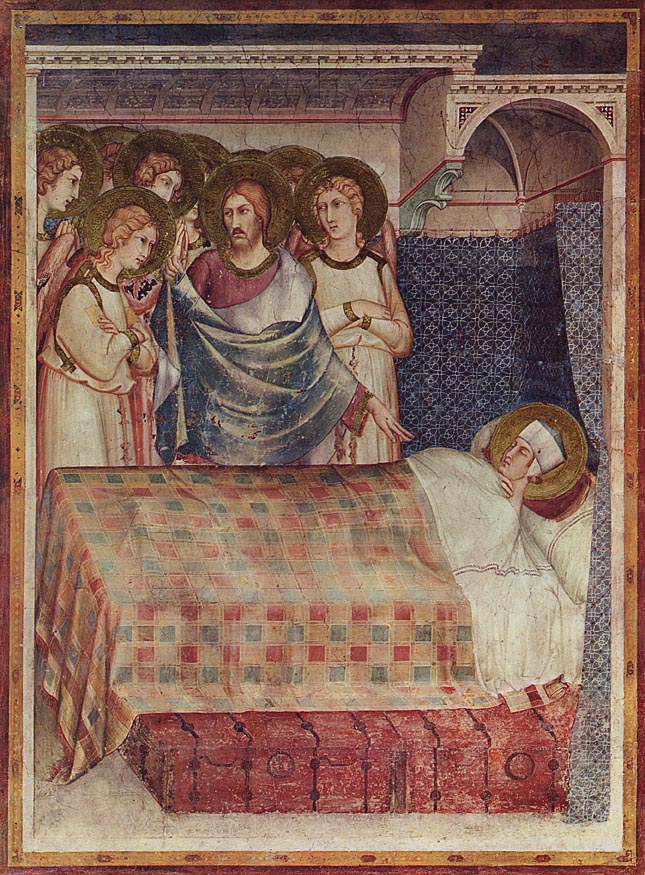
THE INVESTITURE OF ST. MARTIN
This scene recalls the Neapolitan ceremony during which Simone himself was invested a knight.
In the centre Martin is seen praying while, on his left, the emperor Julian fastens the sword belt around his hips and on the right a squire buckles on his spurs. Behind the emperor two more squires carry the knightly emblems of the helmet and the falcon. On the far right a piper and a lute player are intent on making music. In the background an arcaded portico, adorned with Cosmatesque decoration, marks off the various groups of figures in the scene.
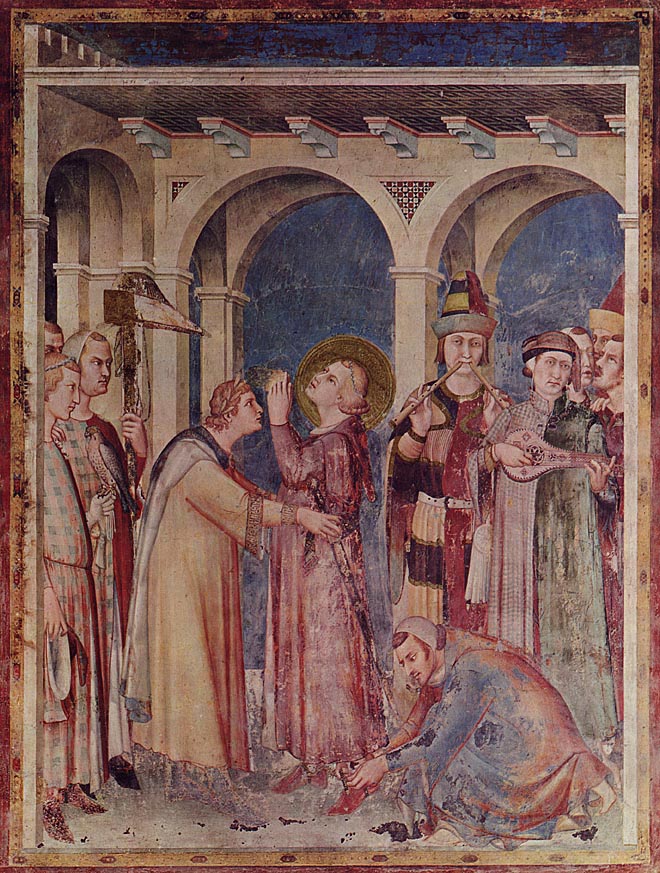
ST. MARTIN RENOUNCES HIS WEAPONS
As the Golden Legend recounts, on the eve of a military invasion, the saint informs the emperor Julian that he will not fight. Accused of cowardice, St. Martin announces that he will fight alone, armed only with the cross of Christ.
In this scene too, as in the previous one, the background serves almost as stage wings to the spatial reality placed in the foreground.
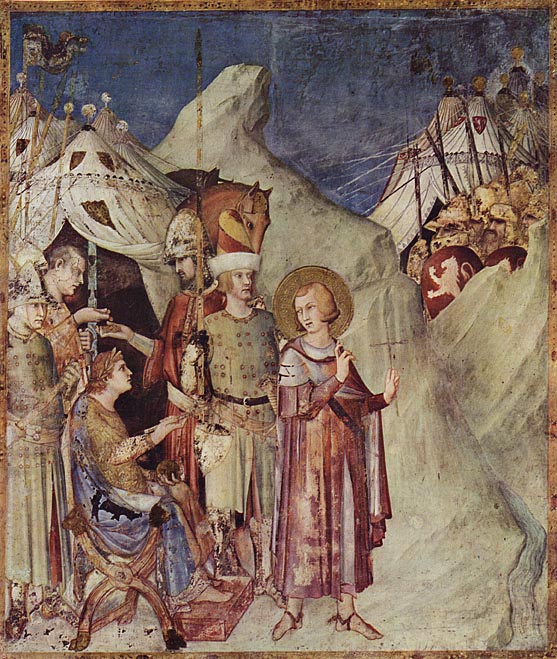
THE MEDITATION OF ST. MARTIN
The scene depicts St. Martin, completely absorbed in meditation, while a cleric on the right, placing a hand on his shoulder, calls him back to attention to remind him to celebrate mass, and, on the left, another, kneeling, hands him the missal.
Simone’s skill is such that the scene seems permeated by an atmosphere of silent peace, typical of a convent.
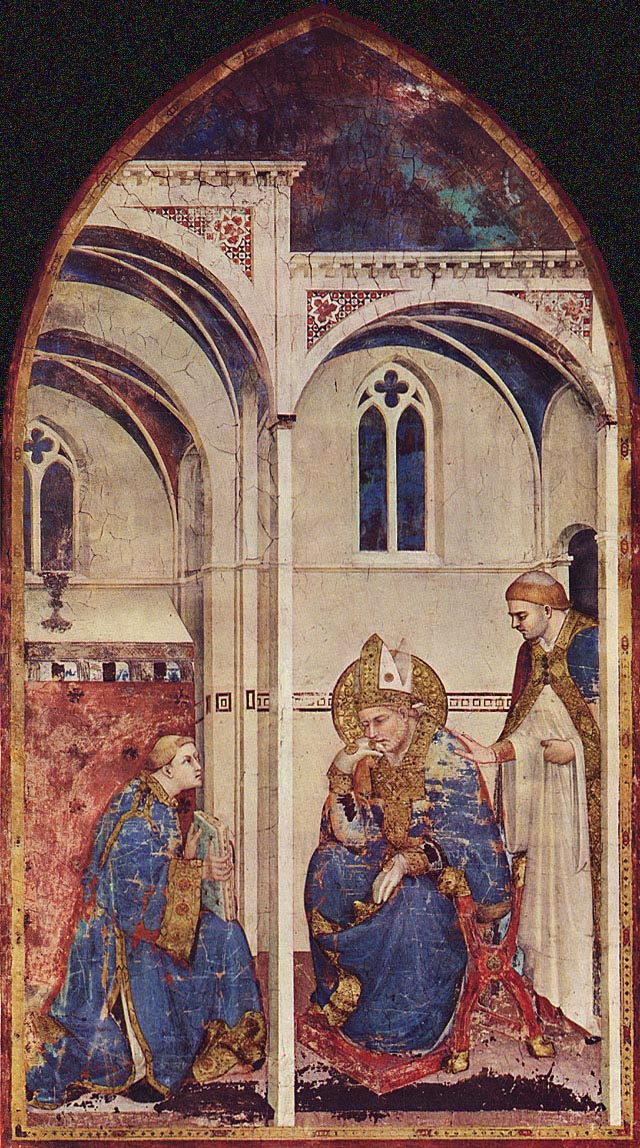
ST. MARTIN RAISES A CHILD FROM THE DEAD (detail)
This episode, according to the Golden Legend, takes place in Chartres. St. Martin, in the crowd, is approached by a woman who holds out to him her son, who has just died. The saint kneels in prayer and immediately afterwards the child comes back to life, stretching out his hands towards him.
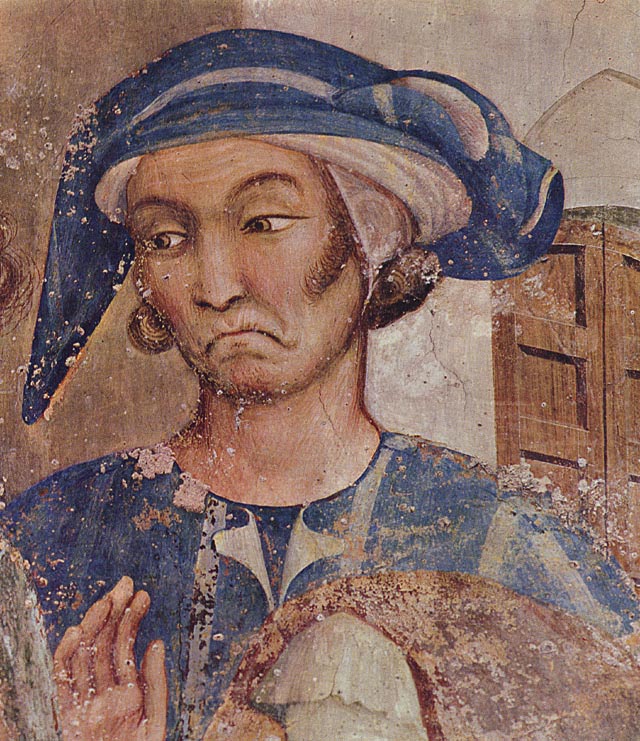
Among the crowd of onlookers stands out the grimacing knight, depicted with a blue cap, who has often, humorously, been identified as a self-portrait of Simone.
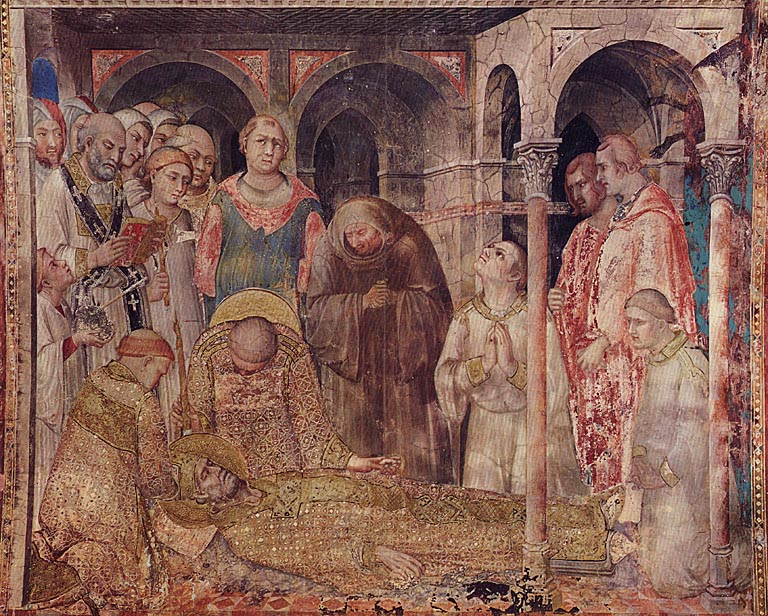
THE DEATH OF ST. MARTIN (detail)
In the centre the body of the saint lying on the ground and all around him the clerics, the faithful and a priest intent on the rite for the dead.
At the top, the soul of St. Martin rising to heaven, accompanied by four angels.
The heads of the faithful and of the clerics seem to form a clear oblique line descending from left to right, balanced by the two knights, isolated in the small aedicule on the far right. Outside this geometry of figures are the two grieving clerics, who, through figurative connections, seem to be the closest to the saint.
THE FUNERAL OF ST. MARTIN
This scene depicts the obsequies of St. Martin, which take place inside a Gothic chapel.
The Legend does not give the identities of the haloed monk and the officiating bishop. Only the latter has been identified by Toesca, not without raising some doubts, as St. Ambrose. There is, in this scene a strong contrast between horizontal and vertical elements. Indeed, the body of the saint is set against the twisted columns, the three-light windows, the candles and the various figures.
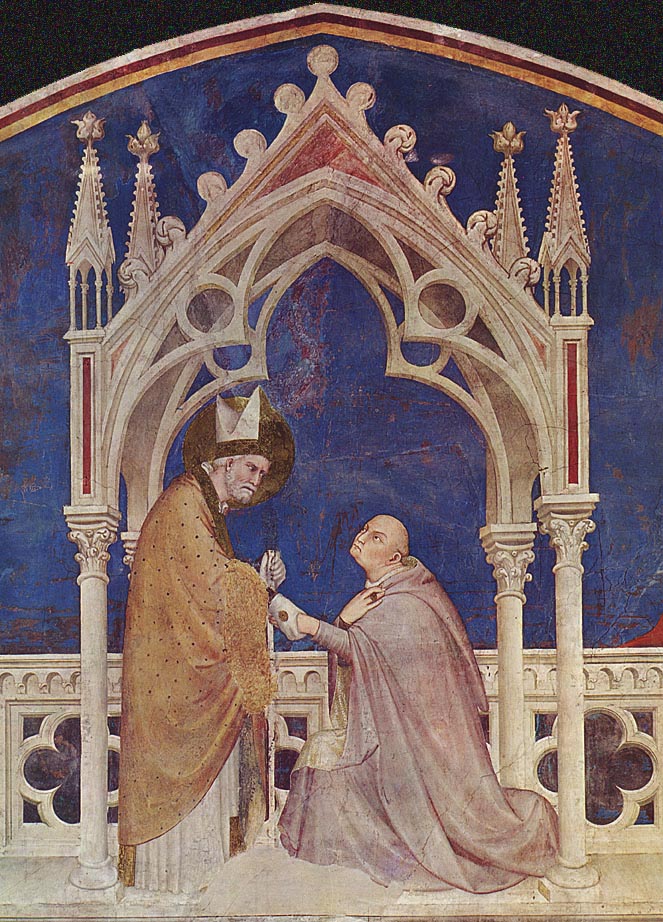
DEDICATION OF THE CHAPEL OF ST. MARTIN
Under a ciborium, represented in a perspective view from below, Cardinal Gentile di Partino da Montefiore kneels before St. Martin, who bends down, holding out a hand to help him rise.
Below, a base in imitation polychrome marble can be glimpsed, while at the back, in front of the blue background of the sky, a panelled balustrade on which rests Gentile’s purple cardinal’s hat.
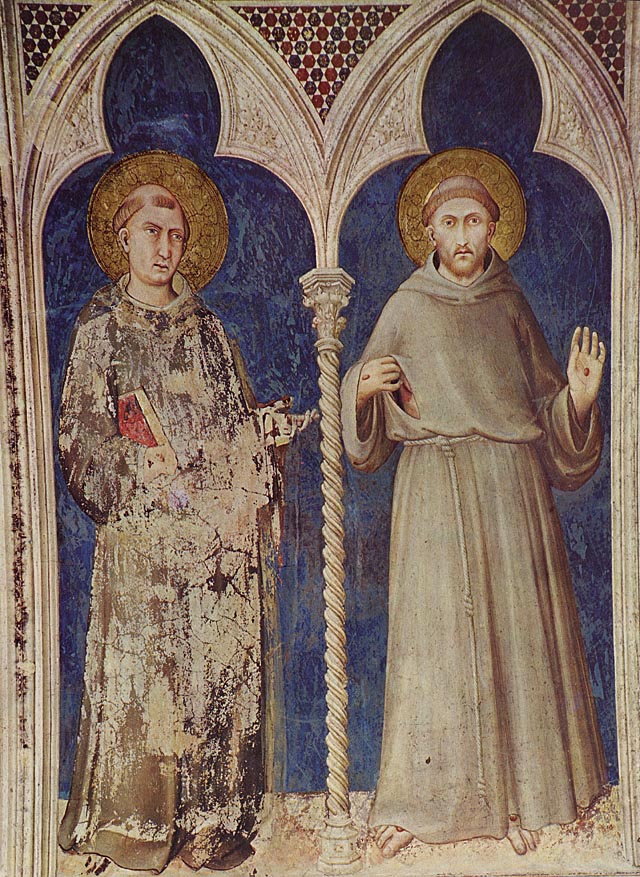
ST. ANTHONY OF PADUA AND ST. FRANCIS
The eight full-length saints, in the soffit of the chapel’s arch, are all depicted in pairs within the openings of a two-light window, with the blue of the sky as a background.
The arrangement of the figures places at the bottom right, St. Anthony of Padua and St. Francis, at the top, St. Mary Magdalene and St. Catherine of Alexandria; on the left, at the top, St. Louis of France and St. Louis of Toulouse, below, St. Clare and St. Elizabeth of Hungary.
Critics have often highlighted a stylistic difference between the figures of the male saints and those of the female saints, attributing the former to collaborators of Simone, because of a presumed inferiority of style compared with the latter.
The presumed inferiority, however, is not real. It is necessary, instead, to consider it a slight shift towards greater formal concision and a clearer plastic definition, which reaches its highest level in the image of St. Francis.
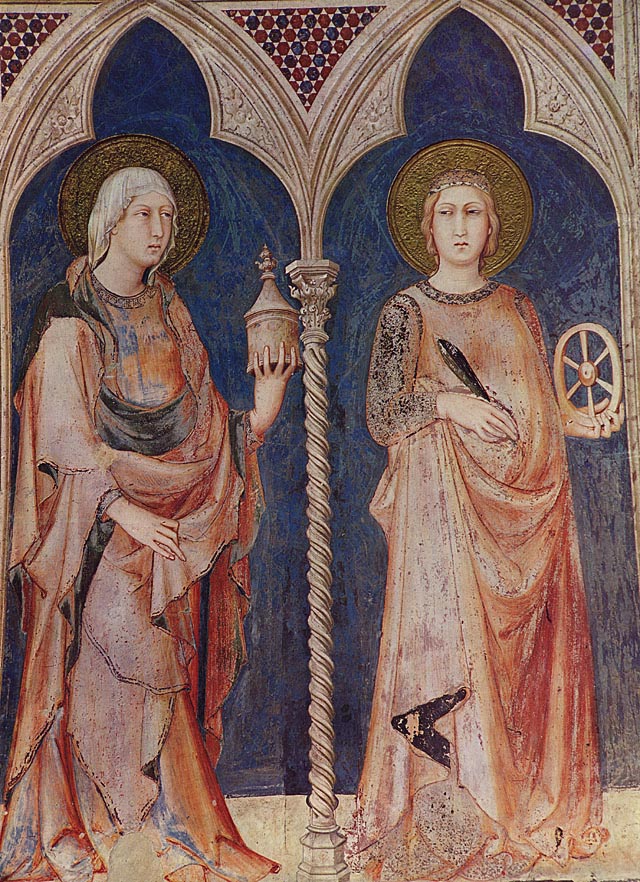
ST. MARY MAGDALENE AND ST. CATHERINE OF ALEXANDRIA
The eight full-length saints, in the soffit of the chapel’s arch, are all depicted in pairs within the openings of a two-light window, with the blue of the sky as a background.
The arrangement of the figures places at the bottom right, St. Anthony of Padua and St. Francis, at the top, St. Mary Magdalene and St. Catherine of Alexandria; on the left, at the top, St. Louis of France and St. Louis of Toulouse, below, St. Clare and St. Elizabeth of Hungary.
Critics have often highlighted a stylistic difference between the figures of the male saints and those of the female saints, attributing the former to collaborators of Simone, because of a presumed inferiority of style compared with the latter.
The presumed inferiority, however, is not real. It is necessary, instead, to consider it a slight shift towards greater formal concision and a clearer plastic definition, which reaches its highest level in the image of St. Francis.
ST. LOUIS OF FRANCE AND ST. LOUIS OF TOULOUSE
The eight full-length saints, in the soffit of the chapel’s arch, are all depicted in pairs within the openings of a two-light window, with the blue of the sky as a background.
The arrangement of the figures places at the bottom right, St. Anthony of Padua and St. Francis, at the top, St. Mary Magdalene and St. Catherine of Alexandria; on the left, at the top, St. Louis of France and St. Louis of Toulouse, below, St. Clare and St. Elizabeth of Hungary.
Critics have often highlighted a stylistic difference between the figures of the male saints and those of the female saints, attributing the former to collaborators of Simone, because of a presumed inferiority of style compared with the latter.
The presumed inferiority, however, is not real. It is necessary, instead, to consider it a slight shift towards greater formal concision and a clearer plastic definition, which reaches its highest level in the image of St. Francis.
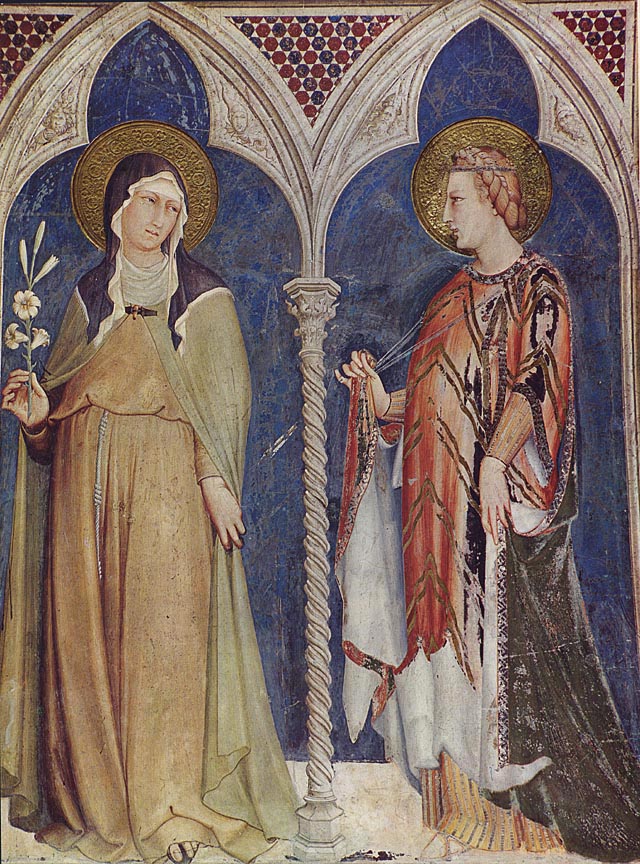
ST. CLARE AND ST. ELIZABETH OF HUNGARY
The eight full-length saints, in the soffit of the chapel’s arch, are all depicted in pairs within the openings of a two-light window, with the blue of the sky as a background.
The arrangement of the figures places at the bottom right, St. Anthony of Padua and St. Francis, at the top, St. Mary Magdalene and St. Catherine of Alexandria; on the left, at the top, St. Louis of France and St. Louis of Toulouse, below, St. Clare and St. Elizabeth of Hungary.
Critics have often highlighted a stylistic difference between the figures of the male saints and those of the female saints, attributing the former to collaborators of Simone, because of a presumed inferiority of style compared with the latter.
The presumed inferiority, however, is not real. It is necessary, instead, to consider it a slight shift towards greater formal concision and a clearer plastic definition, which reaches its highest level in the image of St. Francis.
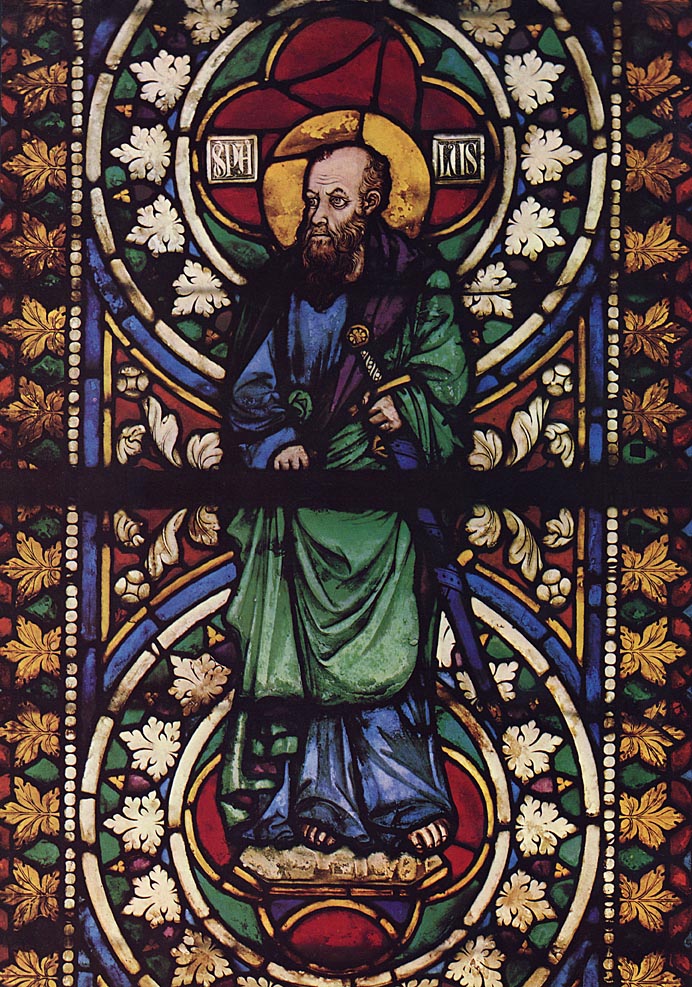
THE APOSTLE PAUL
The figure of the apostle Paul is depicted on one of the three two-light windows in the chapel.
The design of the stained-glass windows, too, is, generally, attributed to Simone Martini, although there are no stylistic elements capable of confirming this.
It is supposed that the coarseness and heaviness of the figures in the stained glass may be attributed both to these designs belonging to Simone’s early formative period, and to a mediocre translation of the designs into glass.
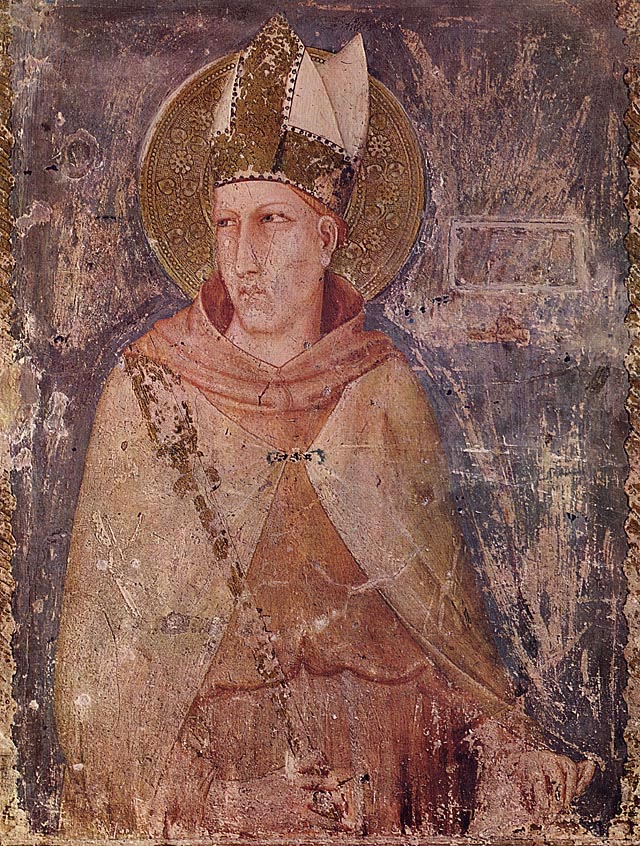
ST. LOUIS OF TOULOUSE
These figures are painted on the end wall of the right arm of the transept.
The figures seem to lean out from a marble parapet that hides their lower half. To give greater emphasis to the idea of a loggia, Simone made use of the representation of small twisted columns, placed in the foreground, while in the background the inevitable blue of the sky can be glimpsed.
Apart from the faces of the saints, certainly executed in fresco, the rest of the work, given the mediocre state of preservation, must have been executed a secco.
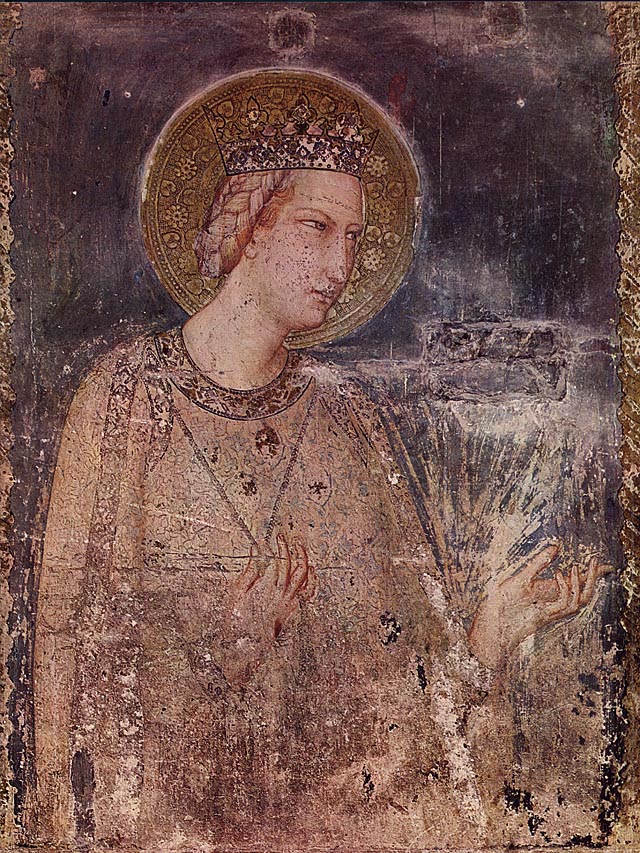
ST. ELIZABETH OF HUNGARY
These figures are painted on the end wall of the right arm of the transept.
The figures seem to lean out from a marble parapet that hides their lower half. To give greater emphasis to the idea of a loggia, Simone made use of the representation of small twisted columns, placed in the foreground, while in the background the inevitable blue of the sky can be glimpsed.
Apart from the faces of the saints, certainly executed in fresco, the rest of the work, given the mediocre state of preservation, must have been executed a secco.
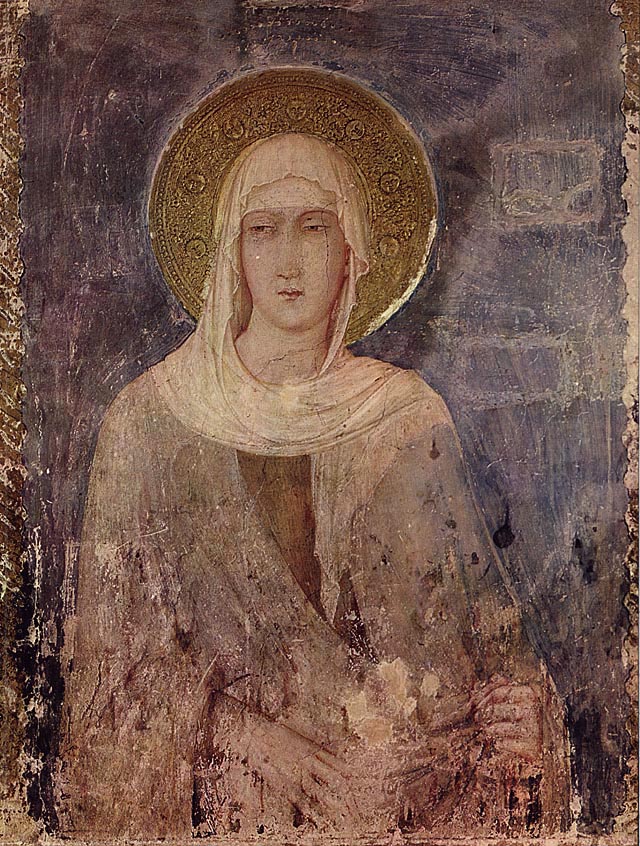
ST. CLARE
These figures are painted on the end wall of the right arm of the transept.
The figures seem to lean out from a marble parapet that hides their lower half. To give greater emphasis to the idea of a loggia, Simone made use of the representation of small twisted columns, placed in the foreground, while in the background the inevitable blue of the sky can be glimpsed.
Apart from the faces of the saints, certainly executed in fresco, the rest of the work, given the mediocre state of preservation, must have been executed a secco.
ST. LOUIS OF FRANCE
These figures are painted on the end wall of the right arm of the transept.
The figures seem to lean out from a marble parapet that hides their lower half. To give greater emphasis to the idea of a loggia, Simone made use of the representation of small twisted columns, placed in the foreground, while in the background the inevitable blue of the sky can be glimpsed.
Apart from the faces of the saints, certainly executed in fresco, the rest of the work, given the mediocre state of preservation, must have been executed a secco.
Pietro Lorenzetti — Stories of the Passion
THE ENTRY INTO JERUSALEM
This fresco presents a composition of figures and architecture of remarkable quality.
It is particularly in the decorations, present in this work, that Lorenzetti’s freest and most surprising thinking can be seen.
THE LAST SUPPER
This is, certainly, one of the finest scenes the master ever painted.
In the background, the dark blue night sky can be glimpsed, studded with stars and the moon, while inside the atmosphere is suffused with the light and warmth given off by the fire and the lantern in the kitchen.
THE CAPTURE OF CHRIST
This is the most damaged fresco of the Stories of the vault, as a result of the cleaning of 1963.
In this scene too, as in the previous one, the dark blue sky, adorned with the moon and stars, suggests that the event takes place during the night, in a fantastic Gothic setting.
THE FLAGELLATION
The work belongs to the master’s early years, as can be seen from his architectural inventions, rich in imagination and freedom of thought, above all in the sculptures of the putti and lions, depicted as ornaments of Pilate’s loggia.
The scene, in fact, takes place precisely in the proconsul’s hall and in the presence of Pilate, elements clearly derived from Duccio, since Duccio himself, his master, had used them in the small Stories of the Maestà (1309-1311).
THE ROAD TO CALVARY
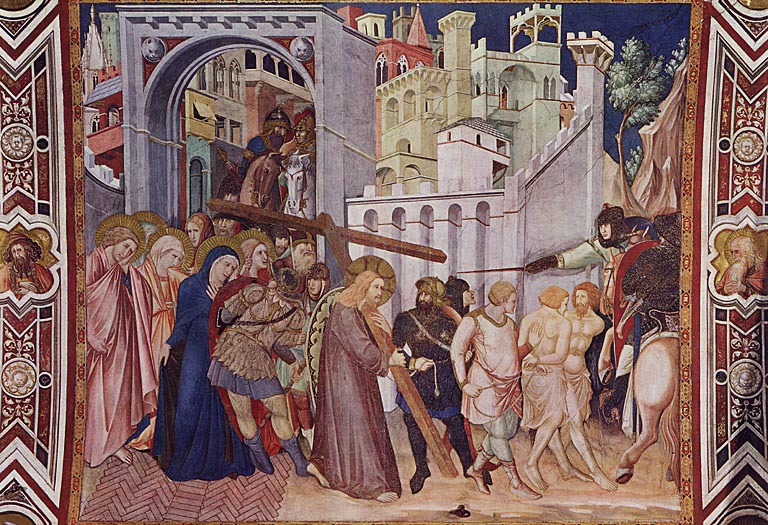
Here too an excessive degree of deterioration can be seen, caused by the cleaning.
The fresco is of great quality, as can be seen from the fantastic view of Jerusalem, of typically Giottesque derivation.
CRUCIFIXION
The fresco, a work of great size and of the highest artistic value, was badly damaged by the later addition of an altar (around 1604, demolished in 1870-79) at the bottom and over the legs of the crucified Christ.
Here, where a gap now appears, probably, originally, two soldiers appeared, casting dice for Christ’s garments.
Thanks to the use of colour a tone of poignant realism emerges, above all in the row of horsemen, who manoeuvre to press the faithful and the figures on foot together in the centre.
DEPOSITION FROM THE CROSS
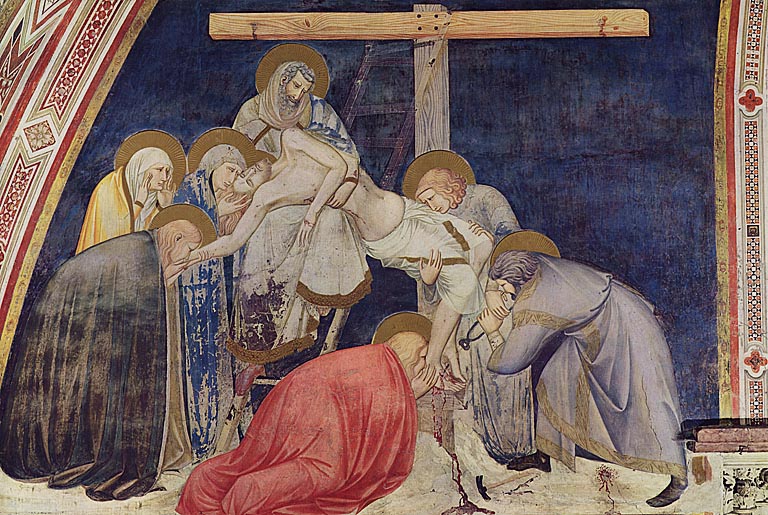
This is the first scene of the series of the post mortem Passion of Christ, despite its position lower down, which reverses the reading order. This is certainly nothing new inside the basilica, since Giotto too had done the same for one of his Stories.
Apart from the usual a secco finishing touches, here above all the garment of Nicodemus, holding up Christ, from which the paint has flaked off, the fresco is in a good state of preservation.
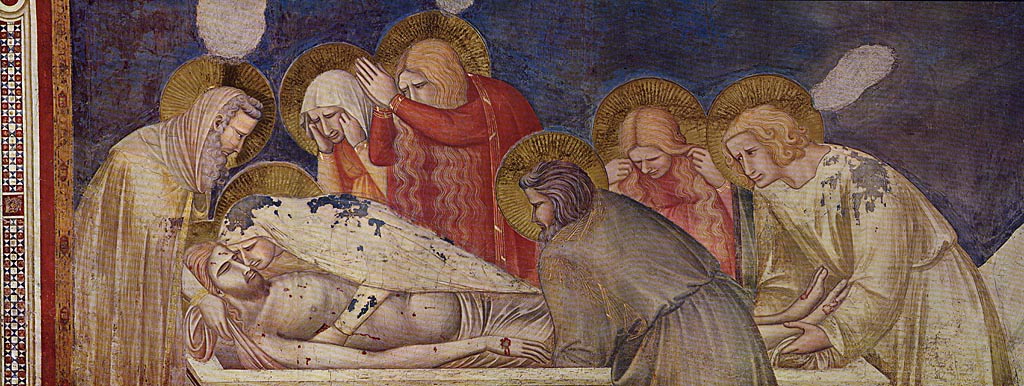
THE ENTOMBMENT OF CHRIST
This fresco too is fairly well preserved, except for the Virgin’s mantle and St. John’s tunic, which had been finished in tempera.
The fresco is to be considered entirely autograph, and the references to Giotto’s art are notable.
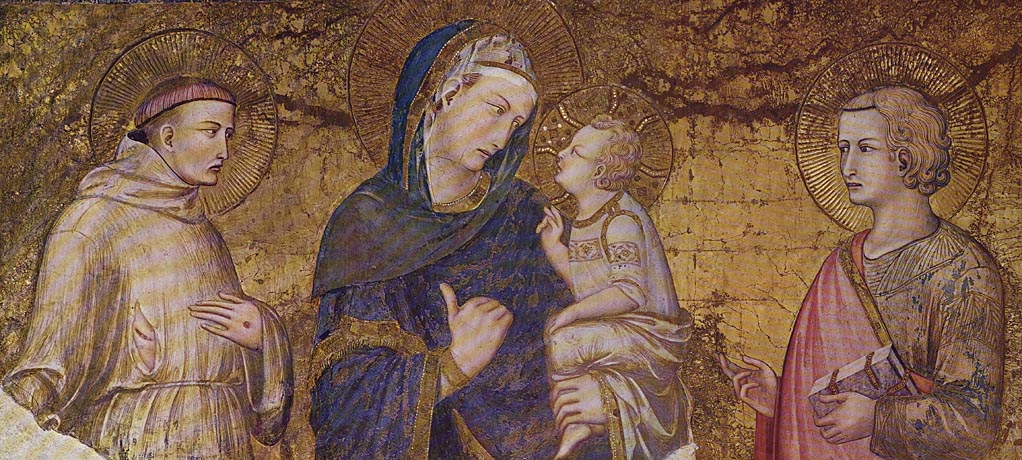
MADONNA AND CHILD BETWEEN ST. FRANCIS AND ST. JOHN THE EVANGELIST
This splendid fresco is divided into two parts: an upper section on which the Madonna is depicted with the Child in her arms between St. Francis and St. John the Evangelist, and a lower base, on the right of which is the portrait of the donor, in the centre a splendid effigy of the Crucifix; on the left, a gash has erased part of the painting where another effigy of a devotee was probably depicted.
Although the figures are in a good state of preservation, the garments of the three main figures show deterioration, again owing to the tempera finishing.
This painting is thought, together with the Hanged Judas and the Stigmata of St. Francis, is to be considered among the latest of the whole cycle, executed, therefore, during the third decade of the 14th century.
THE STIGMATA OF ST. FRANCIS
This fresco, generally considered autograph, is rather well preserved, apart from small losses and abrasions.
The critics’ uncertainty about the work concerns its dating, and the doubt lies, essentially, in whether to consider it contemporary with or later than the Crucifixion facing it.